Business
Trump Imposes 25% Tariffs on Steel and Aluminum From Foreign Countries


President Trump announced sweeping tariffs on foreign steel and aluminum on Monday, re-upping a policy from his first term that pleased domestic metal makers but hurt other American industries and ignited trade wars on multiple fronts.
The president signed two official proclamations that would impose a 25 percent tariff on steel and aluminum from all countries. Mr. Trump, speaking from the Oval Office on Monday evening, called the moves “a big deal.”
“It’s time for our great industries to come back to America,” the president said.
A White House official who was not authorized to speak publicly told reporters on Monday that the move was evidence of Mr. Trump’s commitment to use tariffs to put the United States on equal footing with other nations. In contrast with Mr. Trump’s first term, the official said, no exclusions to the tariffs for American companies that rely on foreign steel and aluminum will be allowed.
The measures were welcomed by domestic steelmakers, who have been lobbying the Trump administration for protection against cheap foreign metals.
But the tariffs are likely to rankle America’s allies like Canada and Mexico, which supply the bulk of U.S. metal imports. They could also elicit retaliation on U.S. exports, as well as pushback from American industries that use metals to make cars, food packaging and other products. Those sectors will face significantly higher prices after the tariffs go into effect.
That is what happened in Mr. Trump’s first term, when the president levied 25 percent tariffs on foreign steel and aluminum. While Mr. Trump and President Joseph R. Biden Jr. eventually rolled back those tariffs on most major metal suppliers, the levies were often replaced with other trade barriers, like quotas on how much foreign metal could come into the United States.
Studies have shown that while Mr. Trump’s first round of metal tariffs helped American steel and aluminum producers, they ended up hurting the broader economy because they raised prices for many other industries, including the auto sector.
The steel tariffs followed other intense trade threats. In his three weeks in office, the president has already threatened more tariffs globally than he did in his entire first term, when he imposed tariffs on foreign solar panels, washing machines, metals and more than $300 billion of products from China.
Since Jan. 20, Mr. Trump has put an additional 10 percent tariff on all products from China, and came within hours of imposing sweeping tariffs on Canada and Mexico that would have brought U.S. tariff rates to a level not seen since the 1940s. Together, those moves would have affected more than $1.3 trillion of goods.
Speaking from the Oval Office on Monday, Mr. Trump said his steel tariffs were “the first of many” to come. He said his team would be meeting over the next four weeks to discuss tariffs on cars, pharmaceuticals, chips and other goods.
Mr. Trump said on Sunday that he also planned to move forward this week with so-called reciprocal tariffs, which would raise certain U.S. tariff rates to match those of foreign countries.
American steelmakers welcomed the tariffs. In a statement on Sunday, Kevin Dempsey, the president of the American Iron and Steel Institute, said the group welcomed Mr. Trump’s “continued commitment to a strong American steel industry, which is essential to America’s national security and economic prosperity.”
But industries that use metals to make other products said overly broad protections would hurt them.
“Tariffs and other broad trade tools can make America great again, but there are unintended consequences for our nation’s food security when a tariff is placed on tin-plate steel,” said Robert Budway, the president of the Can Manufacturers Institute, which represents companies that make cans for fruits and vegetables.
The United Steelworkers union, which has members in Canada, said that it welcomed Mr. Trump’s effort to help the industry but that “Canada is not the problem.”
The new measures will mainly affect U.S. allies. The largest supplier of steel to the United States in 2024 was Canada, followed by Brazil, Mexico, South Korea and Vietnam, according to the American Iron and Steel Institute. Canada is also a major supplier of aluminum to the United States, followed distantly by the United Arab Emirates, Russia and China.
Late Monday, the governments of Canada, Mexico and Brazil had yet to respond to the tariffs. Brazil’s government said it did not have a response to Mr. Trump’s announcement of steel tariffs because it had not yet received any official communication from the U.S. government on the issue.
In his first term, Mr. Trump levied tariffs on foreign steel and aluminum using a national security provision called Section 232 of the Trade Expansion Act. That angered allies like Mexico, Canada and the European Union, which said they were not a security threat.
Mr. Trump used those tariffs as a negotiating tool. His officials reached agreements with Australia, South Korea and Brazil, and rolled back some of those barriers on Canada and Mexico when they signed a revised trade agreement with the United States. The Biden administration later reached agreements with the European Union, Britain and Japan to roll back some of their trade restrictions.
The United States imports very little steel or aluminum directly from China, since Chinese exports have long been blocked by a variety of anti-dumping and anti-subsidy tariffs. But some argue that China’s excess steel production is still flooding other markets and pushing down global prices, leaving U.S. metal makers at a disadvantage in other markets.
Brad Setser, an economist at the Council on Foreign Relations, said Chinese steel exports had basically doubled over the past two years and were creating economic issues globally as they flooded foreign markets, including in Asia and Latin America.
But Mr. Setser said he saw little evidence that Chinese steel was being routed into the United States through Canada or Mexico and undermining the U.S. industry.
“It’s pretty hard to make the case that the surge in Chinese exports globally has triggered a reduction in U.S. production,” he said. “U.S. production has been fairly stable.”
After Mr. Trump put steel tariffs into effect in 2018, U.S. steel imports steadily declined. But that trend reversed during the pandemic, when blast furnaces shuttered and supply chains seized up, and U.S. steelmakers were slower than competitors in Mexico to open back up, Mr. Setser said.
In the last few years, U.S. steel imports have been relatively flat, though they are slightly above the level when Mr. Trump imposed tariffs in his first term.
U.S. unions and major companies like Cleveland-Cliffs and U.S. Steel, which are influential with government, have argued that current protections are insufficient to keep them in business. Amid its financial struggles, U.S. Steel, the iconic Pennsylvania company, agreed to be acquired by Nippon Steel of Japan. That merger was blocked by Mr. Biden, who said he wanted to U.S. Steel to remain an American company.
Supporters of the tariffs have argued that the United States needs strong metal makers for its national defense.
Nazak Nikakhtar, a partner at the law firm Wiley Rein and an official in the first Trump administration, said the president was again “making good on his promise to impose tariffs globally and to increase tariffs on steel and aluminum imports, given their criticality to national security.”
But many economists argue that tariffs on raw materials like steel will hurt the economy, since they raise prices for other manufacturers.
A study by the nonpartisan International Trade Commission, for example, found that Mr. Trump’s earlier tariffs encouraged consumers of steel and aluminum to buy more American metals. The increase in demand pushed up metal prices and allowed American metal makers to expand, resulting in $2.25 billion of additional U.S. production of steel and aluminum in 2021.
But the tariffs also raised costs for industries that buy steel and aluminum to make other things, like industrial machinery, car parts and hand tools. Altogether, industries that consume steel and aluminum saw their production shrink by $3.48 billion as a result of the those higher costs — more than offsetting what the steel and aluminum makers had gained.
Other industries are concerned about being caught in the crossfire and targeted with tariffs as other countries retaliate. China imposed retaliatory tariffs on U.S. exports of liquefied natural gas, coal, farm machinery and other products on Monday in response to the tariffs Mr. Trump put on China last week because of its role in the fentanyl trade.
Mexico, Canada and the European Union have all drawn up lists of American products they could strike with their own levies in response to U.S. measures.
In response to Mr. Trump’s first metal tariffs, for example, the European Union imposed a 25 percent tariff on American whiskey. A deal negotiated by the American and European governments to suspend those tariffs is set to expire soon. If another agreement is not reached, the European Union is set to double that tariff to 50 percent on April 1.
Chris Swonger, the chief executive of the Distilled Spirits Council of the United States, said in a statement that the tariff would have a “catastrophic outcome” for 3,000 small distilleries across the United States.
“We are urging that the U.S. and E.U. move swiftly to find a resolution,” Mr. Swonger said. “Our great American whiskey industry is at stake.”
Colby Smith and Norimitsu Onishi contributed reporting.



Business
January 2025 wildfire victims seek tougher penalties against State Farm over claims handling
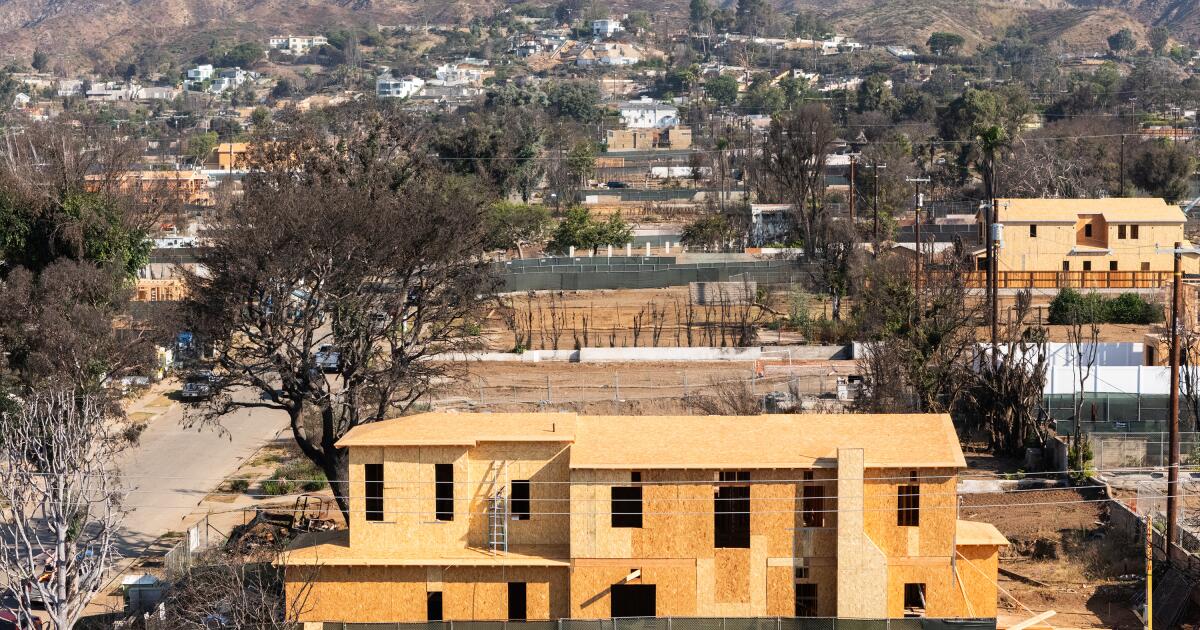
A fire survivors’ group announced Thursday it was seeking tougher penalties against State Farm over its handling of January 2025 wildfire claims.
The Every Fire Survivor’s Network said it was petitioning to join a state enforcement action announced this year against the company to make sure the case results in meaningful changes at California’s largest home insurer.
“We’re seeking a systematic review of all their claims and penalties calibrated to the actual scale of the harm — and we’re seeking the payouts that families are owed,” said Joy Chen, executive director of the group, at a Pacific Palisades news conference joined by victims of the fires.
The Department of Insurance in May filed an administrative action against State Farm General — the subsidiary of the giant Bloomington, Ill., insurer that handles California home insurance — after completing a “market conduct” exam.
The Jan. 7, 2025, fire damaged or destroyed more than 18,000 structures and killed 31 people.
State Farm has received more January 2025 claims than any other insurer — more than 13,700 auto and homeowners claims as of May 4, with payouts totaling $5.7 billion, according to the company.
The market conduct exam looked at 220 sample claims filed by the victims and found 398 violations of state law in about half of them.
Among other alleged violations, it found that the company failed in numerous cases to pursue a “thorough, fair and objective investigation” into claims, failed to come to “prompt, fair, and equitable settlements” and made settlement offers that were “unreasonably low.”
In announcing the action, Insurance Commissioner Ricardo Lara called the company’s claims handling “unacceptable” and said his department was taking “decisive action to hold them accountable.”
The state is seeking a “cease and desist” order to stop the insurer from engaging in unfair or deceptive practices.
It also has threatened to suspend State Farm’s license over the alleged violations, which each carry a penalty of up to $5,000 — or twice that figure if found to be willful. That could amount to a penalty of $2 million or more.
The threat to actually suspend State Farm’s license and its authority to write policies has been viewed skeptically by some, given its roughly 20% market share of the state’s home insurance market.
The company, which had an opportunity to include its responses in the exam report, denied fault in some cases and admitted fault in others. It often blamed problems on individual adjusters and denied systemic issues with its claims handling.
The petition filed by the wildfire survivor’s group criticizes the sample size of the market conduct exam as too small to capture all the alleged deficiencies in State Farm’s claims handling, which it claims are a “general business practice” of the company.
The group is seeking to conduct discovery, cross examine witnesses, present testimony from fire victims and bring more that 1,600 firsthand policyholder statements regarding State Farm’s practices into evidence, according to the petition.
It also wants State Farm to reopen cases in which claimants were paid too little, and it is seeking to participate in settlement discussions in order to increase any penalty State Farm would pay.
It calculated that a $2-million penalty would amount to a minute fraction of the assets of the State Farm Group.
“I submit to you that doesn’t defer bad conduct, it just allows you to continue to do it,” said Michelle Meyers, an attorney for Every Fire Survivor’s Network, at the news conference.
Consumer Watchdog, which has been a harsh critic of State Farm, also is providing legal support for victims’ effort.
Sevag Sarkissian, a spokesperson for State Farm, said the company was aware of the petition.
“We recognize that many wildfire survivors, including those that are State Farm General policyholders, continue to face difficult recovery challenges,” he said. “Our focus remains on helping customers recover.”
Michael Soller, a spokesperson for Lara, said the department is “acting with urgency to assist wildfire survivors in their ongoing recovery by investigating formal complaints filed by survivors and conducting the expedited market conduct exam that led to this enforcement action.”
He added that the department’s position is the state’s Administrative Procedure Act does not contemplate the commissioner or department staff authorizing intervention requests in the case.
He said that would be a hearing officer’s or administrative law judge’s decision when one is assigned to the case.
Meyers acknowledged the request was novel but said her reading of the law is that Lara can make the decision because no judge is yet assigned.
In response to the criticism, State Farm pledged earlier this year to improve its claims handling, including by providing single points of contact and improved communication so there are “fewer handoffs, fewer repeated explanations, and seamless support.”
It also named a new vice president of customer relations for State Farm General.

The state’s trial attorneys and Uber say they have reached a last-minute deal to scrap their dueling ballot measures and avert what was gearing up to be one of most expensive battles of the November election.
The deal, which comes a day after both measures qualified for the November ballot, has Uber agreeing to bulk up safety measures, while the trial attorneys will limit how much they can claim for lien-based medical treatment of victims who get in Uber or Lyft accidents, according to spokespeople for both sides of the campaign.
“Both sides agree: Californians deserve a system that’s safe, fair, and accountable,” read a joint statement from Uber and the Consumer Attorneys of California, a powerful attorney trade group. “This agreement protects patients from unnecessary treatment or getting overcharged, ensures access to medical care and legal representation, and strengthens safety measures.”
The agreement, finalized Thursday, means the ride-share giant will kill its ballot measure to cap how much attorneys can earn in vehicle collision cases and limit medical damages to rates based on insurance. Uber has argued that the costs for medical treatment done on a lien, which allows doctors to get paid from a cut of the plaintiff’s payout, far exceed what it would cost if the victim had used their own insurance.
In return, the Consumer Attorneys of California will cancel its competing ballot measure that sought to increase legal liability for ride-share companies if a passenger is sexually assaulted by a driver. The measure followed an investigation by the New York Times into sexual assault by drivers.
Both sides had poured tens of millions into the campaigns, plastering billboards across Los Angeles.
Lawyers claimed the fight had turned existential with the measure threatening to decimate the profit margin of many personal injury cases and leave drivers with small or thorny cases unable to find an attorney willing to take their case.
Spokespeople say the deal is predicated on their agreement being codified into a bill within the next week. Otherwise, they said, each side will move forward with its ballot measure.
Business
Commentary: A porn firm that a judge called a ‘copyright troll’ now has Meta in its sights — and it could win

This porn company made millions by shaming the little guys who downloaded its films. But now it’s going after Meta for copyright infringement.
It isn’t often that a lawsuit can make me smile, much less laugh out loud. The latest exception is Strike 3 Holdings vs. Meta Platforms, which is currently unfolding in San Jose federal court.
Two things are amusing about the case. One is that Meta, the giant social media company, is accused of copyright infringement for allegedly downloading 2,400 of the plaintiff’s movies to train its AI bots. If Meta loses, that would be a serious (and in my opinion, deserved) blow against AI companies that have used copyrighted materials without permission.
The second part of the joke is the identity of the plaintiff. Strike 3 Holdings, you see, makes porn. Moreover, for years it has pursued a plainly unscrupulous business model in which it sues individuals for allegedly downloading its movies without permission, and shames them into settling for a few thousand dollars at a pop.
While it is possible one or more Meta employees downloaded Plaintiffs’ videos, it is just as possible…that a ‘guest, or freeloader,’ or contractor, or vendor, or repair person—or any combination of such persons—was responsible for that activity.
— Meta points the finger at others for a porn scandal
Whether or not Strike 3 has a legitimate claim for copyright infringement, it doesn’t deserve your sympathy. The firm was flayed in 2018 by federal Judge Royce C. Lamberth of Washington, D.C., for engaging in what he labeled a “high-tech shakedown … smacking of extortion.” Lamberth called Strike 3 a “copyright troll” and threw out its lawsuit against an unidentified internet user for having treated his court “not as a citadel of justice, but as an ATM.”
When I wrote about this scheme in 2023, I counted more than 12,440 lawsuits that the Los Angeles-based firm had filed in federal courts coast-to-coast. The latest count, according to a Lexis search a defense lawyer ran for me, is more than 21,000. The vast majority were settled and closed within a few months of their filing, an indication that they were never meant to go to trial.
Now Strike 3 appears to have hooked a big fish. In the first significant ruling in its lawsuit against Meta, the firm scored a surprise win: On June 11, federal Judge Eumi K. Lee of San Jose denied Meta’s motion to dismiss the case. Meta’s defense, she wrote, “strains credulity.”
More about that in a moment. First, a few words about the litigants. Meta needs no introduction: Formerly known as Facebook and based in Menlo Park, Calif., Meta recorded a profit of $60.5 billion last year on $201 billion in revenue.
Strike 3 portrays itself as an avatar of “Hollywood style and quality” in its adult films, which it distributes through its streaming websites such as Blacked, Tushy, Vixen and Wifey. It has described Greg Landry, its former owner and house auteur, as the porn industry’s “answer to Steven Spielberg.”
Neither Meta nor Strike 3 responded to my request for comment beyond the claims and defenses in court filings.
As I reported in 2023, Strike 3 has flooded federal courts with cookie-cutter lawsuits alleging that defendants infringed its copyrights by downloading its movies via BitTorrent, an online service on which unauthorized content can be accessed by almost anyone with an internet connection. Its targets generally have been individuals with plenty to lose from being publicly outed as porn viewers.
“Given the nature of the films at issue,” a federal judge in Connecticut observed last year, “defendants may feel coerced to settle these suits merely to prevent public disclosure of their identifying information, even if they believe they have been misidentified.”
Strike 3’s letters to its target defendants have warned that the statutory penalty for willful copyright infringement is $150,000, but offer to make the case go quietly away for a few thousand bucks, which would be a fraction of the cost of hiring a defense lawyer, not to mention the downside of exposing oneself as a porn fiend.
J. Curtis Edmondson, a Portland, Ore., lawyer who won a case against Strike 3, estimated in 2023 that Strike 3 “pulls in about $15 million to $20 million a year from its lawsuits.” But financial data that could validate his estimate hasn’t surfaced in court records.
There’s nothing new about content owners’ aggressive pursuit of copyright infringers. The practice was pioneered by the Recording Industry Assn. of America, when the industry feared that unauthorized downloading of music through programs such as Napster threatened its very existence. From 2003 through 2008, the association sued some 35,000 alleged song pirates.
But it abandoned the strategy because its legal dragnet swept up sympathetic targets such as single mothers and teenage girls, creating a public relations disaster.
There followed the appearance of outright trolls such as Prenda Law Group, which posted porn films online as bait to attract downloaders, whom it then sued in what judges ultimately found to be sham lawsuits. Prenda principal John L. Steele even bragged publicly that Prenda had made nearly $15 million with its lawsuits. U.S. Judge Otis Wright II of Los Angeles put the kibosh to its practice by slapping the Prenda lawyers with stiff sanctions for contempt.
That brings us to Strike 3’s case against Meta, which it filed in July. Strike 3 hasn’t been accused of a Prenda-style fraud, since it does own the films at issue and its right to sue copyright infringers isn’t disputed. But its allegation that Meta downloaded its films to train its AI bots, rather than just for personal enjoyment, is a new wrinkle for an old issue.
Strike 3 says its lawsuit grew out of a separate case in which a witness testified that Meta had downloaded thousands of pirated books to train its LLaMA AI bots — that is, feeding the content into LLaMA for it to use to generate answers to user questions. (Numerous lawsuits have been filed against AI firms alleging similar infringement.)
Strike 3 says that case prompted it to look into whether Meta had downloaded any of its content. It says it discovered that 47 IP addresses owned by Meta — that is, digital identifiers of internet accounts — had downloaded its movies without permission.
In all, Strike 3 alleges, those Meta addresses downloaded at least 2,396 of its movies — almost its entire catalog — more than 6,000 times via BitTorrent. What’s more, Strike 3 says Meta then posted some of that content back onto BitTorrent to take advantage of BitTorrent’s “tit-for-tat” mechanism through which users can obtain faster download speeds by uploading content to the platform.
If Strike 3 were to prevail on all its claims for illicit downloading, it would be entitled to about $360 million in damages, observes Eric Fruits, an Oregon economist who has testified for the defense in some Strike 3 lawsuits.
One might ask why Meta might be downloading porn for any reason, bot-training or otherwise. Meta, in its defense filings, says Strike 3 has offered no proof that Meta, as a corporation, was responsible for the downloading. If it happened, Meta says, it would have been inadvertent.
“Tens of thousands of employees and innumerable contractors, visitors, and third parties access the internet at Meta every day,” it wrote in its motion to dismiss the case. “While it is possible one or more Meta employees downloaded Plaintiffs’ videos, it is just as possible … that a ‘guest, or freeloader,’ or contractor, or vendor, or repair person — or any combination of such persons — was responsible for that activity.” The “sporadic downloads,” Meta says, “exhibit the hallmarks of personal use,” not corporate strategy.
This defense has borne fruit in other Strike 3 cases, in which defendants successfully argued simply having an IP address that was used to infringe wasn’t enough to prove they committed the infringements.
Strike 3 says it can show that the downloads weren’t the work of random users. Some downloads, it says, were coordinated among several Meta IP addresses, all based on the same algorithmic keywords and occurring simultaneously, suggesting that the infringements “took place within Meta’s walls.”
On Dec. 15, 2022, for instance, downloads apparently based on the keyword “teen” involved not only the movies “Teenage Mutant Ninja Turtles” and “Teen Titans Go to the Movies,” but also “Teen Sex Sessions 2” and “Teens love Tats XXX,” according to Lee’s ruling. Other simultaneous downloads swept up episodes of “The Big Bang Theory” and “Ted Lasso” out of order, though a putative human user would probably have downloaded them sequentially.
“It strains credulity,” Lee ruled, “to suggest that these correlations are mere coincidence and the product of individual human selections.” Rather, the use of an algorithm would account for “why pornography was downloaded alongside children’s cartoons and sitcoms. … The odds that multiple people using the Corporate IP addresses … coincidentally torrented the same show, rather than simply streaming it, on the exact same day strains belief.”
The case is still at an early stage. For Strike 3, the lawsuit offers the potential of a big score. But Meta has signaled that it’s not inclined to roll over like a family man caught downloading skin flicks and worrying about his reputation at home and around town.
This time, Strike 3 may have a fight on its hands with a defendant that has money to burn.
-

 Iowa6 minutes ago
Iowa man injured in 3-vehicle crash on I-35 near Albert Lea
-
 Kentucky9 minutes ago
Demetrus Liggins disputes Fayette County board’s claim he resigned, attorneys allege misconduct
-

 Kansas9 minutes ago
Where to watch St. Louis Cardinals vs Kansas City Royals: TV channel, start time, streaming for June 19
-

 Louisiana21 minutes ago
After redistricting battles, Southern gathers for Juneteenth celebration: ‘Continue the fight’
-

 Maine24 minutes ago
What a Maine researcher has learned studying woodchucks for nearly 3 decades
-

 Maryland36 minutes ago
Early voting ends with light turnout at polls, thousands of mail-in ballots so far
-

 Michigan39 minutes ago
West Michigan celebrates Juneteenth with parades, more
-

 Massachusetts44 minutes ago
Here’s how to enter for a chance at a low-number Mass. license plate

