Business
Column: Did business leaders do enough to head off Trump's tariff saber-rattling? Obviously not


Former Treasury Secretary Lawrence H. Summers posted some well-chosen words Saturday about Donald Trump’s bewildering and pointless tariff war, which had been launched earlier that day.
In a string of tweets he called the 25% tariffs Trump proposed on goods from Canada and Mexico “inexplicable and dangerous,” joined the near-unanimous chorus of economists in predicting that the tariffs would raise domestic prices on “automobiles, gasoline, and all kinds of things that people buy,” and noted that the arbitrary imposition of tariffs would lead other countries to view the U.S. as a “bad partner,” which will “undermine our economy, our power and our national security.”
The tariffs, Summers wrote, are “an important test for the business community,” which knows that “this is not a pro-business strategy … I hope business leaders have the courage to say so.”
CEOs have kept their powder dry from public discourse knowing that Trump hates the humiliation of being trapped in a corner and can lash out like a wounded animal.
— Jeffrey A. Sonnenfeld, Yale
If only.
Summers’ plea came late, after the tariffs were announced. But with a few notable exceptions, America’s business leaders were silent about the sheer madness of Trump’s launching a trade war without legitimate justification.
In the months, weeks and days before the announcement, they spoke vaguely about how they would navigate tariff barriers affecting their own industries, but little about the broader ramifications. And even the fiercest critics of the tariffs bent a knee to Trump’s ostensible but exaggerated rationale for the tariffs, the flow of fentanyl and undocumented workers coming into the U.S. from Canada and Mexico.
For the most part, the business community’s pushback against tariffs played out via news releases covered largely by the business press, if at all. The impending economic crisis warranted a more direct response in which business leaders tried to seize the stage back from Trump, outlining in ways that ordinary Americans would understand the costs that every American household will shoulder if the tariffs continue.
They didn’t do that.
Business leaders may have calculated that Trump’s breast-beating about imposing higher tariffs was just talk, or part of a negotiating strategy. As it happened, they appear to be right. Monday, hours before the tariffs were to take effect, Trump backed away, agreeing to pause the tariffs for a month, pending negotiations with both cross-border partners.
But Trump’s actions rattled the financial markets, which didn’t fully recover losses sustained while the tariffs appeared to be imminent. Also rattled was the faith of foreign governments in America’s steadfastness, which may not recover as long as Trump is in the White House.
“CEOs have kept their powder dry from public discourse knowing that Trump hates the humiliation of being trapped in a corner and can lash out like a wounded animal,” says Yale business professor Jeffrey A. Sonnenfeld, whose insights into chief executive thinking are unmatched.
Let’s go deeper into the business community’s unsuccessful campaign, such as it was, against the tariffs.
On Saturday, the U.S. Chamber of Commerce called foul on Trump’s citing the Carter-era International Emergency Economic Powers Act as the statute giving him unilateral authority to impose tariffs by citing an “emergency situation” caused by “illegal aliens and drugs” coming from beyond the border.
“The imposition of tariffs under IEEPA is unprecedented, won’t solve these problems, and will only raise prices for American families and upend supply chains, chamber Senior Vice President John Murphy said.
On Jan. 16, in her annual address on the state of American business, chamber CEO Suzanne P. Clark warned that “blanket tariffs would worsen the cost-of-living crisis, forcing Americans to pay even more for daily essentials like groceries, gas, furniture, appliances, and clothing. And retaliation by our trading partners will hit our farmers and manufacturers hard, with ripple effects across the economy.”
The National Assn. of Manufacturers also issued a strongly worded response, noting that “a 25% tariff on Canada and Mexico threatens to upend the very supply chains that have made U.S. manufacturing more competitive globally. The ripple effects will be severe, particularly for small and medium-sized manufacturers that lack the flexibility and capital to rapidly find alternative suppliers or absorb skyrocketing energy costs. These businesses — employing millions of American workers — will face significant disruptions.”
From there, however, there’s a sharp drop-off in the vigor of comments from American industry about tariffs with the potential to upend the global economy. At General Motors, the American automaker most exposed to the impact of the tariffs, CEO Mary Barra wanly addressed the issue during the company’s fourth-quarter earnings announcement conference call Jan. 28.
Barra noted in response to a question that GM builds trucks in Mexico and Canada, “so we can look at where the international markets are being sourced from. So there’s plays that we can do on that perspective to minimize the impact if there are tariffs either on Canada or Mexico…. We’re doing the planning and have several levers that we can pull.”
That was it; no observations about tariff policy itself or its broader economic implications.
A spokesperson told me Monday that the company had “no new statements … at this time” and referred me to its trade groups, the Alliance for Automotive Innovation and the American Automotive Policy Council.
The council has merely asked that its cars and parts be exempted from any new tariffs without making any observations about the consequences of a tariff war. On Saturday, the alliance observed that “seamless automotive trade in North America accounts for $300 billion in economic value” and added, “We look forward to working with the administration on solutions that achieve the president’s goals and preserve a healthy, competitive auto industry in America.”
Drug overdose deaths have been falling sharply since mid-2023, raising questions about Trump’s rationale for tariffs at the Mexican and Canadian borders.
(Centers for Disease Control and Prevention)
I’ve written before that counting on corporate leaders to stand firm against policy threats to American democracy or the U.S. economy is a mug’s game. But these tariffs took direct aim at American businesses, which should have gotten them more stirred up.
The Business Roundtable, an organization of CEOs of top U.S. corporations, was especially mealymouthed. In a statement issued Sunday, it said, “We agree with the President’s goals of securing our borders and stopping the flow of illegal drugs into the country…. Business Roundtable hopes that Mexico, Canada and the U.S. can quickly reach a deal to strengthen security at the border.”
I asked the Roundtable whether it had anything to add, and got a rather snarky response from Michael Steel, its head of communications, that my question “seems a bit OTBE’ed at the moment.”
Steel meant “overtaken by events,” by which he was referring to an announcement Monday that Trump had decided to put Mexican tariffs on hold for a month, based on Mexico’s purported agreement to send 10,000 troops to the border.
As it happens, Mexico had already reached a similar agreement with the Biden administration without Biden’s having had to threaten to trash the global economy. There’s no indication that the 10,000 troops will be additional to the 15,000 troops deployed earlier. Trump is also said to be planning a talk with Canadian Prime Minister Justin Trudeau.
Could American CEOs have headed off the tariffs chaos either by a more focused publicity campaign or more jawboning with Trump? That’s impossible to say, in part because business leaders haven’t been out in front of Trump’s tariff policy in any broadly public way, and because no one can be sure why Trump had decided to impose steep tariffs on America’s most important trading partners without provocation.
More than two dozen CEOs had contacted Trump privately, Sonnenfeld told me, but their efforts to dissuade him plainly didn’t stop him from announcing the tariffs.
The corporate reaction to Trump’s tariff obsession shows that business leaders are still afraid of confronting Trump directly even as his policies threaten to erode their sales and profits, not to mention to undermine the rule of law in the U.S. in ways they will regret.
We know this because even the sternest statements from business organizations embraced Trump’s stated rationale of securing the borders. As a preface to its statement objecting to the tariffs, the Chamber of Commerce said “the President is right to focus on major problems like our broken border and the scourge of fentanyl.”
This isn’t an expression of fact about the border; it’s a shibboleth, designed to communicate that, all things considered, the chamber is still down with Trump’s leadership in general terms.
The truth is that Trump’s rationalizations don’t stand up to scrutiny. Under Biden, enforcement at the Mexican border was sharply stepped up, with 54,000 “encounters” recorded in September 2024, down from 250,000 in December 2023, according to the Migrant Policy Institute. In part this was the result of stronger enforcement by the Mexican government.
On fentanyl, the Centers for Disease Control and Prevention and the Drug Enforcement Administration both documented major victories in stemming the flow of illegal fentanyl into the country and sharply reduced overdose deaths. Drug overdoses peaked at about 114,000 in the year that ended June 2023, were down to less than 90,000 in the year that ended August 2024 and seemed destined to continue falling. Trump has claimed that 300,000 people are dying every year from drugs smuggled from Mexico, but that figure has never been true.
Nor is fentanyl smuggling a significant issue on the Canadian border; in fiscal 2024, U.S. agencies seized 21,000 pounds of fentanyl at the Mexican border, but only 43 pounds at the Canadian border.
All this points to the basic instability of American foreign relations in the Trump regime. Our business leaders need to acknowledge that such a situation won’t be good for anybody, and poses a particular threat to our relations with countries that have been loyal allies of the U.S.
That gives new meaning to the quip once offered by Henry Kissinger, in a different context: “It may be dangerous to be America’s enemy, but to be America’s friend is fatal.”


The luxury shopping center in Pacific Palisades will reopen next month after more than $100 million in renovations forced by the January 2025 wildfire that devastated the Los Angeles neighborhood.
Palisades Village will reopen Aug. 15, owner Rick Caruso announced Wednesday. The outdoor center survived the blaze that destroyed homes and other businesses but needed refurbishment to eliminate contaminants that the fire could have spread.
Crews are putting finishing touches on mall buildings after tearing them down to the studs, treating the wood and rebuilding the walls, Caruso said.
“Everybody’s working, and stores are moving their products in,” he said. “It’s a really cool feeling that people have really locked arms and are working together.”
An electrician installs lighting for a restaurant at Rick Caruso’s Palisades Village on Thursday. The shopping center is scheduled to reopen mid-August.
(Myung J. Chun / Los Angeles Times)
Pacific Palisades resident Allison Polhill, who is rebuilding the home of 30 years that her family lost in the blaze, said she is “thrilled” at the prospect of returning to the mall she used to frequent. Its comeback is a boost for the community, she said.
“Every single step that we make to reopen our commercial corridors is going to bring more people back into the Palisades,” said Polhill, who expects to move back into her home at the end of August.
A total of 6,822 structures were destroyed in the Palisades fire, including more than 5,500 residences and 100 commercial businesses, according to the California Department of Forestry and Fire Protection.
Caruso previously attributed the mall’s survival to the hard work of private firefighters and the fire-resistant materials used in the mall’s construction.
The $200-million shopping and dining center opened in 2018 with a movie theater and a roster of upmarket tenants, including Erewhon, which may be the only grocer in the heart of the fire-ravaged neighborhood when it opens.
Caruso’s company was able to fill the mall with tenants despite the long shutdown.
Palisades Village is 99% leased, with the majority of tenants returning, said Jackie Levy, chief financial and revenue officer. Nearly one-third of the shops and restaurants are new to the property.
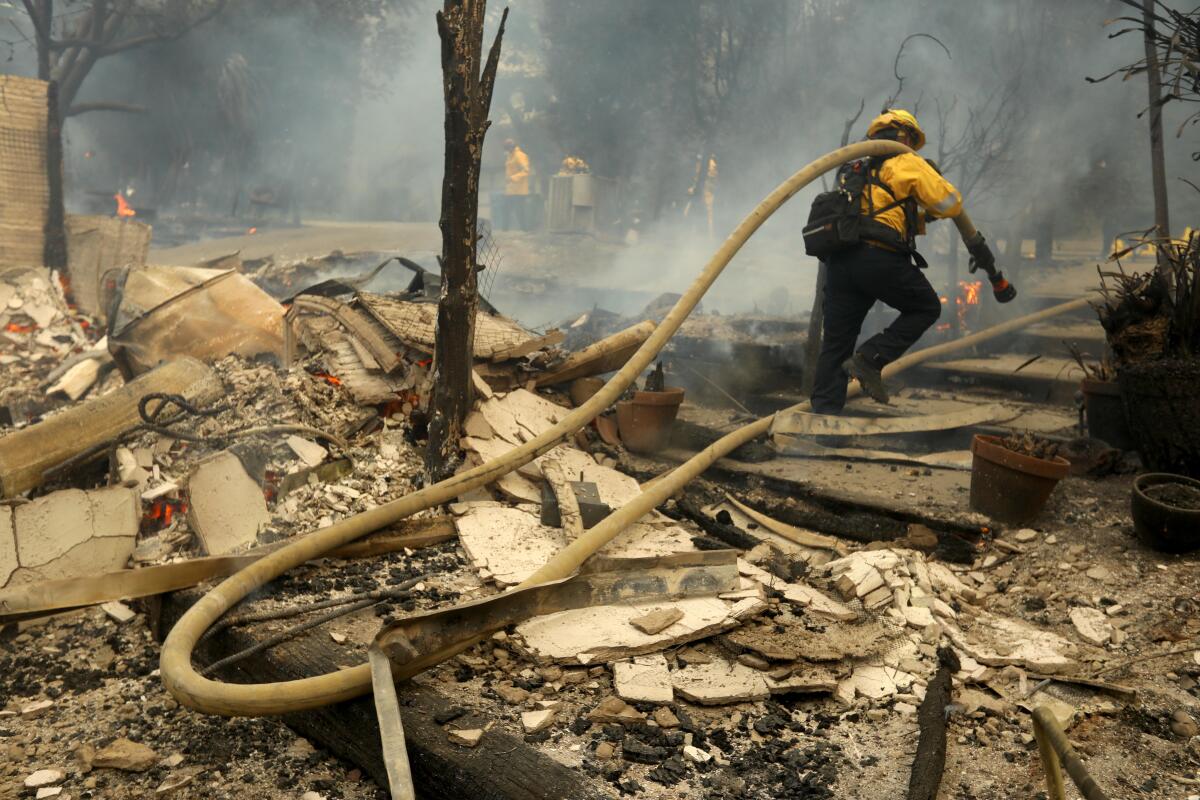
A firefighter carries a hose back to his rig while walking through a destroyed home from the Palisades fire in Pacific Palisades on Jan. 7, 2025.
(Genaro Molina / Los Angeles Times)
Last year, Pacific Palisades-based fashion designer Elyse Walker said she would reopen her eponymous store in Palisades Village after losing her 25-year flagship location on Antioch Street to the inferno.
Other neighborhood shops destroyed in the fire that are reopening at the mall include K Bakery and Loomey’s Toys, which caters to children up to age 12 and used to be across the street from Palisades Elementary Charter School.
“It’s been a journey and I’m excited because I wasn’t sure that there was going to be a place to come back to,” said toy store owner Amanda Rastegar. “Hopefully we can bring some of that magic back.”
Rastegar’s home in the Palisades survived but was damaged by the fire. The family returned about eight weeks ago. Her last memory of the fire was a burning supermarket.
“I just couldn’t wrap my brain around what was happening,” she said. “By the time I left, Gelson’s was on fire.”
Among the returning tenants is Angelini Ristorante & Bar. Well-known Los Angeles chef Gino Angelini said he will be in the kitchen next month for a return of the Italian restaurant.
“We won’t do a big celebrity open,” he said. “We want to have a very soft opening and see our customers come back.”

Construction takes place at Rick Caruso’s Palisades Village on Thursday. The shopping center is scheduled to reopen mid-August.
(Myung J. Chun / Los Angeles Times)
An elaborate celebration would not feel “correct for me,” Angelini said, because the devastation has been “very sad” for so many.
Other new tenants include local chef Nancy Silverton, who has agreed to move in with a new Italian steakhouse called Spacca Tutto. Women’s activewear retailer LESET will open its first West Coast location.
Caruso said he is optimistic that customers will return to the center, even though many Pacific Palisades residents are still dispersed. One tracking system estimated that about 30% of the Village’s customer base was impacted by the fire, he said.
“That means 70% did not get impacted, so there’s a lot of customers still left out there,” Caruso said. Historically, the center drew customers from as far away as Beverly Hills and Calabasas, as well as Malibu, Brentwood and Santa Monica.
He also hopes many will be inspired to visit the revived mall.
“I believe in the goodness of people and I believe that people are going to want to support the Palisades,” he said. “They’re going to want to be there and support the businesses that have had the courage and the heart to reopen.”

Walmart is rapidly expanding its network of electric vehicle chargers designed for customers to use while they shop.
The network could help fill gaps in EV infrastructure in states with greater need for chargers. Walmart, which has more than 5,000 locations in the U.S. and hundreds in California, says more than 90% of Americans live within 10 miles of one of its stores.
The chargers also offer an incentive for customers to choose Walmart — Walmart Plus members will receive a 10% discount off an average price of $0.46 per kilowatt-hour of energy at the company’s chargers.
Walmart chargers are already available at more than 75 locations in 17 states, with Texas boasting the most charging stations, followed by Florida and Arizona.
Matthew Nelson, Walmart’s director of energy policy, said last week on LinkedIn that the network will soon reach 29 states, including California.
“We are delivering on the promise of affordable, reliable and convenient charging,” Nelson said in his post.
According to Walmart’s website, six charging stations are coming to California soon, though the company did not offer a specific timeline.
The chargers will be installed at stores in Antelope, Brea, Fresno, Stockton, Suisun City and Vallejo.
Most charging sites in California will include eight to 16 fast-charging stalls, said Walmart spokesperson Kelsey Bohl.
The company first announced plans in April 2023 to install its own EV chargers at Walmart and Sam’s Club stores, with a goal of installing thousands of chargers by 2030. Partnering with ABB E-Mobility and Alpitronic, it added 25 new charging sites this past May and six more in June.
“Walmart is building a leading retail-integrated EV fast-charging network, focused on delivering an affordable, reliable and convenient charging experience where customers already shop,” Bohl said in an emailed statement. “Customers can charge while they shop, access stations through the Walmart app they already use, and benefit from affordable pricing.”
The charging stations already available include 612 individual charging stalls using 400-kilowatt chargers. Each stall has a dual charging cord with both Combined Charging System and North American Charging Standard connectors. The standard connectors, designed by Tesla, are smaller and lighter than the combined systems.
The primary way to pay for the chargers is through the Walmart app, but the company is also experimenting with built-in credit card readers to allow those without the app to use the stations.
Customers can check charger availability on the Walmart app. The company said the chargers will be available 24 hours a day.

Robotaxis could be turning into robocops.
A self-driving Waymo reported two teens to San Mateo, Calif., police on Monday after they were found drinking alcohol and shooting toy guns in the back of the vehicle.
According to a social media post from the San Mateo Police Department, officers detained two 15-year-olds after the Waymo they were riding in contacted the department and stopped in a parking lot until law enforcement arrived.
“Parents do you know where your teens are?” the San Mateo Police Department wrote on Facebook following the incident. “Waymo does!”
Officers removed both teens from the vehicle and determined they were using toy guns to shoot Orbeez out the windows. Orbeez are small, water-absorbing beads sold at toy stores.
“Toy guns, water guns, and BB guns all pose real dangers, especially to an untrained eye,” the Police Department said. “The simple handling of them can cause fear in [passersby].” “
A video posted on Facebook shows at least five officers and a police dog responding to the scene and approaching the Waymo with their weapons raised.
Waymo did not immediately respond to a request for comment.
Waymo vehicles have internal cameras and microphones that may be used in an emergency or to “promote safety and security,” according to Waymo’s online support page.
The cameras are also used to ensure the vehicles are clean and to help find lost items, according to the support page.
The company said it does not use facial recognition or other biometric identification technologies to identify individuals.
“In more urgent circumstances, support may access live video during a trip,” the Waymo page said.
The San Mateo Police Department’s Facebook post has garnered nearly 60 comments, with one user accusing Waymo of “snitching.”
“At least they got a designated driver?!” one user commented.
-

 News25 minutes ago
Three more people charged with damaging Reflecting Pool after Trump’s multimillion-dollar restoration | CNN Politics
-

 Los Angeles, Ca2 hours ago
Loved ones search for missing 34-year-old Southern California woman
-

 Detroit, MI2 hours ago
Chickens, geese found at vacant home after nonprofit reports them stolen
-

 San Francisco, CA2 hours ago
What’s next for San Francisco Giants as MLB trade deadline approaches?
-
 Dallas, TX2 hours ago
Dallas millionaire files lawsuit against groundwater district
-

 Miami, FL2 hours ago
7 more women arrested at southwest Miami-Dade massage parlors, accused of prostitution in undercover sting
-

 Boston, MA2 hours ago
‘They’re my buddies’: 96-year-old Back Bay woman befriends French soccer team
-

 Denver, CO3 hours ago
Denver officers cited for separate incidents, 1 fired

