Sports
What makes Chiefs coach Andy Reid the screen master? ‘His attention to detail is the best’


KANSAS CITY, Mo. — Andy Reid often describes himself as more than a coach. He considers himself a teacher.
The classroom for Reid — the NFL’s oldest head coach at 66 — is a major reason he continues to arrive at the Chiefs’ training facility around 4 a.m.
“I enjoy teaching,” Reid said.
From his voluminous playbook, Reid loves instructing his players on his massive collection of screen passes. The Chiefs have installed more than 100 screens this season, variations meant to surprise opponents — and some they have yet to unveil.
The Chiefs know — whether it’s the first week of the offseason program, training camp or the first day of a game week — Reid will go through several meticulously designed screens, plays that require his players to have proper synchronization.
Reid is known for many things — his deep passing attack, his penchant for trick plays, his affection for cheeseburgers and Tommy Bahama Hawaiian shirts. In 26 years as a head coach, Reid has become most known around the NFL as the screen master, his schematic innovations of the play being one of his core contributions to the sport.
“It’s important in the pass game that you have certain things that can offset it,” Reid said. “That’s a complementary play to your dropback pass game. It can be complementary to your play-action game and even that you’re throwing off of it can be complementary.”
Since Reid joined Kansas City in 2013, after 13 years in Philadelphia, the Chiefs have been one of the league’s best teams at executing screens. Since quarterback Patrick Mahomes arrived in 2018, the Chiefs have been the league’s best team at screens. During that time, in the regular season, the Chiefs have attempted and completed the most screens (433 of 483), have generated the most yards on screens (3,062) and have been the most effective team in the NFL on screens in terms of passer rating, expected points added per dropback and percentage of attempts going for a first down or a touchdown, according to TruMedia and Next Gen Stats.
The Chiefs have scored 19 touchdowns on screens since 2018 — eight more than any other team.
WOOOOORTHY 🏃♂️#ProBowlVote + @XavierWorthy#ProBowlVote + @PatrickMahomes pic.twitter.com/lIDZTM1Z2L
— Kansas City Chiefs (@Chiefs) December 15, 2024
“He’s got a great feel for when to dial those up,” Los Angeles Rams coach Sean McVay said of Reid. “We always talk about how no screen is the same — every screen has its own story. But for some reason, everywhere Andy Reid has been, that team has a good feel for it.
“Big Red is the man. There are so many layers to it. I’ve studied them every year. That’s one of the things you’re going to spend an offseason studying.”
Over the past year, The Athletic has asked many in the Chiefs organization a simple question: Why is Reid so good at screens? Almost every player and coach touched on the same sentiment: Reid’s success is in the details.
“He’s really good at teaching the base screens, even more than I had ever been taught,” Mahomes said of Reid. “Every day (in camp), we have a part of our install where we talk about screens, how we’re setting up this screen and what it goes off of and how we want to make it look like this different (play).”
GO DEEPER
Why Trey Smith’s dream NFL career with the Chiefs almost never happened
The screen pass was invented in 1906, more than 50 years before Reid was born.
Bob Zuppke, who became a coaching legend at Illinois, invented the screen while coaching at Hackley Manual Training School in Muskegon, Mich. Zuppke drew up several screens, including one in which the punter, while in punt formation, passes the ball to a receiver on a crossing route with offensive linemen in front of him. Notre Dame, under coach Knute Rockne, further advanced the play in the 1930s.
As a player in the ’70s, Reid was a talented tackle before he suffered a knee injury that altered his college career.
“In high school, we ran the Veer,” Reid said, smiling. “There wasn’t a lot of screens going on.”
Reid was introduced to the intricacies of the screen when he arrived at BYU, learning why the play could be a strong option for any offense under coach LaVell Edwards, who in 1981 convinced him to become a coach. Eleven years later, Reid entered the NFL as assistant offensive line and tight ends coach with the Green Bay Packers. Coach Mike Holmgren paired Reid with Tom Lovat, the offensive line coach.
For much of the ’90s, the Packers, with Hall of Fame quarterback Brett Favre, were consistent at gaining chunk yards with screens. They had more variations of screens than most teams.
“I was lucky to have real good coaches all the way up,” Reid said. “We talked about sidewalks and creating sidewalks to run down on screens. That was all Tom Lovat in Green Bay.”
During a 1998 offensive line clinic, an annual event in Cincinnati led by Bob Wylie, who was an offensive line coach in the NFL for 15 years, Lovat gave a seminar on the Packers’ screens. Lovat told his peers that they had to commit to running screens, teaching the quarterback, linemen and the running back their landmarks on the practice field without the defense.
The sidewalk, Lovat said, was made up of the numbers on the field. Lovat learned that if the linemen and running back drifted too wide of the numbers, they were too close to the sideline, the 12th defender. Staying on the numbers gave the ball carrier enough space to bounce the run to the outside or cut back toward the middle of the field.
One highlight in Lovat’s seminar was from the 1995 season. He showed how the Packers’ offensive line slid its protection to the right, giving the Minnesota Vikings the appearance of a traditional, dropback pass.
“Watch the center (Frank Winters) using the numbers as a reference point to clean up the (linebacker) — and boom!” Lovat shouted. “It’s like a fullback. (Running back Dorsey Levens) goes right down the (sidewalk). He’s trusting what we’re telling him.”
The Packers gained 20 yards, setting up an opening-drive touchdown in their victory. When Lovat finished showing his clips, a coach asked him how many screens Holmgren has in a game plan.
“Probably three,” Lovat said. “We’d put a special one in for the red zone, something to take advantage of what they’re doing down there. … Who do we want (the defense) to put on the field for the play? Hopefully you’ll do that.”
Reid enters most games with at least 10 screens.
When he coached the Eagles, he started putting screens on steroids. No longer was it just two linemen, usually the center and a guard, going out on the perimeter. Reid created landmarks and sidewalks all over the field, even within hashes. Some screens involved a shift, a motion or play action. Others had an element of a reverse or a rollout for the quarterback.
“If you’re a running back for Coach Reid, it’s a lot of fun because you have to be a better receiver than a runner to play in his offense,” general manager Brett Veach said. “Brian Westbrook was the pinnacle.”
The details begin with the center. Creed Humphrey is the league’s best center in large part because of his above-average athleticism for the position.
In November, Humphrey was the first lineman to leave his usual spot when the Chiefs ran a screen against the Carolina Panthers. The next lineman out, either the guard or the tackle, was supposed to be 2 yards next to the center. Next to Humphrey was right tackle Jawaan Taylor, the two creating the sidewalk for tight end Travis Kelce, who started the play blocking outside linebacker Charles Harris. After the catch, Kelce ran between blocks from Humphrey and receiver JuJu Smith-Schuster — and still had Taylor as a lead blocker, the play resulting in a 19-yard gain.
(Drew Jordan / The Athletic)
“The guard has to pass set, extend their arms and release,” offensive line coach Andy Heck said during his 2023 seminar at the clinic. “Initially, it looks like a normal pass set to a defender — eyes are up, our hands are inside and our feet are underneath us.
“You step up to get out. If you’re an uncovered (interior) lineman, you’ve got to be an actor. Don’t look guilty. Give this (play) the look of you’re in pass pro and let’s try to get (linebackers) into pass drops (into coverage).”
Heck found the simplest way to explain the timing of “set, extend, release” was the equivalent of “a thousand one, a thousand go.” Heck learned it from Lovat in 2004 when he was the assistant line coach with the Jacksonville Jaguars.

GO DEEPER
Why a simple 3 x 5 notecard with two words explains Andy Reid’s leadership style
Reid gets most involved when it’s time to address the entire unit.
“He teaches the screen to the skill players from an O-lineman’s perspective, what we’re asking them to do out in space,” Chiefs pass game coordinator Joe Bleymaier said of Reid. “He tells (skill players) you can help them set up the blocks and get what you need to accomplish by following these guidelines.”
Reid has requirements for the running back’s first three steps, which help set up the linemen’s blocks. He wants the skill-position player to catch the ball on the shoulder that is leading him upfield. The running back or tight end knows the center or the guard is supposed to release the defensive lineman with their inside shoulder, away from where the pass is going.
“It’s about the fundamentals,” Mahomes said. “Coach Reid is the best that I’ve ever met at that. All the other stuff is fancy — all the, as I would say, ketchup on the side — to bring the meal to a different level. At the same time, you’ve got to have that steak to make that screen work.”
Give it to Jerick McKinnon on 3rd & 20.
📺: #KCvsSF on FOX
📱: Stream on NFL+ https://t.co/USkaudAkBK pic.twitter.com/519UnO1KzK— NFL (@NFL) October 23, 2022
While the center and guards on other teams might continue drifting, Reid demands that his linemen reach a specific landmark and stop.
“Every step for the O-line is calculated,” guard Mike Caliendo said. “Blocks downfield is what makes those screens go for big plays. We like being able to get out on those (smaller defenders).”
Once the pass is completed, Reid tells the ball carrier and his blockers to get upfield together as soon as possible, which should put the scrambling defenders in the linemen’s path.
“The best feeling is when it works,” right guard Trey Smith said, laughing. “Any play that I put someone on their back, I’ll take it.”
Smith did just that in 2022 when the Chiefs ran a screen to running back Jerick McKinnon against the Denver Broncos. Smith swat-released linebacker Josey Jewell, who blitzed, inside and away from Mahomes’ pass. Then in the open field, Smith crushed safety Justin Simmons, leading McKinnon to leap into the end zone for a 10-yard touchdown.
Two quarters
Two @JetMckinnon1 TDs📺: #KCvsDEN on CBS
📱: Stream on NFL+ https://t.co/TzmdzbFm9o pic.twitter.com/AdFvjY41vw— NFL (@NFL) December 11, 2022
Offensive coordinator Matt Nagy shared a detail that separates Reid from his peers: You cannot properly practice a screen in a walkthrough. The Chiefs dedicate time in practice by simulating the screens at a tempo that is as close as they can get to game speed. Reid does that to help the players stay in rhythm, which leads them to stay on time.
“It’s a bit intellectual and a bit physical and it’s something different,” former right tackle Mitchell Schwartz said. “Guys get excited for it because the coaches are pretty good about telling you what the possibilities are. You also feel prepared. That’s really just what you want in life.”
Reid’s most famous game weaponizing screens occurred in 2013 against the Raiders, who then played in Oakland. The Chiefs won 56-31, racking up 127 yards on six screens. Running back Jamaal Charles scored five touchdowns and generated 215 all-purpose yards. Three of his five touchdowns were the byproduct of a screen.
“Those clips were still making the rounds when I was there, as teaching tape,” Schwartz said, laughing.
Running back Kareem Hunt believes Reid loves screens because those plays are designed to make the linemen the leading stars.
“He likes seeing those big guys get rolling and put people on their back,” Hunt said, smiling. “That’s his favorite thing.”
GO DEEPER
Chiefs’ defensive failure against the Bills last time will fuel them in the AFC title game
Steve Spagnuolo, the Chiefs’ defensive coordinator, knows why his peers in the league have struggled to stop Reid’s screens.
“Everybody gets their opportunity,” Spagnuolo said. “That makes it challenging. Sometimes you play a team, and this is the screen back or that’s the screen receiver. But with our guys, it could be anybody.”
This season, the Chiefs have completed a screen pass to 10 players.
“Andy lets those guys, the coaches and the players, be creative,” Spagnuolo said. “He takes all that feedback. It’s the things they do before the ball is snapped that become as challenging as the screen itself.”
(Drew Jordan / The Athletic)
Few coaches are more funky, clever and imaginative with their pre-snap eye candy than Reid.
In 2022, the Chiefs ran their most exotic play: “Arctic Circle.” After a timeout, the Chiefs revealed a never-before-seen huddle to baffle the Raiders. Mahomes and his teammates linked their arms and began shuffling their feet to the right, transforming their huddle into a counter-clockwise carousel. It resembled school children dancing in a circle while singing “Ring Around the Rosie” on the playground at recess. After the Chiefs’ antics, several Raiders defenders looked at one another.
McKinnon received the snap in the pistol and went through a run-pass option action with receiver Kadarius Toney. Next, McKinnon pitched the ball back to Mahomes, who threw a pass across the field — from the numbers to the numbers — to Toney, who went 9 yards into the end zone.
There was one problem, though. The touchdown didn’t count. The score was nullified by a holding penalty on Humphrey. The Chiefs, though, scored on the next play.
“The screens are Andy’s baby,” former Bears tackle Kyle Long said last year on the “This is Football” podcast. “If you watch the way that this offense has a feel for screens, it looks like a really good basketball offense. … They understand spacing better than anybody.”
Coming out of a spinning huddle, the Chiefs aligned in a wildcat formation, setting up a screen pass to Kadarius Toney with a blocking advantage.
Toney found the end zone on the play, however, the TD was called back due to a holding call.#KCvsLV | #ChiefsKingdom pic.twitter.com/YmfAndpPZ6
— Next Gen Stats (@NextGenStats) January 7, 2023
Early in Mahomes’ career, Reid called creative screens to be an elite changeup to the Chiefs’ deep passing attack.
One of the Chiefs’ slowest screens came against McVay’s Rams in a memorable 2018 game. Inside the red zone, receiver Tyreek Hill sprinted in motion, confirming the Rams were in man-to-man coverage. Mahomes executed three play-action fakes — to Hill, Hunt and a fake end-around to receiver Demarcus Robinson.
“It’s just a lot of stuff for the defense’s eyes,” Hunt said.
When Mahomes completed his pass to Hunt, nine Rams defenders were either on the left side of the field, away from the screen, or behind the line of scrimmage. Hunt scored on an easy 21-yard touchdown.
“Typically, man coverage is when you want to dial it up,” Kelce said of Reid’s screens. “His attention to detail is the best. He does so much work behind the scenes of understanding how defensive coordinators are calling (their plays) and being in the flow of the game — feeling the edge rushers, the pressures and when you can catch a team in a specific zone coverage.”
One way Reid has accentuated the talent of his skill-position players while keeping his design simple is by using quick scenes.
(Drew Jordan / The Athletic)
Last season, the Chiefs noticed that the Miami Dolphins did a Cover 0 blitz in the red zone early in the season when the Eagles went to an empty formation. The Dolphins’ tactic prevented Eagles quarterback Jalen Hurts from scoring on a designed run on a third-and-goal snap. When the Chiefs faced the Dolphins, they showed an empty formation in the red zone. Anticipating the Dolphins’ Cover 0 blitz, the Chiefs countered with a quick screen to Rashee Rice, who scored an 11-yard touchdown thanks to blocks by receiver Justin Watson and left tackle Donovan Smith.
“His screen game is tricky,” Seattle Seahawks coach Mike Macdonald said of Reid. “There’s a timing component to it that it seems that they’ve really ironed out. It speaks to their continuity and how well they coach it. They’re the standard right now.”
In addition to his designs, Reid has two undeniable ingredients that give his screens maximum potency: He has the perfect quarterback (Mahomes) and pass-catching tight end (Kelce).
In 2016, Reid started experimenting with screens for Kelce. That season, Reid had Kelce line up on the perimeter against the Broncos. Two seconds after the snap, Kelce caught a pass from quarterback Alex Smith while Schwartz and tight end Demetrius Harris blocked a cornerback and linebacker. No defender touched Kelce. He ran 80 yards for a touchdown.
“That was probably the coolest screen ever ran,” Kelce said. “You don’t always see a tight end outside the numbers getting a jailbreak screen.”
Since 2018, Kelce has led all tight ends in screen targets (72) and receptions (63), according to TruMedia and Next Gen Stats. Mahomes, meanwhile, leads all quarterbacks in screen attempts (457) and completions (413). During that time, Mahomes has thrown only one interception on a screen.
“He’s the best at what we call ‘dealing cards,’” Bleymaier said of Mahomes. “The ball handling that he’s able to get away with, he’s one of a few that can, from any vantage point — even a no-look — get the ball out and around (defenders) to where it needs to be for the (pass catcher).”
Mahomes’ favorite screen from last season came in the Chiefs’ biggest drive on the NFL’s biggest stage: overtime of Super Bowl LVIII.
Before overtime, the Chiefs scored only one touchdown in five red zone trips. Needing a touchdown to win the game, Reid called two screens. The first was a traditional screen to running back Isiah Pacheco, who gained 5 yards. Once the Chiefs entered the red zone, Reid looked down at his large, laminated play sheet.
“It’s a way of getting the ball in your good players’ hands at a low risk,” Reid said of his screen for Kelce. “We had done some blocking things with our tight end, so keeping Kelce in there to help out (against 49ers defensive end Nick Bosa) made sense. He’s deadly with the ball in his hands.”
Can the @Chiefs recreate this game-winning drive from SBLVIII during the rematch against the @49ers in Week 7? 👀 pic.twitter.com/AJ90M9SvFy
— NFL (@NFL) May 20, 2024
Kelce initially blocked Bosa while Humphrey and Taylor set up blocks for him. After his catch, Kelce ran through three defenders for a 7-yard gain, setting up the Chiefs for a first-and-goal snap from the 3-yard line.
“It was using a great player’s strengths against them,” Mahomes said. “We wanted Bosa to think he had the advantage and he was going to try to make a big play happen. I gave my eyes to Pacheco on the rail route out in the flat and it got (Bosa) to jump just a little and you get the ball to Travis.”
One play later, Kelce lifted his arms, signaling the game-winning touchdown just as Mahomes completed an easy 3-yard, walk-off touchdown to receiver Mecole Hardman, who was wide open in the corner of the end zone.
“When they’re run at the right time, they’re the best thing possible,” Kelce said of Reid’s screens. “You get the (defense) off guard with a whole bunch of big guys out in front of you. That’s the best part.”
— Jourdan Rodrigue contributed to this report.
(Top illustration: Demetrius Robinson / The Athletic; photos: Erick W. Rasco / Sports Illustrated via Getty Images, Nick Cammett / Diamond Images via Getty Images, Justin K. Aller / Getty Images)



NEWYou can now listen to Fox News articles!
CM Punk appeared on “Friday Night SmackDown” ready to take on any challenger that was ready to step to him after winning the Undisputed WWE Championship against Sami Zayn.
Punk entered the ring in Oklahoma City and called back to the “Monday Night Raw” after WrestleMania 42 when he told Cody Rhodes he’d be ready to deliver if a championship opportunity fell “out of the sky.”
COMPLETE PRO WRESTLING COVERAGE ON FOX NEWS DIGITAL
Cody Rhodes and CM Punk face off during SmackDown at Paycom Center in Oklahoma City, Okla. (Craig Ambrosio/WWE via Getty Images)
“When championship opportunities fall out of the sky, CM Punk catches them,” he said.
Punk named potential SmackDown superstars he’d think might come for the title, including Gunther, Finn Balor, Royce Keys, Damian Priest and Trick Williams. He even said that Zayn could come back around and get his rematch if he wanted. He didn’t mention Rhodes’ name, but the “American Nightmare” came out uncalled and marched his way down to the ring.
“I don’t think you and I can run away from each other anymore,” Punk told Rhodes.
Cody Rhodes looks on during SmackDown at Paycom Center in Oklahoma City, Okla., on July 10, 2026. (Craig Ambrosio/WWE via Getty Images)
Rhodes agreed and mentioned that Punk would want a match with him, just “say when.” It was a quick retort from Punk, who said, “when.” SmackDown general manager Nick Aldis, who was in the ring for the segment, booked the match for SummerSlam.
Punk will defend the Undisputed WWE Championship at SummerSlam, which takes place Aug. 1 and 2 at U.S. Bank Stadium in Minneapolis.
First, however, Punk and Rhodes will be involved in a tag team match at Saturday Night’s Main Event in New York City next week. Aldis made the match after Gunther demanded that Aldis put him in a match against Punk. Gunther was hoping it would be for the championship. Instead, Gunther will tag with Zayn.
Gunther didn’t take too kindly to that and attacked Aldis. Rhodes came back out to break up the calamity. He wanted to take on Gunther after the show went off air but Gunther walked away.
Gunther makes his entrance during SmackDown at Paycom Center in Oklahoma City, Okla., on July 10, 2026. (Rich Wade/WWE via Getty Images)
CLICK HERE TO DOWNLOAD THE FOX NEWS APP
Punk definitely has his hands full as he moves to SmackDown to become a fighting champion.
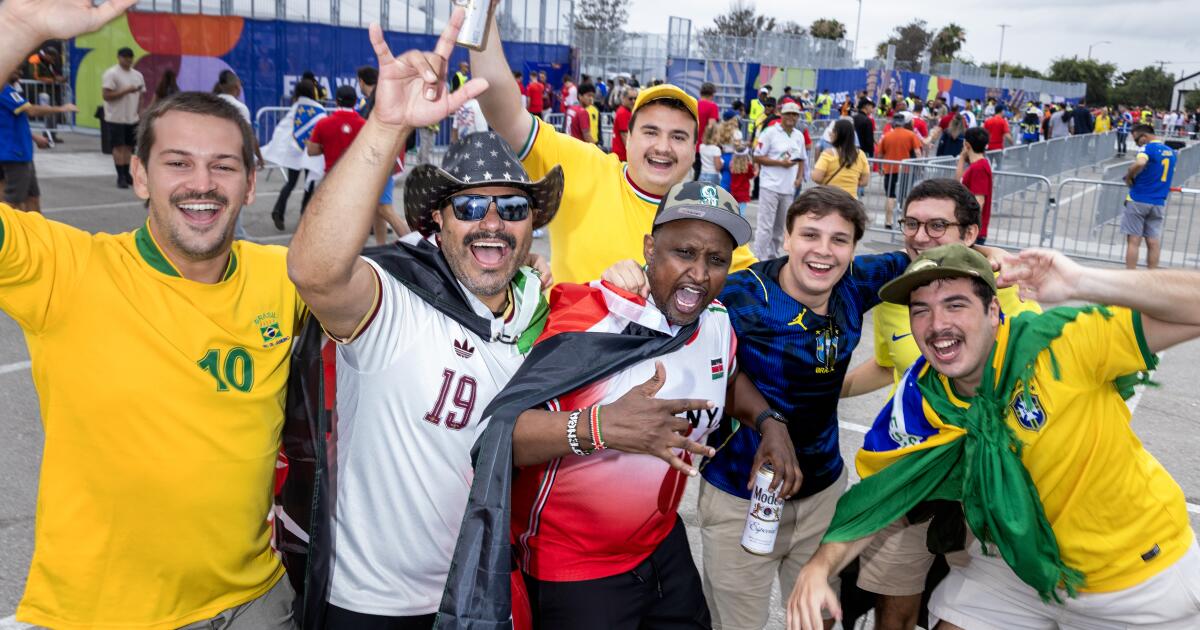
World Cup tourists are coming to L.A. for the soccer, but they’re staying for the $21 smoothies and Double-Doubles.
As the last Los Angeles FIFA World Cup event ended Friday, soccer fans were eating like locals and famous chains from the region were cashing in.
In the weeks that L.A. has hosted the World Cup, international soccer enthusiasts have flocked to big brands from the area, often in large groups wearing their countries’ jerseys.
It is a phenomenon seen at many of the host cities. In Dallas, giant gas station Buc-ee’s is the main attraction. For people visiting New Jersey, deli shops have been a hot ticket. In L.A., the place to be between matches was Erewhon.
Thirsty international sports fans gathered for pictures outside different Erewhons, wandered their aisles smiling, and, of course, picked up pricey smoothies.
While Erewhon would not comment on its business, mobility data company Arity, which uses phone data to track consumers, said Erewhon visits at the outlets around SoFi Stadium were quadruple what they were a week earlier on June 12, the day of the U.S. national soccer team’s opening match there.
Arity looked at what stores people visited within a 10-mile radius of SoFi that day and also found surges in visitors to nearby El Pollo Loco and Trader Joe’s.
Locals have spotted groups of people in Korea jerseys huddled together, trying to decide what to order at In-N-Out.
Some complained on social media that international tourists at Trader Joe’s were buying up all the mini canvas tote bags.
Soon after the Belgium vs. Spain quarterfinal ended Friday, the In-N-Out near SoFi had a long line of soccer fans stretching out the door in bright red and yellow and black jerseys and matching striped hats and scarves.
One of the workers said he had to explain “spread” and “animal style” to foreign football fans.
“I didn’t know this place existed,” a fan from Romania said while waiting in line.
Los Angeles and other cities and states that have hosted the event need the soccer fans to spend money to make the event worth all the time, effort and money it requires.
A rosy 2024 report projected the World Cup could bring more than $800 million to the L.A. region as 180,000 people converge on the area to sleep, eat and spend.
There were early concerns people weren’t turning up for the event because of the high ticket prices and the difficulty of obtaining visas for citizens of some countries.
However, at least for some L.A. hotels, there was a surge of last-minute visitors which pushed up occupancy and room rates.
While sports fans are not in the region to shop, they do make time for it.
World Cup customer spending is also apparent in beer sales. Andrew Heritage, the chief economist at the Beer Institute said beer purchases at entertainment and attractions in L.A. – outside of World Cup spaces – were up around 10% from normal.
“That tells me that fans in the L.A. area have decided to extend their stay and take in all the other things that the area has to offer, rather than just the match itself,” he said.
On social media, the purpose of these shoppers is clear: grab a quick souvenir or local specialty and take a selfie.
The data from Arity suggests that fans are very efficient when they spend at local spots, diving in, getting what they want and getting out as soon as possible, said Jeff Schlitt, a director at the company.
“Normally you’re there for an hour. They’re going to be there for 15, 18 minutes,” he said. “Why is that? Because they were purpose-driven shoppers.”
For some travelers, the more popular American chains aren’t unfamiliar. But some of the native L.A. fare still comes as a surprise.
As one Belgium-Spain matchgoer from the Netherlands stood taking a picture of the In-N-Out sign after the game, he said he’d never had a burger like the one he’d just tried.
“We only have McDonald’s and Burger King,” he said. “It’s way better.”

NEWYou can now listen to Fox News articles!
The face of baseball will not be at Tuesday’s All-Star Game.
Shohei Ohtani was scratched from his start on Friday as the Los Angeles Dodgers said he will also miss the Midsummer Classic with what the team called left knee irritation.
Ohtani, for obvious reasons, has become an All-Star Game fixture. He has earned the honor in each of the past five seasons and made his first start in 2021.
Starting pitcher Shohei Ohtani #17 of the Los Angeles Dodgers warms up before the MLB game against the Arizona Diamondbacks at Chase Field on June 03, 2026 in Phoenix, Arizona. (Photo by Christian Petersen/Getty Images) (Christian Petersen/Getty Images)
The two-way phenom is on his way to winning his fifth MVP award in his last six seasons as he is hitting .290 with a .939 OPS and pitching to a minuscule 1.79 ERA, the second-lowest in the sport among pitchers with 80-plus innings. His OPS is also the seventh-best mark in the league.
The Dodgers said Ohtani will be the team’s designated hitter up until the break, but he will “have some interventions on his knee to put him in the best position for the second half of the season.”
Ohtani dealt with knee issues earlier in the season.
It is certainly a big hit for the game as the other face of the sport, Aaron Judge, will miss the game due to a fractured rib that has kept him out since late May.
Shohei Ohtani #17 of the Los Angeles Dodgers gets ready in the on deck circle against the Arizona Diamondbacks at Chase Field on June 01, 2026 in Phoenix, Arizona. (Photo by Norm Hall/Getty Images) (Norm Hall/Getty Images)
DODGERS WILL AGAIN VISIT WHITE HOUSE TO CELEBRATE WORLD SERIES CHAMPIONSHIP, OFFICIAL SAYS
Ohtani hit 99 home runs combined in 2024 and 2025, leading the National League with a 1.025 OPS in that span. Ohtani did not pitch in 2024 after elbow surgery but returned to the bump last year and owned a 2.87 ERA and 11.9 K/9, a figure he also put up in 2022 that led the American League.
The “Japanese Babe Ruth” is the only player in MLB history to have 300-plus plate appearances and 40-plus innings in six separate seasons (Ruth only did it twice and never stole 50 bases), and he has more than excelled at both.
Shohei Ohtani pitches for the Los Angeles Dodgers against the San Francisco Giants at Dodger Stadium in Los Angeles, California, on May 13, 2026. (Gary A. Vasquez/Imagn Images)
CLICK HERE TO DOWNLOAD THE FOX NEWS APP
Ohtani is not hitting like he has in the past, but certainly the best pitching performance of his career will make up for it. He “only” has 20 homers and 56 RBI this season.
Follow Fox News Digital’s sports coverage on X, and subscribe to the Fox News Sports Huddle newsletter.
-

 Georgia3 minutes ago
How Georgia football can make sure they are the defining program of the 2020s
-

 Hawaii5 minutes ago
Filipino dignitaries embrace RIMPAC hospitality amid outside protests – Hawaii Tribune-Herald
-

 Idaho11 minutes ago
Follow the clues and find $15,000 in East Idaho's biggest treasure hunt yet
-

 Illinois18 minutes ago
Real estate sales in Peoria, Tazewell, Woodford counties for July 11, 2026
-

 Indiana21 minutes ago
4-vehicle crash shuts down eastbound I-94 in Michigan City, Indiana
-

 Iowa25 minutes ago
‘Best friend,’ teen describes her grandma, Iowa Gov. Kim Reynolds
-

 Kentucky36 minutes ago
11 Amazing Kentucky Day Trips That Are Worth The Drive In 2026
-

 Louisiana41 minutes ago
Louisiana judge admits to misconduct; is suspended without pay for rest of term

