Lifestyle
Weaving is a sanctuary and a canvas for this L.A. fiber artist with ADHD

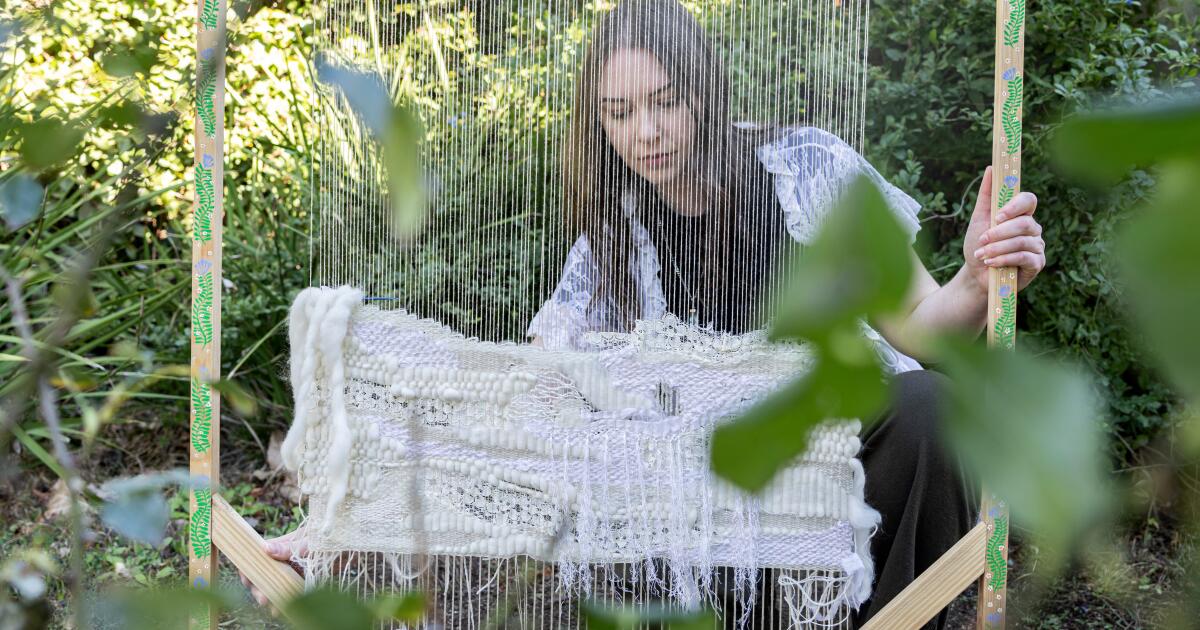
In Fiona Simpson’s Sherman Oaks bedroom, a warm and art-filled space teeming with baskets of yarn and colorful weavings, a Leclerc floor loom from the 1980s occupies nearly as much area as her queen-size bed.
On a recent Saturday in January, with binaural beats playing softly in the background, Simpson threaded her loom using a boat shuttle and shared how the repetitive art form has changed her life.
“Weaving is the one thing, other than sitting down and meditating, that turns my thoughts off,” said the 28-year-old fiber artist, who was awakened at 4 a.m. on Jan. 10 by a false evacuation warning for the Palisades fire. “When I am weaving, I am present. Sometimes there is stillness and quiet; other times it is a way for me to process things. I don’t worry about other things. It’s like a form of therapy, a healing process.”

“It’s like a form of therapy,” said Simpson as she weaves on the Leclerc floor loom in her Sherman Oaks bedroom.
In the face of unprecedented fires and winds in Los Angeles, the mental health benefits of Simpson’s weaving process, which she describes as “the cornerstone” of her well-being, became even more pronounced. “Sometimes there is stillness and quiet, but other times, it is a way to process things — diving into what is happening. And so it was last night as I was packing to evacuate. My heart goes out to all the artists whose life’s work has gone up in flames. I hope they will continue to create art.”
Apart from the joy that comes from working with her hands, Simpson said there is power in repetitive tasks. “I compare it to meditation: inhale, exhale,” she said as she pulled the horizontal beater bar toward her to push the yarn into place. “Everything is threaded one strand at a time. It reminds me of, in simple terms, putting one foot in front of the other.”
It’s not a surprising response from someone who describes herself as neurodivergent, having only recently been diagnosed with attention-deficit/hyperactivity disorder, which often includes difficulty paying attention.
In this series, we highlight independent makers and artists, from glassblowers to fiber artists, who are creating and producing original products in Los Angeles.
“I felt scattered, restless in my thoughts,” Simpson said. “It took me a long time to figure out what I wanted to do.”
For as long as she can remember, Simpson has been a creative person like her family members. Both of her great-grandmothers were painters; her father, Brian Simpson, is a smooth jazz pianist; and her mother, Beverley Simpson, is a collage artist. “I grew up wearing knit sweaters by my grandmothers,” Simpson said with a smile.
But like so many neurodivergent learners, she struggled to manage her time and attention.

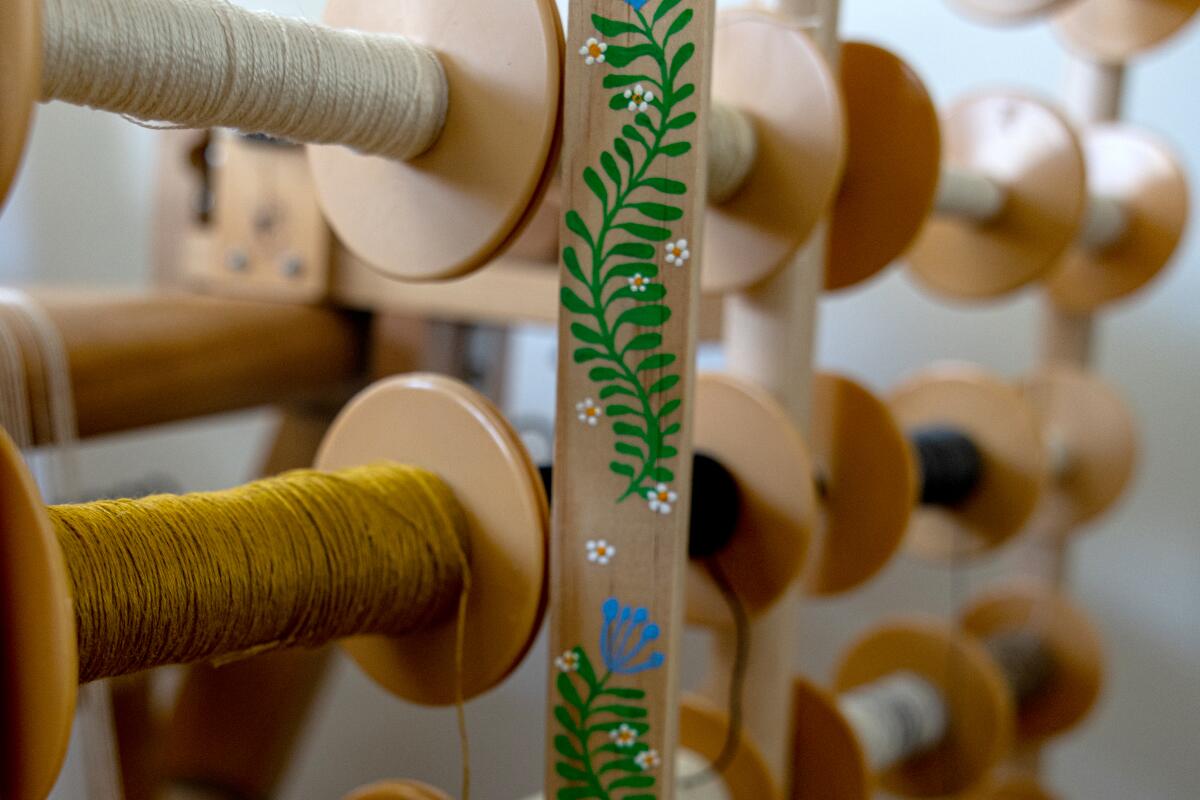

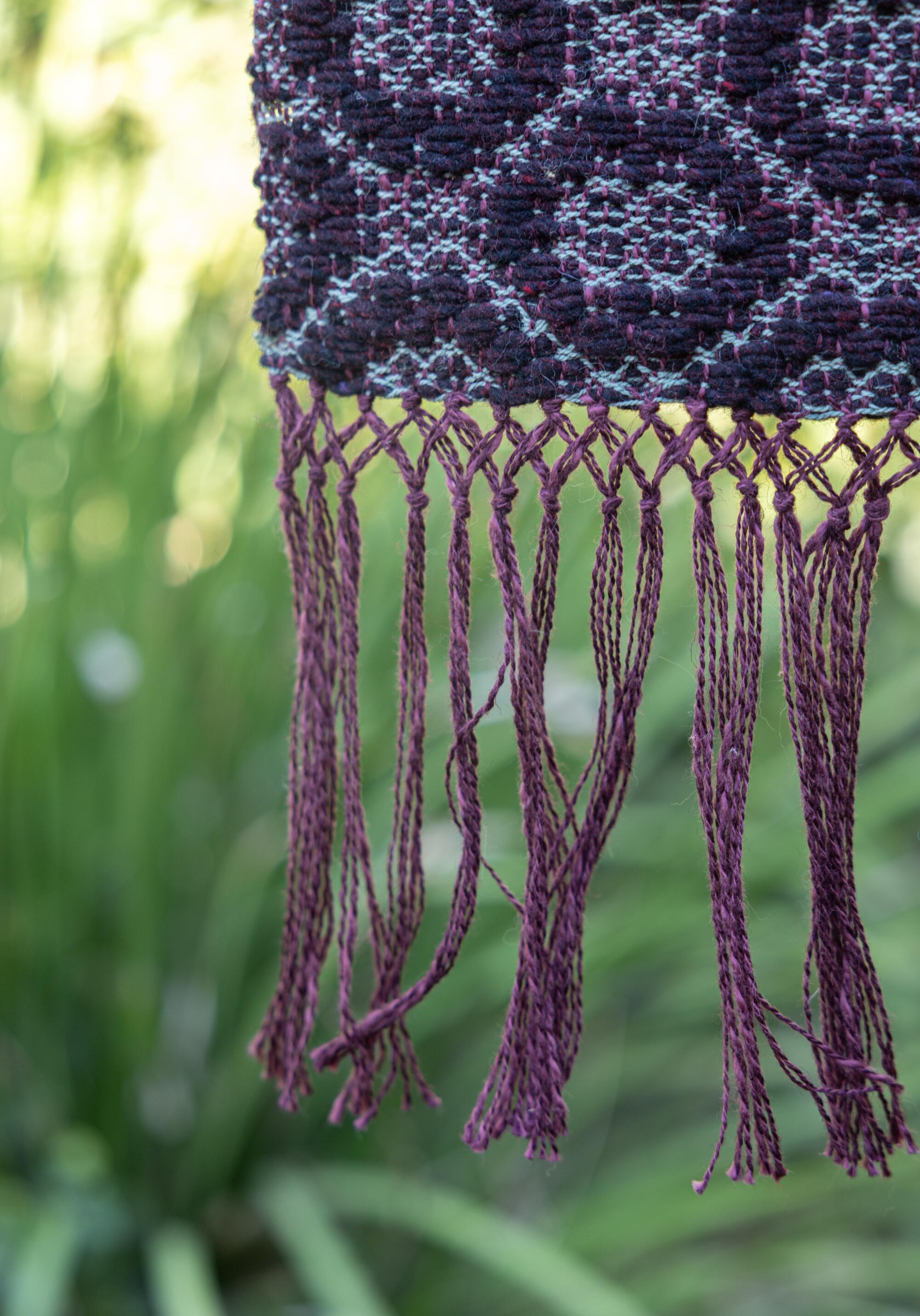
A selection of Simpson’s woven pieces at her home in Sherman Oaks.
“It was tough knowing I wanted to pursue art but not what direction to go,” she said. “I was a C student and coasted for as long as I can remember. When I was 18, I was told by a doctor that I had anxiety and depression. But that diagnosis never felt right.” (A 2023 study by Epic Research found that more women are being diagnosed with ADHD as adults because, as girls, they often mask symptoms and present differently than boys do.)
In 2007, Simpson started weaving “for fun” when her 70-year-old neighbor, fiber artist Mary Beth Schwartzenberger, offered her a floor loom.
“It wasn’t until I took a sculpting class that I realized how much I love working with my hands,” said Simpson. “That was the turning point. I tried ceramics; I tried so many different things. It wasn’t until the loom that I realized, ‘This is me. This is what I need to be doing.’”
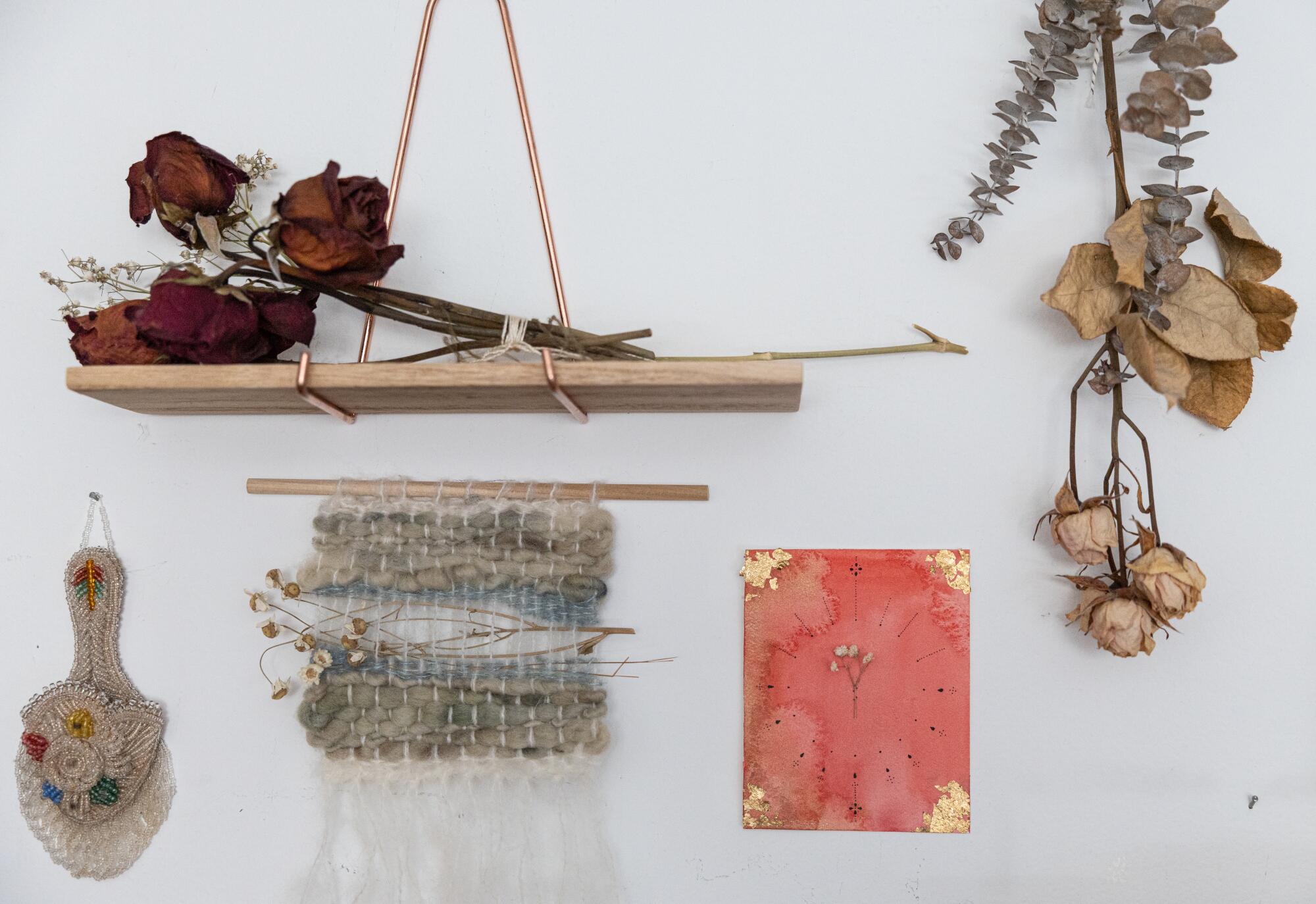
Sentimental mementos on the wall of Simpson’s bedroom.
As a former production weaver who churned out a line of unisex sweaters she sold through the American Craft Council, Schwartzenberger understands the meditative qualities of weaving. “Fiona wasn’t resonating with people her age because she was drawn to fiber, nature and paper arts and not technology,” Schwartzenberger said. “When I started weaving in the 1970s, fiber arts were exploding. There used to be weaving shops throughout Los Angeles, but now those shops are all gone. It’s such a loss. To meet a young person who is even interested in weaving? I thought, ‘Oh, my God, it won’t die.’ It was my privilege to pass it along.”
With help from Schwartzenberger and the internet, Simpson was off and running.
“I ended up not teaching her much because she fell in love with the weaving process,” Schwartzenberger said with a laugh.
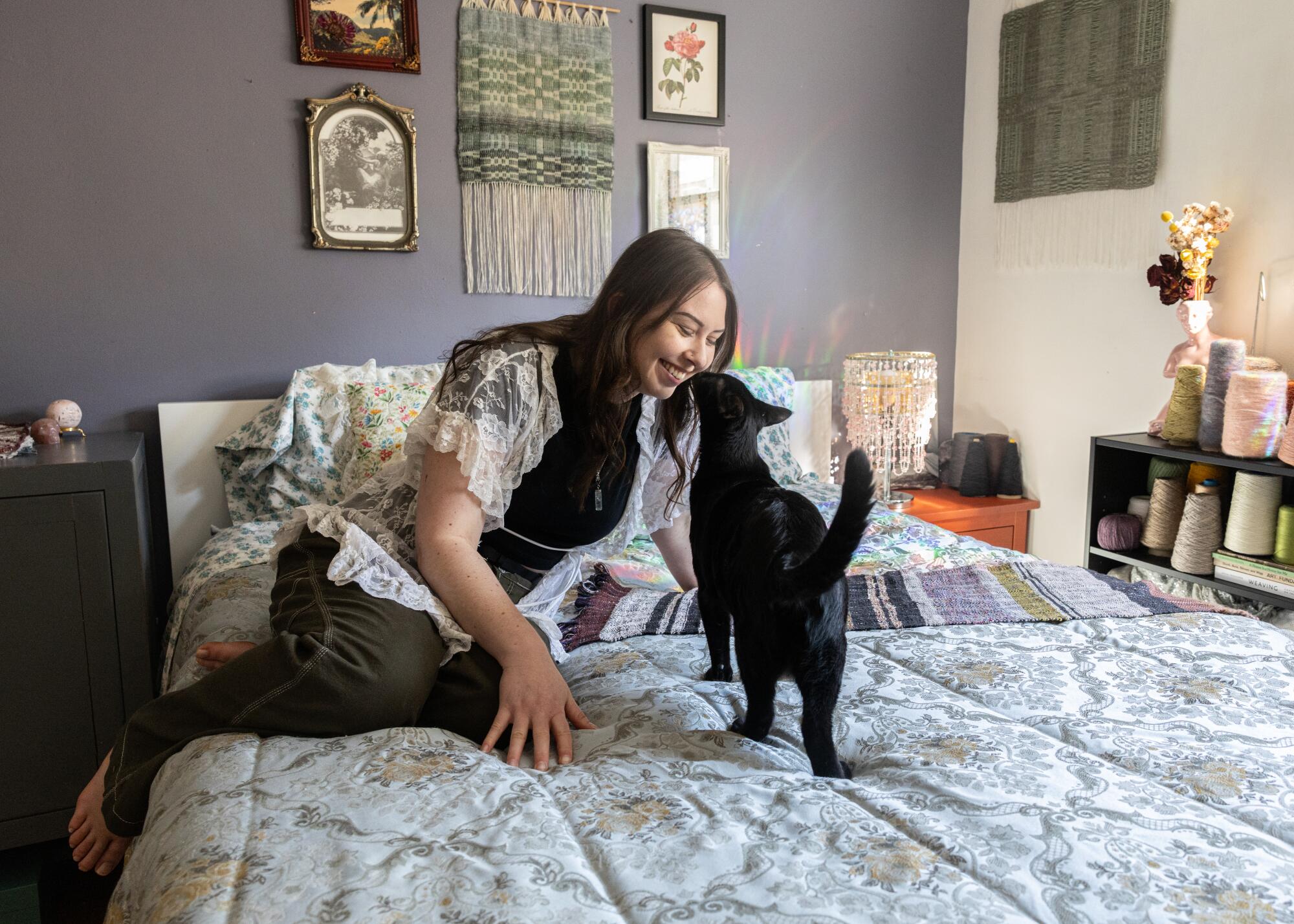
Fiona Simpson and her cat, Milo, exchange a nose kiss in her bedroom studio.
Holding her first weaving, a table runner, Simpson recalled the first time she sat down at the loom. “It was a powerful moment,” she said. “I had goose bumps and thought, ‘This is what I love.’”
Simpson stopping weaving for a few years although she had connected strongly with the art. “It was part of that classic struggle in being neurodiverse — the insecurity of ‘Am I dumb?’ ‘Why can’t I sit down and do this?’ ‘What’s wrong with me?’” she said.
Looking back, Simpson said her ADHD diagnosis, coupled with weaving, has been life-changing. “It felt like putting on a pair of glasses,” she said of getting individual therapy and having a strong support group. “Since then, feeling like I’m standing on the ground has been incredible. It’s not just getting by. I’m able to fully be myself now.”

One of Simpson’s works in progress rests on a table in her bedroom.
On a warm afternoon back in October, Simpson offered a tour of her work on display at M Street Coffee in Sherman Oaks. On the walls, weavings in saturated colors and textures were interspersed with mixed-media pieces incorporating intricate embroidery, photographs and dried flowers. Creating a color palette, Simpson said, is a big part of her process. “It starts with color. It comes from a natural inclination and inspiration, and much of it is spontaneous.”
On a lace vintage doily, Simpson embroidered the Japanese proverb “Fall seven times, stand up eight,” a fitting metaphor for her metamorphosis as an artist. Asked what she hoped viewers would take away from her work, Simpson said, “Stop, look, pause and enjoy the moment.”
As a mentor figure, Schwartzenberg is moved that her simple gift of a floor loom would have such a profound influence on Simpson, whom she has known since birth. “It was my good fortune to know I touched someone,” she said. “Once you have access to the work of the hand, that never leaves you. My only request of Fiona was that if she decided to keep the loom, she please pay it forward.”
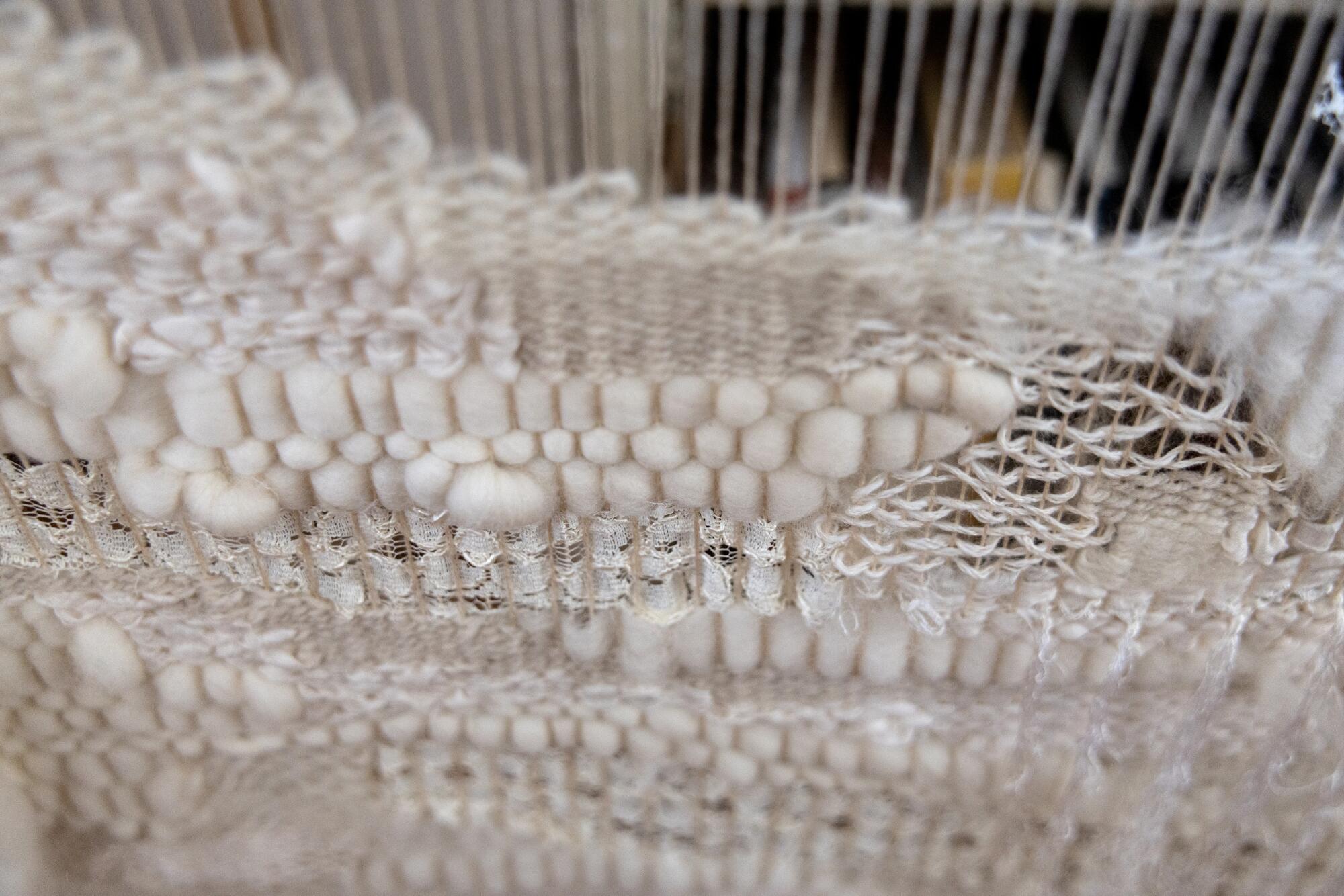
A weaving composed of lace and wool on the standing loom that Simpson built with her father.
For now, the loom is staying with Simpson. Before she returns to her junior year at Cal State Long Beach following winter break, Simpson has been working on several weavings that will be available for sale on her website. (Her woven pieces range from approximately $350 to $1,400.) She is beginning a table runner on the Leclerc floor loom, a wall hanging made of different cream-colored textiles on the standing frame she built with her father and a tapestry in earth tones that is emerging on a more petite frame — her latest in a series of weavings inspired by nature.
She said she is unsure what the future holds, but she’s committed to earning her bachelor of fine arts in fiber art and possibly pursuing a master’s degree. “I don’t have a linear plan for the next few years,” she said. “I’m open to opportunities as they arise and where life takes me. The one thing I know for certain is that I’ll never stop creating.”



For Iris van Herpen, couture is a laboratory as much as a runway. Our chief fashion critic, Vanessa Friedman, takes us inside this Dutch designer’s latest Paris show — from sci-fi-inspired gowns to an audacious attempt at a dress made of charged plasma.
Lifestyle
The BoF Podcast | Decoding Paris Haute Couture: Wonder, Restraint and the Call of the Void


-

 Illinois5 minutes ago
Illinois Senator opposes Shah Senate bid, cites 2015 Legionnaires’ outbreak
-

 Indiana8 minutes ago
Indiana State Police sergeant recovering, suspect killed in Michigan City
-

 Iowa13 minutes ago
Gelita USA opens new wastewater treatment plant near Sergeant Bluff after Iowa DNR violations
-
Kansas20 minutes ago
Kansas Lottery Mega Millions, Pick 3 winning numbers for July 10, 2026
-
Kentucky22 minutes ago
Trooper still recovering 1 year after fatal Lexington shooting spree
-

 Louisiana28 minutes ago
6 Best Out-of-State 529 Plans for Louisiana Residents (Beyond START Saving) – Big Easy
-

 Maine35 minutes ago
Maine Resiliency Center launches survey to gauge Lewiston shooting’s impact
-

 Maryland38 minutes ago
Maryland crab prices climb as catches fall

