Midwest
DOGE bro Ramaswamy likely to announce Ohio governor run by month's end: sources
Former Republican presidential candidate Vivek Ramaswamy is expected to announce a run for governor in his home state of Ohio by the last week of January, a source close to the multimillionaire biotech entrepreneur told Fox News Digital.
The development on his timetable comes two days after multiple sources confirmed to Fox News that Ramaswamy, who along with Elon Musk is co-leader of President-elect Trump’s Department of Government Efficiency (DOGE) initiative, was likely to launch a gubernatorial campaign “shortly.”
“Vivek’s base plan remains [the] same: to get accomplishments at DOGE and then announce a run for governor shortly,” an Ohio operative familiar with Ramaswamy’s thinking told Fox News on Friday.
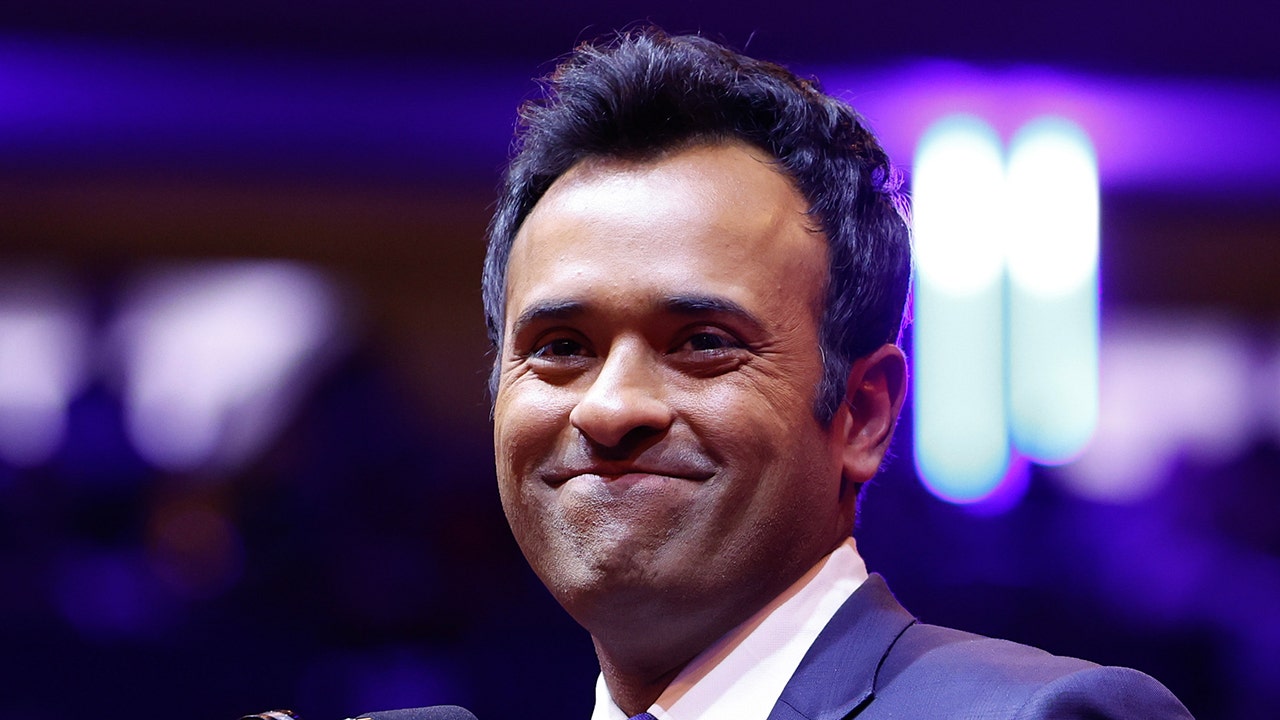
Vivek Ramaswamy speaks before former President Trump takes the stage at the campaign rally at Madison Square Garden on Oct. 27, 2024, in New York City. (Anna Moneymaker/Getty Images)
Ohio Republican Gov. Mike DeWine is term-limited and cannot seek re-election in 2026.
DeWine on Friday announced that Lt. Gov. Jon Husted would fill the U.S. Senate seat that was held by former Sen. JD Vance until earlier this month, when the vice president-elect stepped down ahead of Monday’s inauguration.
MUSK AND RAMASWAMY IGNITE MAGA WAR OVER SKILLED WORKER IMIMGRATION
Before the Senate announcement, Husted had planned to run for governor in 2026 to succeed DeWine. Ramaswamy, for his part, had expressed interest in serving in the Senate.
DeWine’s decision to choose Husted to fill the vacant Senate seat appeared to accelerate Ramaswamy’s move toward launching a run for governor.
Ohio Gov. Mike DeWine announces his appointment of Lt. Gov. Jon Husted, right, to fill the U.S. Senate seat formerly held by Vice President-elect JD Vance at a news conference on Friday, Jan. 17, 2025, in Columbus, Ohio. (AP Photo/Julie Carr Smyth)
Ramaswamy, 39, who launched his presidential campaign in February 2023, saw his stock rise as he went from a long shot to a contender for the Republican nomination.
CLICK HERE FOR THE LATEST FOX NEWS REPORTING ON VIVEK RAMASWAMY
Ramaswamy campaigned on what he called an “America First 2.0” agenda and was one of Trump’s biggest supporters in the field of rivals, calling Trump the “most successful president in our century.”
Vivek Ramaswamy endorses former President Trump during a campaign event in Atkinson, New Hampshire, on Jan. 16, 2024. (Timothy A. Clary/AFP via Getty Images)
He dropped his White House bid a year ago after a distant fourth-place finish in the Iowa caucuses and quickly endorsed Trump, becoming a top surrogate on the campaign trail.
Ramaswamy was named along with Musk, the world’s richest person, to lead DOGE, in an announcement in November by Trump.
Ohio, which was once a top general election battleground, has shifted red over the past decade as Republicans have dominated statewide elections.
Read the full article from Here
Illinois
How a clump of moss helped convict grave robbers in Illinois
It was a particularly heinous crime. Four workers at a cemetery near Chicago dug up more than 100 bodies and dumped the remains elsewhere in the grounds, in order to resell the burial plots for profit.
Now, nearly two decades after the scandal broke at Burr Oak cemetery in Alsip, Illinois, scientists have released details of how a tiny clump of moss became crucial forensic evidence that helped convict the grave robbers.
Dr Matt von Konrat, head of botanical collections at the Field Museum in Chicago, was drawn into the case in 2009 when he received a phone call from the FBI. “They asked if I knew about moss and brought the evidence to the museum,” he said.
An investigation by local police had found human remains buried under inches of earth at the cemetery, a site of enormous historical importance. Several prominent African Americans are buried at the cemetery, including Emmett Till, whose murder in 1955 became a catalyst for the civil rights movement, and the blues singer Dinah Washington.
Alongside the re-buried remains, forensic specialists spotted various plants, including a piece of moss about the size of a fingertip. Hoping that it would help them crack the case, the FBI asked von Konrat to work out where the moss came from and how long it had been there.
After examining the moss under a microscope and comparing it with dried specimens in the museum’s collection, the scientists identified it as common pocket moss, or Fissidens taxifolius. A survey at the cemetery found that the species did not grow where the corpses were discovered, but was abundant in a lightly shaded area beneath some trees where police suspected the bodies had been dug up. The moss had evidently been moved with the bodies.
But when was the crime committed? The answer lay in a quirk of moss biology. “This is the cool thing about moss,” von Konrat said. “When we’re dead, we’re dead, but with mosses, it’s bizarre. Even when we might think they’re dead, they can still have an active metabolism.” The metabolism drops slowly over time as cells gradually die off.
One way to measure moss metabolism is to bathe it in light and see how much is absorbed by the chlorophyll used to make food through photosynthesis, and how much light is re-emitted. The scientists ran tests on the moss found with the bodies, on a fresh clump from the cemetery, and other specimens from the museum’s collection.
“We concluded that the moss had been buried for less than 12 months and that was important because the accused’s whole line of defence was that the crime took place before their employment. They were arguing that it happened years and years earlier,” said von Konrat. Details are published in Forensic Sciences Research.
Doug Seccombe, a former FBI agent who worked on the case and a co-author of the study, said the plant material from the cemetery was “key” to securing the convictions when the case went to trial.
Von Konrat, who is a fan of the BBC forensic science drama Silent Witness, never expected to be working on a criminal case, but now wants to highlight how important mosses might be for forensic investigations. “I had no idea we’d be using our science, our collections, in this manner,” he said. “It underscores how important natural history collections are. We never know how we might apply them in the future.”
Indiana
Watch Indiana basketball’s Lamar Wilkerson give his mom a Cadillac
Indiana basketball sharpshooter Lamar Wilkerson is known for his generosity.
Upon joining the Hoosiers, he gave a tidy sum of his NIL earnings to his previous program, Sam Houston State.
“I was blessed to be able go from that, from not having a lot, to being here, having a lot more than I even knew what to do with,” Wilkerson said at the time. “I just thought, I can give them this.”
He upped the ante on IU’s Senior Night, giving his mother a Cadillac after the Hoosiers throttled Minnesota.
You could imagine her reaction.
Want more Hoosiers coverage? Sign up for IndyStar’s Hoosiers newsletter. Listen to Mind Your Banners, our IU Athletics-centric podcast, on Apple Podcasts, Spotify or wherever you get your podcasts. Watch the latest on IndyStar TV: Hoosiers.
Iowa
Iowa House OKs ‘3 strikes’ bill with 20-year prison terms. What to know
5 key issues the Iowa Legislature faces in the 2026 session
Eminent domain, property taxes and DOGE cuts are all on the table for legislators this session.
Repeat offenders convicted of multiple serious crimes would receive a mandatory 20-year prison sentence under a bill passed by House lawmakers.
House lawmakers debated for more than an hour about high costs, lack of prison space and the bill’s impact on Black Iowans before voting 68-23 to pass House File 2542, sending it to the Iowa Senate.
Seven Democrats, including Minority Leader Brian Meyer, D-Des Moines, joined Republicans in voting in favor of the bill.
“It will put public safety first,” said the bill’s floor manager, Rep. Steven Holt, R-Denison. “It will ensure that the debt to victims and society is paid. It will prioritize victims and public safety over criminals. It will establish real and effective deterrence that is nonexistent in our current system. It will reduce chaos and violence in our society.”
Here’s what to know about the bill.
What would the House Republican three strikes bill do?
Iowans who accumulate three strikes would face a mandatory 20-year prison sentence, with no parole, under the bill.
That would replace Iowa’s current law that says habitual offenders must serve a minimum three-year prison sentence before they are eligible for parole.
All felonies, as well as aggravated misdemeanors involving sexual abuse, domestic abuse, assault and organized retail theft would be considered level-one offenses that are worth one full strike.
Other aggravated misdemeanors, as well as serious misdemeanors involving assault, domestic abuse and criminal mischief would be considered level-two offenses worth half a strike each.
Lawmakers amended the bill to remove theft, harassment and possession of a controlled substance from the crimes that would count toward a person’s strikes.
And the amendment specifies that the bill would only apply to convictions that occur beginning July 1, 2026.
If someone is arrested and convicted of multiple offenses, only the most serious charge would count towards the defendant’s strikes.
Convictions would not count toward someone’s total if more than 20 years passes between a prior conviction and their current conviction.
Rep. Ross Wilburn, D-Ames, tried unsuccessfully to amend the bill to say that only a violent crime would qualify as someone’s third strike, but Republicans rejected the amendment.
“The bill still scores murder, felony embezzlement and felony theft the same, even though they are very different crimes,” Wilburn said. “One point is one point and three gets you 20 years with no ability for parole or judicial discretion.”
Holt said the legislation leaves room for judicial and prosecutorial discretion.
“There are deferred sentences, there are plea bargains,” he said. “There is plenty of opportunity for grace and judicial discretion in the legislation that we are proposing.”
Bill could cost millions, require Iowa to build a new prison, agency says
A fiscal analysis of the bill by the nonpartisan Legislative Services Agency said it could cost Iowa nearly $165 million more per year by 2031 based on the cost of housing inmates for longer prison stays.
- FY 2027: $33 million
- FY 2028: $66 million
- FY 2029: $99 million
- FY 2030: $132 million
- FY 2031: $164.9 million
The agency said if the bill had been in effect between fiscal year 2020 and fiscal year 2025, there would have been 5,373 people who qualified for the 20-year mandatory minimum sentence.
“An increase in the prison population due to increased (length of stay) will require the DOC to build additional prison(s),” the agency states. “The size, security and other features that a future prison may require cannot be determined, but costs would be significant.”
The analysis noted that South Dakota appropriated $650 million last fall to build a 1,500-bed prison.
As of March 1, the Iowa Department of Corrections’ website describes the state’s prison system as being overcrowded by 25%, with 8,705 inmates compared to a capacity of 6,990.
The Office of the State Public Defender could see a projected cost increase of $1.6 million due to an increased number of trials resulting from the legislation.
But the agency’s estimates come with a caveat — the Department of Corrections did not respond to its requests for data.
“The LSA has not received a response to multiple requests for information from the DOC,” the note states. “Without additional information, the LSA cannot estimate the total fiscal impact of the bill.”
Holt called the fiscal note “an embarrassment to the Department of Corrections” and “an agenda masquerading as math.”
“It is clear, in my judgment, that because they did not like the legislation they went all out and extreme to create a fiscal note that cannot be taken seriously in its assumptions,” he said. “It assumes that nothing will change, that there will be no deterrent factor and that the numbers will continue as usual.”
Black Iowans would be disproportionately impacted by the law
The Legislative Services Agency analysis says the bill “may disproportionately impact Black individuals if trends remain constant.”
Of the 29,438 people convicted in fiscal year 2025 of felonies and aggravated misdemeanors that constitute a level one offense under the bill, the agency said about 70% were White, 22% were Black and 9% were other races.
Iowa’s overall population is 83% White, 4% Black and 13% other races, the agency said.
It’s not clear how the bill’s impact would change to account for the House amendment removing some crimes from counting towards the three strikes.
“Expanding three-strike laws will intensify disparities — and that’s what this statement shows — by mandating longer sentences, limiting judicial discretion,” Wilburn said. “We already have a habitual offender statute. We already have one in place. We have a 10-year low in recidivism in our correctional system.”
Rep. Angel Ramirez, D-Cedar Rapids, said California’s three strikes law, passed in the 1990s, worsened racial disparities, and “Iowa is about to repeat the same mistake.”
“I urge every member here, do not pass legislation that our own minority impact statement tells us will deepen inequality in our state,” Ramirez said.
Holt said minority communities in Iowa are impacted by crime and that the legislation “will make citizens of all colors safer.”
And he said the minority impact statement “tells only one side of the story, doesn’t it? It tells the criminal’s story. What about the victim’s story?”
“What about the mother who will continue to tuck her kids in at night and read them Bible stories because she never became the next victim of a violent career criminal?” he said. “Where is that data point in the minority impact statement?”
House lawmakers also approved separate legislation that would increase Iowa’s statewide bond schedule, Senate File 2399.
That bill passed on a vote of 74-19.
Iowans could see more information on judges’ rulings
Iowans would have access to more information about judges’ rulings ahead of the state’s judicial retention elections under a separate measure, House File 2719, which passed on a 73-19 vote.
The Iowa secretary of state’s office would be required to publish information including:
- The percentage of cases in which the judge set a bond amount lower than the state’s bond schedule
- The frequency that the judge releases someone on their own recognizance for a violent offense compared to a nonviolent offense
- The frequency that the judge’s final sentence is lower than statutory recommendations or a prosecutor’s recommendations
- The number of times the judge issues a deferred judgement, deferred sentence or suspended sentence
- The number of times the judge’s rulings are reversed on appeal due to abuse of discretion or error of law
- The average time it takes the judge to rule on a motion or case
- The number of cases the judge has resolved compared to the number of cases on the judge’s docket
The data would have to be displayed with a five-year trend line beginning five years after the bill takes effect.
The Secretary of State’s Office would also be required to maintain a searchable database of all judicial opinions and orders for the judge’s current term and the preceding six years. The decisions would be redacted when appropriate.
And judges would have the opportunity to write a 2,000-word personal statement on their judicial philosophy or data trends present in their rulings.
Stephen Gruber-Miller covers the Iowa Statehouse and politics for the Register. He can be reached by email at sgrubermil@registermedia.com or by phone at 515-284-8169. Follow him on X at @sgrubermiller.
-
World1 week agoExclusive: DeepSeek withholds latest AI model from US chipmakers including Nvidia, sources say
-
Massachusetts1 week agoMother and daughter injured in Taunton house explosion
-
Wisconsin3 days agoSetting sail on iceboats across a frozen lake in Wisconsin
-
Maryland4 days agoAM showers Sunday in Maryland
-
Denver, CO1 week ago10 acres charred, 5 injured in Thornton grass fire, evacuation orders lifted
-
Florida4 days agoFlorida man rescued after being stuck in shoulder-deep mud for days
-
Oregon6 days ago2026 OSAA Oregon Wrestling State Championship Results And Brackets – FloWrestling
-
Massachusetts2 days agoMassachusetts man awaits word from family in Iran after attacks