Lifestyle
'It’s going to be the Wild West.' Devastated by fire, Altadena artists vow to rebuild

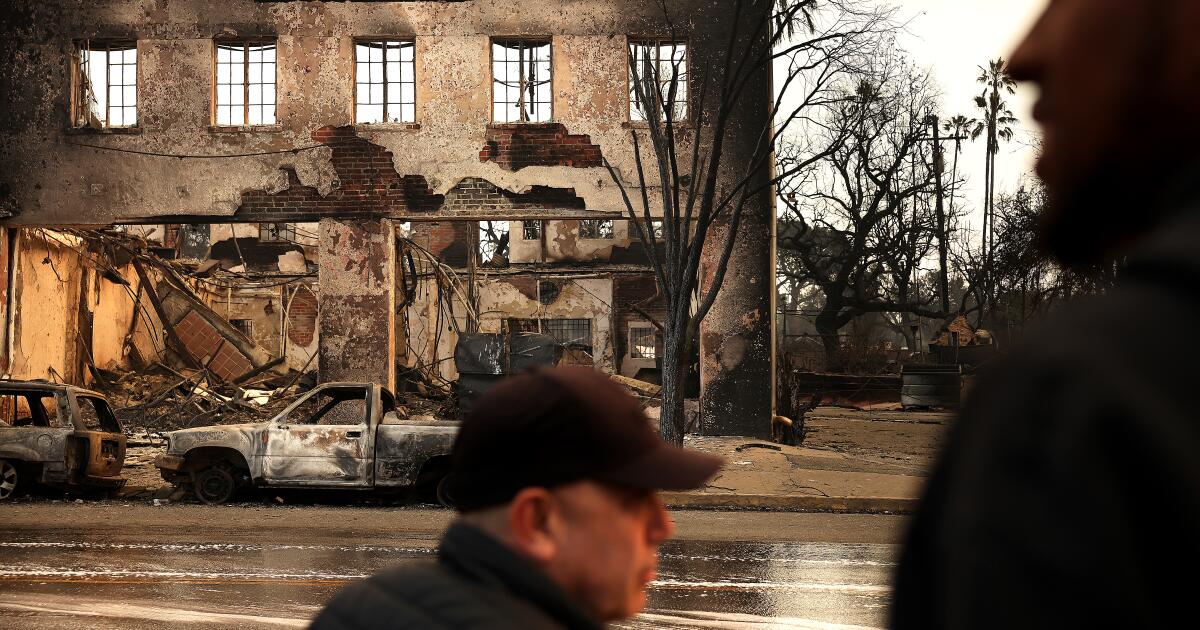
A week after the devastating Eaton fire tore through Altadena, killing 17, with 24 people missing as of this writing, and destroying more than 7,000 structures, cars were double-parked outside Knowhow Shop in Highland Park. People from all over Los Angeles, their faces obscured by masks due to raining ash, carried bags of toys and clothing to donate to Altadena Kindred, a fundraiser for Altadena children who have been displaced.
Just a month ago, one of the event’s organizers, Linda Hsiao, an Altadena ceramist and industrial designer, had helped host a similarly community-minded event in the foothill town. At the holiday craft fair at Plant Material, local artists shared handmade ceramics, knives, jewelry, hot sauce, embroidery and tie-dyed textiles. Adding to the family-friendly vibe, the St. Rita Cub Scout Pack showed up to sell mistletoe foraged from the nearby trails.
Bianca D’Amico, an artist who helped organize the December event — her son attended the preschool on Christmas Tree Lane that burned down — is proud of the hyperlocal market they created together in the former gas station, which amazingly survived, on Lincoln Avenue. “There is something deeply personal about our fellow vendors who pour so much of themselves into their work and are the spirit of Altadena,” D’Amico said, calling them a “creative, plant-loving, dog-friendly, kid-wrangling community of makers, artists and designers.”
In December, Altadena artists gathered at Plant Material on Lincoln Avenue to sell their handmade wares for the holidays. Many of them have lost their homes.
(Lisa Boone / Los Angeles Times)
Today, nearly all the vendors, including Hsiao; her husband, architect Kagan Taylor; and their two children, are homeless. “Our house is still standing, but it’s not safe for us to return,” she said of the smoke damage. “Right now, all I can think about is how we’ve lost our friends, our schools, our entire community.”
Hsiao’s shock was evident as she welcomed friends and accepted donations for Altadena Kindred. “This is where we were supposed to grow old,” she said haltingly. “This is where my son was supposed to ride his bike to school.”
With the loss of neighborhood schools, Hsiao is determined to find a way to create a place where all of the community’s children can gather.
But how do you create something like that when all of your neighbors are gone?
Located at the foot of the San Gabriel Mountains, the unincorporated community of more than 42,000 people has long been a refuge for artists, according to glass and metal artist Evan Chambers, who was born and raised in Altadena, just like his parents and grandparents.

“It’s always been a very accepting community of eccentric people of all types,” said Evan Chambers, pictured in his Pasadena studio.
(Evan Chambers)
“It’s always been a very accepting community of eccentric people of all types,” said Chambers, who purchased his home from the estate of the infamous compost czar Tim Dundon, also known as Zeke the Sheik.
He credits gallery owner Ben McGinty with creating a space for all artists at his Gallery at the End of the World, which survived the fire. “He accepted all of us,” Chambers said of the gallery, which has existed for more than two decades. “I had my first show there.”
Chambers, 44, grew up surrounded by river-rock walls and Arts and Crafts homes that have informed his aesthetic as a glassblower. He lost his home, including the ceramics studio he built for his wife, Caitlin, but is adamant that he will rebuild. “We’re going to rock this,” said the father of two. “With climate change, there is no safe place to go. All that matters is that you suffer with the people you want to help and be helped by. If you’re going to burn, you burn with your people.”
Born and raised in Los Angeles, ceramist Victoria Morris has lived in many neighborhoods throughout the city. But when she purchased a small midcentury house in Altadena a decade ago, the artist felt like she had found a home, personally and professionally. “I thought, ‘This is my last stop,’” Morris said.
The ceramist worked in a studio on Lake Avenue, two miles from her home, where she stored photographs and hard drives in the basement. Just a month ago, Morris hosted a holiday sale, and people packed the showroom to shop for her midcentury-inspired lamps and vases.
Today, it’s all gone.
Morris feels fortunate to have a second home in Ojai. Still, she grapples with the nightmare of evacuating on Jan. 7 and what she has lost. “My husband, Morgan [Bateman], said, ‘Grab your wedding ring, your passport, the animals, and get a jacket and some sturdy shoes.’ There was this beautiful vintage Japanese print that cost nothing, but I loved her so much. And as I was leaving, I thought, ‘Should I grab her?’ Something in my brain said no. I have a notebook where I write the formulas for all my work. It’s been my bible for the last 20 years. Did I grab that? No. Our hard drives? Gone.”
When Bateman finally managed to get access to their property, he found their home and beloved garden smoldering. “All our neighbors are gone,” he told her, rattled.


Brendan Sowersby and Annabel Inganni’s Altadena home, which burned down, was filled with custom furnishings and accessories designed by the couple. Their son Bird stands outside Lake Avenue’s Cafe de Leche, which is also gone. (Annabel Inganni)
On Wednesday, Wolfum textile designer Annabel Inganni was thinking about her 14-year-old son as she waited to pick up a free mattress and box spring at Living Spaces in Monrovia.
“He is in eighth grade, and his school in Pasadena has something like 67 families that have been impacted,” she said. “They are such a supportive community, but I’ve been burying my sadness just to get Bird back to school. And I know it’s not just us. It’s the entire town.”
Inganni lived in the Rubio Highlands neighborhood with her husband, furniture designer Brendan Sowersby of 100xbtr, their two dogs and three cats (all were evacuated safely). Their home was filled with custom furnishings the couple designed. Now, everything is gone. Many of her neighbors lived in their childhood homes. She describes the community as “heaven on earth.”
“Altadena is the most special, innovative, diverse, accepting, core-values town I’ve ever lived in,” she added. “The sense of community is strong. Now, we don’t even have a post office. I lost my home, studio and the archives of everything I’ve ever done. It’s a lot.”


Chris Maddox and Thomas Renaud lost their Altadena home in the Eaton fire. (Thomas Renaud)
After temporarily evacuating to Moorpark last Tuesday, Thomas Renaud returned to Altadena after learning his neighbors’ home was still standing.
“They wanted to go back and get some things, and I offered to drive them,” he said. Renaud was hopeful that the home he shared with his partner, Chris Maddox, and their dog, Van — who both got out safely — would also be left unscathed. But as he drove down Altadena Drive after dropping off his neighbors on Wednesday, all he could see was ash and fire. “When I rounded the corner to my street, I saw that the entire neighborhood was gone,” he said, “and I just lost it.”
When the LGS Studio ceramist and Maddox purchased their house about five years ago, they immediately fell in love with Altadena’s creative community.
“Many artists, musicians and writers live here, and we felt like we had our slice of that,” he said. “We put so much love into that house; it was a place for all our friends and family. It wasn’t just that we lost a house but a home.”
Although Renaud returned to work at his studio in Glassell Park this week, he said he is still in shock. “I don’t think I’ve slept more than one night in the past week,” he said. “Everything right now feels so overwhelming. All the support humbles us, but where do we begin?”
He said that, like many others without homes, finding semipermanent housing is a good start.

Ceramist Linda Hsiao with her children, Wawona, 3, and Saben, 5, in her Altadena home studio in November. Their home is still standing, but the family is unable to live there.
(Robert Hanashiro / For The Times)
As artists, it’s unsurprising that many are haunted by the things they left behind. For Morris, it’s a set of mugs by Los Angeles ceramists Kat and Roger, a quilt she made with her mother, a pencil drawing of her grandmother by her grandfather.
Chambers mentions a lamp by Pasadena artist Ashoke Chhabra and his great-uncle Charles Dockum’s mobile color projector, as well as Dockum’s correspondence with architect Frank Lloyd Wright.
The journals that Inganni had been keeping since she was 6, along with irreplaceable family mementos, are destroyed. “Brendan’s father passed away two years ago, and we had his ashes and photos, and they’re all gone,” she said. “That’s what gets him the most.”
When it came time to evacuate, Renaud grabbed one bag of clothes, the dog, the dog bed and his great-grandfather’s watch. “I didn’t think the fire would come this far,” he said. “My grandmother was a painter, and I had her original artwork. Those are the things I’m grieving for the most. I was thinking, ‘We’ll come back.’ But it’s family history that we can’t get back.”

“Everyone at the hardware store knew my name and would always offer my dog treats,” said artist Victoria Morris.
(Colleen Shalby / Los Angeles Times)
During the COVID-19 pandemic, Morris sought refuge in her studio. But now the businesses near her studio are gone, like Altadena Hardware on Mariposa Street, Grocery Outlet Bargain Market, Café de Leche and Steve’s Pets. Added Morris: “Everyone at the hardware store knew my name and would always offer my dog treats.”
Despite all they have lost, the artists acknowledge moments of grace. Friends have set up GoFundMe accounts to help them with their short-term needs. Chambers’ friends from preschool and elementary school built beds for him and his family. Morris has received notes that have brought her to tears.
“Two people sent me pictures of one of my vases and a bowl and told me they survived,” she said. “And it has brought them so much happiness. They offered them to me, and I told them no. I want them to keep them.”
Hsaio received a photo from a tequila maker in Altadena who went through his rubble and found one of her Tiki tumblers intact. “These people weren’t just my customers,” she said. “They were my community.”
Still, some are filled with trepidation about what comes next.
Renaud and Taylor have received text messages from strangers offering to purchase their damaged homes. “It’s still smoldering,” Renaud said in disbelief.
“It’s going to be the Wild West,” Inganni said. “Everyone I’ve spoken to is rebuilding. That’s what is percolating in the community. But I think people are very nervous about land grabs and worried about people who don’t have the financial capability to cover themselves.”
In the meantime, Morris just wants to get back to work. “I don’t want to miss being a part of rebuilding Altadena,” she said. “It may be a collective. It may be a store. There’s no way I can cut and run out of a place that’s so special.”
Inganni said Sowersby is considering building desks for the community and developing a fireproof home system.
Renaud, temporarily living in a friend’s accessory dwelling unit, or ADU, in Mount Washington, also wants to help.
“I needed to go and see our house because I needed to grieve,” he said. “If you don’t see what you’ve lost, it’s always a question mark in your mind. But now, I want to be a part of the rebuilding. I have a truck. I’m ready.”


Students walk on the Stanford University campus on March 14, 2019, in Stanford, Calif.
Ben Margot/AP
hide caption
toggle caption
Ben Margot/AP
When Theo Baker arrived at Stanford University a few years ago, he joined the student newspaper, following the path of his journalist parents, Peter Baker, a White House correspondent for The New York Times, and Susan Glasser, a writer for The New Yorker.
Through his reporting as a student journalist, he eventually broke a story about manipulated data in Stanford President Marc Tessier-Lavigne’s neuroscience research that helped lead to the university president’s resignation.
Theo Baker’s book, How to Rule the World: An Education in Power at Stanford University was released May 19. In it, Baker describes Stanford as a place where proximity to Silicon Valley gives rise to a parallel system of influence, recruitment and money, with investors looking to identify promising students almost as soon as they arrive on campus.
He told Morning Edition host Steve Inskeep there was “a sort of Stanford inside Stanford,” where elite students are drawn into an “alternate reality” of excess and access to cut corners.
In the interview, he discusses how Stanford is not just a university but also a pipeline where status and power can matter as much as ideas.
We reached out to Stanford University for comment and have not heard back.
Listen to the interview by clicking play on the blue box above.


The scoreboard shows the results of the women’s singles final match between Iga Swiatek of Poland and Amanda Anisimova of the U.S. at the Wimbledon Tennis Championships in London, Saturday, July 12, 2025.
Kirsty Wigglesworth/AP
hide caption
toggle caption
Kirsty Wigglesworth/AP
Fifteen points in tennis? Nice. Thirty, 40 — even better. Advantage — that sounds good. “Love” — that also must be great, right? Well, not quite.
As the French Open rolls on and Serena Williams has announced her return to the sport, maybe you’ve been paying a little more attention to tennis. The sport’s scoring system is notably distinct, and can sometimes be hard to grasp for newcomers. But even tennis aficionados might not know why, or how, “love” became the unmistakable callout for zero points. For this installment of NPR’s Word of the Week, we’re exploring how a word that signifies trailing behind got such a sweet name.
“Love” comes from the heart — or an egg?
It’s hard to pinpoint when the first tennis ball went over the net. Tennis is a derivative of lots of other sports, such as “jeu de paume,” a handball game played in France, said JT Buzanga, the collections manager at the International Tennis Hall of Fame museum.

But tennis became a patented, official sport in 1874, said Steve Flink, a journalist whose tennis coverage got him inducted into the International Tennis Hall of Fame. It has retained its unique, mysterious scoring system ever since.
“By and large, the original system has held up almost entirely,” Flink said.
The use of “love” goes back to the late 18th century, said Jesse Sheidlower, a lexicographer. But it was used earlier than that in card games such as whist and bridge. Before the term made its way to tennis, the sport favored plain old “nothing,” or “nil,” he said.
Why love in the first place, though? Historians don’t really know for sure, but there are a few theories.
The French could have something to do with it. Some historians believe “love” derives from “l’oeuf,” which means “the egg” in French. Because eggs are shaped like zeros, terms such as “goose egg” and “duck’s egg” have been used in other contexts to mean zero, Sheidlower said.
It’s also possible English speakers mispronounced l’oeuf as “love.” But Sheidlower isn’t convinced that’s the answer.
“It’s the French equivalent of an English expression. But since that expression doesn’t appear in French, the French word wouldn’t have been used,” he said.
To be sure, France has had a lot of influence on tennis culture, Buzanga said. For example, “deuce” or a game tied at 40 points, comes from the French word for “two”: “deux.” But he prefers another prominent theory: that “love” comes from the idiom “for the love of the game.” Even if a player hasn’t scored, it doesn’t matter, because their heart is in it. It’s the theory Sheidlower said is the most plausible, because the idiom was used by the English before tennis was popularized.

Another variation of the “love of the game” theory is that the word could have come from the Dutch “lof,” or “honor” — or the Latin “amare,” meaning “to love,” Flink said.
But if tennis’ “love” doesn’t come from a French word, the theory at least has a French sensibility.
“I think the ‘for the love of the game’ is kind of romantic,” Buzanga said.
“Love” probably isn’t going anywhere
Tennis used to be a sport of leisure. The style of play has changed a lot over the years; players are more athletic and competitive, for instance, Flink said. But the rules of the sport are more steadfast, he said.
“There’s this incredible, enduring respect for tradition in tennis,” he said. “Changes are not made easily.”
There has been one major change in modern history: the tie-break. Matches can go on and on because players have to score two consecutive points to break a deuce, or by two games to break a tied set. But the onset of television meant matches would have to get shorter if the sport wanted to capture a larger audience, Flink said.

Change even came for “love.” An alternative sprouted up in the 1970s, and is still used today: “bagel,” named for its zero shape, Sheidlower said. Novices may say “zero,” and insiders will understand what they mean, but they “will needle them about it,” Flink said.
But “love” still prevails.
“People kind of like it,” Flink said. “It’s different. Why say zero when you can say love?”
-

 Rhode Island2 minutes ago
Rhode Island DCYF discloses fatality of 18-year-old
-

 South-Carolina9 minutes ago
DECISION 2026: What to know about primary elections in South Carolina
-

 South Dakota12 minutes ago
USF becomes South Dakota’s first ‘cardiac ready’ campus
-

 Tennessee17 minutes ago
2026 Tennessee football preview: Grady Dangerfield
-

 Texas24 minutes ago
Fort Worth police launch drone program to speed response times
-
 Utah27 minutes ago
Got cargo? Utah Highway Patrol, DPS want you to secure your load before you drive
-

 Vermont32 minutes ago
Vermont barn-building ‘legend’ still visits every job site at 83
-

 Virginia39 minutes ago
West Virginia Vs. Cal Poly Predictions & Preview: 2026 NCAA Baseball Tournament Super Regional

