Politics
Even Without Its Most Famous Son, Carter’s Hometown Remains a Destination


Plains has no major hotel, a single small gas station and only a couple of restaurants, neither of which is usually open for dinner. Still, for the longest time, the tiny town had something that no other place in Georgia did: Jimmy Carter making it his home.
Especially as Mr. Carter withdrew from public life, the town has had years to prepare for life after him. But now that he is gone — Mr. Carter died last month at 100 — the town is hoping that its prospects as a tourism destination have not been buried along with its most famous son.
The optimism in Plains is grounded in the experience of other small towns known almost exclusively for their ties to a former president, which history has shown can still attract a crowd decades or centuries after that president has died.
Hyde Park, which borders the Hudson River in New York, has a steady stream of tourists coming to visit Franklin D. Roosevelt’s presidential library, home and gravesite. Tampico, Ill., has erected signs advertising itself as the birthplace of Ronald Reagan, trying to encourage people to take a brief detour on the way to Chicago to see the apartment where Mr. Reagan was born.
These towns and others are banking on the country’s enduring fascination with its presidents. particularly among the collection of history buffs who find the insights they can offer irresistible.
“I recognized that there was something about getting to experience what they experienced and getting to see the world through their eyes,” said Joe Faykosh, a history professor at Central Arizona College.
He has visited all the available presidential birthplaces and homes and has interned at the Rutherford B. Hayes Presidential Center in Fremont, Ohio. He met the Carters in 2017 after the former president taught Sunday school at Maranatha Baptist Church in Plains.
There is no guarantee that the appeal will last forever, though. More than 100 presidential sites in big cities and backcountry towns attract thousands of visitors each year, but interest can fade as a president drifts further into history. In recent years, the reappraisal of historical figures and the sins of the past that has toppled monuments and renamed schools has also affected the appeal of historic sites.
Charlottesville, Va., has seen a decline in visitors to Monticello, the plantation that once belonged to Thomas Jefferson. Tourism officials there have adapted, broadening what had once been a largely generous interpretation of Jefferson’s history to a more complex portrayal, including his role in upholding slavery as an institution. They have also tried to market Charlottesville as an emerging wine region — an identity Jefferson had also worked to establish around 250 years ago.
“Leisure trips have focused in the past on kind of historical discovery, and now people — because of their relationship with history, because of the politicizing of history — have a different relationship with the past,” said Courtney Cacatian, the executive director of the Charlottesville Albemarle Convention and Visitors Bureau. “A lot of people don’t seek it out as part of their vacation experience anymore.”
Plains isn’t so worried about the judgment of history. Many in the community believe that people’s perceptions of Mr. Carter’s legacy will continue to be favorable. Americans remain divided about his performance as president. But the week of funeral events highlighted a widespread admiration for his character and the extensive work he did after leaving office to protect democracy, fight ailments like Guinea worm disease and provide support to impoverished people worldwide.
Plains has become somewhat stuck in time — a capsule capturing the lives that Mr. Carter and his wife, Rosalynn, had lived there, even while they were still alive.
There are no drive-throughs or supermarkets. The Dollar General downtown has a brick facade that makes it look like it has been there forever. Plains High School no longer has students — it is a site maintained by the National Park Service, just like the Carter family farm outside town and even the Carters’s home off Main Street.
It is a transformation the Carters have been deeply involved in. They created an exhibition at the high school about segregation. Visitors walking around the president’s boyhood home and farm can hear recordings of Mr. Carter sharing memories of his childhood, such as visiting his Black neighbors who lived in a ramshackle home nearby and the absolute joy he felt when he received a pony for Christmas.
“There’s just so many things that President Carter had his hands in,” said AB Jackson, a councilwoman in Plains.
Sarah Wollenweber and her 17-year-old son, London, said that the amount of documentation of Mr. Carter’s life and where he grew up set Plains apart from other presidential sites they had visited across the country.
“He’s one of the last great presidents we’ve seen who is genuine and actually kind, so it’s been really great to experience this,” London said. He and his mother drove 12 hours from Bloomington, Ill., to see Mr. Carter’s coffin being carried through Plains last week.
“They dedicated the whole town to him and his wife,” he added.
Many residents believe the Carters were keenly aware of how much their presence attracted tourists and positively impacted the town’s economy.
From 2014 to 2019, when Mr. Carter was still routinely teaching Sunday school at Maranatha Baptist Church, at least 50,000 tourists a year came to Plains. Beginning in 2020, the number of sightseers dropped significantly, as the pandemic stymied tourism and the Carters’ health declined. But visitorship picked up again last year, with approximately 45,000 people coming through the town. That does not include the hundreds of people per day who descended on Plains after Mr. Carter died on Dec. 29.
Over many years, Mr. Carter encouraged improvements to increase the appeal for tourists. He founded the Friends of Jimmy Carter, a nonprofit that owns the Plains Historic Inn, with its seven suites, as well as the antique mall below it. He was also instrumental in opening one of the town’s two restaurants: the Buffalo Café, which serves cheeseburgers, salads and pimento cheese sandwiches. And he convinced legislators to fund a train that would drop visitors off at his former campaign headquarters.
“He wanted to make sure that the town stays viable,” said Kim Carter Fuller, the president’s niece. “Whatever he could do within reason, he did.”
But Plains could only accommodate so much. The town is less than one square mile in size and has little public land to sell for development. There is also tension between wanting to attract more tourists and not wanting to disturb the town’s traditional way of life.
“We don’t really want to change Plains,” said Ellen Harris, a councilwoman. “That’s what makes us unique.”
Locals were grateful that the Carters chose to be buried at their home instead of at their presidential library in Atlanta, a decision they hope will help to maintain a steady stream of visitors. In the coming months, the gravesites of the Carters will be opened to the public. The modest ranch home the president and the first lady built in 1961 — where they raised their children and returned to after leaving the White House — will be made accessible to the public for the first time shortly after.
Events with historical ties — like the city’s yearly peanut festival in September that pays homage to Mr. Carter’s roots as a farmer — will continue to be a draw, some say. There are also newer attractions. The latest, Apt. 9A, which opened for private tours in October, is the government-subsidized home Mr. Carter moved his wife and three sons into after his father’s death in 1953.
After a 2001 walk-through with Ms. Carter in the apartment, Annette Wise, who led the project, received donations and searched through thrift stores to find items to recreate the family’s modest furnishings at a time when they had almost no income. Paint chips in a closet helped her to track down the precise shade of dark green the Carters had painted their living room and later used in campaign signs.
Ms. Wise said she believes all the time and effort will ultimately be worthwhile.
“Plains is headed in the right direction,” said Ms. Wise, who is a member of the Plains Historical Preservation Trust and a founder and the president of the Rosalynn Carter Butterfly Trail. “They’ve left us big shoes to fill. But they’ve given us plenty of time to learn what to do.”
Rick Rojas contributed reporting. Kirsten Noyes contributed research.



new video loaded: Erika Kirk’s Message for Women at Turning Point USA

By Vivian Yee, Christina Shaman, Lauren Pruitt, James Surdam and Melanie Bencosme
June 18, 2026

NEWYou can now listen to Fox News articles!
FIRST ON FOX: Americans are nearly evenly split between favoring Iranian regime change and a negotiated U.S. settlement with Iran, according to a new survey.
Some 39% of respondents favor a negotiated settlement where Iran’s current government remains in place, with verifiable limits on its nuclear and missile programs, according to the findings of the Reagan Institute Summer Survey, while 36% favor replacing Iran’s current government with one more favorable to the U.S.
Another 16% favor a weakened regime where the current government stays in place but is significantly diminished militarily and economically, and 8% responded that they don’t know.
The findings underscore the political challenge facing President Donald Trump as his administration pursues a newly signed memorandum of understanding with Iran. While the agreement seeks to curb Iran’s nuclear ambitions through negotiations, Americans remain divided over the ultimate objective of U.S. policy toward the Islamic Republic.
Americans are nearly evenly split between favoring Iranian regime change and a negotiated U.S. settlement with Iran, according to a new survey. (Mandel NGAN / AFP via Getty Images)
AMERICANS AGREE WITH TRUMP THAT IRAN POSES THREAT TO UNITED STATES: POLL
Republicans who responded to the survey favored replacing Iran’s government by a 2-to-1 margin over a diplomatic deal.
Republicans were far more likely than Democrats to favor a more aggressive outcome in Iran. Half of Republican respondents said they would prefer to see Iran’s current government replaced with one more favorable to the United States, compared to 25% who said they would favor a negotiated settlement that leaves the regime in place in exchange for verifiable limits on its nuclear and missile programs.
The findings were nearly identical among self-identified MAGA Republicans, 51% of whom favored regime change while 25% backed a negotiated settlement.
SHARP PARTISAN DIVIDE EMERGES OVER IRAN STRIKE, TRUMP’S STRATEGY: POLLS
Democrats, meanwhile, largely favored diplomacy. A majority, 52%, said they would prefer a negotiated settlement with Iran’s current government, while 25% favored regime change. Another 14% favored leaving the regime in place but significantly weakened militarily and economically.
The Reagan Institute Summer Survey was conducted May 26 through June 3 among 1,555 respondents nationwide and carries a margin of error of plus or minus 2.5 percentage points. The survey used a mixed-mode methodology that included live telephone interviews, an online panel and text-to-web responses.
Smoke rises over Tehran following an explosion amid ongoing U.S. and Israeli military strikes on Iranian targets on March 2, 2026. (Majid Saeedi/Getty Images)
The findings underscore the political challenge facing President Donald Trump as his administration pursues a newly signed memorandum of understanding with Iran. (Hamid FOROUTAN / ISNA / AFP via Getty Images)
Republicans were far more likely than Democrats to favor a more aggressive outcome in Iran. (Pool via WANA/Reuters)
To better reflect the U.S. population, the results were weighted using demographic benchmarks from the U.S. Census Bureau’s 2023 American Community Survey, including age, gender, race, region and education levels. The poll also included an oversample of 331 MAGA Republicans under age 30, a group with a margin of error of plus or minus 5 percentage points.
The Reagan Institute is a Washington-based policy organization that advocates the Reagan foreign-policy tradition of “peace through strength” and sustained American leadership abroad.
The findings come as Trump has defended a newly signed memorandum of understanding with Iran as a way to reduce tensions and create a pathway toward a broader agreement addressing Tehran’s nuclear program.
The memorandum establishes a 60-day negotiating period during which the United States and Iran will attempt to reach a more comprehensive deal. The agreement also includes provisions aimed at restoring commercial shipping through the Strait of Hormuz and provides limited sanctions waivers tied to continued negotiations. Several of the most contentious issues, including the long-term future of Iran’s nuclear program, are expected to be addressed in subsequent talks.
Trump has described the arrangement as a means of avoiding a wider conflict while pursuing what he called a “great settlement” with Tehran. He has also argued that the agreement could help stabilize energy markets by reopening the Strait of Hormuz, a critical global shipping route, while creating an opportunity to negotiate additional restrictions on Iran’s nuclear activities.
CLICK HERE TO DOWNLOAD THE FOX NEWS APP
The president added that he agreed to a settlement to avoid “economic catastrophe.”
“I didn’t want to see economic catastrophe. If you kept this going, that could have happened,” he told reporters at the G7 Summit in France.
WASHINGTON — The White House pushed back Thursday against growing bipartisan criticism of a negotiated settlement to the war with Iran, arguing its concessions to the Islamic Republic were contingent on its conduct and essential to securing peace.
The administration’s defensive posture came as details of the framework agreement, known as a memorandum of understanding, were finally shared with the public, revealing a raft of compromises with Tehran long opposed by Republicans.
Vice President JD Vance, who helped negotiate the deal, told reporters Thursday that the deal was structured to reward Iran for good behavior. But the text of the agreement suggests otherwise.
The Trump administration agreed to release billions of dollars in Iranian assets that were frozen and restricted by the United States “upon the implementation” of the memorandum — before any further actions are taken or additional negotiations begin. The president will issue sanctions waivers on Iranian oil, allowing Tehran to resume trading its most valuable export and breaking with decades of policy. And to facilitate that trade, boosting Tehran’s revenues, Trump agreed to immediately end a U.S. naval blockade of Iranian ports.
Still more concessions were offered to the Iranians, including a commitment by the U.S. administration to establish a fund of “at least $300 billion for the reconstruction and economic development of the Islamic Republic” — in effect providing reparations for the war Trump started.
“All required licenses, waivers and permissions needed for the relevant financial transactions will be granted by the United States of America,” the memorandum reads.
Taken together, the document reads as a stunning reversal of U.S. policy toward Iran after decades of concern across administrations in Washington — including throughout Trump’s two terms — that the Islamic Republic represents the nation’s greatest security threats as the world’s largest state sponsor of terrorism.
Criticism from Republican senators, in particular, has been sharp and swift.
Sen. Roger Wicker (R-Miss.), chairman of the Senate Armed Services Committee, said the $300-billion fund “would make Iran’s payoff under President Obama’s 2015 deal look like a pittance by comparison.” And Sen. Ted Cruz (R-Texas) accused the Trump administration of giving Iran money it would use to kill Americans.
“History demonstrates that giving billions of dollars to theocratic lunatics who want to murder us is an exceptionally bad idea, and I think, unfortunately, the president is receiving some really bad advice on this deal,” Cruz said. “I don’t want to see us send a penny to the ayatollah. And I hope that we don’t.”
The Obama-era deal, known as the Joint Comprehensive Plan of Action, included structured sanctions relief for Iran in exchange for concrete and verifiable steps by Tehran to dismantle much of its nuclear program — a framework that Republicans broadly criticized at the time.
By contrast, Trump’s agreement commits the United States to pursuing economic relief for Iran while providing no clarity about the future of Iran’s nuclear program — the very issue Trump cited as the rationale for launching the war.
The memorandum includes a pledge by Iran to never purchase or construct nuclear weapons — a vow the Islamic Republic has made multiple times before, including by signing the Nuclear Non-Proliferation Treaty, in a religious edict issued by the late supreme leader and in the Obama-era nuclear accord.
Vice President JD Vance speaks to reporters at the White House on June 18, 2026.
(Manuel Balce Ceneta / Associated Press)
Detailed negotiations over Iran’s nuclear program — including whether Tehran could continue domestic uranium enrichment, at what level, and under what monitoring regime — were left for another day.
For more than a decade, the U.S. intelligence community has assessed that Iran sought a threshold nuclear capability, securing the strategic advantages of a nuclear power without incurring the costs of openly pursuing a bomb.
The agreement does include a commitment by Iran to do its “best” to bring commercial shipping traffic through the Strait of Hormuz, a vital international waterway, back to prewar levels. But critics of the president said he had to make deep, historic concessions just to secure a status quo ante upended by the war he started. And in the document, Tehran agreed to refrain from imposing a toll on ships transiting the strait for only a 60-day period.
“Unless you were homeschooled by a day drinker, no one’s confident that Iran is going to do anything,” Sen. John Kennedy, a Republican from Louisiana, told reporters this week.
Sen. Bill Cassidy, Kennedy’s Republican counterpart from Louisiana, called the deal “the worst foreign policy blunder in decades” that would have President Reagan “rolling over in his grave.”
“Iran’s nuclear ambitions were not curbed, and they have learned that threatening the Strait of Hormuz works and will undoubtedly leverage it in the future. Now, Iran gets to build brand-new infrastructure under this deal,” Cassidy said.
“Before the war, the strait was open, Iran was being crushed by sanctions, and 13 service members were still alive,” he added. “Now, 13 Americans are dead, families have paid billions at the pump, sanctions will be lifted, and the bombing has stopped.”
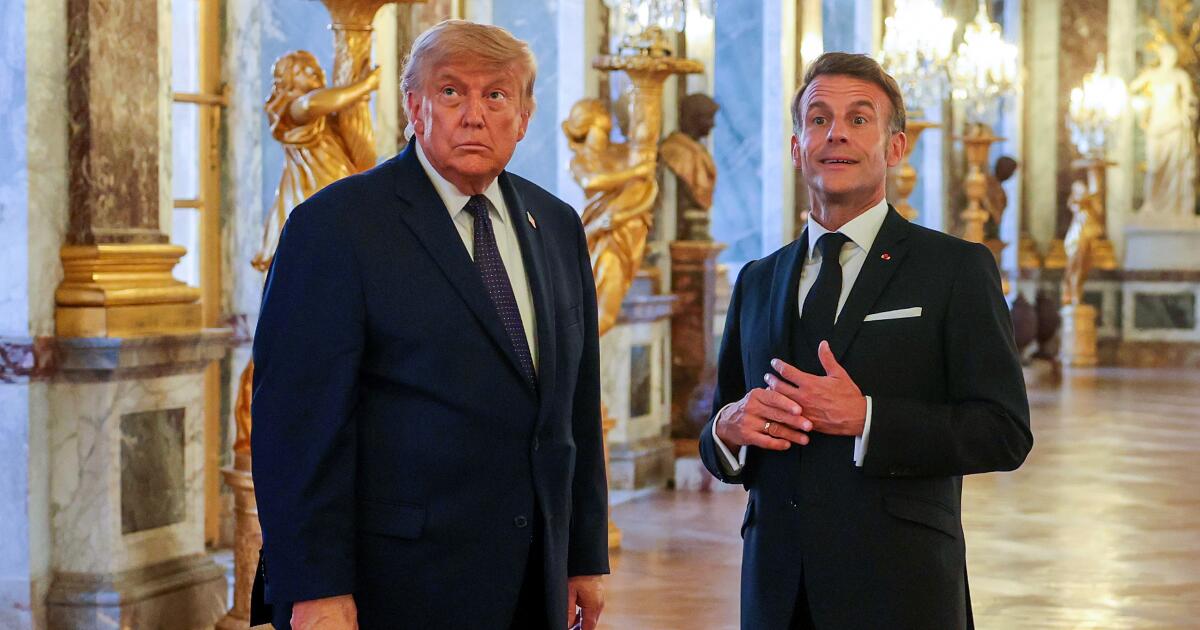
Despite mounting criticism, Trump put his signature to the memorandum on Wednesday night while attending a dinner with the French president in Versailles, a palace infamous for hosting a treaty signing that disgraced Germany at the end of the First World War.
He defended the agreement while in Europe and suggested further concessions might be forthcoming, including recognition of Iran’s claimed right to enrich uranium and a new willingness to tolerate its continued ballistic missile development — another program that Trump had vowed to eliminate as a central war aim.
“He took America to war — killing 13 soldiers, thousands of Iranian civilians and costing taxpayers $60 billion — to get rid of Iran’s missile program. And now that he’s lost the war, he pretends like it’s no big deal,” said Sen. Chris Murphy, a Democrat from Connecticut.
“Just unforgivable,” he added. “What a charlatan.”
-

 Washington15 seconds ago
Washington State University Vancouver faculty, staff anxiously await details of 15% budget cuts
-

 Wisconsin7 minutes ago
President of Wisconsin’s largest mosque released from ICE custody
-

 West Virginia10 minutes ago
Community Catalyst Grant applications are open through West Virginia First Foundation through June 30 – WV MetroNews
-
 Wyoming15 minutes ago
250 Portraits self-portrait exhibition now on display throughout downtown Jackson
-

 Crypto22 minutes ago
Crypto’s Courtside Takeover: Digital Assets in Pro Tennis
-

 Finance25 minutes ago
Consumer confidence plunges among younger adults
-

 Fitness30 minutes ago
Kylie Minogue, 58, shares how she stays fit without a strict exercise routine – ‘I don’t really work out’
-

 Movie Reviews40 minutes ago
Movie Review: ‘Leviticus’ makes a demon out of desire in an auspicious debut for Adrian Chiarella – Sentinel Colorado

