News
What happens during a presidential funeral and a look back at past funerals


(Original Caption) Billy Graham delivers the sermon at the graveside services for former President Lyndon B. Johnson at the family cemetery on the LBJ Ranch.
ATLANTA – A presidential funeral in the United States is a carefully orchestrated event, blending solemn traditions and heartfelt tributes. It spans several days and includes multiple stages, giving the nation time to mourn and honor its former leader. Here’s an easy-to-follow breakdown of what happens during these historic occasions:
1. The Initial Announcement
When a former president passes away, the sitting president issues an official proclamation to announce their death. Flags are lowered to half-staff across the country for 30 days as a sign of national mourning. The Department of Defense is tasked with organizing a state funeral to honor the late president’s service.
2. Local Ceremonies
Before heading to Washington, D.C., there are usually private ceremonies in the president’s home state or city.
- Private Service: Close family and friends gather for a quiet memorial.
- Lying in Repose: The president’s body is placed at a significant location, such as a presidential library, where local residents can pay their respects.
3. Washington, D.C. Ceremonies
The capital plays a major role in the state funeral. Here’s what happens:
- Arrival in Washington: The president’s remains are flown to D.C., often on a special aircraft designated for this purpose.
- Procession Through the City: The casket is transported with military honors, often by a horse-drawn caisson. This symbolic journey reflects the nation’s respect.
- Lying in State: The casket is placed in the Capitol Rotunda, where the public can pay their respects. A special platform called the Lincoln Catafalque, first used for Abraham Lincoln, supports the casket.
- State Funeral Service: A formal ceremony is held, usually at the Washington National Cathedral, featuring eulogies from notable figures like current and former presidents, hymns, and prayers.
4. The Final Goodbye and Burial
After the ceremonies in Washington, the president’s remains are returned to their chosen burial site, often their hometown or a location of personal significance.
- Private Funeral: A smaller, more intimate service is held for family and close friends.
- Interment: The president is laid to rest, often with military honors such as a 21-gun salute or a flyover.
Ceremonial Highlights
Throughout the process, several traditions make these funerals uniquely presidential:
- Military Honors: Elite honor guards and military bands participate, reflecting the president’s role as commander-in-chief.
- 21-Gun Salute: This traditional military tribute honors the late president’s service.
- Eulogies: Delivered by prominent leaders, these heartfelt tributes celebrate the president’s life and legacy.
A Time for National Mourning
The entire process, from the initial announcement to the burial, typically lasts 7 to 10 days. It allows Americans to grieve collectively, remember the president’s contributions, and reflect on their impact on the nation.
RELATED: PHOTOS: Ceremonies begin for former President Jimmy Carter | 1924-2024
A Look at the Last 8 Presidents

Joint services military honor guards carry the casket of former U.S. President George H.W. Bush to a Union Pacific train in Spring, Texas, U.S., on Thursday, Dec. 6, 2018. Bush, the longest-living president in U.S. history at age 94, died at his home
George H.W. Bush (41st President)
- Died: Nov. 30, 2018
- Funeral: A state funeral spanned several days in Texas and Washington, D.C. Bush lay in state at the U.S. Capitol before a service at the National Cathedral. Attendees included President Trump, First Lady Melania Trump, former presidents, first ladies, and foreign dignitaries.
- Highlights: His remains were transported via a train painted in an Air Force One color scheme, reflecting his love of trains.
- Burial Site: George H.W. Bush Presidential Library, College Station, Texas, alongside his wife, Barbara, and daughter Robin.
- Estimated Cost: $500,000–$2 million
washington, UNITED STATES: Betty Ford pauses at the flag draped casket of her husband and former US president Gerald R. Ford, as he lies in state in the Rotunda of the US Capitol Building in Washington DC, 01 January 2007. Ford died in California on
Gerald Ford (38th President)
- Died: Dec. 26, 2006
- Funeral: Ceremonies took place in California, Washington, D.C., and Michigan. Services included a memorial at St. Margaret’s Episcopal Church, lying in state at the Capitol, and a funeral at the National Cathedral.
- Highlights: Ford’s body lay in repose at his presidential museum in Michigan, where 67,000 people paid their respects.
- Burial Site: Gerald R. Ford Presidential Museum, Grand Rapids, Michigan, alongside his wife, Betty Ford.
- Estimated Cost: $7 million
TOPSHOT – Former US First Lady Nancy Reagan (C), escorted by Maj. Gen. Galen B. Jackman, watches 09 June, 2004, as the guard honor carries the casket bearing the remains of her husband former US president Ronald Reagan to the presidential airplane fo
Ronald Reagan (40th President)
- Died: June 5, 2004
- Funeral: A week-long state funeral included services in California, Washington, D.C., and a private burial at the Reagan Library. Reagan lay in repose for two days at the library and later in state at the Capitol, where 100,000 mourners visited.
- Highlights: A sunset burial service marked the return of large-scale presidential state funerals.
- Burial Site: Ronald Reagan Presidential Library, Simi Valley, California.
- Estimated Cost: $400 million (including extensive security costs).
Flowers for Richard Nixon’s Funeral (Photo by �� Steve Starr/CORBIS/Corbis via Getty Images)
Richard Nixon (37th President)
- Died: April 22, 1994
- Funeral: A private service held at the Nixon Presidential Library in California, attended by world leaders and five living presidents.
- Highlights: Nixon lay in repose at the library, where 50,000 people waited up to 18 hours to pay their respects.
- Burial Site: Nixon Library, Yorba Linda, California, alongside his wife, Pat.
- Estimated Cost: Approximately $200,000
Honor guard bearing former Pres. Richard Nixon’s flag-draped coffin during funeral service (Rev. Billy Graham at far L). (Photo by Diana Walker/Getty Images)
Lyndon B. Johnson (36th President)
- Died: Jan. 22, 1973
- Funeral: Services included ceremonies in Washington, D.C., and Texas. Johnson lay in state at the Capitol and was later buried with military honors on his ranch.
- Highlights: A Texas National Guard Unit fired a 21-gun salute during his burial.
- Burial Site: Johnson Family Cemetery, Stonewall, Texas, alongside Lady Bird Johnson.
- Estimated Cost: Likely under $500,000
John F. Kennedy (35th President)
- Died: Nov. 22, 1963
- Funeral: A three-day event following his assassination. Kennedy lay in repose at the White House, then in state at the Capitol, before a funeral Mass at St. Matthew’s Cathedral.
- Highlights: Jacqueline Kennedy lit the eternal flame at his Arlington gravesite. The funeral was the first to be televised.
- Burial Site: Arlington National Cemetery, Arlington, Virginia.
- Estimated Cost: Roughly $4 million (adjusted for inflation).
Funeral of Harry Truman, miscellaneous views of casket as it lies in state of Truman Library. (Photo by UPI Color/Bettmann Archive/Getty Images)
Harry S. Truman (33rd President)
- Died: Dec. 26, 1972
- Funeral: Truman requested a modest funeral. Services included a private memorial at the Truman Library and a public memorial at the National Cathedral.
- Highlights: His body passed by the Truman home, where Bess Truman watched from a window.
- Burial Site: Truman Library, Independence, Missouri, alongside his wife, Bess.
- Estimated Cost: Likely under $100,000
The late President Franklin Delano Roosevelt is laid to rest in the rose garden of his Hyde Park estate. Mourners and military officers gather to pay their last respects. | Location: Hyde Park, New York, USA.
Franklin D. Roosevelt (32nd President)
- Died: April 12, 1945
- Funeral: Services were held at the White House and St. John’s Episcopal Church before his burial at Hyde Park.
- Highlights: Thousands lined the train route from Warm Springs, Georgia, to New York. The ceremonies were scaled down due to WWII.
- Burial Site: Springwood Estate, Hyde Park, New York, alongside Eleanor Roosevelt.
- Estimated Cost: Unknown
Costs for Future Presidential Funerals
Modern presidential funerals have become increasingly expensive due to heightened security and larger public ceremonies. Estimated costs for future funerals could reach $8–10 million or more.
Presidents Still Living
- Joe Biden (46th President)
- Donald Trump (45th President)
- Barack Obama (44th President)
- George W. Bush (43rd President)
- Bill Clinton (42nd President)



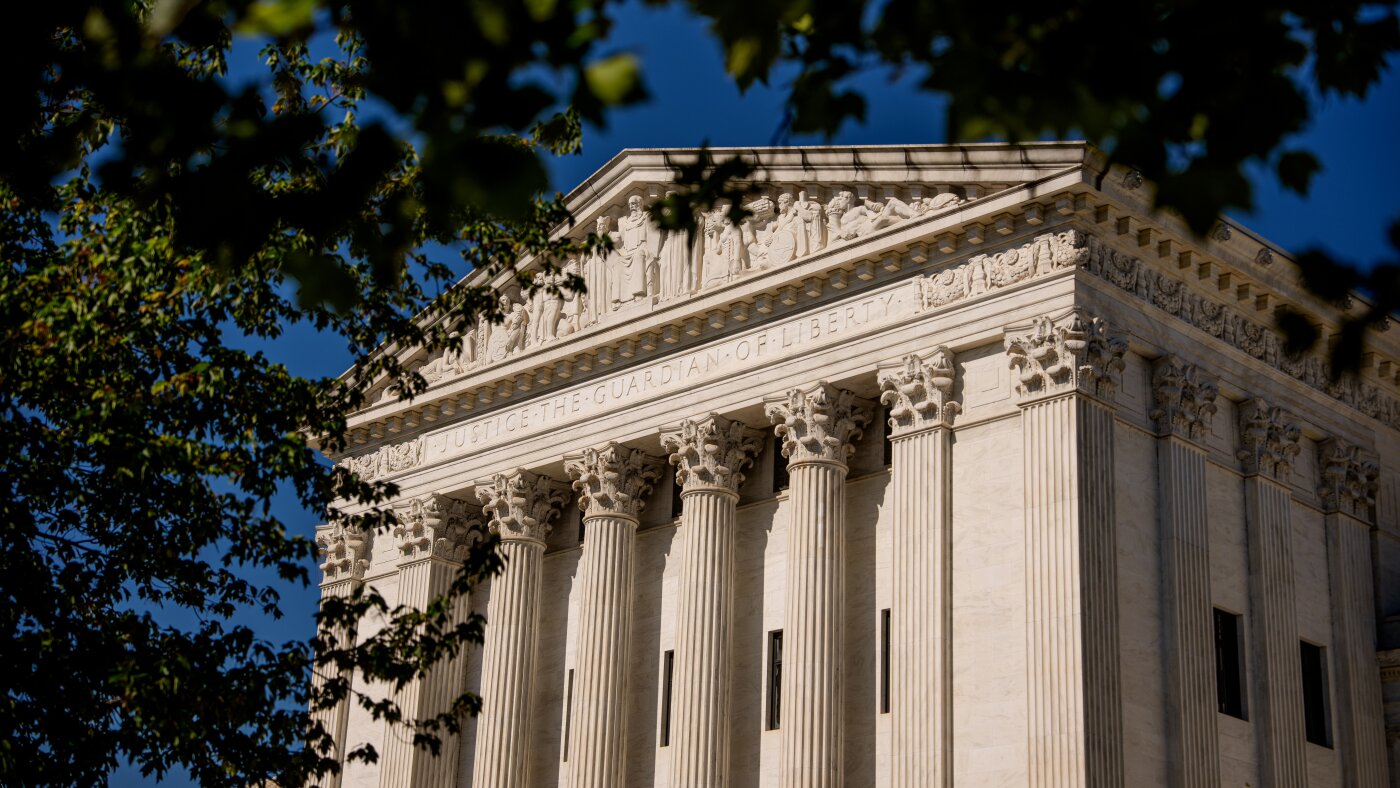
The U.S. Supreme Court
Andrew Harnik/Getty Images
hide caption
toggle caption
Andrew Harnik/Getty Images
The U.S. Supreme Court refused Friday to allow Virginia to use a new congressional map that favored Democrats in all but one of the state’s U.S. House seats. The map was a key part of Democrats’ effort to counter the Republican redistricting wave set off by President Trump.
The new map was drawn by Democrats and approved by Virginia voters in an April referendum. But on May 8, the Supreme Court of Virginia in a 4-to-3 vote declared the referendum, and by extension the new map, null and void because lawmakers failed to follow the proper procedures to get the issue on the ballot, violating the state constitution.
Virginia Democrats and the state’s attorney general then appealed to the U.S. Supreme Court, seeking to put into effect the map approved by the voters, which yields four more likely Democratic congressional seats. In their emergency application, they argued the Virginia Supreme Court was “deeply mistaken” in its decision on “critical issues of federal law with profound practical importance to the Nation.” Further, they asserted the decision “overrode the will of the people” by ordering Virginia to “conduct its election with the congressional districts that the people rejected.”
Republican legislators countered that it would be improper for the U.S. Supreme Court to wade into a purely state law controversy — especially since the Democrats had not raised any federal claims in the lower court.
Ultimately, the U.S. Supreme Court sided with Republicans without explanation leaving in place the state court ruling that voided the Democratic-friendly maps.
The court’s decision not to intervene was its latest in emergency requests for intervention on redistricting issues. In December, the high court OK’d Texas using a gerrymandered map that could help the GOP win five more seats in the U.S. House. In February, the court allowed California to use a voter-approved, Democratic-friendly map, adopted to offset Texas’s map. Then in March, the U.S. Supreme Court blocked the redrawing of a New York map expected to flip a Republican congressional district Democratic.
And perhaps most importantly, in April, the high court ruled that a Louisiana congressional map was a racial gerrymander and must be redrawn. That decision immediately set off a flurry of redistricting efforts, particularly in the South, where Republican legislators immediately began redrawing congressional maps to eliminate long established majority Black and Hispanic districts.

An explosion and fire drew a large emergency response on Friday to a lumber mill in the Midcoast region of Maine, officials said.
The State Police and fire marshal’s investigators responded to Robbins Lumber in Searsmont, about 72 miles northeast of Portland, said Shannon Moss, a spokeswoman for the Maine Department of Public Safety.
Mike Larrivee, the director of the Waldo County Regional Communications Center, said the number of victims was unknown, cautioning that “the information we’re getting from the scene is very vague.”
“We’ve sent every resource in the county to that area, plus surrounding counties,” he said.
Footage from the scene shared by WABI-TV showed flames burning through the roof of a large structure as heavy, dark smoke billowed skyward.
The Associated Press reported that at least five people were injured, and that county officials were considering the incident a “mass casualty event.”
Catherine Robbins-Halsted, an owner and vice president at Robbins Lumber, told reporters at the scene that all of the company’s employees had been accounted for.
Gov. Janet T. Mills of Maine said on social media that she had been briefed on the situation and urged people to avoid the area.
“I ask Maine people to join me in keeping all those affected in their thoughts,” she said.
Representative Jared Golden, Democrat of Maine, said on social media that he was aware of the fire and explosion.
“As my team and I seek out more information, I am praying for the safety and well-being of first responders and everyone else on-site,” he said.
This is a developing story. Check back for updates.

Crime scene tape surrounds a bicycle in front of St. Lukes Episcopal Church in Atlanta on May 14, 2026. (SKYFOX 5)
ATLANTA – The woman stabbed to death on the Beltline has been identified as 23-year-old Alyssa Paige, according to the Fulton County Medical Examiner.
The backstory:
Paige was killed by a 21-year-old man Thursday afternoon while she was on the Beltline. Officials confirmed to FOX 5 that the stabbing happened near the 1700 block of Flagler Avenue NE.
Atlanta Police Chief Darin Schierbaum said the department was alerted around 12:10 p.m. that a woman had been stabbed just north of the Montgomery Ferry Drive overpass. She was rushed to Grady Memorial Hospital where she later died. Another person was also stabbed during the incident, but their condition remains unknown.
According to officers, the man responsible attacked a U.S. Postal worker prior to the stabbing before getting away on a bike. He then used that bike to flee the scene of the stabbing as well.
The suspect was arrested near St. Luke’s Episcopal Church on Peachtree Street in Midtown around 5:25 p.m.
What we don’t know:
While officials haven’t released an official motive, they noted the man may have been suffering a mental health crisis.
The Source: Information in this article came from the Fulton County Medical Examiner’s Office and previous FOX 5 reporting.
-

 Sports5 minutes ago
Justin Thomas, Keegan Bradley get heated with official over pace of play at PGA Championship
-

 Technology11 minutes ago
AI data centers may soon ride ocean waves
-
 Business17 minutes ago
Why the infuriatingly catchy Kars4Kids jingle got yanked off the air in California
-
 Entertainment23 minutes ago
Filmmaker Brian Lindstrom, known for underdog documentaries, dies at 65
-
 Lifestyle28 minutes ago
How to have the best Sunday in L.A, according to Vivica A. Fox
-
 Politics35 minutes ago
Supreme Court turns away Virginia Democrats seeking to reinstate new voting map
-
 Sports47 minutes ago
Sparks hold off late Toronto Tempo rally, earn first win of season
-

 World59 minutes ago
Lebanon, Israel extend nominal truce; Iran ready for ‘serious’ US talks