Politics
Newsom aims to limit unhealthy food in California, getting ahead of Trump administration and RFK Jr.

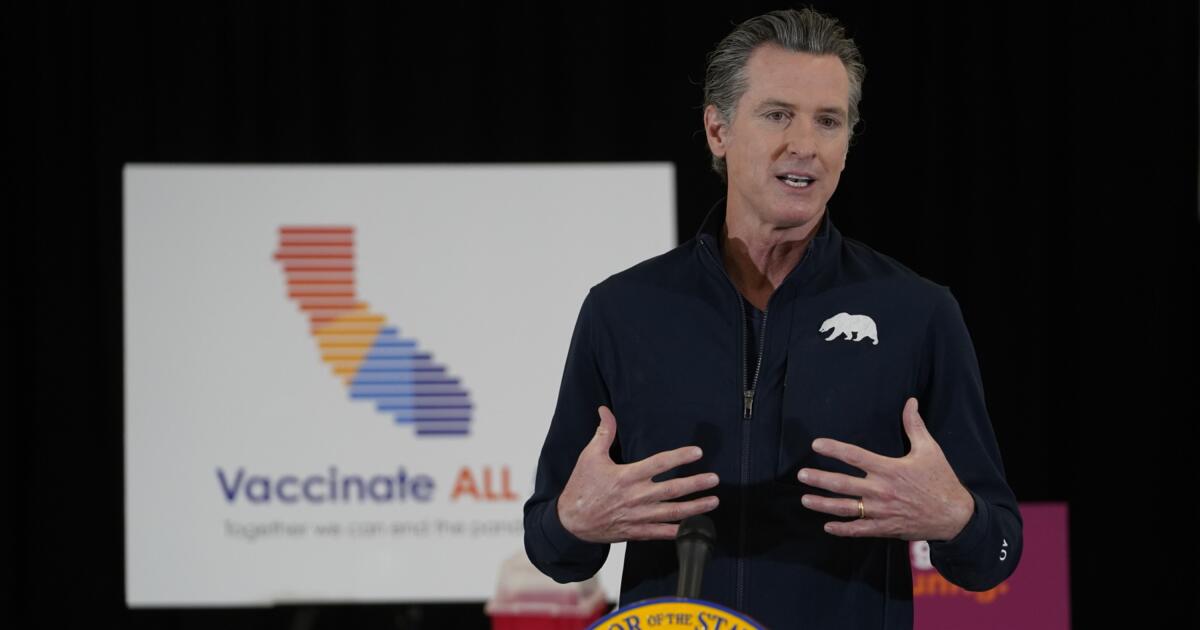
Gov. Gavin Newsom issued an executive order on Friday attempting to limit access to ultra-processed foods, a directive he cast as a continuation of California’s “nation leading” nutrition and health standards.
“The food we eat shouldn’t make us sick with disease or lead to lifelong consequences,” Newsom said in a statement. “California has been a leader for years in creating healthy and delicious school meals, and removing harmful ingredients and chemicals from food. We’re going to work with the industry, consumers and experts to crack down on ultra-processed foods, and create a healthier future for every Californian.”
The order directs state agencies to develop recommendations to limit the health harms of ultra-processed foods and calls for proposals to reduce the purchase of candy, soda and other unhealthy foods made with synthetic dyes or additives by recipients of government food benefits.
The move comes weeks before President-elect Donald Trump is sworn into office for his second term, with iconoclastic former environmental lawyer Robert F. Kennedy Jr. as his nominee for secretary of Health and Human Services. Kennedy still needs to be confirmed by the Senate, but he has been a vocal critic of ultra-processed foods and promised to radically overhaul the country’s food system. Food dyes, pasteurized milk and seed oils are among the common items he has criticized, sometimes making health claims that are not backed up by science.
Though Newsom didn’t mention Kennedy, the Democratic governor of California is planting a preemptive flag around the issue and signaling his refusal to concede the terrain to the incoming Trump administration. His executive order included a long list of steps the state has taken to improve nutrition.
Processed foods are foods altered from their natural form, like frozen vegetables, whereas ultra — or highly —processed foods are foods that have been significantly altered from their natural state, like packaged chips or soft drinks. Ultra-processed foods make up the vast majority of the U.S. food supply, research shows.
The Golden State has indeed been a national leader in banning food additives, with Newsom signing a 2023 bill that made California the first state in the nation to prohibit four additives found in popular cereal, soda, candy and drinks.
The California Food Safety Act was colloquially referred to as the “Skittles ban” before its passage because an earlier version of the bill also targeted titanium dioxide, which is used to color Skittles and several other popular candies. But the final law was amended to remove reference to the substance, solely banning brominated vegetable oil, potassium bromate, propylparaben and red dye No. 3.
Last year, Newsom signed a separate bill into law that bars snack foods containing a number of synthetic food dyes from California public schools. That law will prevent popular snack foods like Flamin’ Hot Cheetos from being stocked in school vending machines or cafeterias when it goes into effect on Dec. 31, 2027.
Laws to protect students from sugary drinks go back decades: In 2009 California banned all K-12 schools from offering soda.
The governor’s order cites the link between “ultra-processed foods” and cancer, obesity, diabetes and other health problems. The order says the U.S. allows more than 10,000 chemicals in food, color additives, or ingredients, compared to 300 that are allowed in the European Union.
Newsom is requiring the California Department of Public Health to provide recommendations by April 1 to limit the harms associated with ultra-processed foods and food ingredients that pose a health risk, which may include warning labels. He tasked the Californa Department of Social Services to issue recommendations to reduce the purchase by California food-stamp users of soda, candy, other ultra-processed foods, or foods made with synthetic food dye or additives on the same timeline.
Among several health directives, his order also requires state agencies to identify areas to increase standards for healthy school meals and to investigate the negative health consequences of food dyes.
Ultra-processed foods will likely be at the forefront of the national discourse in the coming weeks as Kennedy prepares for his Senate confirmation hearing.
Kennedy, a prominent anti-vaccine activist, has promoted a number of false health claims and fringe conspiracy theories. But his positions against food additives have also brought support from unlikely bedfellows who have criticized other parts of his “Make America Healthy Again” agenda.
“Yes, there are some things that he supports that we would agree with, but they feel more like the stopped clock that’s right twice a day,” Dr. Peter Lurie, president and executive director of the Center for Science in the Public Interest, said in an earlier interview with The Times — citing food additives as one example.
Lurie characterized Kennedy’s potential appointment more broadly as a dangerous choice because of his inability “to discern the difference between good and bad science.”
The Food and Drug Administration — the agency perhaps most publicly in Kennedy’s crosshairs — could be significantly impacted by his leadership if he is confirmed by the Senate.
The agency, which falls under the the Department of Health and Human Services, has a massive purview, regulating about 77% of the U.S. food supply and overseeing the safety of nearly $4 trillion worth of food, tobacco and medical products, according to federal data.

Politics
Rubio sanctions Cuban groups with ties to US nonprofit network funded by communist donor Neville Roy Singham

NEWYou can now listen to Fox News articles!
Secretary of State Marco Rubio put U.S. organizations on notice: they can no longer do business with a key Cuban organization that has spent over six decades – since the launch of Fidel Castro’s communist revolution in 1959 – cultivating relationships with U.S. activists and groups, many of them now funded by communist American tycoon Neville Roy Singham.
The sanctions target the Cuban Institute of Friendship with the Peoples, known by its Spanish acronym ICAP, an organization founded by Castro in 1960 to spread Marxist ideology and support for Cuba. Long ago, U.S. officials and intelligence assessments concluded ICAP is a key component of Cuba’s intelligence apparatus.
“For decades, Cuba has been the world capital for radical left-wing terrorism,” Rubio said. “The regime in Havana has recruited, trained and backed violent Marxist and third-worldist movements across our hemisphere and beyond.”
REVOLUTIONARY TOURISM: INSIDE THE $600M MARRIAGE OF DARK MONEY AND FAR-LEFT AGITPROP
Marco Rubio moves to put sanctions on a group that Fidel Castro established in 1960 to spread Cuba’s communist influence in the world. (Sven Creutzmann/Mambo Photography/Getty Images; Nathan Posner/Anadolu via Getty Images)
Earlier this year, ICAP worked with U.S. nonprofits, including the People’s Forum, Progressive International and CodePink, to organize a March “convoy” that included controversial Marxist streamer Hasan Piker landing in Cuba to support Cuba’s communist party.
The trip has since attracted federal scrutiny, with CodePink co-founder Medea Benjamin confirming she received questions from federal officials about the trip, investigating whether she violated sanctions.
Late last month, Fox News Digital published a three-part series, reporting that federal investigators are examining Cuba’s alleged malign foreign influence operation in the U.S., investigating a network of 145 groups with collective revenues of about $1 billion, promoting Cuba’s agenda and communist ideology.
“Today, we are targeting the network that enables and funds Cuba’s subversive and radical operations,” Rubio said.
The groups working closely with ICAP include the People’s Forum, CodePink, BreakThrough News and Tricontinental, funded by Singham, a Marxist tech tycoon living in Shanghai. As reported, Singham has pumped $285 million into nonprofits since 2017 that have built very close relationships with ICAP and the communist government of Cuba.
Singham is married to CodePink co-founder Jodie Evans.
INSIDE CUBA’S FOREIGN INFLUENCE CAMPAIGN: FROM THE VENCEREMOS BRIGADE OF THE 1960S TO SATURDAY IN A UNION HALL
ICAP is today led by Fernando González Llort, one of five former Cuban intelligence officers, known as the “Cuban Five,” convicted in the U.S. years ago on espionage-related charges and released after spending time in jail.
Critics say ICAP acts as a gateway for revolutionaries from around the world to get embedded in the propaganda, organizing tactics and strategic goals of the Communist Party of Cuba. ICAP has denied wrongdoing and says it’s a civil society organization.
ICAP was one of five entities that Rubio designated as off-limits under sanctions authorities established by President Donald Trump’s Cuba executive order. The sanctions also target Cuba’s Ministry of the Revolutionary Armed Forces (MINFAR), the Committees for the Defense of the Revolution (CDR), Minera La Victoria S.A. and the state-run tourism company Amistur Cuba S.A., which has arranged trips to Cuba with U.S. nonprofits in the Singham network.
Experts said the move signals that the Trump administration is focused not only on the Cuban government but also on U.S. institutions that U.S. officials believe help project Cuban influence internationally.
A declassified CIA report from the Cold War era, “Cuba: Castro’s Propaganda Apparatus and Foreign Policy,” described Cuba’s international propaganda and influence activities as a central component of Castro’s foreign policy strategy. The report named ICAP among organizations that act as important instruments for cultivating sympathetic political movements abroad and extending Cuban influence beyond the island.
DOJ, TREASURY INVESTIGATE NONPROFITS AND LEADERS ALLEGEDLY COORDINATING WITH CUBA IN INFLUENCE CAMPAIGN
One of the most notable examples was the Venceremos Brigade, a Cuba solidarity program established in 1969 that brought generations of American activists to the island through exchanges organized with Cuban authorities and institutions including ICAP.
The program became one of the most visible pipelines connecting American activists to the Cuban revolutionary government.
Today, the Venceremos Brigade operates as a fiscally-sponsored project of the People’s Forum.
Lawmakers and federal authorities are examining whether organizations funded by Singham have acted on behalf of foreign interests without properly registering and have helped amplify messaging favorable to the Chinese Communist Party and the Communist Party of Cuba.
Cuba’s President Miguel Diaz-Canel (C) listens to Progressive International’s general coordinator, David Adler, during an event at the Cuban Institute for Friendship with the Peoples (ICAP) in Havana, on March 21, 2026. (Ernesto Mastrascusa/AFP via Getty Images)
HOW A RHODES SCHOLAR WITH TIES TO CUBA’S PRESIDENT ORGANIZED THE CONVOY THAT BROUGHT HASAN PIKER TO HAVANA
During the recent convoy in March, Progressive International co-founder David Adler appeared alongside Cuban President Miguel Díaz-Canel and ICAP President González at an official event hosted by ICAP.
Years ago, Los Angeles Mayor Karen Bass participated in Venceremos Brigade trips, a connection that her mayoral candidate Spencer Pratt resurfaced during her campaign. Bass has denied any wrongdoing.
Supporters of such exchanges describe them as educational and humanitarian programs intended to foster international understanding. Critics argue they function as political influence operations designed to build support for the Cuban regime and its ideological objectives.
The Cuban government condemned Rubio’s sanctions shortly after the announcement.
President Miguel Díaz-Canel accused the United States of escalating economic pressure against Cuba and attempting to intensify tensions between the two countries.
Hasan Piker, a Democratic Socialists of America member, and CodePink co-founder Jodie Evans meet in Havana, Cuba, as part of a “United Front” supporting the communist regime. (CodePink via Storyful)
“The Treasury Department has added new names of Cuban leaders, organizations and companies to an illegitimate sanctions list,” Díaz-Canel wrote on social media. “They are aimed at reinforcing the blockade measures and the scenario of conflict between Cuba and the United States.”
Rubio’s warning extended beyond the sanctioned entities.
The action signals that the administration is increasingly focused on the networks, partnerships and influence channels that U.S. officials believe have helped advance Cuban interests abroad long after the Cold War officially ended.
“Anyone providing services to these sanctioned actors is at risk of sanctions themselves,” he said. “Foreign banks and other companies that provide services to these entities should freeze those activities.”
CLICK HERE TO DOWNLOAD THE FOX NEWS APP
Fox News Digital’s Reagan Schroeder contributed to this report.
Politics
Commentary: No, Mr. Hilton, our elections are not ‘a joke.’ It’s time for you to stand up to Trump

Well, that didn’t take long.
A day after California’s primary election, President Trump took to social media with baseless claims of election fraud — predictable, but also dangerous.
“Look what’s happening in California, the Dumocrats, right before our very eyes, are stealing the Vote,” Trump wrote in one post.
“There’s BIG cheating by the Dumocrats in California,” he wrote in another, apparently enamored of his latest juvenile slur.
Never mind that his candidate, Steve Hilton, is in the lead — for now anyway.
California has once again become the main dish on Trump’s buffet of bull-hockey as he continues to undermine democracy and consolidate authoritarian power, using this disingenuous and patently untrue narrative that American elections are rigged by shadowy Democratic forces working in collusion with illegal immigrants.
That last part is called the Great Replacement Theory, the idea that “elites” are replacing white people — and white voters — with Black and brown immigrants in a bid to destroy white culture. It’s at the heart of Trump’s voter fraud allegations.
The twist this time is that Hilton, the man who wants to represent all Californians, seems to be jumping on the election fraud conspiracy train with the president. I get it, there’s the MAGA base to feed, and it’s a base that feasts on outrage and fakery. Serving up resentment glazed with lies and propaganda has been the MAGA playbook for years under Trump, a strategy that no one can deny has been heartbreakingly effective.
But Hilton is a smart man and must certainly know that voter fraud is rare, to the point of being inconsequential to election outcomes. Hilton by his own admission understands voting patterns, and that in this cycle, Republicans have voted early and often by mail, despite Trump’s claims that all vote-by-mail should be suspect. So Hilton understands that early votes have skewed his way, and that later vote tallies will likely favor Democrats.
And Hilton is definitely intelligent enough to expect that in a state where Democrats outnumber Republicans nearly three to one, he will not keep the top spot in this primary, and a slim chance remains that he will not make it into the top two. That’s just simple math.
So if Hilton truly seeks to represent this state as its top elected executive, now is the time to renounce election fraud myths and stand up to Trump’s lies. If Hilton can’t say that he believes our recent election was free and fair, then he has no business being our governor.
Unfortunately, that doesn’t seem to be the path he’s taking, even as it seems increasingly likely that he will advance to the general election.
This week, speaking with far-right podcaster and former Turning Point USA creative director Benny Johnson (who was allegedly duped into working for a Russian influence operation), Hilton said that while “so far we’re not seeing any signs” of cheating, “we’re going to be all over it. We’re not going to let them do that.”
Hilton was responding to a question from Johnson on whether Hilton will sue over “cheating.”
On a post-election appearance with Laura Ingraham, the conservative Fox News host who has repeatedly promoted the Great Replacement Theory, Hilton delved into more conspiracy.
“Just to really underline the point that you made about the corruption,” he told Ingraham an anecdote about supposed fraud in a previous election cycle when a “whistleblower” at the post office told him that they were instructed that a handwritten postmark was acceptable when sorting ballots to deliver to the county registrar.
“It’s just unbelievable, and of course, that’s why so many people don’t believe the results, but it just undermines confidence,” he told Ingraham, certainly knowing that the post office forwarding a ballot on to a county registrar in no way means it will be certified or counted. Would we really want the USPS deciding which ballots to deliver? Disingenuous on Hilton’s part at best.
“The whole thing is a joke,” Hilton went on to say of California elections, which of course, is absurd.
Thursday, when I asked Hilton’s team to speak with him about his views on voter fraud, they sent back a response that focused on the slowness of the California vote count; voter rolls Hilton has described as “wildly inaccurate,” which is a wildly inaccurate claim; and two instances of actual fraud with voter registration — not examples of votes that were counted.
To be sure, all those items are important. Any malfeasance should be punished, and the system should always strive to improve.
But how hard is it to simply be against fraud, while accurately acknowledging that it is rare and our current system provides accurate results?
I am against voter registration fraud. I am against vote fraud. I am absolutely pro-democracy, including policies such as mail-in voting that increase participation.
I do not believe that there is widespread fraud in the California primary, or in American elections in general, because the evidence does not support that conspiracy. I do not believe that Democrats are running a decades-long, nationwide conspiracy to replace white voters with votes from Black and brown undocumented immigrants, because that is both false and racist.
Pretty basic stuff, and statements in line with the values and common sense of the majority of Californians Hilton says he will represent.
If Hilton can’t come out and clearly say that Trump is wrong — about fraud and about the Great Replacement Theory — can he really be trusted to represent the values of the Golden State?

new video loaded: Jan. 6 Rioter Hired by Pentagon
transcript
transcript
Jan. 6 Rioter Hired by Pentagon
Elias Irizarry, who pleaded guilty to climbing through a broken window at the Capitol on Jan. 6, 2021, now works for an office responsible for uncovering and defending against terrorism plots at the Pentagon.
-
“Full pardon or commutation?” “Full pardon.”
By Alisa Shodiyev Kaff
June 4, 2026
-

 San Francisco, CA2 minutes ago
First Thursdays kicks off Pride Month in San Francisco
-

 Dallas, TX9 minutes ago
Dallas Cowboys Defense is ‘Annoying’ CeeDee Lamb and That’s a Good Thing
-
 Miami, FL12 minutes ago
Tampa Bay Rays vs Miami Marlins Live Stream: How to Watch MLB
-

 Boston, MA17 minutes ago
Orioles news: O’s win series in Boston
-

 Denver, CO24 minutes ago
Denver Broncos roster review: OLB Dasan McCullough
-

 Seattle, WA27 minutes ago
Your Seattle-area weekend events guide: Pride, pinball, and car shows! – MyNorthwest.com
-

 San Diego, CA32 minutes ago
Opinion: The city should honor its agreements with the Padres
-

 Atlanta, GA36 minutes ago
With World Cup, Atlanta Seeks to Show How It Has Moved on From 1990s Notoriety

