Connect with us

Northeast

Woman burned to death in horrific subway attack identified: police

Published

on

Woman burned to death in horrific subway attack identified: police

The woman who was heinously burned alive in a New York City subway car last week has been identified as a 57-year-old woman from New Jersey, Fox News Digital has learned.

Police tell Fox News Digital the woman has been identified as Debrina Kawam of Toms River, a township and coastal town located on the Jersey Shore in Ocean County. Kawam was lit on fire and burned to death on a subway train in Brooklyn, New York, on Dec. 22.

Officials were unable to identify Kawam’s body for days after the attack because she was so severely burned. The NYPD did not provide an official cause of death.

Police investigate at the Coney Island-Stillwell Avenue Station in Brooklyn after a woman aboard a subway car was set on fire and died in New York, United States on Dec. 22, 2024. Police believe the woman had been sleeping aboard the train when a man approached her and set her on fire. She was pronounced dead at the scene. (Kyle Mazza/Anadolu via Getty Images)

SANCTUARY CITY NEW YORK PRESSURED TO MAKE DRASTIC CHANGE AFTER ILLEGAL MIGRANT ALLEGEDLY BURNS WOMAN ALIVE

Advertisement

The homeless nonprofit Coalition for the Homeless previously stated that the victim may have been homeless at the time of her death. Police were unable to confirm if she was homeless.

The New York Post, citing police sources, reports that Kawam had been living in New York City shelters since at least Sept. 9 and had been given a bed at the Franklin Williams Women’s Shelter in the Bronx on Nov. 30 but left on Dec. 2.

WATCH: Eric Adams discusses subway burning victim Debrina Kawam

On Tuesday, New York City Mayor Eric Adams said he did not have any additional information on Kawam, other than that she had a brief stint in the city’s homeless shelter system.

“Our hearts go out to her family. A horrific incident to have to live through,” Adams told reporters at a daily press briefing. 

“Just watching that tape, just really I couldn’t watch it all the way through. It was just a bad incident and it impacts on how New Yorkers feel.”

Advertisement

He said that homeless people should not be living in the subway system and instead should be in a place of care. 

“And no matter where she lived, that should not have happened,” Adams said. “But we have far too many people that believe, they should be on our subway system and living on our streets, and we can’t throw our hands up and allow that to happen.”

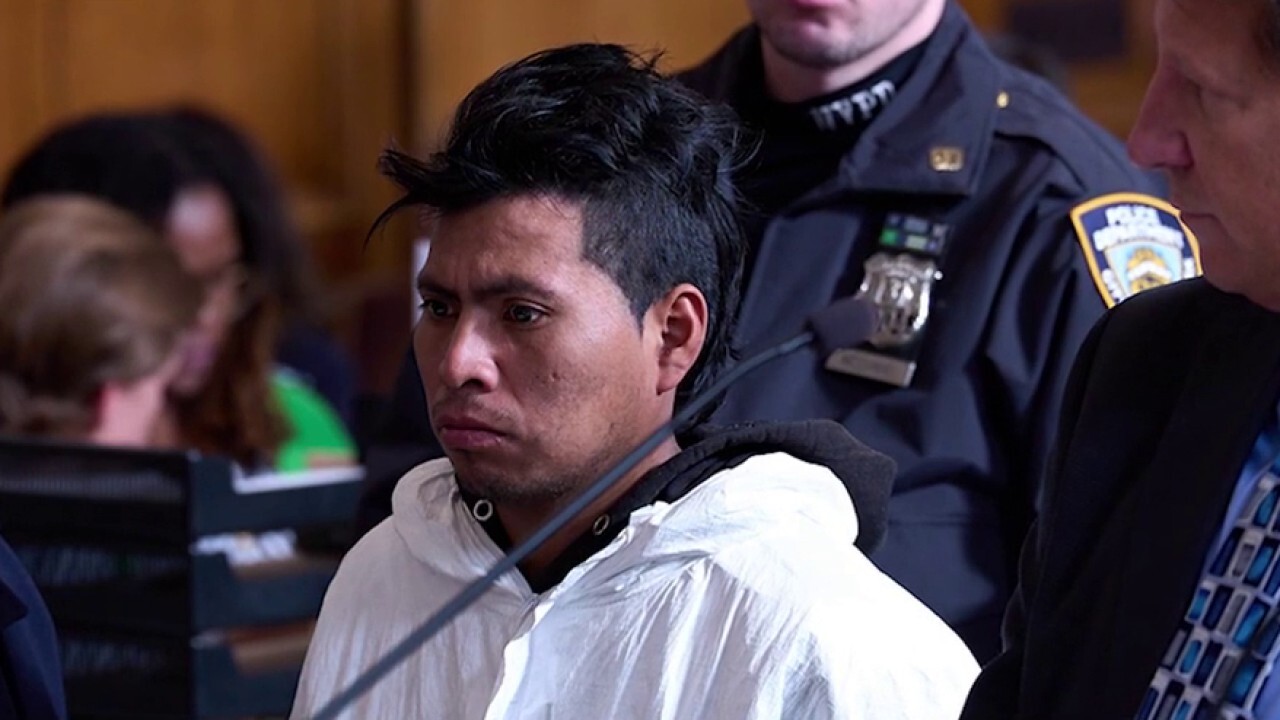
Sebastian Zapeta, 33, a previously deported immigrant from Guatemala, was arrested hours after the horrific incident which shocked the nation. 

H⁠⁠e’s been indicted on one count of murder in the first degree, three counts of murder in the second degree and one count of arson in relation to the horrific case. 

NYPD officers escort Sebastian Zapeta from an F train in Coney Island from a precinct in Lower Manhattan on Dec. 22, 2024. (Courtesy: G.N. Miller/New York Post)

Advertisement

CRITICS WARN OF ‘DANIEL PENNY EFFECT’ AFTER WOMAN BURNED ALIVE ON NYC SUBWAY CAR AS BYSTANDERS WATCHED

Surveillance video of the attack showed the suspect approaching the woman, who was sitting motionless and may have been sleeping, while aboard a stationary F train at the Coney Island-Stillwell Avenue subway station and then setting her on fire.

Police say Zapeta used a lighter to ignite the victim’s clothing, which became fully engulfed in a matter of seconds. Video from the scene shows Kawam standing while on fire, indicating she was alive when set on fire. 

The suspect then stayed on the scene and sat on a bench just outside the train car, as officers and a transit worker extinguished the flames. The victim was pronounced dead at the scene.

Sebastian Zapeta, accused of setting a woman on fire inside a New York City subway train, appears in court on Dec. 24, 2024, in New York. (AP Photo/Curtis Means via Pool)

Advertisement

Zapeta faces life without the possibility of parole on the murder in the first-degree charge, while second-degree murder carries 25 years to life, Brooklyn District Attorney Eric Gonzalez said earlier this week.

“This was malicious. A sleeping, vulnerable woman on our subway system,” Gonzalez added. “This act surprised many New Yorkers as they were getting ready to celebrate the holidays but now New Yorkers are waking up and understanding that on the 22nd of this year, this happened. This was intentional and we hope to prove this.”

Adams’ office tells Fox News Digital that the mayor has directed the NYPD and ICE’s Homeland Security Investigations (HSI) team to explore criminal charges against Zapeta under the federal arson statute.

Zapeta was apprehended by Border Patrol and subsequently deported by the Trump administration on June 7, 2018, after he crossed illegally into Sonoita, Arizona, a week prior, ICE spokesperson Jeff Carter tells Fox News. Zapeta later re-entered the U.S. illegally on an unknown date and location, Carter said. 

Advertisement

Read the full article from Here

Advertisement
Continue Reading
Click to comment

Leave a Reply

Your email address will not be published. Required fields are marked *

This site uses Akismet to reduce spam. Learn how your comment data is processed.

Pennsylvania

Geospatial Study Ties Melanoma Hot Spots to Farming Practices in Pennsylvania | Managed Healthcare Executive

Published

on

Geospatial Study Ties Melanoma Hot Spots to Farming Practices in Pennsylvania | Managed Healthcare Executive


Melanoma, a cancer most often associated with sun exposure and individual risk factors, appears to follow the contours of Pennsylvania’s agricultural landscape, according to a new analysis that highlights striking regional differences in incidence. Adults living in counties with more cultivated land and heavier herbicide use had significantly higher melanoma rates, even after researchers accounted for ultraviolet radiation and social vulnerability.

The study, published in November 2025 in JCO Clinical Cancer Informatics, identified a 15-county cluster in South Central Pennsylvania where melanoma incidence among adults ages 50 years and older was 57% higher than in the rest of the state. Counties with larger shares of cultivated acreage and herbicide-treated land consistently showed higher rates, suggesting that agricultural practices may contribute to geographic disparities in melanoma risk.

Melanoma incidence in the United States has tripled since the mid-1970s. Although advances in treatment have improved survival, the disease is still expected to claim thousands of lives this year. Ultraviolet radiation is the leading environmental risk factor, but studies of outdoor workers, including those in agriculture, have produced mixed results. That inconsistency has fueled interest in whether farming-related exposures, such as pesticides, may play a role alongside sun exposure.

To examine that question at the population level, a team of researchers at Penn State College of Medicine conducted an ecologic analysis using county-level data from across Pennsylvania. The team analyzed invasive melanoma incidence from 2017 through 2021 among adults 50 years and older and paired those data with measures of agricultural land use, pesticide application, ambient ultraviolet radiation and socioeconomic vulnerability.

Advertisement

Using geospatial clustering techniques, the researchers identified a statistically significant melanoma hot spot spanning 15 counties in South Central Pennsylvania. Eight of those counties are designated as metropolitan, challenging the assumption that agriculture-related cancer risks are confined to rural areas. Compared with counties outside the cluster, those within it had nearly three times more cultivated land and more than double the proportion of herbicide-treated acreage.

In statistical models adjusted for ultraviolet radiation and social vulnerability, each 10% increase in cultivated land corresponded to a 14% increase in melanoma incidence. A roughly 9% increase in herbicide-treated acreage was associated with a similar 14% rise. Herbicides showed the strongest and most consistent association, while smaller positive associations were also observed for insecticide-, fungicide- and manure-treated land.

The authors noted that the entire high-incidence cluster falls within the 28-county catchment area of the Penn State Cancer Institute. That alignment, they wrote, creates an opportunity to integrate research, outreach and prevention efforts in a region with elevated melanoma burden.

Because the study used an ecologic design, it cannot establish cause and effect or assess individual-level exposures, the authors cautioned. The analysis also could not account for personal behaviors, genetic risk or direct measures of pesticide exposure. Still, the findings add to a growing body of literature linking agricultural practices, particularly pesticide use, with melanoma risk in farming regions.

Taken together, the results support a broader One Health approach to cancer control, one that considers how environmental, occupational and behavioral factors intersect. For agricultural regions such as South Central Pennsylvania, the authors suggest melanoma prevention strategies may need to extend beyond sun protection alone to include safer pesticide practices, environmental monitoring and community-based education tailored to populations affected by agricultural exposure.

Advertisement


Source link

Continue Reading

Rhode Island

CRMC asks RI Superior Court to force Quidnessett Country Club to take down rock wall

Published

on

CRMC asks RI Superior Court to force Quidnessett Country Club to take down rock wall


The Rhode Island Coastal Resources Management Council (CRMC) filed a counterclaim against Quidnessett Country Club in Providence County Superior Court Tuesday. It wants a judge to force the North Kingstown country club to remove the 600-foot stone wall built without permission roughly three years ago.


Source link

Continue Reading

Vermont

Vermont medical cannabis patients on the rise

Published

on

Vermont medical cannabis patients on the rise


MONTPELIER — As medical dispensaries dwindle but retailers receive medical use endorsements, a data point sticks out. 

“The number of medical patients continues to grow,” Olga Fitch, executive director of the Cannabis Control Board, said at the Dec. 17 board meeting. 

About 3,043 patients were registered for the program at the time of the meeting, according to a slide show presentation. More than 40 patients were added to the count since the November board meeting, Fitch said.

Advertisement

Looking at data starting in 2011, Fitch said the medical program peaked around 2018 with 5,300 patients. She noted November 2023 is the last time, before now, that the state recorded more than 3,000 patients. 

Vermont now has 20 retailers with medical use endorsements. They’re in Bennington, Brattleboro, Manchester Center, Middlebury, Montpelier, Rutland, St. Johnsbury, South Hero, Bethel, Brandon, Burlington, Essex, Essex Junction, Johnson, White River Junction, Winooski and Woodstock. Five of them received the endorsement in December. 

A law passed this year by the Vermont Legislature established the program, which allows approved retailers the opportunity to sell higher potency products and offer curbside, delivery and drive-thru services to patients. Registered medical cannabis patients in Vermont are also exempt from paying the state’s cannabis excise tax and the standard sales tax. 


Vermont rolls out cannabis medical-use endorsement program

Retail establishments with the medical use endorsement are gearing up for the new initiative. 

Advertisement

The first Enhanced Budtender Education course was held during the first week of December, a CCB newsletter stated, “paving the way for medical cannabis sales at medical-use-endorsed retailers.”

The CCB thanked “the budtenders and licensees who took the time to register, attend, and successfully complete the multi-hour course.”

“We are excited to roll out better access for patients and caregivers in the Medical Cannabis Program,” the CCB said.

Advertisement

At least one employee at an endorsed retailer is required to go through enhanced budtender training, which is offered through a contract with Cannify. To qualify, retailers must be in good standing for six months, with a clean compliance record and up-to-date tax payments.


Source link

Continue Reading
Advertisement

Trending