Nevada
Elections 2.0 : Nevada Embraces Blockchain For Transparency


16h10 ▪
5
min read ▪ by
The American elections have always represented a global symbol of democracy and stability. However, in the digital age, they face unprecedented challenges, exacerbated by technological advancements and threats to the integrity of electoral processes. Recently, Nevada was at the center of a major controversy related to the accusations of “false electors” during the 2020 presidential election. Although these accusations were dismissed, they highlighted critical flaws in the electoral certification system. In the face of this crisis of confidence, the state of Nevada made a bold decision by choosing blockchain technology to ensure the security and transparency of its elections. This adoption, hailed as a major breakthrough, aims to anchor electoral certifications in an immutable ledger, making any attempt at falsification practically impossible.
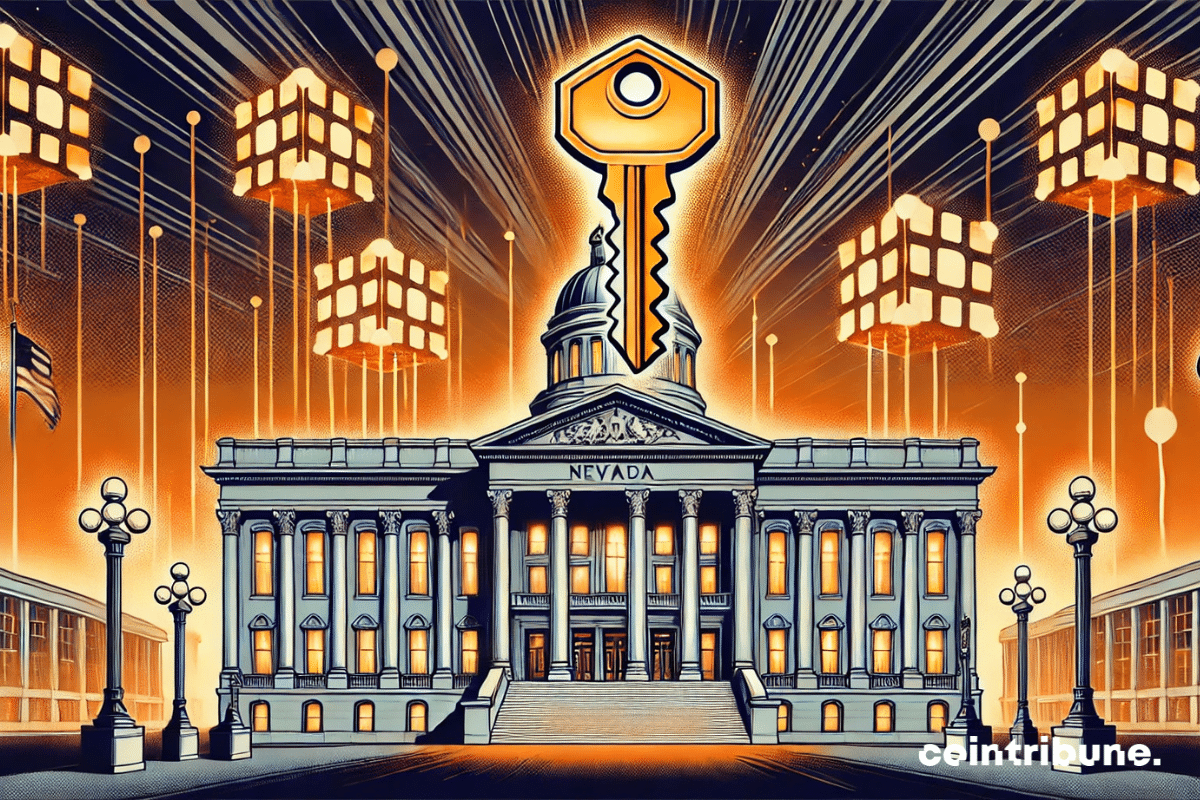
Blockchain in Service of Electoral Integrity
Nevada Secretary of State Francisco Aguilar announced on December 9, 2024, an initiative that could redefine the standards of electoral security in the United States. In a statement published on the state’s official platform, he unveiled the integration of blockchain technology into the certification process of electoral results. To justify this measure, Aguilar declared that it constituted “a vital step to ensure the transparency and reliability of the results.”
Specifically, blockchain will be used to record electoral certificates on an immutable digital ledger, aiming to make any attempt at data falsification or modification practically impossible. Such an innovation aims to address an increasingly urgent requirement: to restore public trust in an electoral system weakened by past scandals.
In a context where the United States is intensifying efforts to modernize its electoral infrastructure, Nevada hopes to stand out as a national model of security and transparency. Although the technical modalities of implementation remain to be clarified, the stated objective is clear. Aguilar emphasized the ambition of his administration to “ensure some of the safest elections in the country,” aiming to position Nevada at the forefront of democratic innovation.
Lessons from the Past and Perspectives
Nevada’s decision is part of a context marked by the “false electors” affair of 2023. During this episode, six Republican officials in the state were accused of attempting to manipulate the results of the 2020 presidential election. Although these accusations were dismissed by the courts, they reveal significant vulnerabilities within the current electoral systems. According to Francisco Aguilar, these events have revealed… “The urgency to protect the electoral process against any attempt at corruption or alteration.”
In response to these challenges, Nevada does not merely seek to correct past errors. By adopting blockchain, the state aims to redefine electoral security standards, both for itself and for the rest of the country. This initiative is not a first in the United States. Similar pilot projects have been undertaken in Alaska and Georgia, reflecting a growing interest in this technology in the public sphere. However, Nevada hopes to go further by integrating this innovation into its certification system, with the goal of establishing a reference model for other states.
If this strategy proves effective, it could profoundly transform how elections are organized at the national level. Through enhanced transparency and strengthening voter trust, blockchain could become a key lever to address a political climate often marked by allegations of fraud. More than just a technological tool, this initiative illustrates a desire to reconcile citizens with a democratic process that is frequently criticized.
Through this adoption of blockchain, Nevada addresses the gaps revealed by past electoral controversies, while also paving the way for a better-secured democracy. This approach, which combines technological innovation with institutional strengthening, illustrates a desire to restore citizens’ trust in order to establish a model that can be adapted by other states. By choosing to place transparency at the heart of its priorities, Nevada thus paves the way towards a future where emerging technologies become guarantors of civil rights and democratic stability.
Maximize your Cointribune experience with our “Read to Earn” program! For every article you read, earn points and access exclusive rewards. Sign up now and start earning benefits.

Diplômé de Sciences Po Toulouse et titulaire d’une certification consultant blockchain délivrée par Alyra, j’ai rejoint l’aventure Cointribune en 2019.
Convaincu du potentiel de la blockchain pour transformer de nombreux secteurs de l’économie, j’ai pris l’engagement de sensibiliser et d’informer le grand public sur cet écosystème en constante évolution. Mon objectif est de permettre à chacun de mieux comprendre la blockchain et de saisir les opportunités qu’elle offre. Je m’efforce chaque jour de fournir une analyse objective de l’actualité, de décrypter les tendances du marché, de relayer les dernières innovations technologiques et de mettre en perspective les enjeux économiques et sociétaux de cette révolution en marche.
DISCLAIMER
The views, thoughts, and opinions expressed in this article belong solely to the author, and should not be taken as investment advice. Do your own research before taking any investment decisions.


The expected vote is the total number of votes that are expected in a given race once all votes are counted. This number is an estimate and is based on several different factors, including information on the number of votes cast early as well as information provided to our vote reporters on Election Day from county election officials. The figure can change as NBC News gathers new information.
Source: Vote data via the Associated Press. Projections by the NBC News Decision Desk.

LAS VEGAS (AP) — Nevadans are choosing their party nominees Tuesday for two closely watched congressional seats and the governor’s race, among others, as the state grapples with an affordable housing shortage, exploding energy demand from data centers and federal cuts to key state programs.
The state has a closed primary, meaning only registered Democrats and Republicans will vote in party contests after an effort to open them up failed in 2024.
Several primaries feature matchups between candidates backed by party leaders and political outsiders promising change. Come November, the governor’s race is considered one of the most competitive in the country, and holding on to the 3rd Congressional District is considered crucial for Democrats’ hope of retaking the U.S. House.
Here’s a look at the most prominent races:
Democrats seek a rival for Lombardo
Gov. Joe Lombardo, a Republican, is considered one of the most vulnerable governors in the country this fall.
The Democrats vying to challenge him include state Attorney General Aaron Ford, who has the backing of the Democratic congressional delegation and former Vice President Kamala Harris, and Alexis Hill, a county commissioner in northern Nevada who campaigned as a candidate willing to shake things up.
They focused their campaigns on affordability, as the state continues to see a shortage of affordable housing, some of the highest gas prices in the country and cuts to federal healthcare and food assistance programs.
Ford largely ignored Hill, instead directing his attacks at Lombardo and arguing that both the governor and Trump are responsible for Nevadans’ economic woes. He is trying to become Nevada’s first Black governor.
2nd Congressional District
In the Republican contest to replace longtime Rep. Mark Amodei, who is retiring, President Donald Trump has endorsed David Flippo, a loyalist of the president who has never held elected office. Amodei and Lombardo have backed James Settelmeyer, a former state senator with a long political track record.
The district covers northern Nevada and includes Reno and Carson City, the capital, along with an immense rural expanse.
Trump-endorsed candidates have seen successful in primaries elsewhere, underscoring his unrivaled power over the Republican Party as he enters the last years of his presidency. He easily won the district in the 2024 presidential election.
The GOP nominee has a good chance of winning in November, as registered Republicans outnumber Democrats by 70,000 in the 2nd District. A Republican has held the seat since the district was created in the 1980s.
Still, Democrats hope to entice the large number of nonpartisan voters in the district this fall. Their candidates include Teresa Benitez-Thompson, a former majority floor leader of the Nevada Assembly, and Greg Kidd, an investor who ran in the last cycle as a nonpartisan.
3rd Congressional District
Nevada’s other three members of Congress, all Democrats, are expected to win their primaries easily.
In the 3rd District, Republicans are battling to determine who will face Democratic Rep. Susie Lee in what is considered the most competitive congressional district in Nevada because of its narrow Democratic registration advantage, its high number of nonpartisan voters and a history of razor-thin election margins. In 2024 both Lee and Trump won narrowly.
Candidates include Trump-backed Marty O’Donnell, a composer who worked on the “Halo” video game series and ran unsuccessfully for the seat in 2024; Jeff Gunter, a dermatologist and former ambassador to Iceland; neurosurgeon Aury Nagy; and businessperson Tera Anderson.
The candidates ran on border security, energy independence and decreasing the federal debt.
Attorney general
With Ford term-limited and running for governor, the opening has prompted competitive primaries for the state’s top law enforcement post.
The Democratic side features state Senate Majority Leader Nicole Cannizzaro and Treasurer Zach Conine. Both campaigned on promises to take on the Trump administration, following in the footsteps of Ford, who filed numerous lawsuits against the federal government.
For the Republicans, Trump-backed attorney Adriana Guzmán Fralick faces Douglas County commissioner Danny Tarkanian. Tarkanian, son of legendary University of Nevada, Las Vegas basketball coach Jerry Tarkanian, previously ran unsuccessfully in multiple congressional races.
Both candidates campaigned on “election integrity,” casting doubt on voting security. Nevada is one of the swing states in which Trump falsely claimed the 2020 election was stolen, despite officials finding no evidence of widespread fraud.
Tarkanian promised to investigate voter fraud allegations, while Guzmán Fralick vowed to seek passage of the SAVE Nevada Act, which would be similar to changes Trump has sought at the federal level.
Her legislation would require all votes to be counted on Election Day, end universal mail ballots and eliminate automatic voter registration. It would almost certainly hit a dead end in the Democratic-controlled Legislature.
GOP secretary of state candidates question Nevada’s elections
Several Republicans are running for secretary of state, the office that oversees elections, including some who falsely claimed the 2020 election was stolen from Trump. The winner of the primary will take on Democratic Secretary of State Cisco Aguilar.
The GOP candidates include Jim Marchant, a former state lawmaker and perennial candidate who has said the 2020 election “was probably stolen”; Sharron Angle, a former state lawmaker who was part of an effort to block the certification of Nevada’s 2020 election results; and Shirley Folkins-Roberts, an attorney who received Lombardo’s endorsement and has denied there is widespread fraud in Nevada’s elections.
All the candidates support implementing voter ID, which will be on the ballot for the second time in November after the question passed by a wide margin in 2024.
Angle promises to enforce voter ID if voters pass it and supports Trump’s executive order seeking to require documentary proof of citizenship to vote. The courts have so far halted that order, issued last year, from taking effect.
Marchant wants to eliminate electronic voting machines and end the state’s universal mail ballot system. He also wants to require paper ballots, which would be counted by hand, according to his campaign website.
Folkins-Roberts said she will work to keep voter rolls accurate and up-to-date, require voter ID and ensure that election results are delivered on time. She also wants to reverse the automatic voter registration system. In an interview with News 4 Reno, Folkins-Roberts said she believes Nevada’s elections are “good,” but wants to improve voters’ confidence by making changes.

LAS VEGAS (KSNV) — We’ll start the week with a heightened fire danger with dangerous heat later this week.
TODAY
Expect mostly sunny skies with winds picking up again on Monday. High temperatures will reach 98 degrees in Las Vegas with south winds 10-20 mph and wind gusts up to 30 mph.
A RED FLAG WARNING is in place from 10am to 9pm Monday for gusty winds and dry weather, so if a fire started, it would spread quickly.
Winds are estimated to be 20-25 mph with gusts around 40 mph at times with relative humidity of 5%-15%.
Air quality is ranked ‘good’ to ‘moderate’ for dust and tree pollen. The most common pollens are juniper, cedar, willow, sycamore and palm.
TONIGHT
We’ll see variable clouds this evening with skies going from mostly cloudy to mostly clear overnight.
Wind gusts will pick up again before midnight with gusts 30-40 mph possible downslope of the Spring Mountains in the west valley.
Elsewhere, gusts will be 20-30 mph. Breezes will eventually back down to 5-15 mph overnight. Valley lows will drop to around 74 degrees.
WHAT’S NEXT
We have reached 109 consecutive days without measurable rain in Las Vegas.
No rain is in sight, but for perspective, June is the driest month of the year in Las Vegas. Fingers crossed on a hopefully more active monsoon season!
High pressure builds next with highs 5-10 degrees above normal. Temperatures will reach around 108 degrees in Las Vegas by Friday. The last time we hit a high temperature of 108 degrees was back on August 20th of last year.
Not much relief is in sight by the weekend with highs around 107 degrees and temps at or above 105-106 degrees NEXT Monday through Wednesday.
-

 San Francisco, CA57 seconds ago
Beloved Chit Chat Cafe at closed Pacifica Municipal Pier demolished
-

 Dallas, TX8 minutes ago
DPS cites statewide demands in decision to end NTTA tollway patrol agreement
-

 Miami, FL11 minutes ago
Miami’s first boutique wedding chapel is now open and it’s so cute
-

 Boston, MA16 minutes ago
Red Sox’s Aroldis Chapman Wants to Stay, But Boston Holds the Cards
-

 Denver, CO23 minutes ago
Trammell Crow, PCCP secure Denver area’s largest industrial lease in years
-

 Seattle, WA26 minutes ago
Seattle Mayor Katie Wilson mayor ripped after unveiling fleet of tiny homes likened to porta-potty drug dens
-

 San Diego, CA31 minutes ago
San Diego City Council will vote on fiscal year 2027 budget
-

 Milwaukee, WI38 minutes ago
1 injured in shooting near two Milwaukee schools and a daycare center

