Politics
Supreme Court may sharply limit environmental impact statements that block energy development


WASHINGTON — The Supreme Court may be about to sharply limit the reach of so-called environmental impact statements, which gauge potential harm caused by new developments and can often block or scale back large projects.
For more than 50 years, federal law has required agencies to take a hard and broad look at the “reasonably foreseeable environmental effects” of a building or development project before approving it.
The justices sounded ready on Tuesday to reconsider that approach in a case involving a proposed 88-mile railroad line in Utah that would allow crude oil to be shipped to refineries on the Gulf Coast.
“Focus on the project,” argued Paul Clement, a Washington attorney representing county governments in support of the project. He urged justices to consider only the direct impact of the rail line’s construction, and not potential secondary impacts that are “remote in time and space.”
In their comments and questions, the justices appeared to agree.
If so, their ruling could rein in the reach of environmental impact statements, an outcome that would be welcomed by developers and condemned by environmentalists.
Three years ago, the Surface Transportation Board, the federal agency which regulates freight railroads, approved the construction of the Utah rail project
But it did not weigh the environmental impact of drilling new oil wells in northeastern Utah, the extra air pollution at the refineries on the Gulf or the danger of sending nine more trains per day along the Colorado River and through the Rockies.
Environmentalists sued along with Eagle County, Colo., and won a ruling from the D.C. Circuit Court of Appeals last year that said the board had failed to consider the “upstream and downstream” impacts on the environment.
The seven Utah counties appealed, arguing the D.C. court had gone too far.
Eight justices appeared to agree that decision should be reversed.
Justice Neil M. Gorsuch, a Colorado native who is a friend of billionaire Philip Anschutz, said last week that he would not participate in the decision. Anschutz is not a party to the case, but the Anschutz Exploration Group, which produces oil and gas in Utah, Colorado and Wyoming, submitted a friend-of-the-court brief which urged the court to limit the law’s focus to environmental effects that are under the direct control of an agency.
Clement, who represented the seven Utah counties, said the court should rein in the “bloated and anti-development” impact statements that range too broadly.
He said it made sense for the federal board to consider the railroad’s potential impact on the bighorn sheep in the area, but not “imponderables,” such as a potential rail accident hundreds of miles away or extra air pollution on the Gulf Coast.
The Center for Biological Diversity, which sued to challenge the Utah railroad, said environmental impact statements have been crucial to protecting the environment since the early 1970s. It said agencies have been on notice “to consider whether their actions will have long-term, and potentially irreversible, environmental effects.”
These impact statements permit the government and the public to weigh the harms as well as the benefits of a new development.
Wendy Park, an attorney at the center, said “communities in the Uinta Basin and the Gulf Coast will suffer the most from this oil railroad, while oil companies enrich themselves at the expense of the environment and people’s health. It’s disgraceful the railroad’s backers want federal agencies to turn a blind eye to those harms.”


The Trump administration finalized a rollback of the Endangered Species Act on Friday, paving the way for drilling, mining and other human development across protected wildlife habitats.
The move redefines “harm” under the Endangered Species Act, the landmark conservation law that protects threatened and endangered plants and animals. For years, “harm” meant actions that injure or kill wildlife, as well as actions that destroy protected habitats.
Under the new rule, destroying those habitats is no longer illegal.
The decision aligns with the Trump administration’s ongoing effort to slash regulations in the name of economic growth. Interior Secretary Doug Burgum, whose department finalized the move, said the prior definition of harm “interfered with private property rights” and “turned routine activity into a regulatory trap.”
Environmental groups called the decision a disaster, saying it puts protected species on a path to extinction.
The move seems especially poised to hit California, the most biodiverse state in the country, where more than 6,700 species are spread across mountains, forests, deserts and oceans. Of the roughly 2,300 species protected by the Endangered Species Act, nearly 300 are found in California.
These species include amphibians such as tiger salamanders and Yosemite toads; birds such as California condors and northern spotted owls; fish such as Little Kern golden trout and Santa Ana suckers; insects such as Franklin’s bumble bees and Mission blue butterflies; mammals such as gray wolves and Santa Catalina Island foxes; and reptiles such as desert tortoises and green sea turtles.
The Endangered Species Act is widely credited with saving the California condor, which almost went extinct in the 1980s due to several factors, including habitat destruction. Thanks to a recovery program under the act, the condor population has since soared to several hundred. But under the new law, the logging and human development that led to their near demise is now allowed.
A handful of California species recoveries have been championed as success stories under the Endangered Species Act, including southern sea otters, peregrine falcons, humpback whales, bald eagles and green sea turtles.
According to a report from the Center for Biological Diversity, the El Segundo blue butterfly lost 90% of its oceanside habitat due to the construction of LAX and beachfront housing developments. The population dwindled to about 1,000 butterflies in the 1970s, when it was named an endangered species. Now, the population has climbed above 120,000.
In California, the rollback could pave the way for more farming, mining, logging and drilling in areas that were once forbidden due to the potential for wildlife habitat destruction. A report from Earthjustice estimates that expanded oil drilling in California could threaten five marine species including humpback whales, sea otters, leatherback sea turtles, marbled murrelets and wild salmon.
Several environmental groups are planning legal challenges to the ruling.
“For the first time ever, a presidential administration now claims that species protected by the Endangered Species Act shouldn’t be safe from habitat modification that destroys where they live, raise their young, or search for food,” Kristen Boyles, attorney for the environmental nonprofit Earthjustice, said in a statement. “Let’s be clear: there is no support for the Trump administration’s rule — no scientific support, no legal support, no public support. We will see the Trump administration in court.”
Ben Greuel, wildlife campaign manager at the Sierra Club, called the decision “an unlawful attempt to open the door for corporate polluters to degrade vitally important habitats.”
“For more than four decades, the definition of ‘harm’ recognized a simple truth: if you destroy the places wildlife need to survive, you are putting species on a path to extinction,” Greuel said in a statement.
It’s not the first time Trump has taken aim at California environmental regulation.
Earlier this year, Gov. Gavin Newsom, along with the governors of Washington and Oregon, submitted a formal opposition to the Trump administration’s plans to expand drilling off the Pacific Coast, with Newsom saying it leads to “dead wildlife.” In June, the Trump administration ordered a review of the California Coastal Commission, claiming the state’s “environmental extremism” obstructs spaceport development and offshore oil production.
A day before the Endangered Species Act decision, the Trump administration signed off on a controversial plan to use an old oil pipeline to pump water from the Mojave Desert into cities. Environmental groups said the plan threatens springs and local wildlife, since six pumps would need to be built in desert tortoise habitats.
Politics
Trump-aligned House holdouts accused of holding ‘life-saving’ veterans bill ‘hostage’ over SAVE America Act

NEWYou can now listen to Fox News articles!
A sweeping veterans package supporters describe as the largest expansion of veterans’ health care and benefits in more than a decade is expected to return to the House floor when lawmakers come back from the July recess, but backers warn the legislation could once again become collateral damage in the Republican standoff over the SAVE America Act.
The Take Care of America’s Veterans Act rolls roughly 60 veterans bills into a package that would dramatically expand veterans’ health care and benefits. At its core, the legislation would cement veterans’ access to community care outside the VA while increasing benefits for combat-wounded veterans, caregivers and Gold Star families, expanding mental health services and enacting dozens of additional reforms.
House Veterans’ Affairs Committee Chairman Mike Bost, R-Ill., told Fox News Digital he intends to bring the Take Care of America’s Veterans Act back for a vote as soon as the House reconvenes next week.
WASHINGTON, D.C. – MARCH 17: Eugene Simpson, 29, from Dale City, Virginia goes through physical therapy at the Veterans Affairs Medical Center in Washington, D.C. with Michael Minor, a kinesiotherapist with the United States Department of Veterans Affairs on March 17, 2006 in Washington, D.C., USA. (Photo by Jeff Hutchens/Getty Images) (Jeff Hutchens/Getty Images)
HOUSE CONSERVATIVES DERAIL GOP AGENDA IN SAVE AMERICA ACT SHOWDOWN
The legislation was held up last month after a group of House Republicans joined Democrats to defeat a procedural vote, stopping the House from taking up the bill.
“I’m feeling good as long as my members stay with us on the rule,” Bost said. “Right now, there’s some politics being played, not about this bill, but just in general.”
The bill became entangled in a broader House Republican fight over the SAVE America Act, legislation championed by President Donald Trump that would require proof of U.S. citizenship to register to vote in federal elections.
On June 30, the House voted on H. Res. 1398, the procedural rule governing floor consideration of several bills, including the National Defense Authorization Act and the Take Care of America’s Veterans Act. The rule failed after 14 Republicans joined Democrats in opposition, preventing the House from taking up the veterans package and bringing floor business to a standstill. Rep. Anna Paulina Luna, R-Fla., claimed to have voted against the rules vote in protest against House leadership’s handling of the SAVE America Act. As a result, Speaker of the House Mike Johnson sent the members home early.
Bost accused the holdouts of effectively putting veterans legislation on hold.
The US Department of Veterans Affairs building is seen in Washington, DC, on July 22, 2019. (Photo by Alastair Pike / AFP) (Photo credit should read ALASTAIR PIKE/AFP via Getty Images) (Photo credit should read ALASTAIR PIKE/AFP via Getty Image)
‘IT’S A MESS’: GOP TURNS ON HOUSE CONSERVATIVES AS VOTER ID BLOCKADE STALLS TRUMP’S AGENDA
“They’re holding all bills hostage,” Bost said. “They’re not voting for any rule. Any bill that has to pass a rule before it comes to the floor—which this bill does because of its size—can’t move.”
Although Bost said he supports the SAVE America Act and has voted for it three times, he argued the Senate’s failure to act should not stop the House from advancing unrelated legislation.
“I agree with that bill,” Bost said. “But the Senate still has to do their work. We don’t stop our work because the Senate isn’t doing it.”
With 23 legislative days left in the Congressional session, Concerned Veterans for America Strategic Director John Byrnes, a supporter of the bill, said time is of the essence.
“There are lots and lots of things that have to get done,” Byrnes told Fox News Digital. “There’s also the National Defense Authorization Act, which is a must pass every year, so these things eat up time. There’s requirements to have debate on these, which eat up session time.”
Byrnes argued that every procedural delay pushes other legislation further down the calendar.
“This bill will save lives in 2027,” Byrnes said. “If we lose veterans because they could have had faster, better access to health care, we’re never going to get those veterans back.”
Rep. Mike Bost, R-Ill. ( )
TRUMP’S SAVE AMERICA ACT SHOWS SIGNS OF LIFE IN THE SENATE DESPITE REPUBLICAN REVOLT
But Rep. Chip Roy, R-Texas, who also voted no on the procedural vote, told Fox News Digital that he has concerns about how the bill is financed.
“I appreciate what the chairman’s trying to do in some respects, but there’s a few issues,” Roy said.
Among them, Roy pointed to provisions offsetting new spending through changes affecting other veterans.
“You’re taxing certain veterans to provide some sort of benefits and changes to other veterans,” Roy said. “There are concerns about some of the pay-fors.”
Veterans of Foreign Wars has also taken issue with Section 108 of the bill, warning that it would codify changes to future disability ratings for tinnitus and sleep apnea to help finance other veterans priorities.
But Bost said this is inaccurate.
“No veteran is going to have their benefits reduced,” Bost said. “If you’re receiving a benefit right now, that’s not going to be reduced at all.”
Roy, who previously served two years on the House Veterans’ Affairs Committee, said he supported a lot of what the bill was seeking to accomplish; but said other pieces of legislation are priorities, too.
CLICK HERE TO DOWNLOAD THE FOX NEWS APP
“There is a block of us for whom border security, the SAVE Act and demonstrating our leadership on major issues is critical,” Roy said. “Some of these other bills may or may not get hung up based on a desire of many in the conference to see movement on other things.”
Fox News Digital reached out to Luna’s office and the White House for comment.
WASHINGTON — Shortly before President Trump ended a ceasefire with Iran this week, Israeli officials presented his team with intelligence indicating Tehran was hatching new plots to kill him.
It was not the first such warning. U.S. law enforcement and intelligence agencies have tracked evidence for years of Iranian efforts to target the president, with signals only increasing since the start of the war.
Their desire to target Trump and his top aides began six years ago, just outside Baghdad International Airport, when the president ordered a drone strike that killed Iran’s most powerful general. The assassination of Qassem Suleimani brought the two countries to the brink of war.
Yet even as full-scale war was averted, top Iranian officials vowed revenge for the strike, authorizing attempts on the lives not just of the president, but of his secretary of State and national security advisor, among others, even after they had left office.
Now, calls for revenge have reached a sharper pitch in Tehran, after a joint U.S.-Israeli operation killed Iran’s supreme leader, Ayatollah Ali Khamenei, at the start of the war in February.
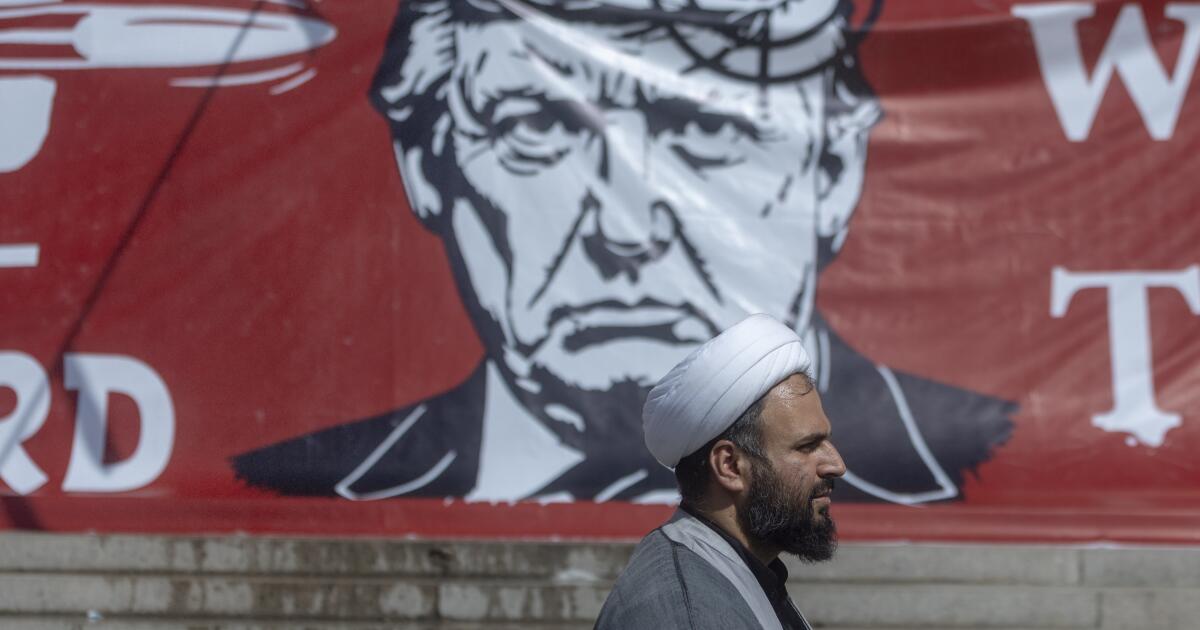
At Khamenei’s funeral ceremonies this week, red flags of vengeance flew throughout the capital as protesters explicitly called on their government to “kill Trump.” His son, Mojtaba, the new supreme leader, was absent from the commemorations, fearing assassination himself.
Mourners hold an anti-President Trump banner at the Imam Khomeini Grand Mosque during mass funeral prayers for Iran’s late Supreme Leader Ayatollah Ali Khamenei and his family in Tehran on Sunday.
(Morteza Nikoubazl / NurPhoto via Getty Images)
The prospect of foreign assassination plots targeting U.S. leaders puts the United States in dangerous new territory, where its embrace of political killings could ultimately place its own officials at unprecedented risk. And experts fear the existential threat of assassination has pushed peace further out of reach: When both sides believe their survival is at stake, the trust required for diplomacy becomes far harder to achieve.
Israeli news organizations have reported that Israel’s prime minister, Benjamin Netanyahu, cited Iranian attempts to kill Trump in recent years as part of his case to go to war in the first place.
A U.S. official told The Times that a range of serious threats exist against the president, including from Iran, but that Israel’s intelligence pointed to a more specific plot. The official did not provide further details. Israeli officials did not respond to requests for comment.
Iran’s president, Masoud Pezeshkian, has said in recent months that the government sees vengeance against U.S. officials as “its legitimate duty and right,” and “will fulfill this great responsibility and duty with all its might.”
“The Suleimani killing accelerated a lifting of restraints on foreign assassinations — and the taboo on targeting and killing foreign leaders, with U.S. military assets, has been more or less lifted,” said Matt Dallek, a political professor at George Washington University.
“If the United States sets the example of how to conduct international relations, and it is using assassination of foreign leaders as a political weapon, it’s only logical that other countries will be more inclined to also engage in assassinations,” Dallek added. “It does seem likely that Trump will have a bigger target on his back.”
Returning from a NATO summit in Turkey on Wednesday, Trump was forced to switch back to an old model of Air Force One — equipped with specialized defensive technologies — from a new plane given as a gift by Qatar, after the Secret Service warned of potential threats to the aircraft from Iran.
“They want to take out the U.S. leader — me,” Trump told reporters aboard the plane. “I’m on whatever list. I saw this morning I’m on every single one of their lists. And so far, I guess I’ve been a bit lucky, but maybe that doesn’t last very long.”
The threat has remained on his mind in the days since. In an interview with the New York Post, Trump told the reporter, “I hope you’ll miss me,” adding that he has “been on their list for a long time.” And in a subsequent social media post Friday night, he warned of a catastrophic response he instructed the administration to pursue in the event Tehran succeeds.
“1000 Missiles are Locked and Loaded and aimed at the Islamic Republic of Iran,” he wrote, “with thousands of more to immediately follow, should the Iranian Government act on its threat, pronounced in many corners of the Globe, to assassinate, or attempt to assassinate, the sitting President of the United States of America, in this case, ME!”
The United States had a decades-old prohibition against assassinating foreign leaders before Trump’s presidency, codified in an executive order signed by President Ford in 1976 over concerns of a CIA plot to kill Fidel Castro.
The policy was only strengthened further by subsequent administrations, fearing a new international standard for targeted killings could result in unintended consequences in the halls of Washington.
Other administrations have been accused of targeting foreign leaders before. Under the Obama administration, an international coalition targeting the Libyan regime of Moammar Kadafi during the country’s 2011 civil war struck his fleeing convoy, leading to his capture and killing by rebel fighters.
But experts say Trump’s explicit targeting of Suleimani and Khamenei — and his public celebration of their deaths — marks a new paradigm.
“Through words and actions, President Trump has done more to normalize political violence than any other U.S. president, certainly in modern times,” said Robert Pape, a professor at the University of Chicago and author of “Our Own Worst Enemies: America in the Age of Violent Populism.”
“On the international front alone, the president routinely brags about killing Iranian leaders and seizing the leader of Venezuela, among others,” he added, “to the point that assassination is becoming the new normal in international politics.”
-
Politics25 seconds ago
Trump slashes wildlife protections, putting endangered California animals at risk
-
 Sports8 minutes ago
Lakers’ Arthur Kaluma erupts for 34 points in breakout Summer League performance
-

 World18 minutes ago
Sheikh Hamad bin Khalifa Al Thani, architect of modern Qatar
-
 News48 minutes ago
Messi and Argentina survive another close call to reach the World Cup semifinals
-

 Los Angeles, Ca2 hours ago
19-year-old arrested, accused of distributing marijuana to minors across Riverside County
-

 Detroit, MI3 hours ago
Phillies end the Tigers’ winning streak at 6 with a 4-2 victory
-

 San Francisco, CA3 hours ago
Giants select Barry Bonds’ nephew Peyton in third round
-

 Dallas, TX3 hours ago
Mark Cuban takes legal action against the Dallas Mavericks ownership over proposed arena deal

