Utah
Utah season wrap-up: Offensive struggles provide déjà vu


In many ways, 2024 felt like déjà vu for Utah fans.
Starting quarterback Cam Rising missed the majority of the season after missing all of 2023, the production behind him never materialized, and the regular season ended with fifth-string Luke Bottari starting once again.
Sound familiar?
Yet again, offense was the weak link on Utah’s team as the Utes scored 23.6 points per game (14th in the Big 12), passed for just 199.4 yards per game (15th in the Big 12) and rushed for 130.4 yards per game (12th in the Big 12).
A season that began with such promise never materialized, as Utah went from preseason Big 12 favorites to finishing 13th in the 16-team league.
Injuries piled up once more on the offensive side of the ball, as Rising, quarterbacks Isaac Wilson, Sam Huard and Brandon Rose, tight end Brant Kuithe, running back Anthony Woods and offensive guard Michael Mokofisi all suffered season-ending injuries.
While the Utes were dealt another bad hand injury-wise, the offensive doldrums, just like last year, came down to the fact that there wasn’t a solid plan if Rising went down with injury.
Unfortunately for the Utes, Rising missed all but 2.5 games, injuring his fingers in Week 2 against Baylor, then suffering a season-ending leg injury in Week 6 against Arizona State.
Without a quarterback that could elevate the offense, Utah suffered seven-straight losses — the longest losing streak in the Kyle Whittingham era and the program’s lengthiest since 1986 — before winning the season finale at UCF with Bottari at quarterback.
The Utes missed a bowl game in a full season for the first time since 2013 — just the third time that’s happened in the Whittingham era.
Utah knows that it has to solve the quarterback quandary that has plaguetd it for two years to find success again, and it’ll be a huge priority this offseason.
“Well, we got to solve our quarterback problems, I can tell you that. And that has been a difficult thing this year,” Whittingham said. “… Quarterback, as I’ve said over and over, the most important position in football, in team sports, period, and you better be good there if you want to have a chance to win. So we’ve got to evaluate just like I’ve got to evaluate my situation, we’ve got to evaluate the quarterback situation and make sure we have ourselves covered for next year.”
With the season wrapped up, here’s a look at how each position group on the Utes’ offense performed in 2024.
Quarterback
With Rising on the sidelines for the majority of the season, backup duties fell to Corner Canyon High true freshman Isaac Wilson, who won the QB2 job in fall camp.
With Rising returning as the undisputed starter, Utah couldn’t attract a quality backup in the transfer portal. The school tried, offering multiple quarterbacks, including Michigan State’s Sam Leavitt, but starting-level quarterbacks wanted to go somewhere where they wouldn’t be the backup to start the year.
Whittingham and the Utah offensive staff decided Wilson would be the best backup — over Rose and Huard — and for the first couple of games, it felt like the right decision.
The true freshman helped Utah to road wins over Utah State and Oklahoma State, and while there was stuff to clean up in both games, he was able to get the job done.
As Wilson started in three of the next four games, his play left a lot to be desired as the losses piled up, offensive coordinator Andy Ludwig resigned, and the Utes failed to score more than 14 points with the true freshman at the helm. After losses to Arizona, TCU, and a poor first half at Houston, Wilson was benched.
Season-long issues kept creeping up over and over — he had a tendency to hold onto the ball a little too long, his processing never improved to an FBS-starter level, and he threw too many interceptions (11 on the season).
Wilson’s final stat line: 1,510 yards, 10 touchdowns, 11 interceptions on a 56.4% competition rate.
“He comes in on his own and watches a ton of film so we’re doing everything we can. He’s doing everything he can to continue to develop and see things quicker,” Whittingham said. “And that was another issue in the (Colorado) game particularly early on. It got better as the game wore on, but holding the ball too long and need to go through those reads and spit it out or tuck it and run.”
There were still flashes of potential, like a 40-yard touchdown pass against Colorado that was Wilson’s best throw of the season, a 71-yard score against TCU, or a throw against Utah State where Wilson didn’t take the easy underneath first-down completion, but instead made a tougher downfield throw to Money Parks, dropping the ball perfectly between two defenders for a 20-yard gain.
Those moments were too far and in between, however.
Utah shouldn’t write Wilson off after one season — he will continue to develop and he could become a good college quarterback, but he clearly wasn’t ready at this moment. The plan was never to have Wilson play this season except in mop-up time while he sat and learned from Rising for a season, but that went out the window early.
Would the Utes have been better served with Rose as their backup?
It’s a small sample size, and the third-year player wasn’t able to deliver a Ute win when he was inserted into the game in the third quarter against Houston, but Utah’s offense looked the most alive it had been since Rising was the quarterback with Rose under center against BYU before he suffered a season-ending Lisfranc injury.
As Utah moves onto the 2025 season, its next starting quarterback may not be on the roster, but in the transfer portal.
Offensive line
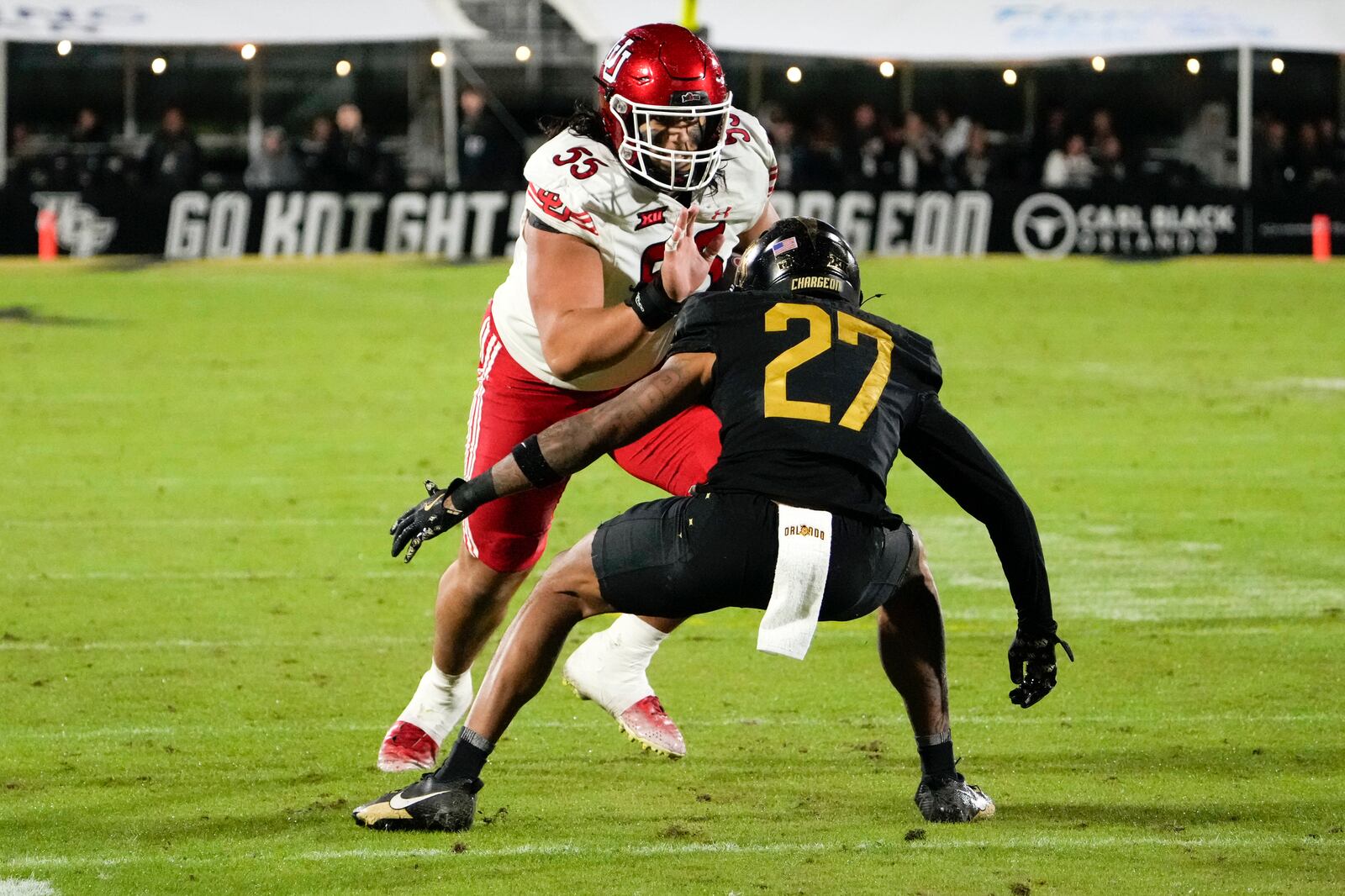
Utah had to replace three starters along the offensive line — tackle Sataoa Laumea, guard Keaton Bills and center Kolinu’u Faaiu — with tackle Spencer Fano and guard Micahel Mokofisi the only remaining starters.
For the majority of the season, Utah went with Caleb Lomu, Tanoa Togiai, Jaren Kump, Mokofisi and Fano.
As a unit, it was an up-and-down performance throughout the season, but one player stood above the rest and was consistently good.
Fano was rated the top tackle in all of college football (minimum 300 snaps) by Pro Football Focus, which gave him a grade of 91.5 (out of 100) on the season. Lomu also had a good first starting season.
Things got dicey in certain games along the interior offensive line, and as the season grew on — and the passing game continued to stagnate and loaded boxes became common — the line struggled to get push at times in the run game.
It’s impossible to completely separate quarterback play and line play, and the offensive line had a tough task this season in the run game due to the lack of a passing offense.
Running back

Utah started the year with a running-back-by-committee approach with Micah Bernard, Mike Mitchell and Jaylon Glover, but Bernard grabbed the RB1 role by the horns and no one really stepped up to be a change-of-pace back this season.
Bernard was the heart and soul of the offense, finally getting a chance to be the lead back after five years in the program. He made the most of his opportunity, becoming the 17th Ute to rush for 1,000 yards in a season.
“He’s been huge this year. He has been the vast bulk and majority of our rush game this year. He’s by far got the most carries and the most production,” Whittingham said. “And talk about a guy who maybe thought he was done playing football last year to what he accomplished this year is pretty impressive, and we’re elated that obviously he was on our team this year and came back for this last year.”
While Bernard had some great performances — he rushed for over 100 yards four times this year — the lack of an RB2 was a little bit puzzling.
Of course, when you have an RB1 with the production of Bernard, they’re going to get the ball the vast majority of the time, but it’s nice to have someone that can help shoulder the load.
Mitchell assumed that role at the beginning of the year, but had a nagging injury much of the season and didn’t produce as much as hoped — 158 yards on 47 carries.
Beyond that, there was pretty much nothing. Glover only had 12 carries for 60 yards and Dijon Stanley wasn’t utilized much after the first game.
With Bernard graduating, this is one of the more intriguing positions heading into 2025. Who will grab the RB1 position?
Wide receivers

Dorian Singer is one of the most talented receivers Utah has ever had, and it would have been fun to see what he could have done with a healthy Rising.
Even with the middling quarterback play this season, Singer still had 702 yards and a touchdown on 53 receptions. He was the safety blanket for Wilson for much of the season and was a fantastic route runner, consistently getting open. His hands were the surest thing on the team, too — he dropped just one of his 93 targets this season.
Money Parks was a decent second option, catching 21 balls for 291 yards, but after that, there was a steep dropoff.
Mycah Pittman played through injury and wasn’t able to produce much, and players like Daidren Zipperer, Damien Alford and Taeshaun Lyons rarely saw the field.
One player to watch next season is Zacharyus Williams, who played four games (preserving his redshirt) and ended up with the third-most receptions among receivers — 10 for 101 yards.
Tight end
Perhaps the most puzzling position group on the team this year was the tight end room.
Brant Kuithe played for the first time since 2022 and had a great season with 35 receptions for 505 yards and six touchdowns before suffering a season-ending injury.
But a tight end room that was touted as six-deep never truly materialized this season.
You have to take the lack of production across the board overall into account, but for the majority of the season, Kuithe was the only tight end getting consistent targets. Landen King had just three receptions for 54 yards and Dallen Bentley had just two receptions for 15 yards.
Caleb Lohner had a solid year — he could have potentially been used a little bit more in goal-line situations — and made the most of his opportunity playing college football. He had four receptions — all of them resulting in touchdowns.
UCLA transfer Carsen Ryan was rarely utilized, but a strong game against Colorado — 78 yards on four receptions — made him the second-most-productive tight end this season in terms of yardage.
A lot of things didn’t go as planned for the offense this season, but the lack of utilization of the tight end room might be the most head-scratching.




The Utah Jazz won their final summer league game against the Portland Trail Blazers 83-79. It was a fun game that came down to the wire, with a few Jazz players showing promise that could help the team.
The player who surprisingly didn’t help as much as you’d hope was Blake Hinson, who shot just 1/9 from three. Hinson was a sharpshooter for the Jazz last season, and it’s too bad that he couldn’t show that shooting stroke in the summer league. It’s likely not a big deal, but it would have been nice to see that shooting continue in the summer league. It does make you wonder why all the players who played for Utah last season, or will be getting regular minutes next year, didn’t shoot well in Las Vegas. Is that a trend? Or is it just a coincidence? It makes you wonder if the Jazz have been running hard practices, or if the players are tired from enjoying their time in Las Vegas? There’s no way to really know, but it’s interesting.
Utah’s strongest performer, in terms of plus-minus, was Bez Mbeng. He was a team-leading +14 and, even though he didn’t shoot the ball well either, his defense and intensity really shows on the floor. In this one, Mbeng had 4 steals and handled the ball for a lot of the game. He was also one of the top players in minutes with 20 in this one. I personally really like Mbeng and I’m rooting for him to make the team. I do think he can be a defensive-focused do-it-all player who could really contribute if he keeps improving.
Justin Harmon scored the ball well, leading the team in scoring with a team-leading 21 points. He had 6 free throws in this one and was a positive contributor overall. Harmon could be a nice addition to the training camp roster and, if he can show out, maybe he can earn himself a roster spot. He’s worth watching going forward at the very least.
And with that, the summer league is now over, and we now enter a long summer that will lead into one of the most exciting eras of Jazz basketball I can remember. It will be led by the best prospect in Jazz history to actually suit up for the Utah Jazz, and I can’t wait to see him develop into a superstar wearing the purple and blue.

Jon Anderson will be charged with moving the Orem school forward following the death of conservative commentator Charlie Kirk on campus last year.
(Bethany Baker | The Salt Lake Tribune) Incoming UVU President Jon Anderson poses for a photo with his family after an event announcing his selection at Utah Valley University in Orem on Friday, July 17, 2026.

BEAVER COUNTY, Utah — A massive community effort is underway as volunteers and Beaver County crews distribute thousands of sandbags to protect homes from the potential path of floodwaters.
After the Cottonwood Fires, residents have been waiting for weeks for relief to come in the form of rain, though officials now warn it may come all at once with an increased risk of flooding and debris flow.
Emergency Service Director Les Whitney believes that the fire has left plenty of debris to bring trouble for residents.
“We got a lot of water. We’re bringing debris with it, so tree branches, tree limbs, logs, lots of different size firewood, and that’s all in the creeks. We’re worried about that plugging up our bridges and stuff, so we have heavy equipment and excavators located in strategic places so that we can keep those bridges open,” said Whitney.
An estimated 140 homes and condominiums were spared from the flames, but remain in the paths of floodwaters.
Residents can also pick up sandbags at the Beaver County Sheriff’s Office or at the Beaver County Rodeo Fairgrounds.
-

 Kentucky4 seconds ago
Two-vehicle crash injures one in Pike County, Kentucky, troopers say
-
 Louisiana6 minutes ago
Lafayette Renaissance edge rusher Ansinneo Charles commits to Louisiana
-

 Maine12 minutes ago
Maine Trust announces 2 hires in Augusta, Waterville
-

 Maryland18 minutes ago
What Doesn’t Change in Chevy Chase, Maryland
-

 Michigan24 minutes ago
Huntington Bank to close 13 Michigan branches by the end of August — see full list here
-

 Massachusetts30 minutes ago
Massachusetts RMV under fire after illegal immigrant trucker kills state trooper
-

 Minnesota36 minutes ago
Thousands expected to attend Minnesota Yacht Club festival in St. Paul
-

 Mississippi42 minutes ago
Mississippi Lottery Mississippi Match 5, Cash 3 results for July 17, 2026

