Lifestyle
Jake Paul Beats Mike Tyson Convincingly


Jake Paul just beat up Mike Tyson … winning his highly touted super fight with the boxing legend convincingly.
The two pugilists squared off in a ring inside of AT&T Stadium in Arlington, Texas on Friday night … and, initially, Iron Mike looked good.

The 58-year-old came out swinging in the first round … and appeared to win it on the judges’ scorecards.
But, as the two-minute rounds wore on … Tyson’s age showed. He bit down on his gloves repeatedly, and stopped moving with pace. At times, he simply stood flat-footed, as Paul threw flurries of punches his way.
The 27-year-old Paul seemed to win all six of the final rounds — and in the last few seconds of the eighth, he actually paused the action to bow and show his respects to Mike.
Jake showed up to the tilt in a diamond-studded silver fit in a custom car with his brother, Logan. Mike, meanwhile, headed out to the ring with little fanfare in an all-black getup.
The crowd featured a ton of A-list celebs, including Jerry Jones, Shaq, Michael Irvin, Rob Gronkowski, Josh Duhamel, Charlize Theron, Joe Jonas and Micah Parsons.
After the match, Mike hinted this wouldn’t be the last time we see him in the ring … he actually called out Logan!
As for Jake, he was humble in victory, and thanked Mike for a good fight.



Paper Trident/Getty Images
I have this daydream where I go to the park and read under a tree. The sun is shining. It’s not too hot. The ground beneath me is comfortable. I have snacks on hand, I’m hydrated, and I am captivated by the book in front of me.
The problem is it doesn’t usually pan out like this. Two minutes in, I’m sweating, my butt hurts from sitting on tree roots, I realize I forgot the snacks and I can’t focus. So I close the book, go home and turn on the TV.
Perhaps you’ve had the same experience. We think reading should feel romantic, like this landmark event in our day.
“But if you wait for all those moments, you’re never going to finish a book,” says Kevin Nguyen. He’s the author of My Documents and New Waves, and is a reading evangelist. In 2017, he wrote a popular article for GQ magazine titled “How to read a whole damn book every week.”
The point here? Allow yourself to read whenever, wherever.
There’s a lot more you can do to start or restart a reading habit. A neuroscientist, the organizer of a children’s book festival and the host of a book podcast share their best advice.
Look for smaller opportunities to read throughout the day
Standing on the train platform? There’s a few minutes to read. In a long line for lunch? You can get a few pages in! Read when you’re early to school pickup or when you’re waiting for your clothes to be done at the laundromat.
Don’t forget your commute, Nguyen says. “You’re driving to work? It’s audiobook time. You get on the subway? It’s time to open the book, not play videogames on your phone or listen to a podcast.”

Keep your books within reach
Put books all over the place and always have one with you, and “pretty soon you’ll pick one up and start reading,” says Juanita Giles, executive director of the Virginia Children’s Book Festival.
“I have an upstairs book and a downstairs book and a car book and a bathroom book and a bathtub book,” she says.
Opt for the paper version to minimize distractions
This is a tip from Maryanne Wolf, a cognitive neuroscientist at the University of California, Los Angeles, and the author of Reader, Come Home: The Reading Brain In A Digital World.
When you read on your phone, you’re just one moment away from a text, an email or a news alert. Even if you turn those off, you might go looking for other entertainment on your browser or social media, just out of habit.

You also may default to your typical screen behaviors — like skimming for information, which Wolf says “is one of the greatest disruptions of deep reading.” (For more deep reading tips from Wolf, listen to her Life Kit interview here.) So if you’re trying to get back into reading and have the option, choose paper.
Match the book you want to read with the time you have available
Because books have different textures and demand different kinds of attention, it’s smart to read something lighter when you’re at the DMV, for instance.
“Some books can be read quite quickly. Siddhartha can be read a lot faster than Narcissus and Goldmund or poetry,” Wolf says.
It’s OK to stop reading the book if you don’t like it
“If you’re falling asleep, checking your phone or rolling your eyes as you’re reading the sentences, that might be a good sign that you don’t like what you’re reading,” says Traci Thomas, creator and host of the book podcast The Stacks.
“So put the book down. Save yourself. There are too many books in the world to read. That is called ‘cultivating taste,’” she says. (Thomas shares more tips with Life Kit on how to find the perfect book. Listen to the episode here.)
This episode was produced by Sylvie Douglis. The visual editor is CJ Riculan. We’d love to hear from you. Email us at LifeKit@npr.org. Listen to Life Kit on Apple Podcasts or Spotify, and sign up for our newsletter.

Fred Armisen loves living in Los Angeles.
“It’s my favorite city in the world,” says the comedian, musician and actor best known for the beloved sketch comedy series “Portlandia” and for “Saturday Night Live.” “It has a really strong sense of community for such a giant city,” he adds, noting the recent celebration surrounding the new Los Angeles County Museum of Art and Metro’s D Line extension.
In Sunday Funday, L.A. people give us a play-by-play of their ideal Sunday around town. Find ideas and inspiration on where to go, what to eat and how to enjoy life on the weekends.
Armisen enjoys being behind the wheel, which is how he first noticed Hulu’s “Deli Boys,” where he plays casino boss Max Sugar in the show’s second season.
“Strangely, I was a fan before I was a fan of the show,” he says. “I was a fan of the billboards. I saw ads for it, and I was immediately curious. Like, ‘What is that? Why is it called ‘Deli Boys’? Who are these people?’ There was something about the three leads, a sort of chemistry or charisma, that I wanted to be a part of.”
For him, the perfect Sunday involves traversing the city, checking out record stores and visiting museums like the Museum of Jurassic Technology in Culver City. “I fell in love with it as its own art piece,” he says. He also enjoys going to live shows, sometimes performing and spending time at home with his family. For him, the ideal day in L.A. “is a mix of all of those things.”
The one place you won’t find the sun-averse actor is the beach. “Los Angeles is a great place for people who hate the sun,” he says. “There’s a goth quality to it. So many of the best punk bands came out of Los Angeles.” He appreciates that you can avoid the sun by staying in your car. “It feels like I get to confront my hatred for the sun without being in it,” he says.
This interview has been lightly edited and condensed for length and clarity.

5 a.m.: Early rising
I love Los Angeles so much that sometimes, when I wake up, it’s still dark outside. So it’ll be, like, 5 or 6 o’clock in the morning, and it’s dark, but the palm trees are silhouetted in the sky. Right away, I’ll have granola or Grape Nuts with almond milk and blueberries. And then I just like to sit in silence while it’s still dark out, while sipping two mugs of coffee. If I do go out, the Village Bakery and Cafe on Los Feliz Boulevard is really nice for breakfast or if you have to meet someone. There is a scramble there that I really like. But lately, I’ve also been getting granola with yogurt.

8 a.m.: Make it a work day in Elysian Valley, a.k.a. Frogtown
I like to make every day a work day. So even if I have a day off, I still try to do one work-related task. I have a music-and-writing space in Frogtown where I’ve had an office for a while. I had one there when we wrote “Portlandia.” I’ve got my drums set up, and I usually like to get things ready for touring. I have all these flight cases and drums there and I get all my equipment together. I’ll just clean them up a little bit. Sometimes I practice — not practicing to get my rudiments up for drumming — but just because I enjoy drumming so much.
11 a.m:. Lunch in Frogtown
There are a few places in Frogtown where I like to have lunch. There’s a vegan cafe near me called Just What I Kneaded, which is great, or the Spoke Bicycle Cafe, which is a little down the river. I like the chickpea farro bowl with Brussels sprouts and tempeh. Sometimes I’ll go to Wax Paper and order the Kai Ryssdal sandwich. Their sandwiches are really good and are named for National Public Radio hosts. We have to embrace being pretentious. I think in these cafes, we should talk about the Velvet Underground. It’s almost like cosplaying. Like, let’s really be Silver Lake. Well, you know, with bicycles.

1 p.m.: Run errands at the Americana at Brand
I can’t just stay in Frogtown, so I’d next go to the Americana at Brand outdoor mall because sometimes, when a place is devoid of all those pretensions, it’s actually very relaxing. You can walk around and get a lot of errands done. I love the sushi place the Bar — Hand Rolls by Seabutter.

2 p.m.: Take a drive through Griffith Park
I love driving. That’s one thing that I love about Los Angeles. Everywhere I go, I get to be in my car. I like listening to the radio. It’s just a peaceful place to be. There’s something special about it, especially as day turns into dusk. I like going down Sunset Boulevard or Beverly Boulevard. I also love driving Crystal Springs Drive through Griffith Park. It is the prettiest drive. The speed limit is nice and slow. In the summer, there’s a free Shakespeare festival in that same park. I haven’t made it yet because I’m usually traveling, but I’ve always wanted to go.
3 p.m.: Hit the record stores
I know it’s a cliché for me to say I go to record stores, but I do. I like going to Amoeba Music in Hollywood. I’ll get any reissue, like a new box set. And there’s always something that’s just come out. Sometimes I’ll go to a musical instrument store called Caveman Vintage Music in Lincoln Heights just to pick up a few things that I’ll need, you know, drumsticks or whatever. Or sometimes I’ll get a weird little amp or keyboard.

6 p.m.: Sushi dinner in Glendale
If I go out to dinner, I like going to Sasabune in Glendale. It’s on the third floor of a building near the Americana. In my opinion, Los Angeles has the best sushi in the world. Ventura Boulevard in the Valley is amazing, but this place is my favorite restaurant in the world. Wow. I love it.
8 p.m.: See live music
Once a month, although not usually on Sundays, I play covers at a bar and record store called Permanent Records Roadhouse in Cypress Park. Sometimes I do stand-up at Largo at the Coronet. But I love to see live bands. The Bellwether and the Teragram Ballroom are great venues to see bands. Those two, I’d say, are my two favorites to go to because I like a little bit of space, because I can’t be up at the front. You know, I’m so famous that bands stop playing [laughs] when they see me. No, I’m just a patron. I’m a fan. The Greek Theatre is a fantastic place to see live music. And the Ford amphitheater! The last time I went, I thought, ‘Why don’t I come to every show here?‘ because it’s the perfect size. It’s outdoors. It’s not gigantic. Every seat is good. It’s really, really great. I saw Neil Young there. I saw Paul McCartney at the Fonda Theatre in March, and he was unbelievable. I love that he played there. I like the Hollywood Bowl, obviously, but everybody knows that.
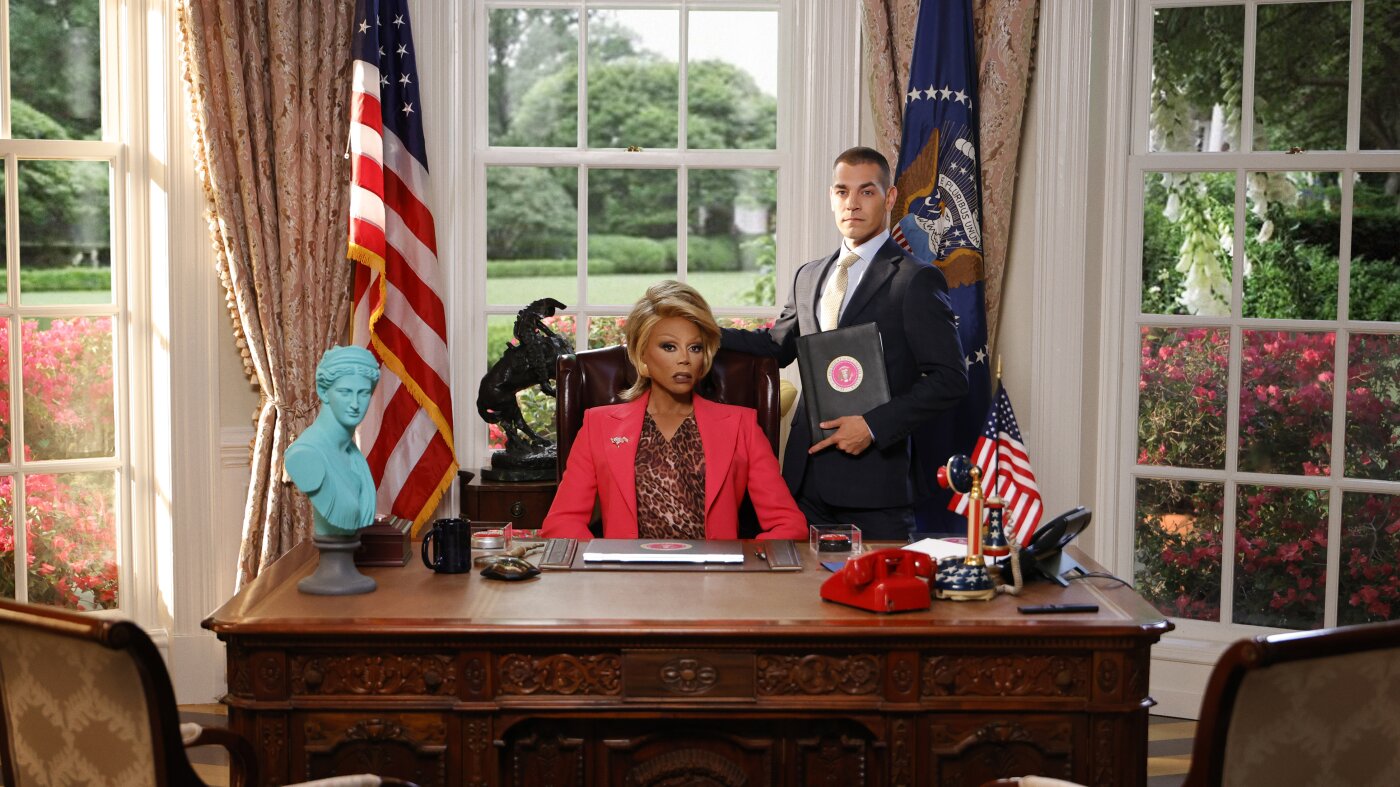
RuPaul and Matt Rogers in Stop! That! Train!
World of Wonder/Bleecker Street
hide caption
toggle caption
World of Wonder/Bleecker Street
When I tell you, reader, that the new film Stop! That! Train! plays exactly like an extended, slightly better-than-average Acting Challenge on a slightly better-than-average season of RuPaul’s Drag Race, some among you will nod sagely, and hie your butts to the theater in boisterous gaggles of girls, gays and theys. (A not-insignificant subset of you may also stop along the way to buy a box of cheap-ass blush wine so you can remove the bag and smuggle it into the theater, and I can’t stop you, that’s your own business.) Some among you will take that same report under advisement, secure in the knowledge that you’ll be fine waiting to stream it in the comfort of your own homes, where you’ve stashed enough champagne … to fill da Nile! Some among you — let’s face it, the younger, hotter, more evolved crowd that prefers your humor to grow organically out of things like characterization, cultural insight and dry wit — will grimace, and resolve to avoid it at all costs.
But the vast majority of you haven’t watched enough Drag Race to internalize its every formulaic tic, and thus won’t be able to glean any useful information from the comparison, so let me break it down for you.
Stop! That! Train! parodies ’70s disaster movies in exactly the way the 1980 film Airplane! did, which is to say: By submitting it to a ceaseless fusillade of broad, sweaty and very dumb jokes, by busting out a parade of game celebrity cameos and by deploying a just-shy-of-legally-actionable number of precisely the same gags.
The only salient difference turns out to be one of sensibility. Where Airplane!‘s humor chiefly arose from encasing its jokes in a thick layer of deadpan solemnity (think Leslie Nielsen’s Dr. “And don’t call me Shirley” Rumack), Stop! That! Train!‘s entire schtick is one of arch, winking camp (think Stephen Stucker’s Johnny, the hilariously queeny control-room worker who served as resident court jester/chaos gremlin).
So think of it as Airplane! with nothing but the Johnny jokes. In a word: drag.
Which only makes sense, as the film’s key roles are filled with queens from RuPaul’s Drag Race and those who love them. There’s Jujubee and Ginger Minj as DeeDee and Tess, two not-so-fresh-faced “train hostesses” whose low-rent rail service folds, causing them to bluff their way into jobs on a Glamazonian Express luxury bullet train.
They receive a frosty reception from the train’s trio of first-class hostesses, Amber (Brooke Lynn Hytes), Allie (Marcia Marcia Marcia, credited here as Marty Lauter) and the ridiculously spelled Ayshleiygh (Symone). Keep an eye out for Latrice Royale, Monét X Change and Angeria Paris VanMicheals while you’re at it.
If you’re finding yourself concerned that you’re eight paragraphs into this review and still don’t know what the movie’s actually about, just know that you, cookie, are not the target demographic for this particular project. But here goes: A high-speed train malfunctions on a cross-country journey and barrels into a series of mishaps involving an escaped scorpion, a haunted tunnel and a climatological event known as a “Stormaganza” while a lot of very funny people stand around making stupid, usually pun-adjacent jokes. Also: RuPaul sports a Deborah Vance wig to play U.S. President Judy Gagwell (see above, in re: pun-adjacency) and does some really stellar face-acting.

Ginger Minj and Jujubee.
World of Wonder/Bleecker Street
hide caption
toggle caption
World of Wonder/Bleecker Street
Also also: the great Rachel Bloom plays Donna, the only government official to understand the peril facing the train’s passengers and crew, whose dire warnings fall on the cartoonishly boorish, misogynist ears of her co-workers. (Her boss, played by Evan Mulrooney, delivers a masterclass in the kind of prideful, bullying willfulness currently stalking the halls of power; it’s the closest thing this defiantly silly little flick comes to a political statement.)
The whole thing’s over and done with in a brisk 90-minute trot, and you’ll have a very good time. Oh sure, you might find yourself squinting at the special effects, such as they are. Not because they evince the now-familiar muddiness of bad CGI, but because they instead bear the disquietingly bright, clean, sharp lines of AI slop. (Director Adam Shankman felt compelled to release a statement attempting to clarify the film’s status, which reads in part: “There are a sum total of ZERO shots conceived by AI in the movie.” [Emphasis mine, because he’d apparently already told Xtra Magazine that some AI was used, in combination with CGI.]) But in the end, the jankiness of the film’s effects only feed into the hey-queens-let’s-put-on-a-show vibe, not distract from it.
You may also find yourself wishing, as you watch drag queens trading barbs, flaring their nostrils and mime-slapping the bejeezus out of one another, that the barbs in question were better, meaner, fiercer. They’re mildly cutting when they could and should be lacerating, and they feel like place-holders. But the script’s downright neutronic joke-density ensures that you won’t be able to linger over such quibbles; so many more jokes are barrelling toward you that by the time the credits roll (do I need to tell you there’s a gag reel? Of course there’s a gag reel) the comedic signal to noise ratio will prove satisfying.
And hey, it’s Pride. You’re already out and about; why not top off your brief interlude with these cinematic queens by taking in a real drag show where IRL performers are waiting, tucked and plucked and working hard, sweating through their foundation to entertain you? Between numbers you can nip off to the bar and debate with your friends which one of the film’s dumb jokes was the absolute dumbest.
Trust me, you’ll be there a while.
-

 Pennsylvania4 minutes ago
Pennsylvania State Police issue over 6,000 citations during ‘Operation Hands Off’
-
South-Carolina7 minutes ago
Clemson receiver Tristan Smith granted temporary injunction for 5th season by South Carolina judge
-

 Rhode Island7 minutes ago
Hailey Bieber’s beauty brand Rhode launches summer tour in Newport
-

 South Dakota19 minutes ago
South Dakota leaders approve funding for projects in Rapid City, Lake County and Sioux Falls
-

 Tennessee21 minutes ago
Tennessee SNAP enrollment drops by more than 100,000 following federal rule changes
-

 Texas27 minutes ago
Deadly mass shooting in Texas
-

 Utah34 minutes ago
South Salt Lake AMBER Alert canceled about 30 minutes after initial notification
-

 Vermont37 minutes ago
Margaret Lapointe


