Washington, D.C
DC, federal employees and Trump's Department of Government Efficiency: What we know so far


President-elect Donald Trump’s promise to restructure federal agencies and cut bureaucracy could have a major impact on the D.C. area, where the government is the largest employer.
Tech billionaire Elon Musk and conservative activist Vivek Ramaswamy will lead a new Department of Government Efficiency, or DOGE for short, Trump announced Tuesday night. Despite its name, the group will function outside of government and not be a government agency.
“These two wonderful Americans will pave the way for my Administration to dismantle Government Bureaucracy, slash excess regulations, cut wasteful expenditures, and restructure Federal Agencies,” Trump said in a statement.
News4 is working to learn more about how DOGE could affect federal employees and the DMV. Here’s what we know so far.
What is the Department of Government Efficiency and how will it work?
Trump said in his statement that Musk and Ramaswamy will offer the White House “advice and guidance” and will partner with the Office of Management and Budget to “drive large scale structural reform and create an entrepreneurial approach to Government never seen before.” He added the move would shock government systems.
It’s not clear exactly how the organization will operate. It could come under the Federal Advisory Committee Act, which dictates how external groups that advise the government must operate and be accountable to the public.
Federal employees are generally required to disclose their assets and entanglements to ward off any potential conflicts of interest, and to divest significant holdings relating to their work.
The arrangement would likely allow Musk and Ramaswamy to continue working in the private sector and serve without Senate approval.
Trump didn’t immediately provide details about how the two men would work together or who might pay for the operations of the group.
Trump had made clear Musk would likely not hold any kind of full-time position, given his other commitments.
“I don’t think I can get him full-time because he’s a little bit busy sending rockets up and all the things he does,” Trump said at a rally in Michigan in September. “He said the waste in this country is crazy. And we’re going to get Elon Musk to be our cost cutter.”
Here are five things to know about Elon Musk.
How many federal employees are there in the D.C. area and what could job cuts mean for the DMV’s Black middle class in particular?
Of more than 2 million full-time federal workers across the U.S., more than 300,000 are concentrated in the D.C. metro region.
For generations of Black residents of the DMV, federal jobs have been a powerful driver of wealth and stability. Federal job cuts could be particularly devastating to Black communities in our region, as the News4 I-Team reported.
More than 18% of federal workers are Black, according to the most recent statistics from the Office of Personnel Management. That’s higher than the proportion of Black Americans that make up the country’s population, at just over 12%.
Unionized federal employee Aleseia Saunders, a mother of three who works for the Department of Education, told News4 her family constantly worries about changes to the federal workforce.
“What’s going to happen to my household? What’s going to happen to my paycheck? What’s going to happen to my career?” Saunders asked.
Black Americans have been drawn to federal jobs in part because of benefits that have often eluded Black employees in private workplaces, Howard University political science professor Marcus Board previously told News4.
“They have worker protections, federal worker protections, that are guaranteed by the federal government, and so it’s one of the few places where they can be sure that they’re going to be supported, protected and taken care of,” he said.
What do we know about the goals of the Department of Government Efficiency?
The president-elect has often said he would give Musk a formal role overseeing a group akin to a blue-ribbon commission that would recommend ways to slash spending and make the federal government more efficient.
Musk has said he wants to cut $2 trillion from the federal budget, which is more than the discretionary budget of $1.7 trillion. He has provided few details about what he’d like to cut, though he has attacked relatively small recipients of federal money, such as the Education Department and NPR.
“This will send shockwaves through the system, and anyone involved in Government waste, which is a lot of people!” Musk said in the statement released by Trump’s transition team.
On X, he added: “Threat to democracy? Nope, threat to BUREAUCRACY!!!”
Ramaswamy has called for mass layoffs at federal agencies, a tactic that could sidestep legal protections that otherwise insulate the federal civil service from targeted political cuts.
Ramaswamy campaigned for president in the Republican primaries on eliminating federal agencies, and his initial targets included the FBI; the Bureau of Alcohol, Tobacco, Firearms and Explosives; the Education Department; the Nuclear Regulatory Commission; and the Food and Nutrition Service within the Agriculture Department.
Trump said he wanted the department to help deliver “drastic change.” He compared its ambitions to those of the World War II project to develop atomic weapons.
“It will become, potentially, ‘The Manhattan Project’ of our time,” Trump said. “Republican politicians have dreamed about the objectives of ‘DOGE’ for a very long time.”
He gave a deadline of July 4, 2026, for the department to conclude its work.
What does the acronym DOGE reference?
“DOGE” is a nod to a meme and the dogecoin cryptocurrency associated with Musk.
How will the Government Accountability Office interact with the Department of Government Efficiency?
The Government Accountability Office (GAO), the main federal government watchdog, indicated it would provide any necessary information to the new entity.
“GAO has cooperated and shared information in the past when presidential or congressional commissions have been established to address the federal government’s programs and operations, as well as fiscal and other challenges. We will take that same approach with any new commissions formed and stand by ready to assist the new Congress and the Executive branch,” Gene Dodaro, United States Comptroller General and head of the GAO, said in part in a statement.
What do Project 2025 and Trump’s previous Schedule F executive order have to do with the Department of Government Efficiency?
Project 2025 is the right-wing think tank The Heritage Foundation’s sweeping plan for the incoming president. Its guidebook for Republican presidents has been published every four years for decades.
The document lays out the return of Trump’s Schedule F executive order, which was reversed by President Joe Biden. It would strip job protections from career officials in policy roles, make it easier to fire civil servants and require loyalty to the president.
Though former Trump officials helped craft Project 2025 and the plan praises Trump’s prior administration, the president-elect has distanced himself from the plan. He said in his debate with Vice President Kamala Harris that he had not read the document and will not read it.
The News4 I-Team asked experts on both sides of Project 2025 how the dismantling would affect the D.C. area’s Black middle class. News4’s Tracee Wilkins reports.
News4 sends breaking news stories by email. Go here to sign up to get breaking news alerts in your inbox.
Facing a possible overhaul to the federal workforce, Department of Housing and Urban Development employee Ashaki Robinson previously told News4 she loves her job and doesn’t want to even consider leaving it.
“It has created such a stability. People talk about my ‘good government job.’ My good government job has paid for a lot of things,” she said.
This article includes reporting by NBC News’ David Ingram and Vaughn Hillyard, The Associated Press’ Colleen Long and Jill Colvin, and NBC Washington’s Tracee Wilkins and Caroline Tucker



Washington, D.C
DC reaches settlement with man detained while protesting troops with Darth Vader song

The District of Columbia has reached a settlement agreement for an undisclosed amount of money with a resident who claims police illegally detained him for following an Ohio National Guard patrol while playing Darth Vader’s theme song from “Star Wars” on his phone — an act of protest against the Trump administration’s federal law-enforcement surge in the nation’s capital.
A court filing late Thursday says the plaintiff, Sam O’Hara, will drop his lawsuit’s claims against the District and four Metropolitan Police Department officers within three business days of receiving the settlement payment. The filing doesn’t specify a dollar amount for the deal between the district and O’Hara, who is represented by the American Civil Liberties Union of the District of Columbia.
In an email on Friday, an ACLU spokesperson referred to the settlement’s financial terms as “a significant amount” that O’Hara “is pleased with” but said they aren’t disclosing the dollar figure to protect his privacy. A spokesperson for D.C. Attorney General Brian Schwalb’s office declined to comment on the settlement.
O’Hara’s agreement with the district doesn’t resolve his related claims against an Ohio National Guard member. Attorneys for the Guard member, Sgt. Devon Beck, have asked a judge to dismiss O’Hara’s claims against him.
“He was there because that was his assigned duty,” Beck’s lawyers wrote. “This was not an accidental encounter or a one-time disagreement on a public sidewalk.”
An earlier court filing, in February, said O’Hara had reached a settlement agreement “in principle” with the district. In response, a judge agreed to suspend the case while they negotiated terms.
O’Hara sued the district last October, claiming police officers violated his First Amendment rights to free speech and his Fourth Amendment rights against unreasonable seizures and excessive force.
The ominous orchestral music of “The Imperial March” from Star Wars movies was the soundtrack for O’Hara’s peaceful protests against President Donald Trump’s ongoing deployment of Guard members in Washington. Millions of TikTok users have viewed O’Hara’s videos of his interactions with troops, according to his lawsuit.
A series of major events tied to the nation’s 250th anniversary celebrations promise to bring big crowds and heightened security. On the News4 Rundown: That security is likely to include more National Guard troops as a new report says there’s a limit to their impact on safety in D.C.
O’Hara, an artist who works in the hospitality industry, says he didn’t interfere with the Guard troops during their Sept. 11, 2025, encounter on a public street. One of the troops summoned Metropolitan Police Department officers, who stopped O’Hara and kept him handcuffed for 15 to 20 minutes before releasing him without charges, according to the lawsuit.
“The law might have tolerated government conduct of this sort a long time ago in a galaxy far, far away. But in the here and now, the First Amendment bars government officials from shutting down peaceful protests,” the suit says.
Trump, a Republican, issued an executive order declaring a crime emergency in Washington last August. Within weeks, hundreds of Guard troops and federal agents were helping police patrol the city. The surge inflamed tensions with residents of the heavily Democratic district. Hundreds of Guard members remain deployed in the district nearly a year later, with no clear end in sight.
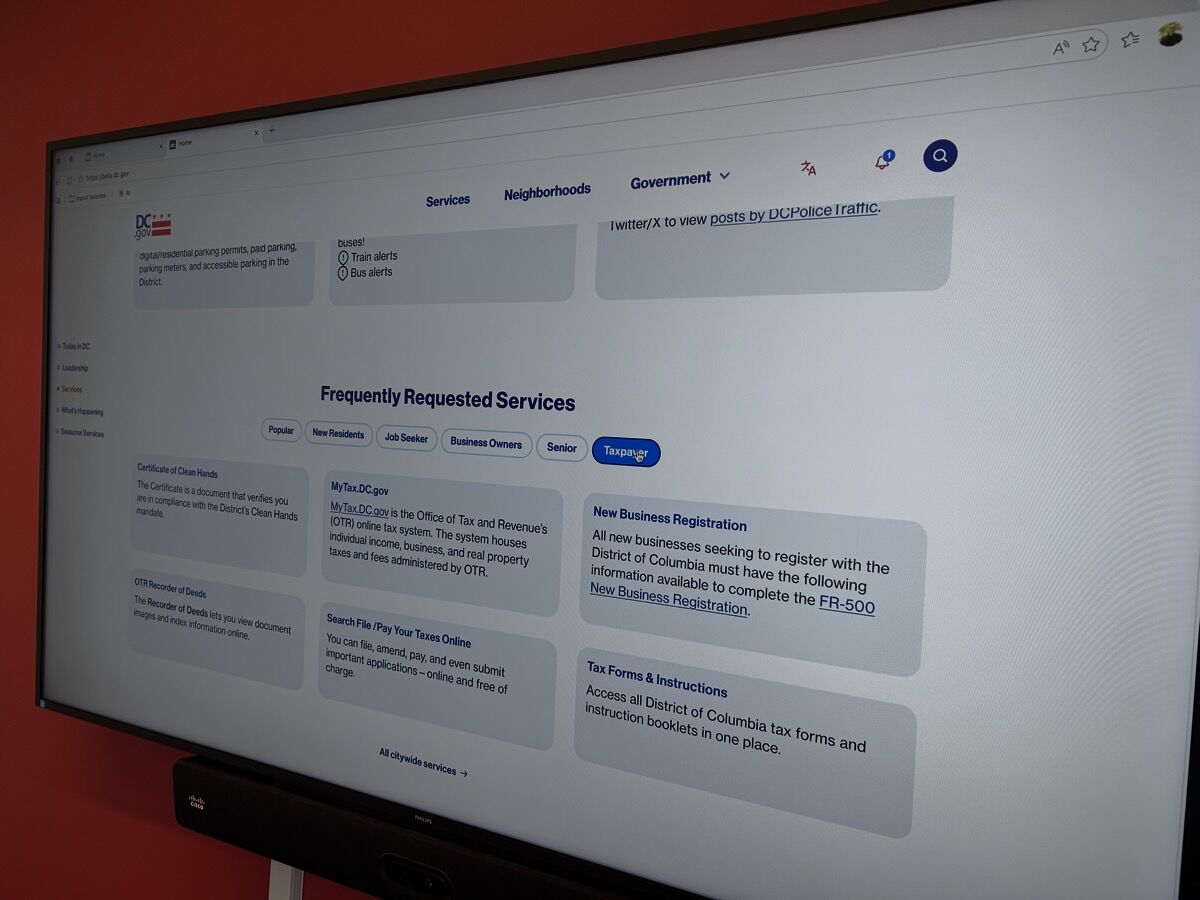
The overhaul is the first in more than a decade and comes in response to feedback that it’s hard to find information on the current site without being efficient at using Google or other search tools.

The D.C. government’s website is getting a complete revamp, a step city leaders hope will make it easier for residents, visitors and business owners to access the help they need.
The District unveiled a beta version of the new DC.gov — beta.dc.gov — and plans to have the redesigned site ready to launch before the end of the year.
The website’s overhaul is the first in more than a decade. It comes in response to feedback that it’s hard to find information on the current site without being efficient at using Google or other search tools.
“This website, it’s really going to eliminate the alphabet soup that you have to remember every day,” said Stephen Miller, the District’s chief technology officer. “So, do you need to know that it’s DPW that’s picking up your trash, or you just need to know that it’s dc.gov?”
The site is built on Drupal 11, which the city said has stronger built-in security features. It includes an integrated calendar and sections for seasonal government services.
Popular searches, based on site traffic data, will also be featured prominently on the main page.
“It’s going to show you, here’s popular services today, based on being a resident, based on being a new resident, based on being a job seeker, based on being a business owner, or based on just being a general resident of the city,” Miller said.
The project cost about $500,000 in dedicated funds.
“We’re setting this up so that you can just go in, say, ‘My trash was missed,’ and it’s going to tell you exactly how to fix that problem,” Miller said.
D.C.’s Office of the Chief Technology Officer is collecting feedback. Residents can leave comments on the beta site and at events at Haynes Senior Wellness Center and Eastern Market, among others, in the coming weeks.
An artificial intelligence-powered search tool, built using Google’s AI technology, will be included on the new DC.gov site after its official launch.
The District, Miller said, is “trying to clean up our content, because what we want to make sure is when we put AI into this site, it’s giving you the right information.”
“We see a lot of future use with AI,” Miller said. “I’d love to get to a point where it’s, ‘Hey Siri, renew my driver’s license,’ and we’ve laid out the foundation for something like that to happen in the future.”
Get breaking news and daily headlines delivered to your email inbox by signing up here.
© 2026 WTOP. All Rights Reserved. This website is not intended for users located within the European Economic Area.

A 16-day state fair is among the biggest attractions of the country’s 250th celebration in Washington DC. The Great American State Fair, which features attractions from each of the 50 states, runs from 25 June to 10 July across the National Mall from the US Capitol to the Washington Monument.
The BBC asked visitors why it was important for them to attend the fair.
Video by Meiying Wu
Produced by Madeline Gerber
-

 Los Angeles, Ca41 minutes ago
Watch Project Angel Food's 'Lead with Love' telethon on KTLA
-

 Detroit, MI1 hour ago
Metro Detroit weather forecast, June 26, 2026 — 4 p.m. Update
-

 San Francisco, CA1 hour ago
Newlyweds celebrate Pride-themed weddings inside SF City Hall as parade preparations underway
-

 Dallas, TX1 hour ago
All Dallas restaurants firing up specials for July 4th and America’s 250th
-

 Miami, FL1 hour ago
Helping Venezuela: State Department deploys Miami-Dade search-and-rescue team
-

 Boston, MA1 hour ago
Photos: Norway takes on France in high-powered World Cup matchup in Foxborough – The Boston Globe
-

 Denver, CO2 hours ago
Denver Transplant Games sets Guinness World Record for mos living donors, recipients in one place at one time
-

 Seattle, WA2 hours ago
How to watch Egypt vs. Iran World Cup match in Seattle

