Alaska
9 Close-Knit Towns to Visit in Alaska


Big in the wilderness and formidable in landscape features, Alaska also contains small, tight-knit communities where history, culture, and nature remain perfectly preserved. Because the formidable Alaskan landscapes have fewer than one person per square mile, towns and villages in the state have residents that forge relationships as enduring as the mountain chains and rivers here. Beyond the big towns, name any other city in Alaska, and it has something unique to say, be it about the Gold Rush, Native Alaskan’s heritage, or just plain everyday survival. From the end of the Iditarod in Nome to the artist haven of Ester, tradition, regard for the land, and welcome hospitality abound.
Nome
Rich history, Gold Rush charm, and exuberant community spirit set Nome apart as one of the most uniquely different towns. Located on the southern Seward Peninsula along the Bering Sea, Nome is designated as the finish line to the internationally famous Iditarod Trail Sled Dog Race, the longest-running dogsled race anywhere in the world, running 1,049 miles.
Polar Café presents a warm, country-like atmosphere, while the Bering Sea Bar & Grill offers fresh catches of the day and typical Alaskan dishes representing Nome hospitality. During summer, the community embraces the absence of night with an annual event appropriately labeled the Midnight Sun Festival, centered around music, food, and cultural events.
The village is proud of its roots, which are fully displayed in The Carrie M. McLain Memorial Museum. This site enables guests to seek out the Gold Rush past of Nome, significant exhibitions about early pioneers, and Native Alaskan cultures that shaped the area. Outdoorsy folks might also want to try Anvil Mountain for views over Nome, providing a glimpse into its significance in the Cold War – with four massive “White Alice” antennas still standing here.
Haines

Placed at the northern end of the Lynn Canal, Haines is known for its spectacular natural beauty and incredible array of wildlife, all combined with a unique, small-town atmosphere. It is one of the most preferred destinations for North American eagles in the continent, where each November, Haines hosts the Alaska Bald Eagle Festival. This is a nature lover’s confluence to marvel at up to 3,000 eagles congregating in the Chilkat Valley.
The Haines Sheldon Museum and Cultural Center offers detailed insight into the town’s rich Tlingit heritage, as brought into view by artifacts and art representative of stories of tradition from the area’s indigenous people.
Local businesses such as the Port Chilkoot Distillery offer handcrafted spirits in small batches inspired by the region. When it is open, Sarah J’s Espresso Shop is a haven where residents can connect over coffee and fresh pastries. The Chilkat Valley, with its virgin beauty, is somehow a statement of the town’s efforts of preservation and attachment to nature and relationships within its community.
Juneau
A scenic view of Juneau, Alaska. Editorial credit: Darryl Brooks / Shutterstock.com
Juneau is one of the most recognized municipalities in Alaska. As its capital, it is also one of the most heavily visited locations in the state. Alongside the Gastineau Channel and against mountains and wilderness, few towns have the natural appeal that Juneau has. Mendenhall Glacier is an excellent example: a nearly 14-mile expanse of ice offering recreation for tourists and locals year-round.
The Alaska State Museum features interactive exhibits on Native Alaskan cultures, early Russian colonies, and indigenous artwork that showcase the true history of The Last Frontier. Other local businesses, such as the Alaskan Fudge Company (best known among the town’s folks for its handmade sweets) and Salt Restaurant, for its inventive take on Alaskan food, offer a warm and inviting experience.
Every even-numbered year, tribes of Tlingit, Haida, and Tsimshian gather for Celebration in a big event of dance, music, and art; such an occasion gives Juneau pride in its indigenous culture, instilling respect in unity within the community.
Homer
Dubbed the “Halibut Fishing Capital of the World,” Homer boasts world-class sport fishing, stunning scenery, and small-town hospitality. Outdoorsy types can head down the Homer Spit: 4.5 miles of real estate jutting into Kachemak Bay, lined with galleries, shops, restaurants, and eateries reflecting Homer’s individual and creative spirit. The Alaska Islands and Ocean Visitor Center features exhibits and educational programs on local marine ecology, allowing visitors to learn about the numerous ecosystems surrounding Homer.
Local businesses include hot spots such as the Bunnell Street Arts Center, which rotates exhibits throughout the year featuring Alaskan artists, and Two Sisters Bakery, which serves homemade pastries and many quirks.
Seward
Seward is often considered to be one of the prettiest communities in Alaska, both for the tightness of its neighborly spirit and its access to the fantastic sights of Resurrection Bay and Kenai Fjords National Park. This national protected space offers much to the outdoor enthusiast, including spectacular views of the native wildlife here, like otters, whales, and puffins.
Although smaller compared to other towns like Juneau, Seward has its set of local businesses that travelers love: Zudy’s Café for fresh baking and The Cookery, which has fresh soul foods and plenty of choices for the visitors.
If all this was not enough to keep Seward going, it also hosts the Mount Marathon Race, a yearly grueling running event up and down Mount Marathon.
Ester
Ester is a quaint little town just outside Fairbanks with a personality all its own. Rooted in Alaska’s gold mining history, it’s a place where the past and creativity seemingly blend effortlessly. The locals like to make a stop or two at places like the Golden Eagle Saloon, a dive with an appealingly rustic quality, home to live music and greasy food. You also want to visit the Ester Community Market, a locale filled with handmade crafts, fresh produce, and friendly faces.
The summer’s high point is the Ester Funk Festival, which colorfully unites artists, musicians, and makers from all over to enjoy the free-spirited vibe in town. This is a great place for anyone to see the real, quirky Alaska.
Hoonah
Hoonah is the biggest Tlingit village in Southeast Alaska and offers visitors a real plunge into Alaskan Native culture and hospitality. On Chichagof Island, Hoonah has the tourist destination of Icy Strait Point, which includes whale-watching excursions, Native American heritage learning packages, and natural beauty exploration. The architectural genius of Huna Tribal House, with all the intricate carvings, showcases the strength of the community and pride in their culture.
Businesses like Hooked Adventures, offering fishing tours, and the renowned gift shop The Fishermen’s Daughter contribute toward making Hoonah welcoming. Hoonah Harbor Days are annual events bringing together residents and visitors for the town’s nautical history and Native traditions that develop pride and camaraderie among the people.
Talkeetna
Talkeetna lies right at the foot of Denali and offers a little Alaskan attitude mixed with adventure and humor. People come from around the state to the annual Moose Dropping Festival, aptly named for its games, contests, and light-hearted fun. The festival celebrates Talkeetna’s pride in its unique community.
For those who want to know more about the community, the Talkeetna Historical Society Museum is a place that will show you how the settlement was started as a supply station for expeditions through Denali.
Converse with locals about the culture; visit the Denali Brewing Company, which serves fine crafts in beers, or Talkeetna Roadhouse, which is famous for feasts combined with friendliness. Vibrant residents and the richness in history make Talkeetna a warm, inviting stop in any Alaskan adventure.
Wrangell
Wrangell is a tiny town on Wrangell Island, Southeast Alaska, full of small-town charm and community spirit. The Wrangell Museum features great exhibits on the Tlingit heritage of this area, Russian influences, and logging history, thus offering a very interesting perspective on the past life in town.
Meanwhile, the annual Wrangell Bearfest celebrates the remarkable population of bears in the area. This is where locals and guests join in for educational presentations, guided tours, and a community barbecue.
With water-view hangouts like the Stikine Inn and Stik Cafe, it’s easy to converse with locals over a hot drink. The beautiful natural surroundings and friendly residents make Wrangell the perfect town for visitors who enjoy its history and nature with a side order of hospitality.
Discover the Heart of Alaska’s Tight-Knit Towns
Alaskan small towns are more than beautiful getaways – they are communities within which residents have family bonds and preserve traditions that still reverberate with the state’s pioneering spirit. From Homer’s bustling halibut fishing docks to Hoonah’s busting cultural festivals, every place opens some panoramic view of the unique tapestry of Alaskan life. In venturing through these tight-knit towns, visitors are afforded a genuinely authentic experience that far outstrips the awe-inspiring landscapes and provides a much deeper insight into what it’s like to live, work, and celebrate in America’s Last Frontier.



Alaska
Man with same name as Alaska Sen. Dan Sullivan can appear on GOP primary ballot, state’s Supreme Court rules

The battle of the Dan Sullivans is on.
The Alaska Supreme Court ruled Monday that a man with the same name as Republican Sen. Dan Sullivan can challenge the sitting lawmaker in the state’s GOP Senate primary in August. The high court upheld a ruling from a lower court judge that cleared the way for Daniel J. Sullivan to appear on the primary ballot, reversing a decision by state officials earlier this month that he was ineligible because he was allegedly trying to confuse voters.
The state Supreme Court directed Alaska’s Division of Elections to decide how Daniel J. Sullivan should be listed on the ballot “within the confines of existing Alaska ballot design law.”
The conflict is taking place in one of the country’s most closely watched Senate elections. The sitting Sen. Sullivan is running for a third term, but former Democratic Rep. Mary Peltola is vying to challenge him, setting up what could be an unusually competitive race in a deep-red state that hasn’t elected a Democrat to the Senate in almost 20 years.
The senator has called his same-name competitor a “sham candidate” and accused him of trying to trick voters and help Democrats flip the seat. Daniel J. Sullivan — a retired teacher and former U.S. Forest Service employee from Petersburg, Alaska — has denied those allegations and insisted he is both qualified and genuinely interested in running for Senate.
About two weeks ago, the Alaska Division of Elections determined that the challenger Sullivan could not appear on the ballot, arguing his paperwork “was not filed in order to declare an actual good-faith candidacy, but was instead filed with a purpose to confuse or mislead.”
In a letter to the candidate, Director Carol Beecher pointed to the fact that Daniel J. Sullivan had initially requested to appear on the ballot as “Dan Sullivan,” the same name format as the senator. She also wrote that he hadn’t previously been affiliated with the state Republican Party, had a website design that “appears to be deliberate[ly]” similar to the senator’s campaign site and had worked with a political consultant with links to Democratic candidates.
Daniel J. Sullivan asked a state court to reverse the decision. On Friday, Judge Thomas Matthews ruled in his favor, finding the non-senator Sullivan met the requirements to run for U.S. Senate and the state didn’t have the authority to exclude him based on “good faith.”
“The court does not minimize the Division’s concern that voters should not be misled,” the judge wrote. But he added that “Alaska election law gives the Division tools to address that concern,” including regulating how candidates appear on the ballot.
With ballots set to be printed this week, the issue was appealed to the Alaska Supreme Court on an expedited basis, with both sides filing court papers over the weekend.
The state Division of Elections asked the high court to overturn Matthews’ ruling, arguing it would “leave Alaska constitutionally required to permit bad-faith ballot access.” The agency said it reached its conclusion about Daniel J. Sullivan after it received a complaint from the National Republican Senatorial Committee “credibly alleging” he was seeking to “cause voter confusion” and made a “bewildering” request to appear on the ballot with the senator’s middle initial.
If Daniel J. Sullivan is permitted to remain on the ballot, the state asked the Alaska Supreme Court to allow it to print his full name and list his party affiliation as “nonpartisan” to “ensure voters are not forced to guess between two nearly identical names.”
The Alaska Republican Party and several GOP-led states filed amicus briefs siding with Alaska.
Daniel J. Sullivan’s lawyers, meanwhile, argued the state “lacked any basis in Alaska law to exclude Mr. Sullivan from the ballot” and didn’t have the power to look into his “private motivations.” They wrote that state law doesn’t give officials the power to keep qualified candidates off the ballot due to potential confusion.
“[All] that Mr. Sullivan asks here is to be listed on the ballot, and the Division is obviously empowered to do so in a non-confusing manner,” his lawyers wrote.
Following oral arguments, the high court sided with Daniel J. Sullivan in a two-page order late Monday, and said it would issue a fuller opinion at a later date.
Jeffrey Robinson, an attorney for Daniel J. Sullivan, told CBS News his legal team is “grateful” for the Alaska Supreme Court’s decision to “affirm Judge Matthews’ well-reasoned, thorough order vacating the Division’s unlawful decision to exclude Mr. Sullivan as a candidate.”
“We expect that the Division will act in full compliance with existing Alaska ballot design law in its preparation of the ballots,” Robinson said in an email.
The senator’s campaign spokesperson, Nate Adams, said: “We’re disappointed in the court’s decision because as the sham candidate Dan J. Sullivan’s lawyers made clear in their legal arguments, the only reason he is running is to deceive voters and manipulate Alaska’s election system.”
“However, we are encouraged by the fact that the Director of the Division of Elections will be able to use her expertise to differentiate between the Petersburg fraud and the incumbent — Senator Dan Sullivan — to the benefit of Alaska voters,” Adams said.

The first Jesuit missionaries in Alaska sailed up the Yukon River in 1887. By the turn of the 20th century, the religious order of the Catholic Church had as many as 50 Jesuits in the state.
Now, only two remain. And by the end of June, there will be none.
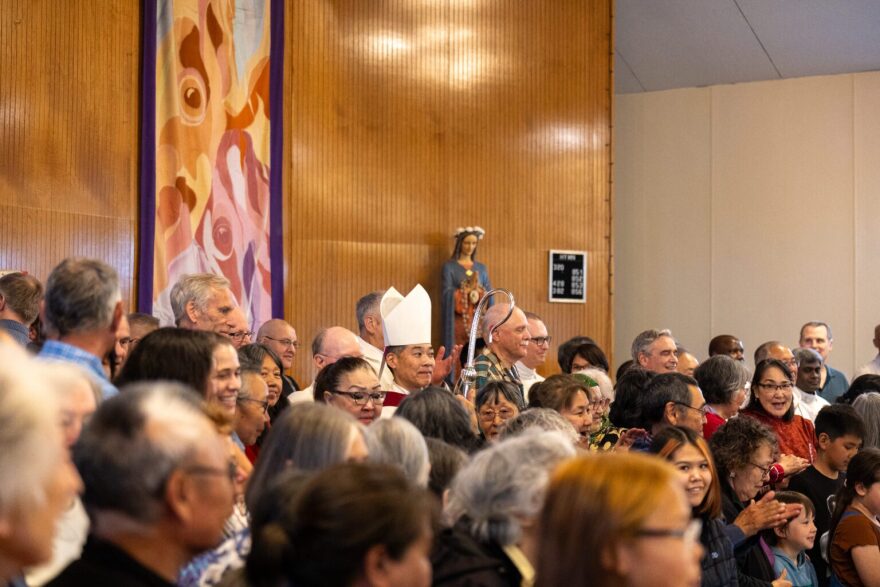
The Jesuits’ nearly 140 years in the state was honored at an event at Bethel’s Immaculate Conception Church on June 16. A procession of priests wearing long white gowns with red hems walked down the aisle to open the event. The Bishop of the Diocese of Fairbanks, Stephen Maekawa, thumped the ground with a shimmering silver staff known as a clozier as he approached the altar.
“My brothers and sisters, we gather together to celebrate this wonderful and blessed occasion to acknowledge the love of God and the work of God through the 139 year mission of the Society of Jesus of the Jesuit fathers,” Maekawa said to open the event.
A traditional Catholic mass followed, with readings in both English and Yup’ik. During the sermon, Maekawa acknowledged the vastness of the Fairbanks diocese, and the tremendous amount of work done by the Jesuits to establish it.
“All of the 46 churches of the Diocese of Fairbanks that we currently have were established by either the Jesuit fathers or by direction of a Jesuit bishop,” Maekawa said. “We have a long history of the Society of Jesus’ presence and ministry here in all of Alaska.”
The Jesuits are an order within the Catholic Church, akin to the Dominicans or Franciscans. They have a reputation for taking on some of the Catholic Church’s most remote assignments.
That missionary spirit brought the Jesuits to the Yukon River in 1887, where they built churches, schools, and ministries. Without their work, Catholicism may not have taken root in huge swaths of Alaska, particularly among Alaska Native communities.

But the Jesuits leave a complicated legacy. Their methods of converting Native people to the religion, particularly in the first half of the 20th century, created generational traumas still felt to this day.
Fr. Sean Carroll is the provincial of the Jesuits West Province, which oversees Alaska and nine other states.

“Thank you for all that you have taught us about who Jesus is and how to love and serve Him wholeheartedly,” Carroll said. “I also thank you for your patience with us. For there have been times when we have sinned and when we have hurt you.”
Missionaries, including the Jesuits, forcefully converted and assimilated Alaska Native people into Western culture and religion. Students at Jesuit-run boarding schools were forced to abandon their Native languages and physically punished when caught speaking languages other than English. Native dancing and drumming were also banned.
The Jesuits West Province maintains a list of 150 Jesuits with credible claims of sexual abuse against minors or vulnerable adults. A quarter of the accused Jesuits served in Alaska at some point in time.
“I ask for your forgiveness for all that we have done that was not rooted in Christ and love for Him, and for when we did not value your culture nor recognize the presence of God in you,” Carroll said.
Carroll gave the order to withdraw from the state last spring. A big issue was the recruitment of Jesuits willing to travel and serve in remote villages. He told the congregation that the Jesuits’ work would continue, just without a permanent presence.

Fr. Rich Magner is one of the two remaining Jesuit priests in Alaska. His last day serving Chevak, Hooper Bay, and Scammon Bay is June 30.
“We all always knew coming in, or should have known, that we’re not going to be here forever. It’s going to be mission accomplished at some point,” Magner said. “And then we hand it off to the diocese that we’ve helped create, and so that’s a good feeling.”
Magner’s next stop is a Clinical Pastoral Education residency in Tacoma, Washington.
The other remaining priest, Fr. Tom Provinsal, first came to Alaska in 1968 to teach. A fond memory, he said, was meeting Elders that practiced traditional subsistence lifestyles.
“Some of the grandmothers, their fingers were just all bent with arthritis and stuff like that, you know, their whole lives they’ve been working out in the cold and the wet, doing food, sewing, all that kind of stuff,” Provinsal said. “I’d say I just feel very privileged to have come when I did come and to see that.”
Provinsal returned in 1975 as a priest and has served in the region ever since. After moving away, he plans to take a five month sabbatical. What happens next, he said, is in God’s hands.
Two lines formed in the aisle for communion at the end of the mass. After taking communion, Bethel’s Parish Administrator Susan Murphy gave a final thank you.
“It’s difficult to say goodbye to people who have been a part of our lives for so long,” Murphy said. “We know that you have done what was yours to do, and have taught us to do what is ours to do. We are grateful.”

Dominic Hunt, a Yup’ik deacon that flew in from Emmonak for the event, led the congregation through a final prayer.
“Bless them with your wisdom, that they may be a word of hope, a world in need. We ask this through Christ, our Lord. Amen,” Hunt said.
About 70 people posed for a photo on the altar – priests, deacons, parishioners, Elders and children — many of them smiling, some standing quietly.
The photo doesn’t tell the whole story. But it’s a moment when gratitude, grief, and memory all shared the same room.

JUNEAU, Alaska (KTUU) – The Supreme Court of Alaska will be taking up the case of the State of Alaska, Division of Elections v. Daniel J. Sullivan, Jr.
The oral arguments will be held Monday at 10 a.m. via Zoom, according to an order and opening notice.
The document also specifies that a decision is expected to be made before noon on Tuesday.
According to documents from the Division of Elections, the state must start printing ballots at noon on the same day.
This comes after an Anchorage Superior Court Judge ordered Dan J. Sullivan on to the ballot Friday.
See a spelling or grammar error? Report it to web@ktuu.com
Copyright 2026 KTUU. All rights reserved.
-

 Movie Reviews9 minutes ago
Movie Review – Minions & Monsters (2026)
-
World21 minutes ago
Pope issues last-ditch appeal, begs breakaway traditionalist group to back off bishop consecrations
-
 Lifestyle59 minutes ago
How should we behave online? : It’s Been a Minute
-

 Technology1 hour ago
After a great start, DC’s new cinematic universe is already slowing down
-

 World1 hour ago
UK asylum seekers could have to pay government $13K before applying for settlement
-

 Politics1 hour ago
Fetterman unleashes on ‘dirtbag’ wing of Dems after far-left victories: ‘Orgy of socialism’
-

 Health1 hour ago
Doctors thought man had brain cancer — they found live tapeworms instead
-

 Sports1 hour ago
Paraguay stuns four-time World Cup champions Germany in penalty shootout after controversial call

