Entertainment
Can arts festivals matter anymore? LA28 Olympics can prove they do, with Salzburg as inspiration


The well-run 1984 Olympics transformed Los Angeles. Not through the Games, which thrillingly came and went, but through the Olympic Arts Festival, which taught us to dream and inspired us to do. Forty year later, we have added Walt Disney Concert Hall, Los Angeles Opera, the Getty Center, the Soraya, the Geffen Playhouse, the Hammer Museum, the Wallis, the Nimoy, the Industry, L.A. Dance Project, Wild Up, the Broad museum and the Broad Stage. The Olympic Arts Festival turned us into an arts capital in a remarkably short period of time.
Now that Paris has symbolically handed the Olympic torch back to us, our Games in 2028 no longer seem so far away. By then, we will have added Frank Gehry’s new Colburn Center, a 1,000-seat concert hall with the potential of turning Grand Avenue into an avenue of the arts unlike any in the world. A short Metro ride away will be the Los Angeles County Museum of Art’s new Peter Zumthor-designed David Geffen Galleries.
This leaves the arts community excited and galvanized but also alarmed after Casey Wasserman, chairman of LA28, the private group putting on the L.A. Games, said following the closing ceremony in Paris: “We don’t have an Eiffel Tower. We do have a Hollywood sign.” Tom Cruise’s motorcycle tour from the boulevards of Paris to the Hollywood Hills in the ceremony’s tacky finale only increased concern. Meanwhile, the death on Sept. 30 of Robert Fitzpatrick, the force of nature behind the 1984 Olympic Arts Festival, has reminded us what he accomplished.
Obviously, in a changed city and a changed world, we hardly require a replay of the 1984 Olympic Arts Festival. But what? Should the ’28 model resemble the current PST Art festival of exhibitions related to science? Funded by the Getty, institutions throughout the region have come up with projects — and we get whatever the cat drags in. Or might the recently appointed chair of the LA28 Cultural Olympiad, Maria Anna Bell, a former Museum of Contemporary Art board chair, and her advisor, Nora Halpern, an art historian and curator based in Washington, D.C., the last two decades, find novel inspiration from Fitzpatrick’s brilliantly curated festival?
Tenor Sean Panikkar in Peter Sellars’ production of Prokofiev’s “The Gambler” at the 2024 Salzburg Festival.
(Ruth Walz / Salzburg Festival)
The Cultural Olympiad (can’t we go back to the friendlier Arts Festival?) is special. It is the only aspect of the Olympics that needn’t be politicized or commercialized. The budget for 1984 was $20 million. The Times set the festival rolling as the main sponsor with a $5-million donation. Around $6 million came from ticket sales. The Olympics supplied the rest. Fitzpatrick used all of it as he saw fit.
Two days after the closing ceremony in Paris in August, I flew to Austria, where I spent two weeks at the annual Salzburg Festival. Its 62-million euro budget ($67.8 million) puts Salzburg on a similar scale to the 1984 Olympic Arts Festival when adjusting for inflation. More important, grand and consequential Salzburg markedly demonstrates what makes festivals matter.
A festival in Mozart’s picturesque birthplace at the foot of the Austrian Alps, a city that attracts hordes of summer tourists along with well-heeled audiences in formal dress, may not exactly suit L.A. But L.A., in fact, serves as an inspiration for Salzburg.
This year, Peter Sellars’ new production of Prokofiev’s opera “The Gambler” and Gustavo Dudamel’s concert with the Vienna Philharmonic were among the highlights.
The festival itself needs no contrived theme. Instead, it becomes, as did our 1984 Arts Olympic Festival, an activist lens onto the world. In 1992, while Sellars was the director of the Los Angeles Festival (which grew out of the Olympic Arts one), he began staging opera in Salzburg, helping revolutionize what had become a stodgy music industry event. Indeed, Markus Hinterhäuser, the festival’s visionary artistic director, told me that Sellars is his most important artistic guide today.
On my first day in Salzburg, I headed for an 11 a.m. concert featuring Riccardo Muti conducting the Vienna Philharmonic in Bruckner’s monumental Eighth Symphony. The full Festspielhaus, the festival’s largest hall, had a worshipful air. We listened in rapt, reverential awe, cozied by Vienna’s velvet strings, velvet winds and velvet brass woven together in a perfect tapestry of lush sonic textures and instrumental colors.

Peter Sellars, photographed this year in Salzburg.
(Jan Friese / Salzburg Festival)
That evening, in an again packed Festspielhaus, Daniel Barenboim conducted the West-Eastern Divan Orchestra in another monumental Eighth Symphony, Schubert’s “Great,” (confusingly known as Schubert’s Ninth outside Austria and Germany). In place of velvet and luxuriant lushness, there was fixating intensity and raw power. The ensemble was so grounded that the feeling here was of everyone giving everything they had to hold the symphony — and symbolically the world — together.
Both Eighths were occasions for community. The Divan is a training orchestra founded 25 years ago by Barenboim and Palestinian American scholar Edward Said to bring together young musicians from Israel and Middle Eastern Arab countries. The orchestra’s current members had spent the last year during the war in Gaza studying at the Barenboim-Said Akademie in Berlin, learning to work through their profound differences for a common cause.
To witness them supporting one another musically and showing inspiring devotion to a frail Barenboim, suffering from a debilitating neurological disease, may be the only gleam of hope we have for peace. At the end of what the players clearly knew was a performance of a lifetime, they lingered onstage, hugging one another. Tying the day together, the Vienna Philharmonic concertmaster that morning was a 27-year-old Muslim violinist from Nazareth, Yamen Saadi, who who got his start at age 10 in the Divan.
This first day became an introduction to the way that knowing creation can bring together a wide range of sources that result in a brave and profound cultural diplomacy, which is a disastrous lost art. This was furthered in much of what I attended during the festival.
Three major opera productions in Salzburg threw needed light on Russia and Ukraine. Two were Russian operas based on Dostoevsky novels: Prokofiev’s little-known “The Gambler” and Mieczyslaw Weinberg’s all-but-unknown “The Idiot.” Presented as compelling theater, they brought in-depth insight into our often simplistic attempts to understand the Russian mind, with its complex aspirations, fears and insecurity that can lead to greatness, grandiosity or outright malevolence.
Sellars revealed “The Gambler” as the dazzlement of addictive behavior, a road map for losing one’s mind. In gripping, high-wire performances, American baritone Sean Panikkar as Alexei succumbs to roulette. Lithuanian star soprano Asmik Grigorian as Polina loses her mind to nihilism. Young Russian conductor Timur Zangiev barreled through Prokoviev’s restless score with compulsive and relentlessness virtuosity.
“The Idiot” is a nearly five-hour slog by a Polish-Russian contemporary of Shostakovich about another Dostoevsky outsider who succumbs to visions of grandeur. But Weinberg’s 1985 barely known gloomy opera is also a profound demonstration of how and why misplaced power can destroy society. And thanks to a terrific cast, led by sensational Ukrainian tenor Bogdan Volkov, and the vivid conducting of Mirga Grazinyte-Tyla’s sleekly modern production by Polish director Krzysztof Warlikowski, “The Idiot” turned out to be Salzburg’s hottest ticket.

A scene from Krzysztof Warlikowski’s production of Weinberg’s “The Idiot,” at the 2024 Salzburg Festival.
(Bernd Uhlig / Salzburg Festival)
Unfortunately, the night I attended, Grazinyte-Tyla had taken ill and had been replaced by her assistant, Oleg Ptashnikov. But video of the production with the colorful Grazinyte-Tyla can be streamed via stage-plus.com and, as can “The Gambler,” on medici.tv.
What made Salzburg special and a little shocking was its daring belief in cultural diplomacy. This included bringing back Teodor Currentzis to lead a revival of an avant-garde production of Mozart’s “Don Giovanni.” The controversial Russian-based Greek conductor has been banished from the majority of Western institutions. While never expressing support for the war in Ukraine, Currentzis is said to have received funding for his Russian ensemble from corporations with ties to Russian President Vladimir Putin.
But Currentzis is also controversial because he is, on one hand, an obsessive perfectionist and, on the other, a showy radical with highly original musical ideas. All of that shows up in the “Don Giovanni,” which came close to perfection and extreme reinvention.
The surreal, visually hypnotizing production by Italian director Romeo Castellucci made little effort to make narrative sense. What’s an upside-down car hanging from the ceiling got to do with anything? But somehow the imagery, mostly against a bare stage, focused attention on a performance in which every single note, sung or played, every movement, every physical object, seemed to have been thought through and was riveting.
This international cast, led by striking Italian baritone Davide Luciano as the Don, brought yet more Russians and Europeans together. The marvelous Utopia Orchestra in the pit was composed of leading players from top European ensembles.
There is much, much, much more to the Salzburg Festival. And months later it still influences how I view international relations and political chaos, how I contend with world leaders, how I vote.
Yes, we’ve got the Hollywood sign, a real-estate advertisement-turned-landmark. But Walt Disney Concert Hall is also a landmark.
There is no time to waste. Planning takes time. But Salzburg does it every year, and there should be no reason why we can’t make a festival and mean it.


Comedy is a matter of taste and preference — it’s a deeply personal thing. Which makes it hard for a critic to give a blanket assessment of a specific kind of comedy, especially if it didn’t work for them, but clearly worked for others (the laughter or lack thereof is the indication). “It’s not funny,” the critic says, “well I had fun,” someone else can reply, and then we’re at an impasse.
Which is the dilemma one finds oneself in with “Gail Daughtry and the Celebrity Sex Pass,” a very strange and shaggy Hollywood satire of sorts from David Wain and The State crew, still riding the goodwill of “Wet Hot American Summer” after all these years. If only this were as funny.
“Gail Daughtry” lives in the same world as that iconic summer camp spoof, as well as Wain’s 2014 rom-com parody, “They Came Together,” in that he’s playing with genre convention and expectation, taking well-known norms to the goofiest extremes. But those films hewed more closely to their respective genres, while “Gail Daughtry” is totally scattered, combining crime and spy movie tropes with a fish-out-of-water comedy and a Hollywood send-up. It has far too many ideas for its own good, and yet no ideas that are good enough to sustain this bizarre curio of a comedy.
What’s ironic is that one of the problems driving this wacky plot forward is the characters have to come up with a movie idea to pitch to star Jon Hamm (playing himself of course), leading them to do some pretty inane and shockingly violent things. It’s almost as if Wain and co-writer and co-star Ken Marino had no idea for a movie, then baked their search for an idea into their script, and then turned it into a madcap adventure about a woman on a quest to have sex with Jon Hamm. What an ouroboros!
OK, about the sex quest. Gail Daughtry (Zoey Deutch) is a chipper hairdresser from Kansas born without the part of the brain that recognizes sarcasm or irony. She’s a cheerful, Pollyanna-ish naïf whose literal-mindedness is almost as extreme as Amelia Bedelia. Her childhood sweetheart and fiancé Tom (Michael Cassidy) is the same. She tells him about the concept of the “celebrity sex pass” as a joke, and he promptly boinks Jennifer Aniston at local book reading.
(Nitpicky aside: why didn’t they use the common nomenclature “hall pass”? Is it copyrighted? “Celebrity sex pass” is clunky and sounds like an off-brand version of the well-known slang.)
That infidelity crisis is how Gail ends up in Los Angeles determined to bang Hamm, collecting a motley crew of similarly clueless helpers along the way. There’s her best friend Otto (Miles Guttierez-Riley), her salon bestie; Caleb (Ben Wang), an overly ambitious intern at Creative Artists Agency; Vince (Marino), a screenwriter turned paparazzo with a heart of gold; and John Slattery, as John Slattery, down on his luck. An accidental briefcase swap has a pair of thugs on their tail, in a forgettable and underdeveloped B-plot.
With a parade of celebrity cameos and collaborators in bit parts, “Gail Daughtry” at times feels like an excuse for Wain and co. to make something at home with all of their friends. Fair enough, it’s great to see all these people employed, but what about what we’re watching? Behold, the Los Angeles of the middle-aged working comedian: the CAA lobby, the Chateau Marmont, Griffith Park, etc. And the plot is as half-baked as the pitch they present to Hamm.
What’s actually interesting about this comedy is the distinct streak of despair and even resentment that reveals itself at the climax, a feeling of helplessness and uselessness. Everyone’s been striving to make it in this crazy town: the intern, the actor, the paparazzo. But not even Jon Hamm can help them get a movie made; even he feels inherently powerless. There’s an unexplored anxiety vibrating there that feels the most thematically fruitful, about what it means, some 25 years after bursting onto the scene with a generation-defining comedy, about maintaining the work, the drive, a sense of purpose, after years of strikes, and in the face of a constricting industry. Do they still have it? Is the dream still alive?
Maybe that’s why Wain and Marino need to invent a dreamer stand-in with Gail, a guileless eternal optimist who knows nothing of the craven Los Angeles and accepts everything at face value (though she is filled with a scary bit of rage too). She might behave like she has a head injury, but she’s going to achieve her goal, dammit. “Gail Daughtry and the Celebrity Sex Pass” might not be as funny as “Wet Hot American Summer” (for this critic), but reframed, it serves as a fascinating status update on life in La La Land for this troupe.
‘Gail Daughtry and the Celebrity Sex Pass’
2 stars (out of 4)
MPA rating: R (for sexual content, violence/bloody images and language)
Running time: 1:33
How to watch: In theaters July 10
Entertainment
Emily Ratajkowski’s viral essay on sex life as a single mom scores her a seven-figure book deal
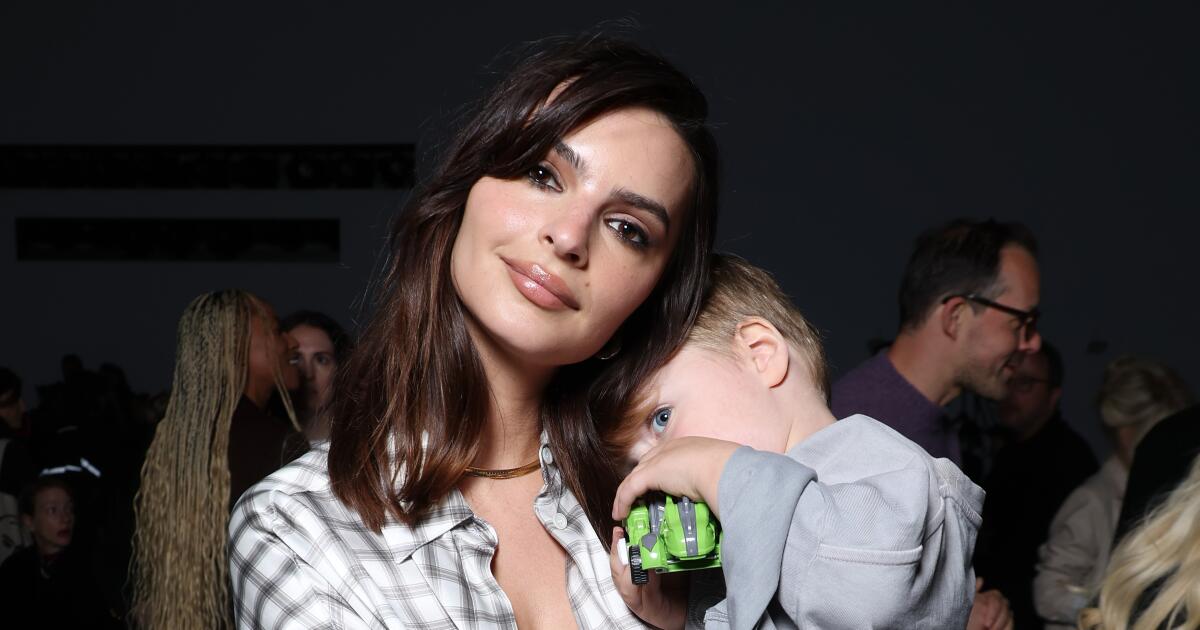
Emily Ratajkowski’s viral essay detailing her sex life as a single mom just landed her a seven-figure book deal.
According to Page Six, the model’s essay in the Cut had publishers champing at the bit in a 12-way bidding war that culminated in the hefty pay day. Editor Helen Rouner at Penguin Press — who also edited Lauren Christensen’s memoir “Firstborn” and Michael W. Clune’s novel “Pan” — reportedly landed the deal.
Penguin Press did not immediately respond to The Times’ request for comment Friday.
Publishers Marketplace announced the forthcoming memoir, describing it as “an examination of modern female identity through the story of the author’s own efforts as a newly single mother in New York City to discover what really constitutes a good life for a woman.”
The essay, which dropped a month ago and quickly broke the internet, drops the veil on EmRata’s sexual adventures (or maybe misadventures) since she and her former husband, Sebastian Bear-McClard, split in 2022.
“It was a violent transition into a new reality of screaming baby on my aching tit and ring on my swollen finger,” Ratajkowski writes of new motherhood. “And then, in a time period that felt both instant and excruciatingly slow, my marriage collapsed. Six months after my son was born, my husband and I stopped having sex. Less than a year later, we separated.”
In the missive, the model interrogates her sexuality — is she a Madonna or a whore? — while untangling bigger questions around gender, power and self-actualization. If Carrie Bradshaw wrote about “Sex and the City,” then Ratajkowski is writing about sex, the city and single motherhood. And naturally, her fleeting paramours have vague monikers: “Vegan Graffiti Artist,” “Spanish Gen-Zer” and “Son of a Billionaire.”
“And then there was the Elder Millennial: obsessed with dental hygiene, psychedelics, and dirty talk,” she writes. “He had approached the subject coyly at first, like it was something he was kind of embarrassed about — the way a kid will test you to see if you’ll talk to them about their dorky obsession of the moment. Do you like Godzilla? What about Star Wars?”
Would-be sleuths with Ratajkowski’s essay and a gossip rag handy will have their work cut out for them.
This will be Ratajkowski’s second book. The first, “My Body,” dropped in 2021 and was a bestselling collection of essays exploring gender, power dynamics, sexuality and the commodification of female beauty in the modeling and entertainment industries.
Ratajkowski’s foray into the spotlight came more than a decade ago when Robin Thicke’s controversial “Blurred Lines” music video made the model an overnight star. She was cast in David Fincher’s adaptation of “Gone Girl,” which hit theaters the following year, and catapulted to top fashion runways — Marc Jacobs, Versace, Victoria’s Secret and Dolce & Gabbana, to name a few. She she’s been romantically linked to Harry Styles, Eric Andre, Shaboozey, Brad Pitt and Pete Davidson, among others.
In 2023, she moonlighted as the host of the “High Low With EmRata” podcast, where she interviewed sex workers, investigated ethical nonmonogamy and pondered the etymology of the word “toxic.” The same year, she told The Times that she was coming into herself post-divorce, “Being able to assert what I want — that feels like it just started: My life as a creator and not as a muse.”

Wainheads will be delighted to see his alums in cameos: Kerri Kenney-Silver, Michael Ian Black, Thomas Lennon, and supporting roles for Zickel and Truglio. A large portion of the cast are his homies. But with Deutch, Gutierrez-Riley, Wang, Slattery, Impacciatore, and yes, Hamm, it’s as if they’re being inducted into a new mad family. Wain and Marino are basically catching Pokémon and hoping they can hold onto the roster (by that logic, yes, Paul Rudd is a legendary Pokémon). The film is anchored by Zoey — everything everywhere all this summer with Voicemails From Isabelle to Minions & Monsters — Deutch in the Dorothy Gale role, exuding a high level of perkiness consistent with the character’s can-do, wide-eyed, midwestern charm and heart.
A major standout, Ben Wang finally gets to show off his comedic abilities, portraying a self-assured, quick-witted agent who makes me laugh every time he reveals his sheltered upbringing in snappy whines at every inconvenience. Sabrina Impacciatore, who has proven to be a comedic juggernaut in The Paper, is having so much fun hamming it up as the mob boss-esque wicked witch counterpart, torturing her henchmen and deliciously chewing up the scenery whenever onscreen. I don’t think they use her to the height of her comedic prowess, but she’s a delight nonetheless. John Slattery is the film’s comedic MVP. The way the writers use his over-the-top character for comedy is downright hilarious every time. They use him as either a punchline or a force of nature, and he’s great. This movie is like Mad Men propaganda, and by God, it works. As someone who’s never seen it, Gail allowed me a better appreciation for Slattery and Hamm.
Man, we don’t deserve Jon Hamm. This is the second time I’ve seen him play a silly, fictionalized version of himself this year (the other being the SXSW crowd-pleasing rom-com Wishful Thinking, which Gail distributor Sony Pictures Classics acquired), and he also voice-acted in his comedic Mayor Jerry role in Hoppers. Maybe working with Wain in 2007’s The Ten was the canon event, but I consider his weird little sex scene with Kristen Wiig in Bridesmaids his awakening. Since then, I’ve only seen him as unserious, and it’s delightful. Oz-like in appearance, he’s funny and befitting the film’s overall light, joyful nature.
LAST STATEMENT
Ultimately, Gail Daughtry and the Celebrity Sex Pass is a campy, delightful romp that succeeds as both a distinctive Hollywood‑centric riff and a Wizard of Oz reimagining, retaining a loving, twisted, demented charm. It’s a weird description, but it’s so high‑spirited and light‑hearted despite being strangely ultraviolent. It might as well be a live‑action episode of Smiling Friends (RIP), yet it’s everything the theatrical market needs today. Ten years ago, this would’ve been a studio production rather than an indie Sundance acquisition, but thank God it exists for the big screen. More absurdist Gail Daughtrys for cinemas (not streaming), please, because this is the most fun to be had in a theater all summer, if not the year thus far.
-

 San Francisco, CA8 minutes ago
Classical music series helps reconnect downtown San Francisco community
-

 Dallas, TX13 minutes ago
Dallas police officers, paramedics recall saving woman stuck in a ravine for days;
-

 Boston, MA23 minutes ago
Red Sox win 7th straight game just hours after landing in New York
-
 Denver, CO28 minutes ago
One tree at a time: Denver nonprofit works to close shade gap as heat dome threatens neighborhoods
-

 Seattle, WA35 minutes ago
VIDEO: West Seattle Summer Fest 2026 day 1, evening report
-

 San Diego, CA38 minutes ago
The World’s Number One Wellness Retreat is Right in Our Backyard
-
 Milwaukee, WI43 minutes ago
Festivalgoers say Milwaukee’s summer events fill a gap in downtown entertainment
-

 Atlanta, GA50 minutes ago
Atlanta mentoring program brings ‘Save Our Sons Tour’ to Jacksonville’s Duval Day

