Sports
Why letting Paul George walk, and saying no to the Warriors, made sense for the Clippers


INGLEWOOD, Calif. — Saying goodbye to Paul George was one thing.
The LA Clippers decided in early July to draw a hard line in negotiations with the 34-year-old, who wanted a four-year, $212 million max deal that he would get from the Philadelphia 76ers instead. The prospect of paying him nearly $60 million at the age of 37 — especially given his health history during his five years in L.A. — was a nightmare scenario the Clippers wanted to avoid.
Ditto for the no-trade clause that George wanted and was denied. Add in the long-term planning component — a four-year max deal for George would have gone one year past the length of Kawhi Leonard’s deal while cutting too deeply into the precious salary cap space that would be better used on younger superstars who might become available — and you start to understand why the nine-time All-Star was in a Sixers jersey for his reunion game at Intuit Dome on Wednesday night.
GO DEEPER
Clippers fans boo Paul George in return; 76ers’ star has no ‘ill will’
Even if this Leonard-led era never pans out — and the track record speaks for itself at this point — the Clippers protected their ability to go big again in the summer of 2027. And with teams like the Bucks and Sixers having gone all in on their problematic three-star plans that are failing miserably at the moment, there’s an argument to be made that the Clippers’ vision will pay off.
If only for a night, it didn’t look like these Clippers needed George in their 110-98 win. Norm Powell, the guard who replaced George in the starting lineup and who deemed George’s departure “addition by subtraction” in the preseason, had 26 points (while hitting six 3s) and six assists while outplaying his former teammate (George had 18 points and seven rebounds).
The newcomer who wouldn’t be here if George had stayed, Derrick Jones Jr., was one of many productive role players who contributed a pivotal part when the lone available Clippers star, James Harden, had an off-night (5-of-15 shooting, six turnovers; 18 points and six assists).

The story of the greatest players in NBA history. In 100 riveting profiles, top basketball writers justify their selections and uncover the history of the NBA in the process.
The story of the greatest plays in NBA history.
Pre-order
The Clippers improved to 4-4 — not too shabby considering Leonard (right knee) has yet to play this season. The Sixers — who have been without Joel Embiid (left knee) all season and George for all but two games (left knee) and must now worry about Tyrese Maxey after he suffered a hamstring injury against the Clippers — saw their pressure-packed situation get even worse as they fell to 1-6.
But when it comes to the George saga that was the top story of the NBA summer, and which will surely be discussed and re-litigated for years to come, the question that has confounded so many rival front-office executives and scouts this season is this: Why were the Clippers willing to say goodbye to George without getting anything in return?
As The Athletic’s Anthony Slater recently detailed, the Warriors remain both frustrated and confused by their offseason pursuit of George (and Utah’s Lauri Markkanen) that fell flat. Everyone from Golden State owner Joe Lacob on down chimed in on the matter, with Steph Curry, Draymond Green, coach Steve Kerr and general manager Mike Dunleavy Jr. sharing their view of the sign-and-trade situation gone wrong.
There’s an old and outdated adage in the NBA that you just don’t let star players walk for nothing, but the Clippers — as so many around the league saw it — had gone against that grain by passing on their only real chance at recouping assets for George with the Warriors.
But just as the Clippers aren’t regretting the choices that led to George’s departure to Philadelphia, team sources are adamant in their defense of the Golden State decision as well. And the reasoning has everything to do with the financial flexibility that they valued more than what the Warriors had to offer. Strange as it might sound, they would argue that there are times when nothing is better than something.

Paul George walks near the Clippers bench on Wednesday. (Harry How / Getty Images)
Had the Clippers agreed to do the deal, with the most likely scenario being Golden State sending Andrew Wiggins, Chris Paul, Moses Moody and a first-round pick their way in exchange for George, then team sources say the second-apron luxury tax penalties that would have come with it would have put the total cost at approximately $110 million. The Clippers had serious interest in Warriors fourth-year forward Jonathan Kuminga and would have likely done the deal if he was included along with the first-round pick, but team sources say he was never truly available.
The two teams did discuss scenarios that included Kuminga, team sources said, but the Warriors later pulled him off the table. Considering he was the only young Warriors prospect whom the Clippers truly saw as a potential star, that was the real X-factor in it all. Even Brandin Podziemski, the second-year guard who was on the Clippers’ wish list, wasn’t available. So rather than take what Golden State offered, and having to navigate the second-apron hell that came with it, the Clippers decided to target the role players of their choosing elsewhere.
If you somehow haven’t heard by now, the second-apron luxury tax penalties that come when a team’s payroll exceeds $189 million are the bane of every billionaire’s existence. Even owners like the Clippers’ Steve Ballmer, the former Microsoft CEO whose net worth of $123 billion makes him the richest owner in sports, are now forced to fear the consequences that come with spending your way to the top.
Frozen draft picks. A restriction against making trades in which multiple player salaries are aggregated. No midlevel exceptions, sign-and-trades, or ability to send cash out in trades. Minimum-salary players abound.
A blank check isn’t enough anymore.
GO DEEPER
How are NBA GMs and execs trying to build teams and compete in the parity era?
The list of roster-wrecking ramifications is long, and perhaps even boring to the casual fans, but the truth of it all is that front-office executives whose teams are in that unwelcome financial state are like handymen with an empty tool belt. Among all of the involved parties in George’s Clippers exit, opinions differ when it comes to the second-apron effect.
On the one hand, the Clippers offered George a three-year, $150 million deal that would have put them in the second-apron territory throughout the length of that contract. They even offered a four-year deal for less than max money, further proving that point. To some extent, quite clearly, they were willing to deal with the second-apron life.
On the other hand, the Clippers showed a strong commitment to avoiding the second apron in all the scenarios that didn’t involve either elite players or young players with the potential to be elite (George or Kuminga). There’s a gray area here on this front, but it’s just silly to pretend that it didn’t come into play.
To watch George fall short against his old team on Wednesday was to wonder if maybe the Clippers didn’t make the right call after all. He is still an elite player in this league, the kind of two-way talent who would fit in beautifully on any legitimate title contender.
But the Clippers aren’t that, not with Leonard’s tenuous status and Harden’s advanced age. Nor are the Sixers, who have a franchise centerpiece in Embiid whose near-constant health issues put him alongside Leonard when it comes to being a calculated risk.
George wanted to maximize his money, and he did just that. The Clippers wanted to protect their future, and they did that too. Whether that makes it a win-win is in the eye of the beholder, but it might be that simple in the end.
(Photos: Tim Heitman, Barry Gossage / NBAE via Getty Images. Illustration: Dan Goldfarb / The Athletic)



NEWYou can now listen to Fox News articles!
It’s a two of a kind for Golden Tempo.
The winner of last month’s Kentucky Derby, who sat out the Preakness Stakes, forfeiting a shot at the Triple Crown, took home the victory at the 158th Belmont Stakes in New York on Saturday.
Renegade opened up as the morningline 2-1 favorite, similar to the Derby, followed by Chief Wallabee at 3-1 and Golden Tempo at 9-2.
The racing post is pulled down the front stretch for a race at Saratoga Race Course. (Gregory Fisher/Imagn Images)
Just like the Derby, Golden Tempo was well at the back of the pack but began to make his move at the final turn. At one point, Golden Tempo was neck-and-neck with Commandment, but Golden Tempo was able to get away from the pack in the final stretch.
This was the second consecutive year in which the Derby winner skipped out on the Preakness to tune up for the Belmont. Last year, Sovereignty won the Kentucky Derby before not traveling to Pimlico Race Course and then taking home the Belmont.
Golden Tempo (9) with Jockey Jose Ortiz crosses the finish line to win the 158th running of the Belmont Stakes horse race, Saturday, June 6, 2026, in Saratoga Springs, New York. (AP Photo/Yuki Iwamura)
CHERIE DEVAUX REFLECTS ON MAKING KENTUCKY DERBY HISTORY AS FIRST FEMALE TRAINER TO WIN THE RACE
“We made our decision, he won today, and we’re happy about that,” trainer Cherie DeVaux said after the race.
Saturday’s Belmont Stakes marked the third consecutive, and final, year in which the race took place at Saratoga Race Course in Upstate New York, as Belmont Park finishes up renovations.
Due to the change in course since 2024, the race ran at 1 ¼ miles instead of its usual mile-and-a-half. Saratoga is home to the annual Whitney, Travers, and Jim Dandy Stakes.
A sign at Saratoga Race Course for the 2026 Belmont Stakes. (Will Waldron/Albany Times Union via Getty Images)
This year’s Belmont did not feature any horses from the Preakness Stakes three weeks ago and just four from the Kentucky Derby in early May: Renegade, Commandment, Chief Wallabee, and Golden Tempo.
All four of them finished in the top four.
Follow Fox News Digital’s sports coverage on X, and subscribe to the Fox News Sports Huddle newsletter.
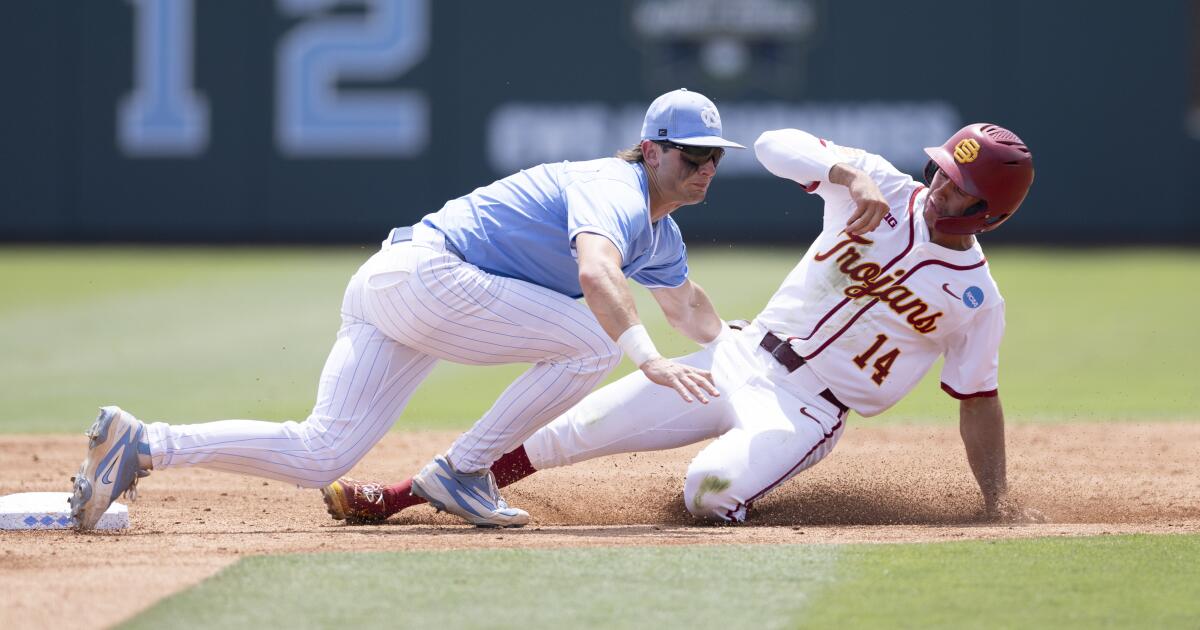
CHAPEL HILL, N.C. — Grant Govel was good, but Jason DeCaro was almost perfect.
USC baseball lost 4-0 in Game 2 of the NCAA Chapel Hill Super Regional, meaning its quest to break a 25-year College World Series drought will come down to a single game on Sunday.
North Carolina (49-12-1) turned to DeCaro with its season on the line, the seventh career NCAA tournament start for the veteran right-hander. DeCaro delivered a complete-game masterpiece, allowing just two hits — singles in the first and fifth innings — with eight strikeouts and one walk on a career-high 117 pitches.
“Obviously it was all about Jason DeCaro,” USC coach Andy Stankiewicz said. “He threw a heck of a game. He spotted his fastball and his breaking ball, we couldn’t get inside of it and couldn’t get through it. A very nice performance obviously by him, but the good thing is, we have tomorrow.”
Outside of giving up a solo home run to Colin Hynek in the second inning, Govel had a strong performance for USC (48-17). After throwing 153 pitches across two appearances in the NCAA regionals, including 64 pitches in Monday’s clinching win over Texas A&M, he gave up just five hits and struck out three over five innings and 83 pitches.
His final pitch was a crucial one, inducing an inning-ending double play with runners on the corners to hold the game at 1-0.
“Physically good,” Govel said when asked how he felt after making 236 pitches over a nine-day span. “I think having a good defense around me the entire time was very helpful. The solo shot didn’t really affect me. I’ve had a lot of homers hit off me this whole entire year. Competing with their guy — hats off to him, he pitched a hell of a game — felt good. The game just didn’t fall where we wanted it to.”
But for all of Govel’s great work, the day was all about DeCaro’s dominance.
North Carolina pitcher Jason DeCaro delivers against USC in Game 2 of the NCAA Chapel Hill Super Regional on Saturday.
(Kara Durrette / For The Times)
North Carolina found success against the Trojans’ bullpen in the sixth. Erik Paulsen hit a 339-foot home run over the left-field corner wall to double the Tar Heels’ lead, just the second home run given up by USC’s Sax Matson all season. The Tar Heels added two more on sacrifice flies in the sixth and seventh innings, but failed to drive in more with the bases loaded in the seventh and ninth innings.
“We pitched well enough to keep ourselves close and give ourselves a shot,” Stankiewicz said. “But at the end of the day, it was just all about DeCaro.”
DeCaro got better as the game continued, retiring the final 10 USC batters. It was a dominant pitching performance, but thanks to USC’s comeback win Friday, the Trojans still have life.
North Carolina coach Scott Forbes confirmed either Folger Boaz or relief ace and National Collegiate Baseball Writers Assn. Stopper of the Year Award finalist Caden Glauber will start Game 3. Stankiewicz did not name a starting pitcher for the decisive game.
Regardless, it will be all hands on deck.
“We’ll need everybody,” Stankiewicz said. “We can’t go too long with too many.”
The game will start at noon PT on ESPN. The Trojans won four elimination games last weekend and they’ll need one more to complete its mission to Omaha.
“We tell our guys Sundays are always important,” Stankiewicz said. “This is probably the most important Sunday that they’ll ever play.”
The biggest afternoon of Trojans baseball in a quarter of a century awaits.
Sports
Maxx Crosby plans to attend America 250 UFC fight, talks White House, Fernando Mendoza, Tom Brady and Olympics

NEWYou can now listen to Fox News articles!
Las Vegas Raiders star Maxx Crosby told Fox News Digital he plans on attending the UFC fight at the White House on June 14 to celebrate America’s 250th anniversary.
“I’ve never been to the White House,” Crosby said. “I’m excited, I like history…
“It’s incredible that we all have an opportunity to celebrate our country and just be part of a historic event… we live in the greatest country in the world and it should be celebrated.”
Maxx Crosby of the Las Vegas Raiders walks on the sideline before a game against the Denver Broncos at Allegiant Stadium in Las Vegas, Nev., on Dec. 7, 2025. (Chris Unger/Getty Images)
For Crosby, as a highly successful NFL star, the celebration represents an opportunity to recognize the freedoms and opportunities he appreciates most as an American.
“You have an opportunity every day to chase your passion,” Crosby said. “Everyone comes from different backgrounds, but in this country you have a choice every day to chase what you love and what you aspire to do. People don’t say the American Dream for no reason. It’s the greatest country because it’s opportunity. It’s a land of opportunity.”
Crosby also revealed who he’s rooting for at the event.
“I think everyone knows how much I love Justin Gaethje,” Crosby said. “Justin Gaethje is one of the greatest fighters to ever do it, and he’s an absolute legend. He’s also a great friend, so I’ll definitely be biased for him. I want to see him go to the White House and do his thing for sure.”
The fight, slated for the South Lawn, came about after Donald Trump casually leaned over to Dana White during a live UFC match and suggested they “do a fight at the White House”. White immediately agreed, and logistics were set in motion days later.
“Dana White is like family to me. He always does it big, and he always does it the biggest and best way. He’s always going to put on an incredible show,” Crosby said.
“I’ve met Trump a couple times, and he’s been incredible to me,” Crosby later added. “I know Dana [White] thinks nothing but the world of him and has a lot of respect for him. But you know we’ve met a couple times, and he’s always been great to me. So, going to the White House, and being there, is going to be a lot of fun for sure.”
Playing flag football for Team USA at the 2028 LA Olympics
Crosby also said he would welcome the opportunity to represent the United States in flag football when the sport makes its Olympic debut at the 2028 Los Angeles Games.
“Oh, no doubt,” Crosby said when asked whether he would consider playing. “I think it’d be incredible.”
While Crosby noted that his family has roots in the Balkans, he made clear where his allegiance would lie if given the opportunity to compete on the international stage.
TEAM USA FLAG FOOTBALL STAR WANTS OPPORTUNITY TO MAKE OLYMPIC TEAM AMID NFL PARTICIPATION
Las Vegas Raiders defensive end Maxx Crosby stands on the field after a loss to the Philadelphia Eagles at Lincoln Financial Field in Philadelphia, Pa., on Dec. 14, 2025. (Eric Hartline/Imagn Images)
“My mom’s side, I’ve got a Yugoslavian background, so I’ve got some Serbian and Albanian in me over there,” Crosby said. “I’m sure they’d give me a call as well, so it’d be an interesting decision.”
Still, the Raiders star said his heart remains with the country where he was born and raised.
“Everyone knows my heart’s here,” Crosby said. “This is the country I’ve been raised in, born and raised, so yeah, it would definitely be special.”
Crosby was also asked whether he would try to recruit Raiders minority owner Tom Brady to play quarterback for Team USA if he joined the Olympic squad.
“I don’t think he would do that,” Crosby said with a laugh. “I think he’s retired and there’s a lot of great quarterbacks right now. But I wouldn’t be mad at Tom Brady coming back. It’s a great time.”
Getting Fernando Mendoza ready for the NFL
Crosby also had high praise for quarterback Fernando Mendoza, who is adjusting to life at the NFL level after a successful college career.
“He’s a young guy and he’s coming in off an incredible season and an incredible college career,” Crosby said. “But when you get to the NFL, you’ve got to start from square one.”
The veteran defensive end said Mendoza has impressed him with his willingness to learn and fit into the locker room.
“I think he’s done an incredible job of just being one of the guys, being humble, being a sponge, just learning from everybody and asking questions,” Crosby said.
WHO IS FERNANDO MENDOZA? THE NFL DRAFT SENSATION NO ONE COULD HAVE PREDICTED
Las Vegas Raiders quarterback Fernando Mendoza warms up during a rookie minicamp at Intermountain Health Performance Center in Henderson, Nev., on May 2, 2026. (Candice Ward/Imagn Images)
But Crosby won’t be taking it easy on the fresh-faced rookie in practice.
“There’s no taking it easy,” Crosby said with a laugh. “We play this game one way, and I’m going to go out there and do what I do. It’s going to help him in the long run and making him better. I want to push all my teammates. That’s how teams improve — by pushing each other and making each other better on a daily basis.”
While many young quarterbacks are immediately compared to established NFL stars, Crosby said Mendoza should be given the opportunity to carve out his own identity.
“A lot of times people try to make comparisons,” Crosby said. “People just need to allow Fernando to be Fernando. I think he’s going to be a really special player.”
Playing for Tom Brady
Crosby also spoke about the unique opportunity to play for an organization that includes NFL legend Tom Brady as a minority owner.
“Tom has had one of the greatest careers, if not the greatest career, of anybody,” Crosby said. “He’s an incredible player and won at the highest level.”
Tom Brady looks on before the game between the Los Angeles Chargers and the Washington Commanders at SoFi Stadium on Oct. 5, 2025. (Jayne Kamin-Oncea/Imagn Images)
While Brady isn’t involved in the day-to-day operations of the franchise, Crosby said having someone with his experience around the organization is a valuable resource.
“Anybody you get around an organization that has done it at that level, I think is a positive,” Crosby said. “He’s not there all the time, but he is a resource for people in that building. I think his winning mindset is only a plus.”
Crosby only played Brady once before Brady retired.
“I wish we could have had a couple more swings at it,” Crosby said.
A big partnership
Crosby’s appearance with Fox News Digital came as part of a partnership with SAXX Underwear, a brand he said immediately caught his attention for more than one reason.
“Obviously, everyone knows I make a living sacking quarterbacks, so the name alone drew me in,” Crosby joked. “The double X was a bonus, too.”
But beyond the name, Crosby said he became a fan of the product itself. Crosby said the product has become part of his everyday routine.
“I literally wear it every single day,” Crosby said. “I wear it during workouts, I wear it around the house, I literally wear it everywhere I go.”
CLICK HERE TO DOWNLOAD THE FOX NEWS APP
Still, while Crosby wears it to workouts, he won’t be wearing it during games.
“It’s not NFL certified yet,” he said. “But I wear it to the games, for sure.”
-

 Health13 minutes ago
YouTube Star Javant Benton Lost 85 Lbs. With These Healthy Food Swaps
-
 Lifestyle35 minutes ago
‘Wait Wait’ for June 6. 2026: Live in Austin with Not My Job guest Elana Meyers Taylor
-

 Technology43 minutes ago
The first Story-Rich showcase was packed with narrative-driven games
-

 World50 minutes ago
Spearfisherman killed by suspected 15-foot shark after third fatal attack in less than a month
-

 Politics53 minutes ago
Steve Hilton launches ad mocking Xavier Becerra’s ’36 years’ as a career politician in California gov race
-

 Health58 minutes ago
Drinking alcohol may influence cravings for certain foods in a surprising way, study suggests
-

 Sports1 hour ago
Golden Tempo, 2026 Kentucky Derby winner, takes home 158th Belmont Stakes
-

 Technology1 hour ago
Why scammers target retirees in a 6-week summer window

