Entertainment
Quincy Jones, legendary American musician and composer, dies


Quincy Jones, who expanded the American songbook as a musician, composer and producer and shaped some of the biggest stars and most memorable songs in the second half of the 20th century, has died at his home in Bel-Air.
Widely considered one of the most influential forces in modern American music, Jones died Sunday surrounded by his children, siblings and close family, according to his publicist Arnold Robinson. He was 91. No cause of death was disclosed.
“[A]lthough this is an incredible loss for our family, we celebrate the great life that he lived and know there will never be another like him,” Jones’ family said in a statement to The Times. “He is truly one of a kind and we will miss him dearly; we take comfort and immense pride in knowing that the love and joy, that were the essence of his being, was shared with the world through all that he created. Through his music and his boundless love, Quincy Jones’ heart will beat for eternity.”
The arc of Jones’ long career stretched from smoky jazz clubs, where he collaborated with innovators such as Miles Davis, Charlie Parker and Dizzy Gillespie, to his Los Angeles power base, where, like a titan, he watched over his musical empire from a mansion atop Bel-Air.
Willie Nelson, left; Quincy Jones, center; and Bruce Springsteen review sheet music before recording “We are the World.”
(Netflix/Courtesy of Netflix)
During his career, Jones helped mold Michael Jackson into a mega-star by producing a trilogy of albums that made the pop singer arguably the best-known musician in the world, raised tens of millions for Ethiopian famine victims by producing the bestselling song “We Are the World” and won 28 Grammy awards, more than any artist aside Beyonce and George Solti.
If some stars reached a career cruising altitude where they were identified by just one name — Prince, Madonna, Sting — Jones boiled it down to a single letter: Q.
Harvard historian and literary critic Henry Louis Gates Jr. said he viewed Jones’ influence and career milestones as being on par with American innovators and big thinkers like Henry Ford, Thomas Edison and Bill Gates.
“We’re talking about the people who define an era in the broadest possible way,” Gates told Smithsonian Magazine in 2008. “Quincy has a lifeline into the collective consciousness of the American public.”
Oprah Winfrey, who worked with Jones when he helped produce and score the music for “The Color Purple,” described him as being a force of nature, unlike anything she’d encountered.
“Quincy Jones on a bad day does more than most people do in a lifetime,” she said in “The Complete Quincy Jones: My Journey and Passions.”
The late Miles Davis put it another way: “Certain paperboys can go in any yard with any dog and they won’t get bit. He just has it.”
When he was young and amid the legends of the day, Jones said he would “sit down, shut up and listen,” silently absorbing lessons he realized he couldn’t possibly get anywhere else. But fame and success ultimately released any reluctance to speak out, and seemed to loosen his ego as well.
Asked by The Times in 2011 to compare himself to Kanye West (now kown as Ye), Jones seemed indignant.
“Did [West] write for a symphony orchestra? Does he write for a jazz orchestra? Come on, man … I’m not putting him down or making a judgment or anything, but we come from two different sides of the planet.”
In testament to the respect Jones commanded, when Barack Obama was exploring a presidential bid, one of his first stops in Southern California was the producer’s Bel-Air estate.
Taking in the home’s king-of-the-universe views, Obama listened while Jones told stories of jamming with legends like Gillespie or the surge of power he felt working the soundboard as one mega-star after another stepped forward to sing a verse for “We Are the World.”
Quincy Delight Jones Jr. was born March 14, 1933, in Chicago. His father, Quincy Jones Sr., was a semi professional baseball player and a carpenter. His mother, Sarah Frances, was a bank officer and an apartment manager. His younger brother, Lloyd, died in 1998.
As a youth, Jones was exposed to Black roots and religious music and early jazz piano. His mother was an avid singer of spirituals and a next-door neighbor, Lucy Jackson, helped Jones learn to tap out boogie-woogie on the keyboard.
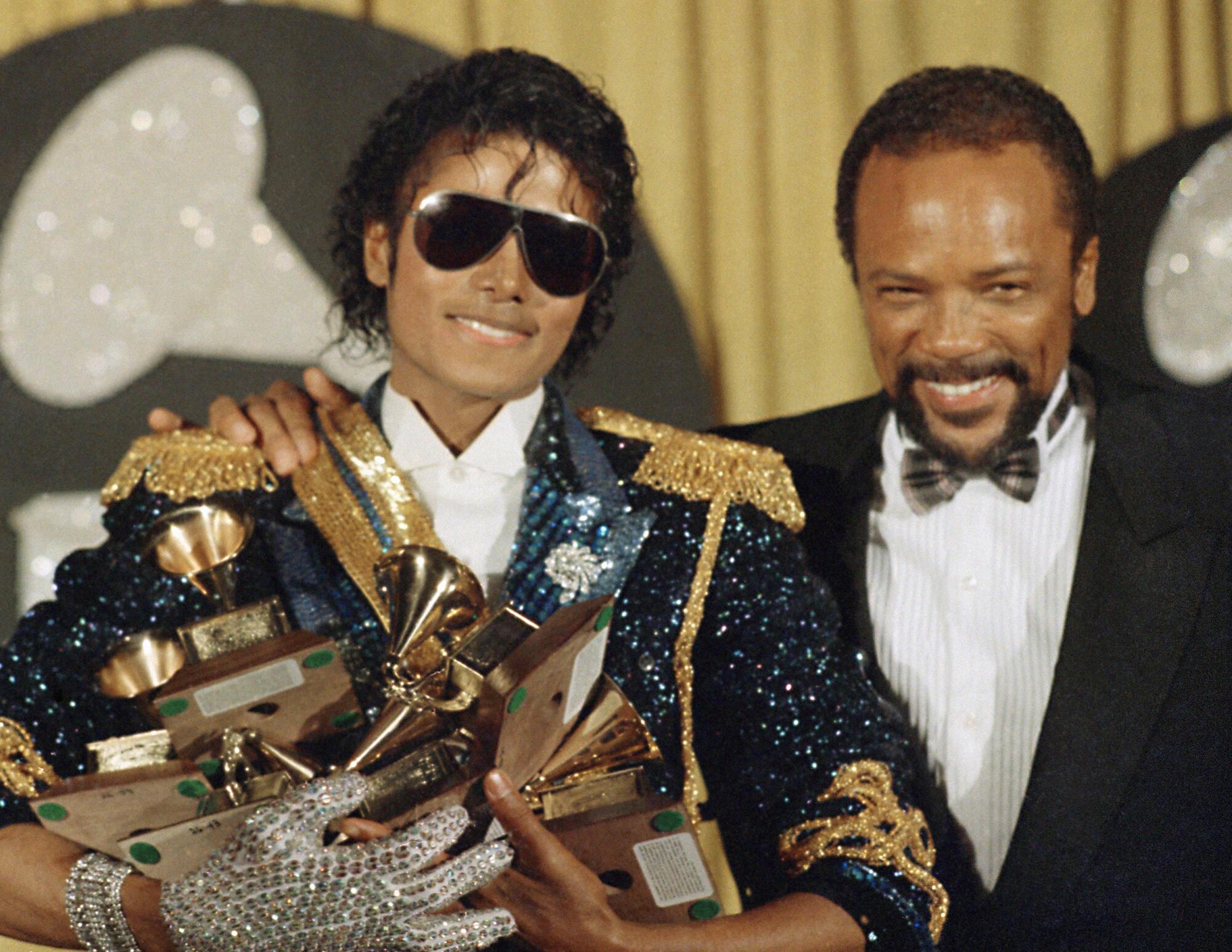
Michael Jackson, left, holds eight awards as he poses with Quincy Jones at the Grammy Awards in Los Angeles on Feb. 28, 1984.
(Doug Pizac / Associated Press)
When he was 10, Jones’ mother was committed to a mental institution. The impact was profound and Jones said he was left with painful memories of the trips to the psychiatric hospital, unsure exactly why his mother couldn’t come home with him.
“They took her away in a straitjacket, man,” he said in a 2009 interview with The Times. “For me, that was the end of what mother meant.”
With his mother institutionalized, Jones said, he began to run the streets. It was a tough, beaten-down neighborhood on the south side of Chicago and gangsters controlled every block. One day when Jones was walking home, a group of street toughs pinned him to a fence, plunged a knife blade into one of his hands and stabbed him in the temple with an ice pick.
That helped convince Jones’ father, who had divorced and remarried, that it was time to get out of Chicago.
In search of a better job and a safer environment, Jones’ father moved his newly blended family to Bremer, Wash., in 1943 and found work at the Puget Sound Naval Shipyard. When the war ended, the family moved to Seattle.
The upheaval and family turbulence shaped Jones. “If I had a good family,” he once joked, “I might have been a terrible musician.”
When he was 14, he befriended a teenager named Ray Charles. The friendship, which lasted a lifetime, opened a new world for Jones.
In Charles, Jones found an emerging prodigy, a musician who played a blend of blues, gospel and R&B he’d never heard. The two started playing together and Charles — blind since he was 7 — urged Jones to pursue arranging and composing.
“I met Ray Charles at 14 and he was 16,” Jones recalled “But he was like a hundred years older than me.”
After high school, Jones attended Seattle University and earned a scholarship to what’s now the Berklee College of Music in Boston. In the early ’50s he joined Lionel Hampton’s big band as a trumpeter and arranger and later toured South America and the Middle East with Gillespie’s big band.
Jones’ visibility escalated and, barely into his mid-20s, he was soon arranging and recording for Sarah Vaughan, Dinah Washington, Count Basie, Duke Ellington and, of course, Charles.
In the late ’50s, Jones relocated to Paris, where he studied composition with the highly regarded teacher Nadia Boulanger and composer Olivier Messiaen. But a European tour leading his own big band in the early ’60s ran into financial problems and came to an unceremonious end.
“We had the best jazz band on the planet,” Jones told Musician magazine, ”and yet we were literally starving. That’s when I discovered that there was music, and there was the music business.”

Music producer Quincy Jones poses for a portrait during the Toronto Film Festival on Sept. 7, 2018.
(Chris Pizzello / Chris Pizzello/invision/ap)
Another door opened when Mercury Records offered Jones a position as musical director of the company’s New York division. In 1964, he was promoted to vice president of Mercury Records, the first Black person to hold an executive position at a major U.S. record company.
Jones’ successes continued. In the mid-’60s, he produced four million-selling singles and 10 Top 40 hits for Lesley Gore, including “It’s My Party.” He also arranged Frank Sinatra’s iconic “Fly Me to the Moon.”
In 1964, he agreed to compose the music for Sidney Lumet’s “The Pawnbroker.” It was the first of more than 30 films that Jones would score, a list that included “The Deadly Affair,” “In the Heat of the Night,” “Bob & Carol & Ted & Alice,” “They Call Me Mr. Tibbs!” and “The Getaway.”
While the jobs came quickly, the undertow of racism in the industry was always there, tugging at him.
When Jones was asked to write the soundtrack for “In Cold Blood,” he said Truman Capote, who wrote the bestselling book the film was based on, tried to block him from working on the film.
“He said, ‘I just don’t understand why you want a colored man’s music in a film with no negros,’” Jones told the San Francisco Chronicle in a 2008 interview. “I knew it was going to be hard for a Black guy to break into movies.”
The musical score for “In Cold Blood,” though, earned him an Academy Award nomination in 1967, the first of seven times he was nominated.
Jones was equally productive for television, composing the theme music for “Sanford and Son,” “The Bill Cosby Show,” “Banacek” and “Ironside.”
His busy schedule also included the founding of his own company, Qwest Productions, and stints providing arrangements for Peggy Lee, Sarah Vaughan, Billy Eckstine and Ella Fitzgerald, Sinatra and his own bands.
After producing the soundtrack for the 1978 film “The Wiz” — which featured Diana Ross and Michael Jackson — Jones was approached by Jackson, who wondered if he would produce his next album.
Jackson’s record label initially stood in the way, worried that Jones was a jazz guy. Jackson pushed back, insisting he wanted to work with Jones.
“Everybody said, ‘You can’t make Michael any bigger that he was in the Jackson 5,’” Jones recalled. “I said, ‘We’ll see.’”
The album, “Off the Wall,” was a critical success, but the follow-up, “Thriller,” released in 1982, became the bestselling album of all time and earned eight Grammy awards. Suddenly, Jackson’s career was kicked into the stratosphere and Jones was regarded as the high priest of pop music.
Five years later, Jackson released “Bad,” the third and final collaboration between the two. It yielded five No. 1 hits.
Jackson, Jones said, was the hardest-working performer he’d ever seen. To fully harness the emotional might that Jackson seemed to possess, Jones said he transformed the recording studio into a concert stage by dimming the lights and urging Jackson to dance while he recorded, as if an entire audience were bearing witness. Decades later, Jones was awarded $9.4 million after a Los Angeles jury determined he’d been shortchanged millions in royalties by Jackson’s estate.
A year later, following the 1985 American Music Awards, Jones assembled a star-studded team of musicians, from Ross to Bruce Springsteen, to record “We Are the World.” The song became one of the bestselling singles of all time and raised nearly $70 million to assist victims of the famine in Ethiopia.
But the workload, the stress and the weight of a crumbling marriage had taken a toll and Jones broke.
He postponed all ongoing projects, canceled his scheduled appearances and flew to Tahiti. Alone.
“I stayed for 31 days,” he told The Times in 1989. “It was the most heavy 31 days of my life. I went all the way down. I just wandered from island to island. I was really in trouble.”
As he put the pieces back together, Jones said he felt oddly renewed, as if he’d undergone a spiritual cleansing. “Sometimes you need God to just slap you and say, ‘Let’s take a look and see what’s going on here.’”
Back in L.A., his career resumed briskly. He formed Quincy Jones Entertainment, a partnership with Time Warner, produced NBC’s ‘Fresh Prince of Bel Air,” staged an inauguration concert for President Bill Clinton and began recording “The Q Series,” an ambitious anthology of Black American music. He also formed Qwest Broadcasting, which then was the largest minority-owned broadcasting company in the U.S.
In 1996, he produced the 68th annual Academy Awards telecast. Three years later, U2 lead singer Bono, singer-songwriter Bob Geldof and Jones met with Pope John Paul II as part of an effort to erase the debt load shouldered by third world nations. And in 2008, he was named an artistic adviser to the 2008 Summer Olympics in Beijing, a post some urged him to reject in protest over China’s dismal human rights records.
The awards and honors bestowed on Jones were nearly mind-bending. He was nominated for a Grammy 80 times, winning 28 times. He received eight Academy Award nominations. He was the first musician whom France honored as both Commandeur de l’Ordre des Arts et des Lettres and Commandeur de la Légion d’Honneur. He was inducted into the Rock & Roll Hall of Fame and he received Kennedy Center Honors.
Jones’ Quincy Jones Foundation distributed millions of dollars in L.A. and abroad to advance humanitarian causes and encourage arts education. Quincy Jones Elementary School in South L.A. was named in his honor. When he attended the ribbon-cutting in 2011, he said it brought back memories of when he first arrived in L.A.
Late in life, Jones reflected on his mortality, telling The Times that he had deleted the names of 188 friends and associates from his iPhone in a single year. All dead.
“You start out playing in bands and doing duets,” he said. “And then you worry that in the end it’s all going to be a solo.”
Jones was married three times, the longest to actress Peggy Lipton. He is survived by seven children, including actor Rashida Jones.
Former Times jazz critic Don Heckman contributed to this story prior to his death in 2020. Marble is a former Times editor.


Comedy is a matter of taste and preference — it’s a deeply personal thing. Which makes it hard for a critic to give a blanket assessment of a specific kind of comedy, especially if it didn’t work for them, but clearly worked for others (the laughter or lack thereof is the indication). “It’s not funny,” the critic says, “well I had fun,” someone else can reply, and then we’re at an impasse.
Which is the dilemma one finds oneself in with “Gail Daughtry and the Celebrity Sex Pass,” a very strange and shaggy Hollywood satire of sorts from David Wain and The State crew, still riding the goodwill of “Wet Hot American Summer” after all these years. If only this were as funny.
“Gail Daughtry” lives in the same world as that iconic summer camp spoof, as well as Wain’s 2014 rom-com parody, “They Came Together,” in that he’s playing with genre convention and expectation, taking well-known norms to the goofiest extremes. But those films hewed more closely to their respective genres, while “Gail Daughtry” is totally scattered, combining crime and spy movie tropes with a fish-out-of-water comedy and a Hollywood send-up. It has far too many ideas for its own good, and yet no ideas that are good enough to sustain this bizarre curio of a comedy.
What’s ironic is that one of the problems driving this wacky plot forward is the characters have to come up with a movie idea to pitch to star Jon Hamm (playing himself of course), leading them to do some pretty inane and shockingly violent things. It’s almost as if Wain and co-writer and co-star Ken Marino had no idea for a movie, then baked their search for an idea into their script, and then turned it into a madcap adventure about a woman on a quest to have sex with Jon Hamm. What an ouroboros!
OK, about the sex quest. Gail Daughtry (Zoey Deutch) is a chipper hairdresser from Kansas born without the part of the brain that recognizes sarcasm or irony. She’s a cheerful, Pollyanna-ish naïf whose literal-mindedness is almost as extreme as Amelia Bedelia. Her childhood sweetheart and fiancé Tom (Michael Cassidy) is the same. She tells him about the concept of the “celebrity sex pass” as a joke, and he promptly boinks Jennifer Aniston at local book reading.
(Nitpicky aside: why didn’t they use the common nomenclature “hall pass”? Is it copyrighted? “Celebrity sex pass” is clunky and sounds like an off-brand version of the well-known slang.)
That infidelity crisis is how Gail ends up in Los Angeles determined to bang Hamm, collecting a motley crew of similarly clueless helpers along the way. There’s her best friend Otto (Miles Guttierez-Riley), her salon bestie; Caleb (Ben Wang), an overly ambitious intern at Creative Artists Agency; Vince (Marino), a screenwriter turned paparazzo with a heart of gold; and John Slattery, as John Slattery, down on his luck. An accidental briefcase swap has a pair of thugs on their tail, in a forgettable and underdeveloped B-plot.
With a parade of celebrity cameos and collaborators in bit parts, “Gail Daughtry” at times feels like an excuse for Wain and co. to make something at home with all of their friends. Fair enough, it’s great to see all these people employed, but what about what we’re watching? Behold, the Los Angeles of the middle-aged working comedian: the CAA lobby, the Chateau Marmont, Griffith Park, etc. And the plot is as half-baked as the pitch they present to Hamm.
What’s actually interesting about this comedy is the distinct streak of despair and even resentment that reveals itself at the climax, a feeling of helplessness and uselessness. Everyone’s been striving to make it in this crazy town: the intern, the actor, the paparazzo. But not even Jon Hamm can help them get a movie made; even he feels inherently powerless. There’s an unexplored anxiety vibrating there that feels the most thematically fruitful, about what it means, some 25 years after bursting onto the scene with a generation-defining comedy, about maintaining the work, the drive, a sense of purpose, after years of strikes, and in the face of a constricting industry. Do they still have it? Is the dream still alive?
Maybe that’s why Wain and Marino need to invent a dreamer stand-in with Gail, a guileless eternal optimist who knows nothing of the craven Los Angeles and accepts everything at face value (though she is filled with a scary bit of rage too). She might behave like she has a head injury, but she’s going to achieve her goal, dammit. “Gail Daughtry and the Celebrity Sex Pass” might not be as funny as “Wet Hot American Summer” (for this critic), but reframed, it serves as a fascinating status update on life in La La Land for this troupe.
‘Gail Daughtry and the Celebrity Sex Pass’
2 stars (out of 4)
MPA rating: R (for sexual content, violence/bloody images and language)
Running time: 1:33
How to watch: In theaters July 10
Entertainment
Emily Ratajkowski’s viral essay on sex life as a single mom scores her a seven-figure book deal

Emily Ratajkowski’s viral essay detailing her sex life as a single mom just landed her a seven-figure book deal.
According to Page Six, the model’s essay in the Cut had publishers champing at the bit in a 12-way bidding war that culminated in the hefty pay day. Editor Helen Rouner at Penguin Press — who also edited Lauren Christensen’s memoir “Firstborn” and Michael W. Clune’s novel “Pan” — reportedly landed the deal.
Penguin Press did not immediately respond to The Times’ request for comment Friday.
Publishers Marketplace announced the forthcoming memoir, describing it as “an examination of modern female identity through the story of the author’s own efforts as a newly single mother in New York City to discover what really constitutes a good life for a woman.”
The essay, which dropped a month ago and quickly broke the internet, drops the veil on EmRata’s sexual adventures (or maybe misadventures) since she and her former husband, Sebastian Bear-McClard, split in 2022.
“It was a violent transition into a new reality of screaming baby on my aching tit and ring on my swollen finger,” Ratajkowski writes of new motherhood. “And then, in a time period that felt both instant and excruciatingly slow, my marriage collapsed. Six months after my son was born, my husband and I stopped having sex. Less than a year later, we separated.”
In the missive, the model interrogates her sexuality — is she a Madonna or a whore? — while untangling bigger questions around gender, power and self-actualization. If Carrie Bradshaw wrote about “Sex and the City,” then Ratajkowski is writing about sex, the city and single motherhood. And naturally, her fleeting paramours have vague monikers: “Vegan Graffiti Artist,” “Spanish Gen-Zer” and “Son of a Billionaire.”
“And then there was the Elder Millennial: obsessed with dental hygiene, psychedelics, and dirty talk,” she writes. “He had approached the subject coyly at first, like it was something he was kind of embarrassed about — the way a kid will test you to see if you’ll talk to them about their dorky obsession of the moment. Do you like Godzilla? What about Star Wars?”
Would-be sleuths with Ratajkowski’s essay and a gossip rag handy will have their work cut out for them.
This will be Ratajkowski’s second book. The first, “My Body,” dropped in 2021 and was a bestselling collection of essays exploring gender, power dynamics, sexuality and the commodification of female beauty in the modeling and entertainment industries.
Ratajkowski’s foray into the spotlight came more than a decade ago when Robin Thicke’s controversial “Blurred Lines” music video made the model an overnight star. She was cast in David Fincher’s adaptation of “Gone Girl,” which hit theaters the following year, and catapulted to top fashion runways — Marc Jacobs, Versace, Victoria’s Secret and Dolce & Gabbana, to name a few. She she’s been romantically linked to Harry Styles, Eric Andre, Shaboozey, Brad Pitt and Pete Davidson, among others.
In 2023, she moonlighted as the host of the “High Low With EmRata” podcast, where she interviewed sex workers, investigated ethical nonmonogamy and pondered the etymology of the word “toxic.” The same year, she told The Times that she was coming into herself post-divorce, “Being able to assert what I want — that feels like it just started: My life as a creator and not as a muse.”

Wainheads will be delighted to see his alums in cameos: Kerri Kenney-Silver, Michael Ian Black, Thomas Lennon, and supporting roles for Zickel and Truglio. A large portion of the cast are his homies. But with Deutch, Gutierrez-Riley, Wang, Slattery, Impacciatore, and yes, Hamm, it’s as if they’re being inducted into a new mad family. Wain and Marino are basically catching Pokémon and hoping they can hold onto the roster (by that logic, yes, Paul Rudd is a legendary Pokémon). The film is anchored by Zoey — everything everywhere all this summer with Voicemails From Isabelle to Minions & Monsters — Deutch in the Dorothy Gale role, exuding a high level of perkiness consistent with the character’s can-do, wide-eyed, midwestern charm and heart.
A major standout, Ben Wang finally gets to show off his comedic abilities, portraying a self-assured, quick-witted agent who makes me laugh every time he reveals his sheltered upbringing in snappy whines at every inconvenience. Sabrina Impacciatore, who has proven to be a comedic juggernaut in The Paper, is having so much fun hamming it up as the mob boss-esque wicked witch counterpart, torturing her henchmen and deliciously chewing up the scenery whenever onscreen. I don’t think they use her to the height of her comedic prowess, but she’s a delight nonetheless. John Slattery is the film’s comedic MVP. The way the writers use his over-the-top character for comedy is downright hilarious every time. They use him as either a punchline or a force of nature, and he’s great. This movie is like Mad Men propaganda, and by God, it works. As someone who’s never seen it, Gail allowed me a better appreciation for Slattery and Hamm.
Man, we don’t deserve Jon Hamm. This is the second time I’ve seen him play a silly, fictionalized version of himself this year (the other being the SXSW crowd-pleasing rom-com Wishful Thinking, which Gail distributor Sony Pictures Classics acquired), and he also voice-acted in his comedic Mayor Jerry role in Hoppers. Maybe working with Wain in 2007’s The Ten was the canon event, but I consider his weird little sex scene with Kristen Wiig in Bridesmaids his awakening. Since then, I’ve only seen him as unserious, and it’s delightful. Oz-like in appearance, he’s funny and befitting the film’s overall light, joyful nature.
LAST STATEMENT
Ultimately, Gail Daughtry and the Celebrity Sex Pass is a campy, delightful romp that succeeds as both a distinctive Hollywood‑centric riff and a Wizard of Oz reimagining, retaining a loving, twisted, demented charm. It’s a weird description, but it’s so high‑spirited and light‑hearted despite being strangely ultraviolent. It might as well be a live‑action episode of Smiling Friends (RIP), yet it’s everything the theatrical market needs today. Ten years ago, this would’ve been a studio production rather than an indie Sundance acquisition, but thank God it exists for the big screen. More absurdist Gail Daughtrys for cinemas (not streaming), please, because this is the most fun to be had in a theater all summer, if not the year thus far.
-

 New Hampshire1 minute ago
Man From Northwood Arrested On Driving Under The Influence Charge: Concord Police Log
-

 New Jersey3 minutes ago
NJ firefighter dies after crash responding to fire call
-

 New Mexico14 minutes ago
Isolated storm chances continue for parts of New Mexico this weekend
-

 North Carolina16 minutes ago
A 4-year-old boy’s simple habit of waving to his neighbors transformed his North Carolina community
-

 North Dakota22 minutes ago
West Fargo attorney named to North Dakota Ethics Commission
-

 Ohio29 minutes ago
Struggling Ohio county seeks funds to care for 16 kids rescued from squalor and prosecute their family
-

 Oklahoma32 minutes ago
Martha Lillard, last US polio patient using iron lung, dies at 78 in Oklahoma
-

 Oregon37 minutes ago
Greater Idaho effort seeks federal help as Oregon lawmakers keep border plan stalled

