California
Inside the battle to save Mountain High ski resort from a monster California wildfire


It was early in the morning when Ben Smith drove his SUV to the top of Mountain High ski resort and looked south. Miles away and across a valley, he could see the ominous red glow of the Bridge fire amid the dark green pines of the Angeles National Forest.
By Smith’s estimate, the fire wouldn’t reach the resort for at least another day.
Then, the fire exploded.
By 6:30 that evening, the resort’s general manager would be racing east down Highway 2 past the town of Wrightwood as flames closed in on the road from both sides.
Smith had done everything he could to save the resort. He was the last to flee after his staff activated a battery of snow cannons to douse the ski area in water.
Now, there was just one thought running through his head: “Hopefully I make it out of here,” Smith recalled as he leaned against a wooden post at the resort’s Big Pines Lodge recently.
The fact the lodge and most of the nearby resort escaped the hellish firestorm is a testament to the work of Smith’s team and firefighters.
“When I left out of here … I expected to come back to everything gone,” he said.
Now, roughly one month later, tree removal crews and electrical trucks crisscross the property. Mountain High operators are optimistic that the resort will open by Thanksgiving.
“Come wintertime — when the snow comes — you won’t even know there was a fire here,” said Damaris Cand, guest services manager.
The Mount Baldy ski lifts are shrouded in smoke from the Bridge fire in Mount Baldy on Sept. 12.
(Genaro Molina / Los Angeles Times)
The Bridge fire began Sunday, Sept. 8, in the early afternoon, 11 miles south of the resort. By Monday, the fire was on Smith’s radar as it slowly inched closer.
On Tuesday, the fire would “explode” — engulfing tens of thousands of acres in a matter of hours, increasing in size tenfold.
At the resort’s staff meeting that early Tuesday morning, the mood was calm. The sky still was clear, and painted with the pinks and oranges of sunrise.
But Smith, who is the vice president and treasurer of the Wrightwood Fire Safe Council, saw potential for calamity, as winds were forecast to pick up.
He directed the team to start placing snowmaking guns strategically along the perimeter of the resort. Some 50 employees — enlisted from a wide range of departments — moved around the resort as the skies grew increasingly dark with smoke.
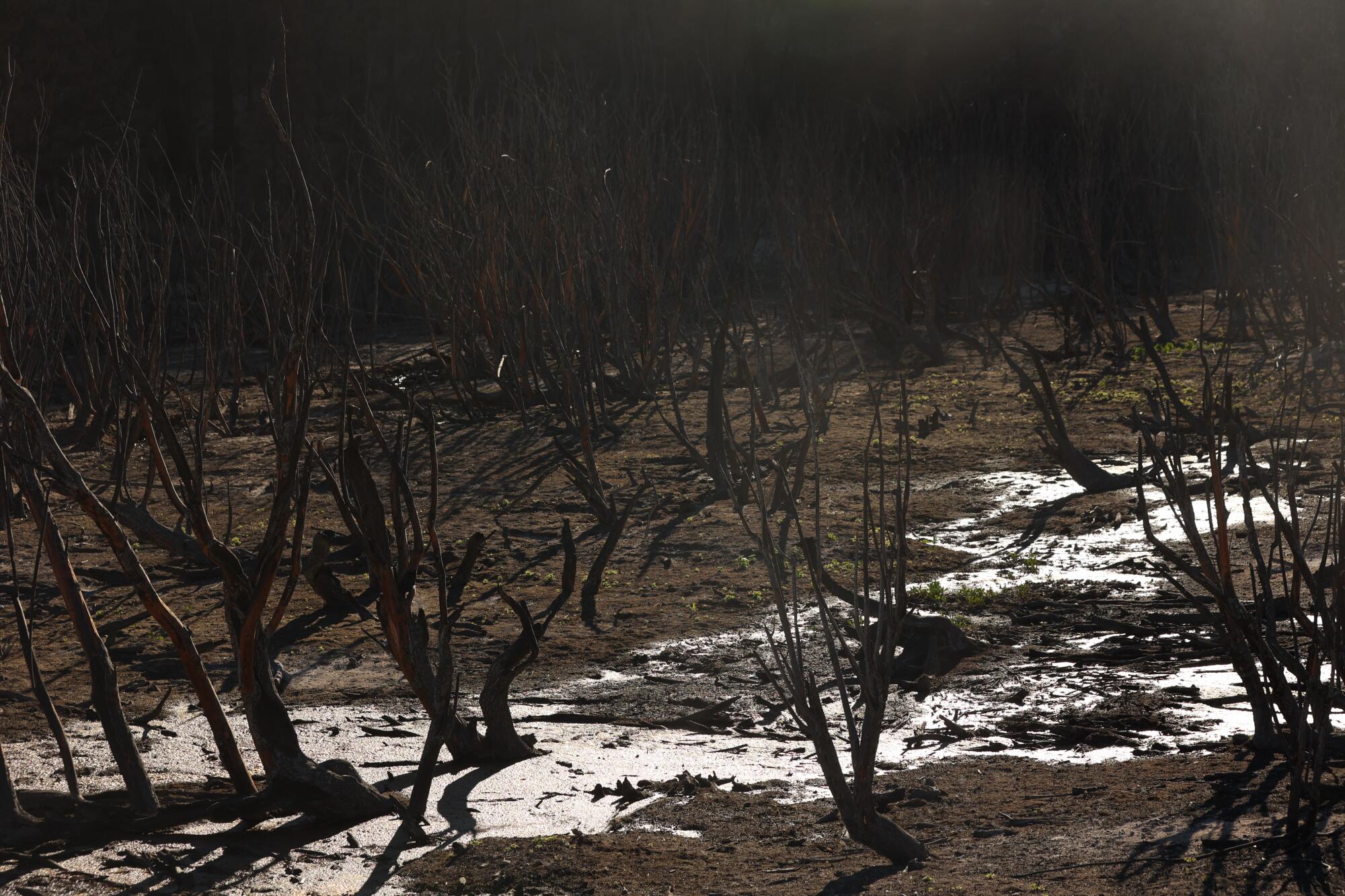
Trees around Mountain High ski resort were left scorched by the Bridge fire.
(Michael Blackshire / Los Angeles Times)
By early afternoon, Smith could no longer see more than 100 feet in front of him. There was no way to directly monitor the fire anymore.
Ash and debris — still on fire — started falling from the sky. At one point, a burning stick about a foot long hit the ground.
Employees started leaving, worried about safety and air quality.
“I got out of here about 2 o’clock, and the sky was black,” said John McColly, vice president of sales and marketing at the resort. “A lot of smoke was being whipped up, and it had this reddish hue to it. … Just for the sake of my lungs, I probably need to get out of here,” he recalled thinking.
Then, around 4:30 p.m., the nightmare scenario that was unfathomable just a few hours earlier became reality. A wall of flames over 300 feet tall by Smith’s estimate crested the ridge, roaring with the sound of a jet engine and blasting the resort with superheated wind and debris.
What had started as cautious fire protection preparations had suddenly became a fight for survival.
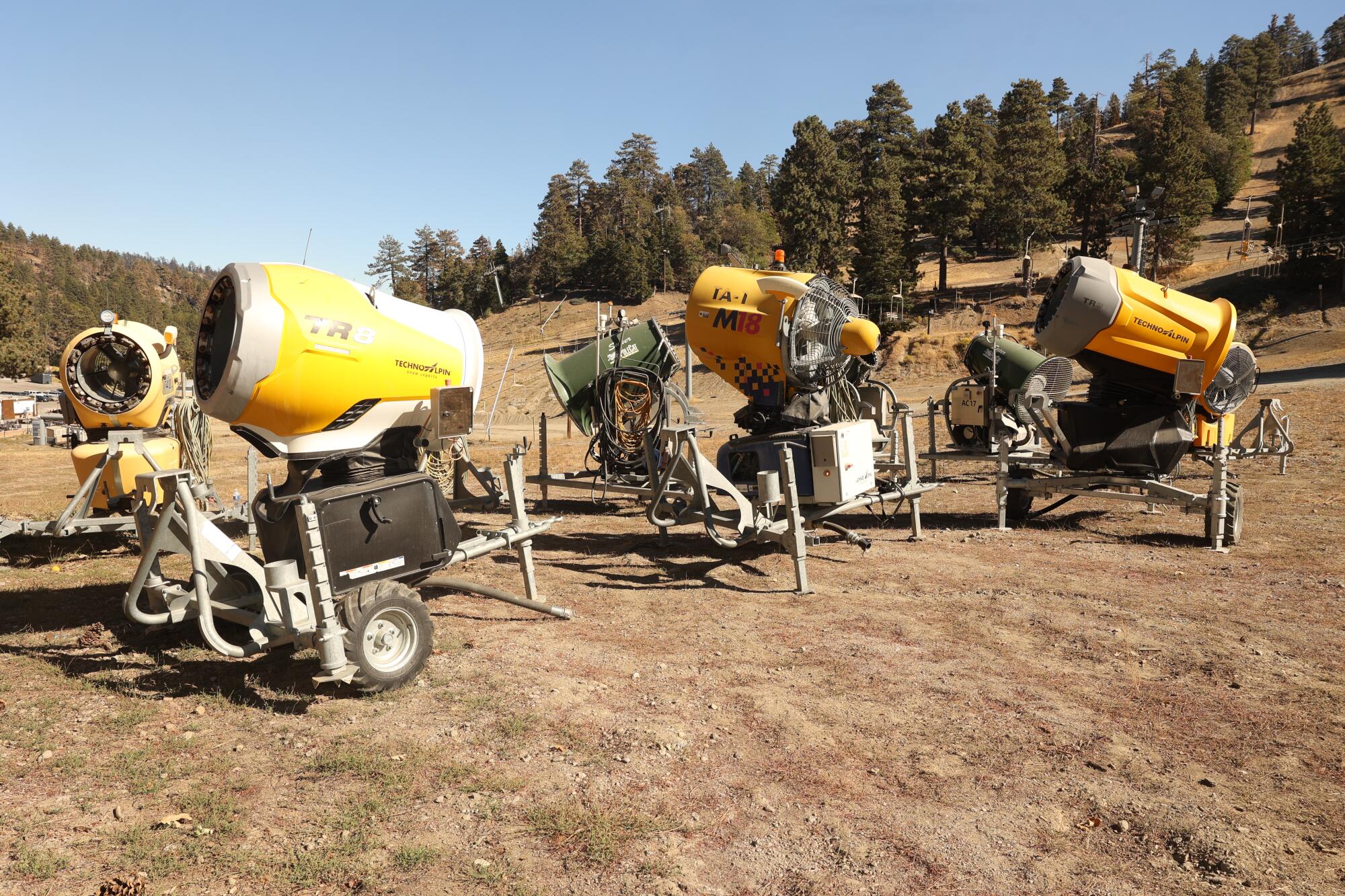
Workers at Mountain High ski resort used snow fan guns to battle the flames of the Bridge fire.
(Michael Blackshire / Los Angeles Times)
Smith directed staff to evacuate nearby campers. The team started pulling time sheets to make sure every employee was accounted for.
Smith sent another team member racing toward the snowmaking control center to activate the giant water system.
The team had stationed about 100 of their roughly 500 snow guns to defend the resort. While they could start about three quarters of them with the push of a button, the rest had to be turned on by hand.
As the majority of the staff evacuated, Smith and a handful of employees remained and raced around the property activating snow guns.
McColly monitored the fire’s progress via the resort’s live camera feed — which is intended to provide skiers a look at snow and weather conditions. He and countless others who had tuned in via social media beheld the flames with awe as they silhouetted a seemingly doomed ski lift terminal.
Smith had alerted fire crews, whom he knows personally through his role with the fire safety council and past wildfires, but they wouldn’t arrive for hours still.
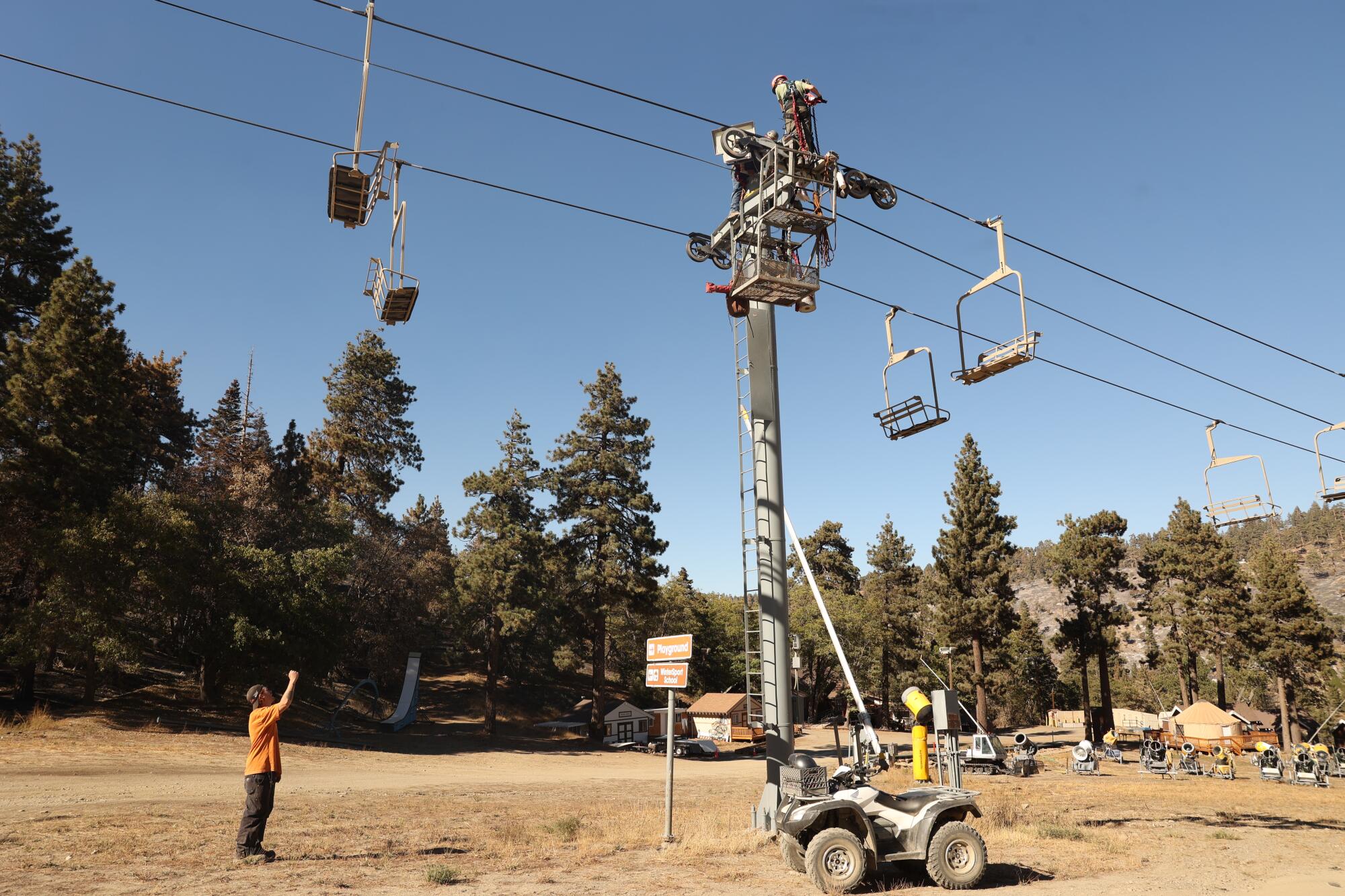
A Mountain High ski resort crew works on a chairlift recently.
(Michael Blackshire / Los Angeles Times)
At multiple points, massive explosions shook the ground, accenting the roar of the fire.
The upper elevations of the resort lost power first. By 5:30 p.m., the base area went dark as well. Without electricity, the water pumps for the snow guns fell silent. Now, the guns were powered only by gravity, which sent water rushing downhill from the 500,000-gallon reservoirs and out the guns’ nozzles.
As the fire burned through telephone poles, phone service went down.
The number of employees left at the resort dwindled to three. Then, two. Then, one: Smith.
At this point — 6:30 p.m. — fire flanked both sides of the resort. Realizing there was nothing left he could do, Smith made his escape.
“I wasn’t trying to be a hero,” he said. “I’ve got a wife and family.”
It wasn’t until night that firefighters were able to get to the scene.
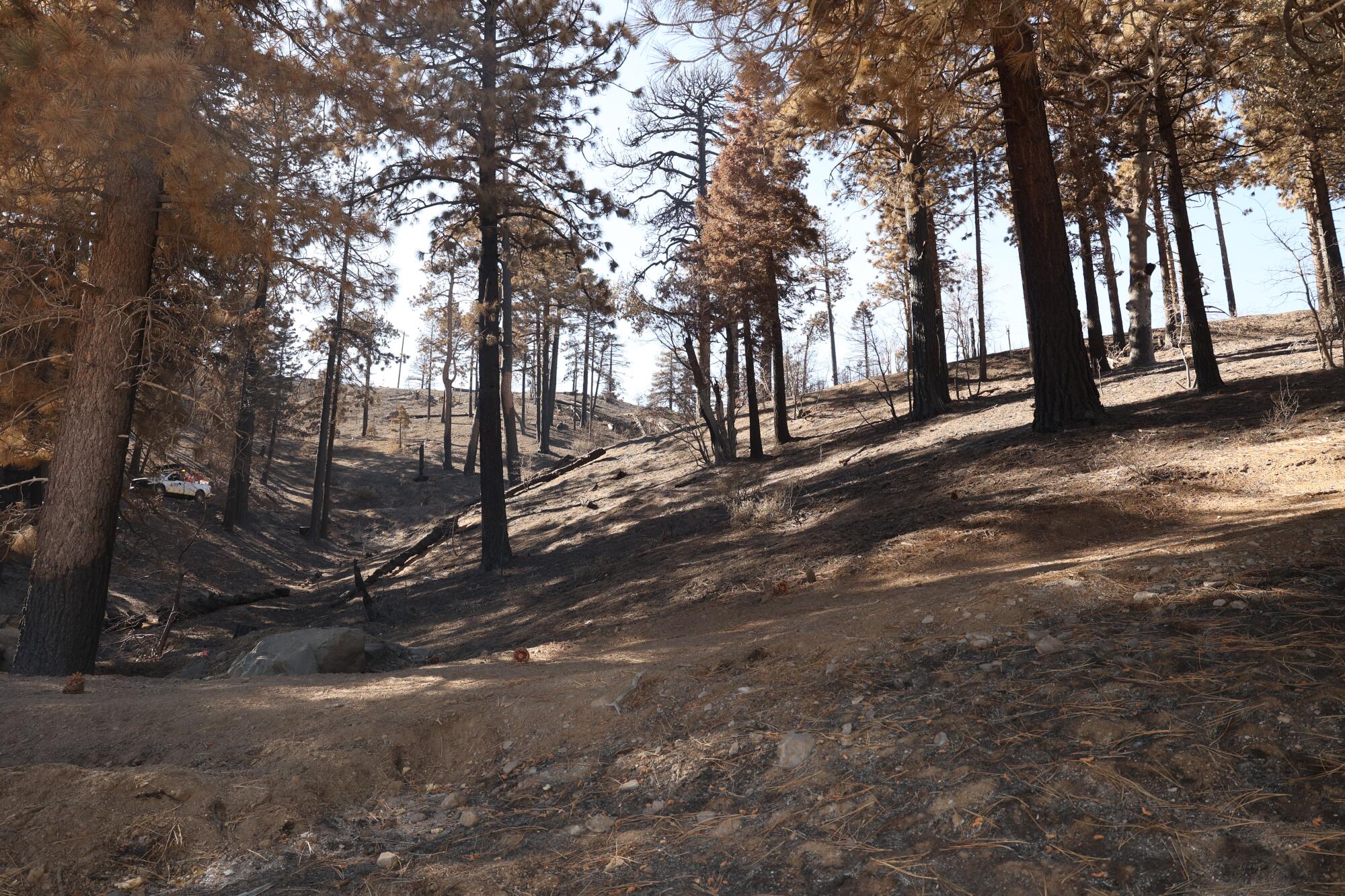
Burnt trees from the Bridge fire dot the landscape in Wrightwood.
(Michael Blackshire / Los Angeles Times)
Smith arrived back at Mountain High the next morning to assess the damage and assist firefighters. The fire continued to rage on — still with hundred-foot flames, just not fanned by violent winds.
“I came up through Wrightwood, and before you get up to our East Resort, … you’re like, ‘hey, everything’s gone,’” Smith said. “But then you hit the East Resort and start seeing green trees, and you see buildings, and you’re like, ‘Well, damn, that ain’t so bad.’”
Not only was the majority of the resort standing, but the snowmaking guns were still pouring water onto the edge of the resort.
In all, the resort had one, unessential ski lift damaged, while a few ski patrol and maintenance shacks burned down.
“I’m very proud of my team,” Smith said. “A lot of what’s still standing here is because of them.”
When the resort isn’t a victim of the fires in Angeles National Forest, it frequently provides firefighters with an invaluable operations hub. Its buildings serve as a command center, its parking lot becomes a helipad, and its water reservoirs are essential resupply stations.
“Through the years, through the fires, through the fire safe council — just having the partnerships with all those groups and to be able to have all those contacts at your fingertips is amazing,” said Smith.
It took nearly a month to secure the resort and restore power, allowing the full team of employees to safely return.
By early October, crews worked to repave Highway 2, which was left cracked and scarred from the fire and the efforts to fight it.
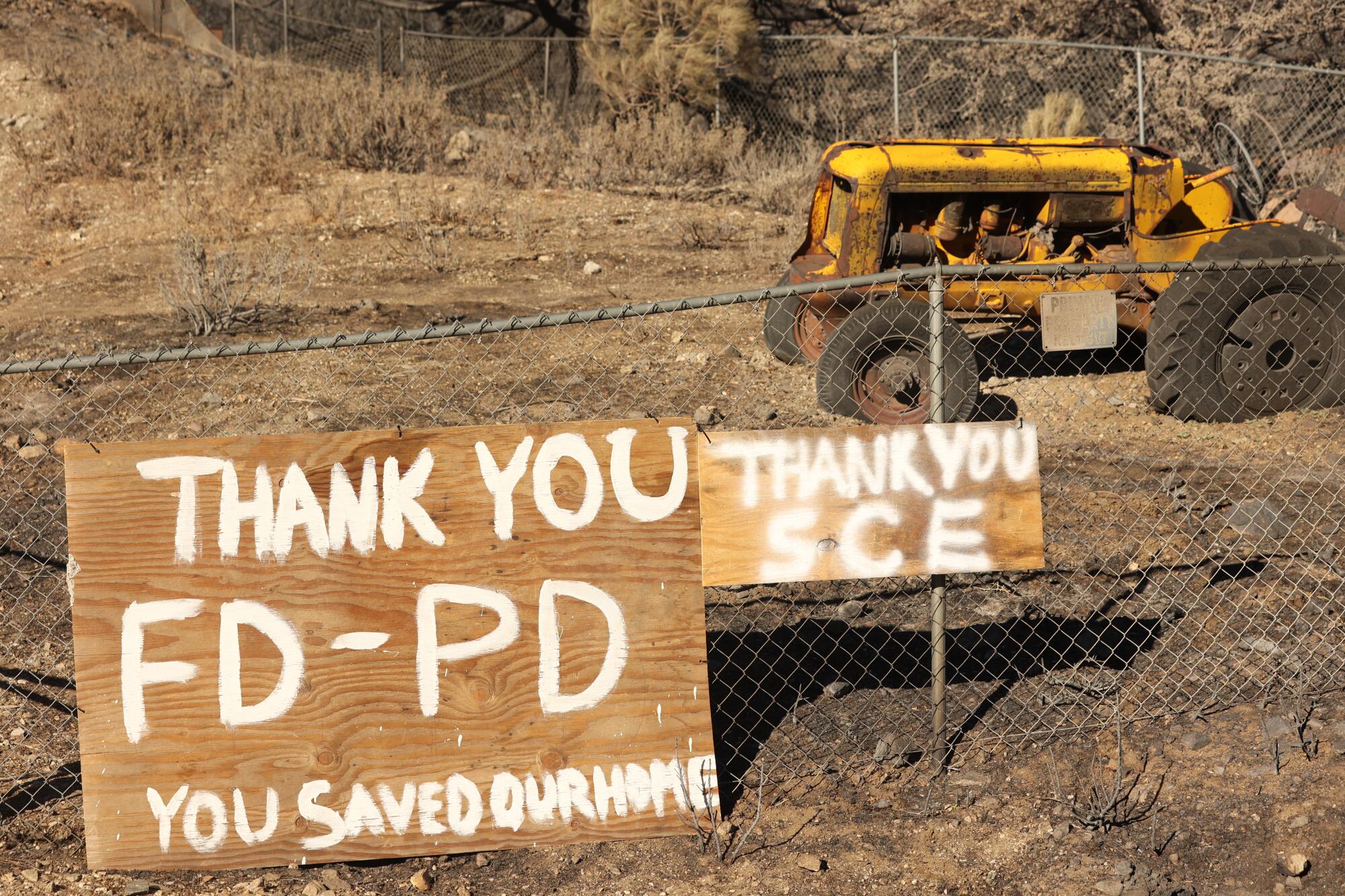
A sign in Wrightwood thanks emergency crews in the wake of the Bridge fire.
(Michael Blackshire / Los Angeles Times)
In Wrightwood, residents have adorned the city with homemade signs.
A piece of plywood, fixed to the Wrightwood city line sign, with black spray-painted letters read “Thank you for saving us.” A colorful hand-painted sign with a firetruck cartoon hung next to the fire station. “We [heart sign] you,” it read.
McColly had returned to his office in a historic cabin, which now smelled like wet rags and old cigarettes.
He turned his computer screen to show a season pass special offer for the resort’s 100th anniversary. Customers would receive a special hat and pin commemorating the season. And the resort would donate $25 to the American Red Cross Disaster Relief.
The Red Cross was onsite after the fire, supporting relief efforts, McColly said. Partnering with the Red Cross is a way to say thank you and pass the help forward.
“They were great to work with,” said McColly. “They really helped us out a lot.”

California
Mother, daughter found ‘alive and well’ after going missing on Southern California hiking trail

A mother and daughter who went missing after going for a hike on a difficult trail in San Bernardino County’s San Gorgonio Wilderness have been found “alive and well,” the sheriff’s department announced Friday.
The San Bernardino County Sheriff’s Department told KTLA they were uninjured and “walked out on their own.”
Krystal Meyers, 41, and her daughter Alexis Meyers Martinez, 21, were hiking on the Vivian Creek Trail Thursday but didn’t return, according to the San Bernardino County Sheriff’s Department.
They were last known to be at the 10,300-foot elevation mark above the High Creek switchbacks at 11 a.m., according to the San Gorgonio Search and Rescue team.
The Vivian Creek Trail is widely considered one of the more strenuous and hazardous routes in the San Gorgonio Wilderness.
The U.S. Forest Service says it’s the shortest and steepest route to the summit of Mount San Gorgonio and requires experienced mountaineering skills.
Officials did not provide any further details about the circumstances surrounding their disappearance.

BAKERSFIELD, Calif. (KBAK/KBFX) — The California Highway Patrol is urging drivers to stay focused on the road as they head out for Fourth of July celebrations.
The holiday weekend can be a dangerous time on our roads as millions of drivers are expected to travel.
CHP Officer Jorge Toro joined Eyewitness News Mornings to share how drivers can stay safe behind the wheel.
Officer Toro also highlighted the importance of sober driving over the holiday.
BE THE FIRST TO COMMENT
He says anyone hosting a party should make sure all of their guests get home safely, ensuring anyone who may be impaired doesn’t drive.

California is returning a stretch of rugged Mendocino County coast to the Indigenous nations whose ancestors once stewarded its shores.
State transportation officials recently approved the transfer of Blues Beach and the surrounding bluffs to Kai Poma, a nonprofit founded by representatives of the Sherwood Valley Band of Pomo Indians, Round Valley Indian Tribes and Coyote Valley Band of Pomo Indians.
The transfer of 136 acres just south of the community of Westport will mark the first time land managed by the California Department of Transportation has been returned to Indigenous tribes.
“This is beyond huge,” said J. Carlos Rivera, tribal chairman of the Sherwood Valley Band of Pomo Indians. “It’s enormous from our tribal perspective that we are basically obtaining the land that our people once lived on before colonization.”
California purchased the swath of rocky cliffs and windswept shoreline in the 1960s to expand the construction of Highway 1 and create a scenic viewpoint for highway travelers, according to a California Coastal Commission report.
More recently, public access has been largely unregulated, and summer weekends and holidays have drawn large groups who camp and party on the beach, at times driving through sensitive areas, damaging cultural sites and leaving behind trash, the report states.
Kai Poma plans to conduct cultural and archaeological resource studies and environmental surveys and then prepare a resource management plan for the property, according to planning documents. The nonprofit and the Coastal Commission have drafted a public access management plan that states the land will be open from sunrise to sunset.
Rivera described the entire property as a sacred site. The coastal waters are used by tribal people for seaweed and abalone gathering, and the shores host youth cultural camps, he said. “Protecting the land, it has a deeper meaning for us because we’re connected to the land,” he said.
The effort to acquire the land took years — and required a change in state law. Caltrans lacked the ability to transfer land to tribal governments until 2021, when Gov. Gavin Newsom signed a bill sponsored by state Sen. Mike McGuire (D-Healdsburg) that enabled the transfer, according to a news release issued at the time. The law also bars commercial activity on the property and requires public access be maintained.
“With 136 acres now officially transferred into tribal stewardship, one of the most spectacular stretches of the Mendocino Coast will be forever protected,” McGuire said in a statement.
“This agreement, the first of its kind in California, gives these three dynamic Native American tribes the rightful opportunity to reclaim sacred lands and cultural traditions on this special piece of earth. And it’s about damn time.”
The land transfer cleared its last regulatory hurdle June 26 with the approval by the California Transportation Commission, said Neil Thapar, an attorney who works as an advisor and legal consultant to Kai Poma. Caltrans staff will next record the deed transferring the title from the state of California to Kai Poma, which is expected to happen any day, he said.
-

 Cleveland, OH3 minutes ago
Lakewood power outage: Day two leaves businesses, residents scrambling
-

 Austin, TX6 minutes ago
City of Austin covers iconic murals, sparking backlash over cultural loss
-

 Alabama11 minutes ago
Thousands attend Alabama concert at West Virginia America 250 celebration – WV MetroNews
-

 Alaska18 minutes ago
Seward pilot helps rescue harbour seal pups from remote Alaska location – Homer News
-

 Arizona21 minutes ago
Arizona boy named Disneyland’s one billionth guest on his 8th birthday in memorable ceremony
-
Arkansas26 minutes ago
Arkansas Lottery Mega Millions, Cash 3 winning numbers for July 3, 2026
-

 Colorado36 minutes ago
Where to watch San Francisco Giants vs Colorado Rockies: TV channel, start time, streaming for July 4
-

 Connecticut41 minutes ago
Several state parks, beaches close Friday due to capacity

