Entertainment
Review: Feminist artists cast a skeptical eye at the linking of gender and nature in new L.A. show

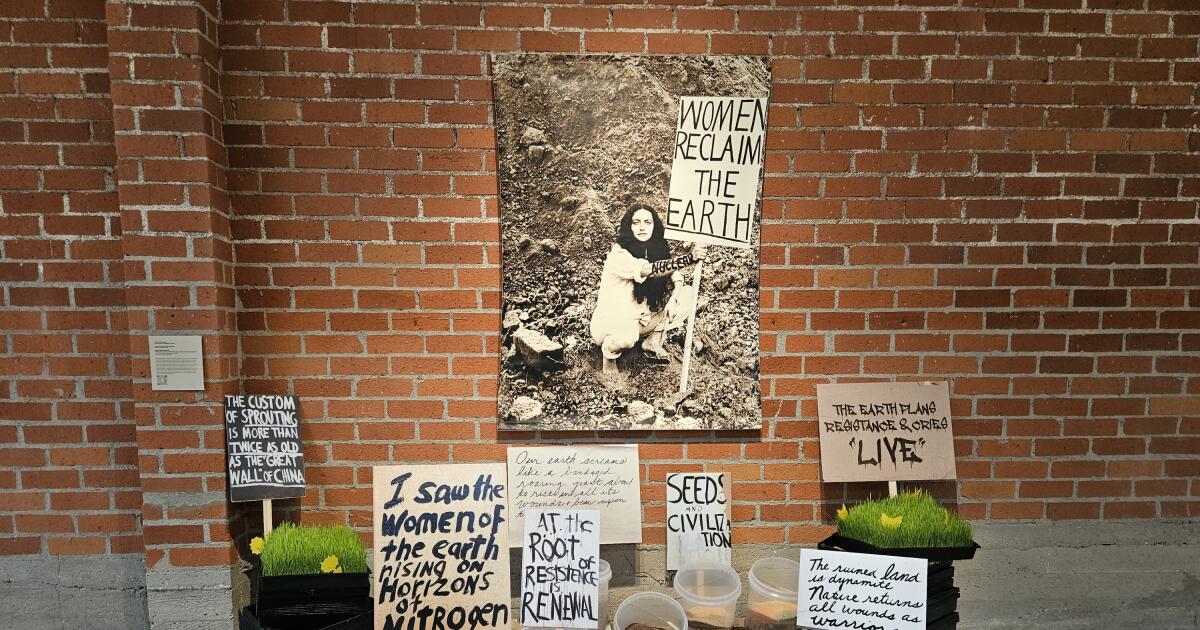
“Life on Earth: Art & Ecofeminism” is a somewhat difficult exhibition to grab hold of, but that’s mostly because its important subject is so much larger than a diverse but relatively modest presentation can encompass.
Ecofeminism rejects the idea of human dominance over nature. The inaugural show at the Brick, an independent art space formerly known as LAXArt and recently relocated to Western Avenue, features 18 works by international artists and collectives that touch several intriguing bases of ecofeminist art launched since the 1970s.
Insistence on the supremacy of people over the natural world is cited as the primary source of environmental destruction. Furthermore, the practice is tightly bound to the seemingly intransigent social marginalization of women. Remember Mother Nature? If we insist on regarding the natural world in such feminine terms, then authority over women is an essential — and equally destructive — corollary to authority over nature.
The show’s earliest piece might be an analogy for the whole. In 1972, when Aviva Rahmani was a student at the California Institute of the Arts, she directed and documented in slides a performance titled “Physical Education.” Filling a plastic bag with tap water, she and a performer drove 50-plus miles from the suburban school in parched Santa Clarita to the Pacific Ocean, stopping four times along the way to deposit teaspoons of water on the side of the road, then replacing each with a spoonful of dirt.
While a student at CalArts in 1972, Aviva Rahmani documented wasteful water practices in Southern California.
(Christopher Knight / Los Angles Times)
When Rahmani got to the beach, the muddy bag was emptied out in the sand and refilled with sea water. She promptly drove it back to CalArts, reversing the process. Upon arrival, she flushed the dirty water down a toilet.
In the exhibition, a cycle of elemental return and fundamental waste unfolds in slides projected from an automated tray onto an ordinary freestanding screen. The setup, common for pre-digital Conceptual art, is much like the way folks used to show the neighbors happy pictures of their summer vacation. Here, water transport assumes a form that is grandly ritualistic if decidedly prosaic.
None of the individual photographic images in “Physical Education” is especially distinctive. The artful feature of the work is instead embedded in the installation’s composition.
Rahmani’s pictures don’t come close to filling the screen, although they could easily have been projected that way like snaps from the family trip to Disneyland or Yosemite. Rather, they nestle down in a corner, modestly flashing by, one after the next, as the slide tray clicks in nonstop rotation. The mostly empty screen’s larger blankness implies that there’s plenty of room for many more pictures awaiting exposure. This work of ecologically minded art is positioned as just one self-aware fragment of a much bigger worldview that needs to be seen as holistic and systemic.
Nearby, a pair of large, documentary performance photographs made five decades later by L.A.-based yétúndé olagbaju resonates against Rahmani’s historical piece. At left in “protolith: heat, pressure,” the artist is seen from behind, dressed in a white robe and headscarf. They emerge from within a rocky outcropping in an otherwise grassy field and hold up their hands, as if in benediction. On the right, the composition is roughly the same, although now their hands press against the massive stone.
Off in the distance, a fence is glimpsed, suggesting a cultivated landscape rather than a wild one, while a lone telephone pole identifies the rural location as tethered to community via modern communication. The photographs smartly picture the classic irresistible force paradox. What happens when an unstoppable force meets an immovable object? Can an artist alter a deeply established cultural relationship to the natural world?
Come to think of it, in these photographs, which is the force, and which is the object — the person or the rock? Or are they interchangeable?
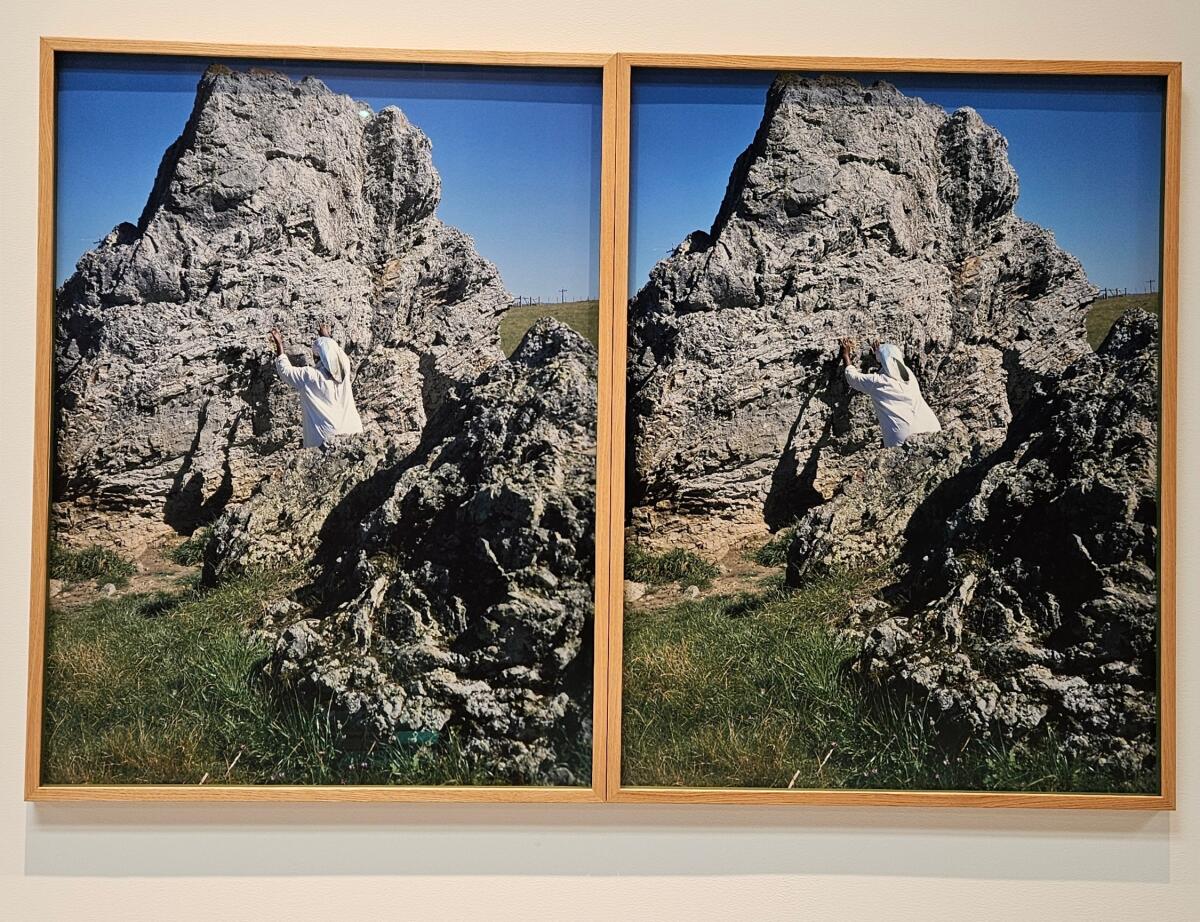
L.A.-based artist yétúndé olagbaju performed a ritual laying on of hands on a rural stone outcropping.
(Christopher Knight / Los Angeles Times)
It takes a moment, but olagbaju’s gesture of first blessing, then touching a seemingly immovable boulder shifts your perspective, and that might be enough to generate at least incremental change. Like the steady drip-drip-drip of water on stone, which over millenniums reduces a monolith to sand, human contact will have its way.
The exhibition is not a comprehensive history of ecofeminist art. Pioneers of the genre such as Agnes Denes, who once transformed a Manhattan landfill into a wondrous urban wheat field, and Helène Aylon, who commemorated the end of the Cold War with anti-nuclear performance art, are absent. The Brick presentation is instead a provocative sketch suggesting that a museum would do well to undertake a full historical overview of ecofeminist art from the last half a century.
It’s also disappointing that no catalog accompanies the show; one is said to be in the works, but publication is not expected until next year, presumably so that new commissions, installations and mixed-media works can be documented and included. Art spaces used to deal with such complications by publishing a two-volume set — a primary one to accompany the exhibition as it opens and a small supplement to record additions. But that traditional practice seems to have fallen by the wayside.
It’s a loss. Yes, the two-tome process is more expensive to produce. Yet, for the benefit of the art audience, it should simply be regarded as necessary.
Still, smartly organized by Brick curator Catherine Taft, with curatorial assistants Hannah Burstein and Kameron McDowell, “Life on Earth” manages to cover a good deal of territory. In this contribution to the Getty-sponsored festival “PST Art: Art & Science Collide,” the breadth, both aesthetic and geographic, is wide.
A graceful mermaid swimming around in an industrial-strength water treatment plant in Lithuanian artist Emilija Škarnulytė’s film “Riparia” becomes a perilous siren, luring the unsuspecting to the rocks. Leslie Labowitz Starus, who has operated an urban farm in Venice for decades, puts sprouts on poetic display. Carolina Caycedo carves a trio of enormous seeds — squash, beans, corn — from wood as elegant sculptural abstractions. Projected videos of rushing rivers and roiling seas mix effortlessly with disparate photographs of human gender fluidity, which marks the people in A.L. Steiner’s exuberant collage environment papering gallery walls.
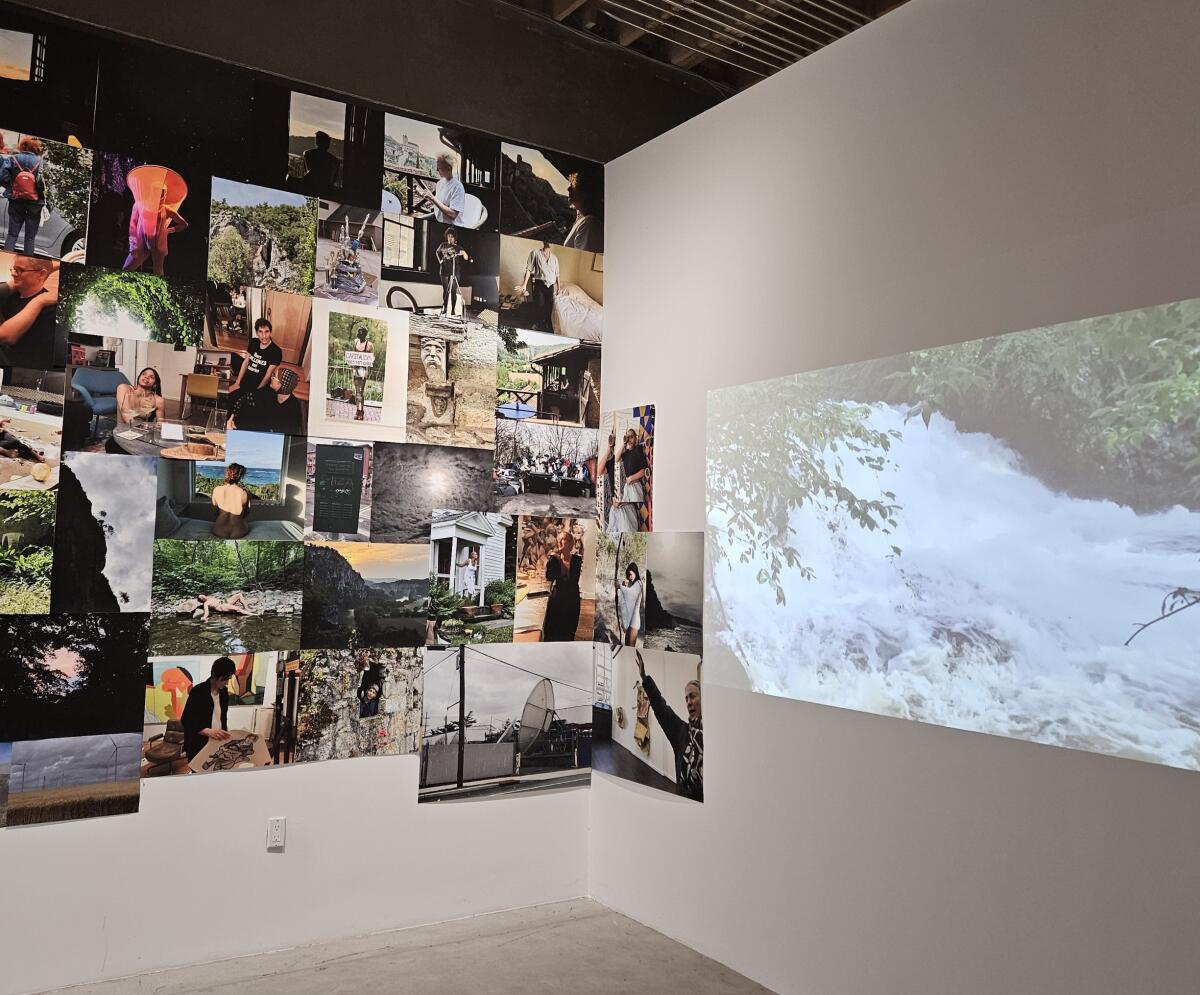
Fluidity describes gender and nature in A.L. Steiner’s installation of photographs and video.
(Christopher Knight / Los Angeles Times)
Steiner’s installation helps unravel perhaps the oldest, most powerful source of the problematic fusion of nature and womanhood in ordinary cultural conceptions. The Book of Genesis doubled down not long after tagging biblical Eve as the agent of the fall from grace in the Garden of Eden. “Be fruitful and multiply,” the command then came, “and replenish the Earth, and subdue it.”
And subdue it. Subjugate women, subjugate nature. Think about that awful binary as the climate continues to change, while stormwater rises and fires burn.
‘Life on Earth: Art & Ecofeminism’
Where: The Brick, 518 N. Western Ave., L.A.
When: Tuesdays to Saturdays, through Dec. 21
Info: (323) 848-4140, www.the-brick.org

Movie Reviews
Bandar Movie Review: Bobby Deol roars in Anurag Kashyap’s unsettling legal thriller that refuses to spoon-feed

Name: Bandar
Director: Anurag Kashyap
Cast: Bobby Deol, Sanya Malhotra, Sapna Pabbi, Saba Azad, Jitendra Joshi, Raj B Shetty
Writer: Sudip Sharma, Abhishek Banerjee
Rating: 3.5/5
Plot:
Bandar follows Sameer Mehra’s character, essayed by Bobby Deol, a fading star who is desperately clinging to his past glory. Just as he attempts to rebuild his life and finds solace in a new relationship, his world comes crashing down. A former girlfriend files a heinous allegation against him, dragging him into a vicious, high-profile legal battle. Written by Sudip Sharma and Abhishek Banerjee, the film moves away from standard Bollywood courtroom setups. Instead, it dives straight into the murky waters of social media trials, public perception, and a sluggish judicial system where the truth gets buried under layers of gray.
What works:
Known for his chaotic energy, Anurag Kashyap takes a remarkably mature and controlled approach here. He avoids sensationalizing a highly sensitive topic, choosing instead to focus on the psychological claustrophobia of the protagonist. The prison sequences are exceptionally well-shot. They create a suffocating, raw atmosphere that makes you feel the weight of the character’s confinement. The script successfully avoids preachy, black-and-white monologues. It bravely forces the audience to confront their own biases regarding modern-day public trials and the digital judge-and-jury culture.
What doesn’t:
Clocking in at nearly two hours and twenty minutes, Bandar feels heavily weighed down in the second half. The narrative stretches thin, and a few subplots demand too much patience, making you wish for a tighter edit. The film stubbornly refuses to take a definitive moral stance or offer a neat resolution. While film enthusiasts might appreciate the complexity, mainstream viewers looking for a clear-cut ending or emotional payoff might walk away feeling detached and frustrated.
Performances:
- Bobby Deol is the beating heart of this film. Stripping away the massive macho swagger and menacing villainy of his recent hits, he delivers a deeply vulnerable, understated performance. He plays Samar with a mix of arrogance, confusion, and raw helplessness, proving his immense range.
- Sanya Malhotra anchors her screen time with her trademark reliability, turning in a grounded and impactful performance.
- Saba Azad and Sapna Pabbi excel in their respective roles, bringing genuine nuance to characters that could have easily been sidelined.
- Jitendra Joshi is an absolute scene-stealer, commanding your attention every single time he steps into the frame.
- Indrajith Sukumaran and Raj B Shetty are absolute show stealers with their raw acting.
Final Verdict:
Bandar is an unsettling, morally complex thriller that refuses to spoon-feed its audience. It isn’t a comfortable watch, nor does it try to be. While the sluggish pacing in the second half prevents it from being an absolute masterpiece, it is worth a watch for Bobby Deol’s spectacular acting reinvention and Anurag Kashyap’s gritty, thought-provoking storytelling.
Disclaimer: The views and opinions expressed in this article are solely those of the author and do not reflect the official policy or position of Pinkvilla. No statement in this article is intended to defame, harm, or malign any individual or entity.
ALSO READ: Maa Behen Movie Review: Madhuri Dixit, Triptii Dimri, and Dharna Durga save a slow-burning mystery

Kathy Hilton will no longer be the grand marshal of West Hollywood’s pride parade.
The city and WeHo Pride on Wednesday released a joint statement, announcing that “The Real Housewives of Beverly Hills” star would no longer serve as the Grand Marshal Icon for the 2026 WeHo Pride Parade. The event is scheduled for Sunday.
“After thoughtful discussions, the City of West Hollywood, the WeHo Pride production team, and Kathy Hilton have determined that the 2026 WeHo Pride Parade will not designate a Grand Marshal Icon honoree,” read the statement.
The decision comes less than a week after Hilton was announced. That May 28 announcement was met with swift backlash from the LGBTQ+ community and allies, who called out Hilton’s ties to President Trump and alleged MAGA-leaning politics. Critics also cited accusations that the socialite had used a homophobic slur while on a trip with other cast members of “The Real Housewives of Beverly Hills,” an action she has previously denied.
In their joint statement, West Hollywood and the WeHo Pride team expressed their appreciation for “the respectful and sincere dialogue” around both the event and the “role and significance” of Pride honorees.
“The City of West Hollywood has always believed that Pride belongs to the community,” the joint statement said. “Since its earliest days, Pride has served as both a celebration and a platform for activism, visibility, resilience, and the ongoing pursuit of equality, dignity, and justice for LGBTQ+ people. … These conversations reflect the passion people have for WeHo Pride and underscore the importance of ensuring that WeHo Pride continues to honor the history, values, and diverse voices of the LGBTQ+ community.”
In a statement, Hilton expressed gratitude for being considered for grand marshal and reaffirmed her commitment to the LGBTQ+ community and causes.
“My reason for wanting to be involved in this year’s WeHo Pride weekend was simple: to celebrate, support, and share in the joy of a community that means a great deal to so many people,” Hilton said. “Pride is, and always will be, about celebrating and uplifting LGBTQ+ voices, experiences, and achievements. … My support for the community and WeHo Pride is unwavering.”
She also mentioned several queer advocacy organizations and events she has supported over the years, including GLAAD, the Elton John AIDS Foundation, the Elizabeth Taylor AIDS Foundation, Dr. Mathilde Krim, God’s Love We Deliver and Project Angel Food.
The latest Pride-related dust-up follows the abrupt cancellation of the Long Beach Pride Festival in May. The city’s Pride Parade took place as planned.
Both snafus have occurred as conservative politicians and advocates continue to attack LGBTQ+ rights and visibility nationwide. Some Republican governors have even pushed for conservative alternatives to Pride month festivities. A recent Gallup poll has found that after years of steady gains, support for marriage equality and same-sex relationships has slipped, particularly among Republicans.
Movie Reviews
Movie Review: Travolta’s “Propeller: One-Way Night Coach” is One for the Ages — All Ages

Back in the good ol’days — the ’90s — John Travolta would love to get off the topic of “Michael,” “Pulp Fiction” or “Get Shorty” in interviews with film journalists like me and regale us with how utterly besotted he had been with his first flying experience, how that drove his passion for piloting and buying planes and airfield-adjacent luxury houses.
He didn’t even seem to mind having to move house when this or that development balked at him flying his Boeing 707 out of there on the way to locations.
Travolta would tell any journalist who asked that he was writing a kid-friendly book, “Propeller: One Way Night Coach,” based on his first flights as a child in old propeller driven airliners — cheap red-eye overnight treks with too many connections for your average jet age traveller to tolerate.
I remember picking up the book when it came out later in the ’90s — at an airport gift shop — and thinking “Well, that’s as cute as I figured.”
And now, decades later and trapped in the B-movie hell of his post “Gotti” career, Travolta’s turned that cute book into the most delightful, fanciful and colorful bon bon of a movie.
“One Way Night Coach” is a child’s fantasy of flight and flying the way it used to be — with pristine, uncrowded, futuristic airports, an early ’60s era of jets and prop planes with over-uniformed stewardesses in white gloves, the days “Back before every Joe Sweatsock could wedge himself behind a lunch tray and jet off to Raleigh-Durham,” as Sideshow Bob memorably sneered on “The Simpsons’.”
It’s a fictionalized account of Travolta’s childhood about an only child (at least two Travolta siblings have bit parts in this movie) of a never-made-it/never-will actress/single-mom (Kelly Eviston-Quinnett) who indulges her aviation-obsessed eight-year-old with a cheap cross-country overnight flight.
Little Jeff (Clark Shotwell) will revel in almost every Idlewild to Pittsburgh to Dayton to Chicago to Kansas City to Denver and Los Angeles minute. He strolls into the cockpit to meet pilots, charms the stewardesses and checks out the sleeping bunks on the TWA Lockheed Super Constellation, loving even the delays if not the Chicken Cordon Bleu he’s offered on legs of the journey that offer a meal.
And as he’s an observant child, he comments (Travolta narrates) on his 50ish mother’s vamping and posing, her choice of cigarettes (Newports) and drinks, the solo traveling men whose attention she pursues and earns.
“I was her best audience,” adult Jeff remembers of the mother who’d read him plays as bedtime stories and delusionally hopes that this trip to Los Angeles might be her “big break” even though she’s pushing 50.
“Hollywood called,” she’d explain about their overnight cheap flight arrangements to ticket agents and crew. “They told me to take the next flight!”
At every turn, Jeff meets or sees kindness — stewardesses who indulge his many questions and bump them up to first class on the mostly-empty planes, a captain who fixes his toy model of a Constellation, a mentally ill flyer who flips out but is calmed by a flight attendant who isn’t overworked and frazzled in jet-powered tin-can jammed with Joe and Jane Sweatsocks who think nothing of traveling in their pajamas.
Normally, I cringe at pictures this reliant on voice-over narration. I recoil from stars who populate their picture with Sandler etc. offspring. But “Propeller” is unfailingly sweet and never cloying.
Sure, it’s fictionalized. But if you’ve followed Travolta’s life and career, a lot of him is in this — his raptoruous engagement with flying, an indulged child who developed a taste for fine food and creature comforts, a mother who was his guiding star as an actor.
I get why there are less adoring reviews than mine floating around “Propeller.” It’s unfailingly sweet. Mom’s man-hunting is seriously dated. This TWA tale is decorated with Gershwin’s majestic “Rhapsody in Blue” — United Airlines’ signature tune. And Travolta’s been around long enough for recent generations to come up and not feel a connection to the “Saturday Night Fever/Get Shorty” star whose career has fallen off and life has been visited by too much tragedy.
But I’d hate to be seated next to anybody who doesn’t appreciate this adorable, pristine and nearly perfect aviation fantasy on any flight, much less an overnight one.
Rating: TV-PG
Cast: Clark Shotwell, Kelly Eviston-Quinnett, Ellen Travolta, Ella Beau Travolta, Olga Hoffmann and John Travolta.
Credits: Scripted and directed by John Travolta, based on his book. An Apple TV+ release.
Running time: 1:01

-

 Los Angeles, Ca1 hour ago
'Top Gun: Maverick' actor identified as victim stabbed to death in Tarzana
-

 Detroit, MI1 hour ago
Storm chances return, which could impact Motor City Pride, graduations this weekend across Metro Detroit
-

 San Francisco, CA2 hours ago
Hilton campaigns in San Francisco as California primary votes still being counted
-

 Dallas, TX2 hours ago
Crews cover up AT&T branding as stadium becomes
-

 Miami, FL2 hours ago
Miami leaders gather for FIFA World Cup Host Committee Gala
-

 Boston, MA2 hours ago
Package fire outside Boston’s Museum of African American History under investigation
-

 Denver, CO2 hours ago
Rockies beat reporter Patrick Saunders to leave Denver Post
-

 Seattle, WA2 hours ago
Seattle granted NFL Franchise on this day 52 years ago

