Lifestyle
'Little Women Ballet' leaps into a historic L.A. site — and you're part of the story


As contemporary Angelenos, seeing the immersive “Little Women Ballet” might be as close as we’ll ever get to stepping into a time machine.
The series of dance works about Louisa May Alcott’s beloved 19th century novel are staged inside the stately Victorian homes of Northeast L.A.’s Heritage Square Museum. Dancers and actors are dressed in period-inspired costumes, from cap-sleeve pioneer dresses to Steampunk-style fashions. Before each performance, the scene is set by a narrator who speaks in a prim, puritanical accent reminiscent of a bygone era. And the production demands the audience’s full participation: as guests, we’re invited to do everything from visit the homes of the novel’s March sisters to step in to play roles to advance the plot.
We begin by splitting off into small groups and following along as a character — in my group’s case, the girls’ wealthy Aunt March — leads us into the various houses where the ballet will be staged. The show is intimate — dancers are not even two feet away from audience members, who are granted limited seating and space to stand in the small rooms. They’re so close that you can hear the muffled sounds of their ballet shoes on the carpet and can make eye contact, which feels both intimate and mildly discomfiting.
Directed and choreographed by Emma Andres, the experience kicked off in May with a spring iteration before bowing its autumn production last month. In late November, the series will conclude with a winter immersive before staging a full-length version of the story at the Wilshire Ebell Theatre in December.
The trilogy emerged organically. “We wanted to take this project in steps to see how it was going to grow and be received by audiences,” Andres said. “When I originally created the spring immersive, I did not know that I would be creating autumn and winter as well.”
Andres created the work with the intention of making space in ballet for more stories focusing on women. “The story of ‘Little Women’ is complicated, but I felt that it would be great for narrative ballet,” she said. “I see myself in all four of the sisters and I felt that they were a group of young ladies who could be inspiring for young audiences to watch and take influence from. Even though they come from a time that’s 100 or so years before our own, they still have very relatable traits to us in 2024.”
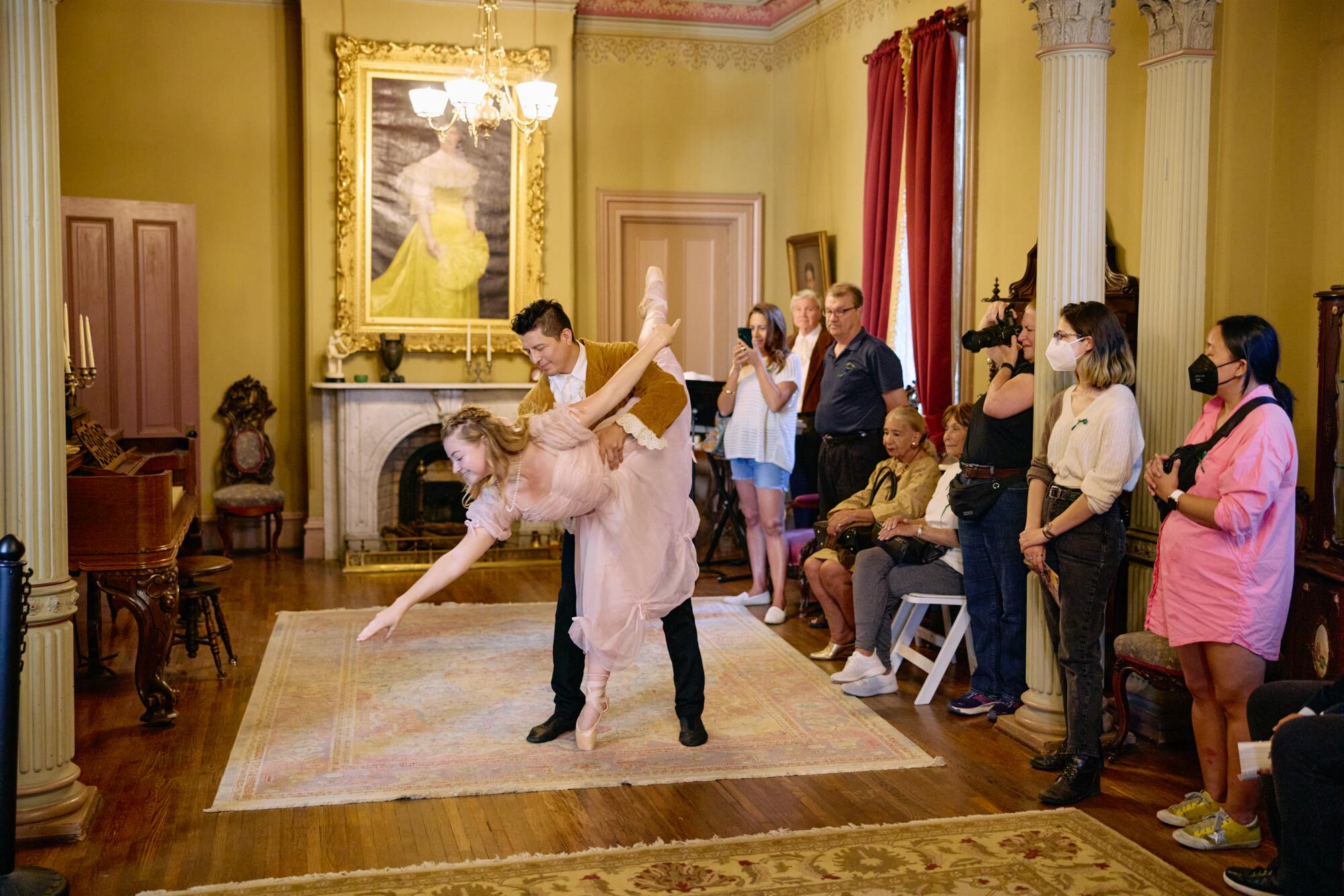
Ellen Relac and Alberto Hernandez, as Meg March and John Brooke, perform in a room of the L.A. Heritage Museum.
Constructed during the Victorian era, the Heritage Square Museum is in many ways the perfect backdrop for this production.
“We don’t have the privilege of being in Concord, Mass., where Louisa May Alcott grew up, but I feel like Heritage Square really shows where we developed our performance, which was California,” Andres said.
Dancing in the antique homes required careful planning. Luckily, it turned out that pointe shoes moved easily across the carpet-covered floors. “[The carpet] kind of acts like rosin so it provides this friction that’s actually really nice and never slippery,” Andres explained.
However, there were other design challenges, particularly the low-hanging chandeliers. To prevent a catastrophe, the team measured all of the rooms and taped down the dimensions in their home studio of Pasadena Civic Ballet. The dancers also walked the space and noted every piece of furniture and potential pitfall during a dress rehearsal.
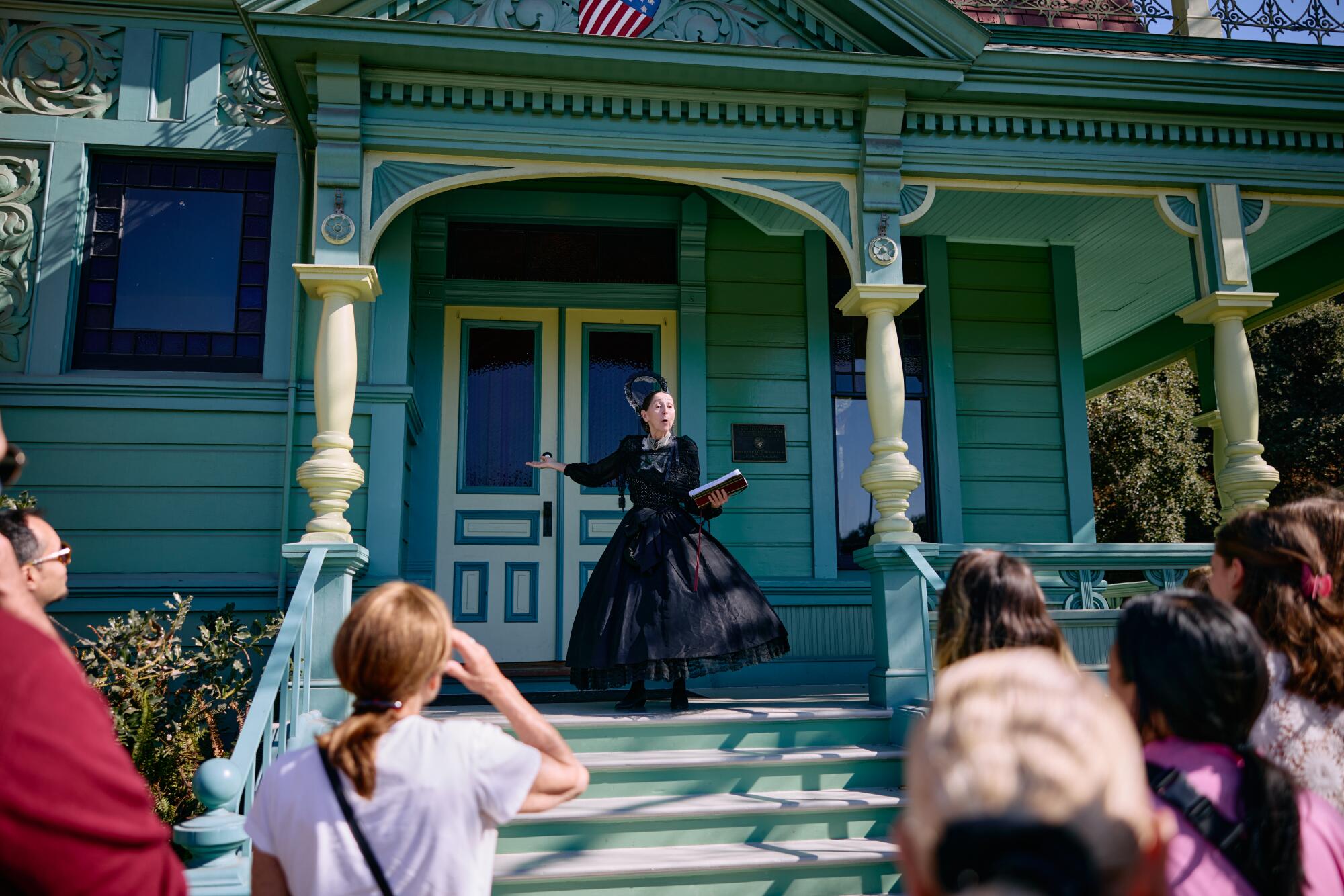
Denise Moses as Aunt March introduces a scene before a group of guests.
Andres grew up dancing with the Pasadena Civic Ballet, which she attended from the age of 4 through 18. “It’s a very unique studio, because they create all their own ballets,” she said, including interpretations of Disney titles like “Peter Pan,” “The Little Mermaid,” “Snow White” and “Alice in Wonderland.”
The company has been directed by Diane De Franco Browne, Tania Grafos and Zoe Vidalakis since 2000. Browne served as production advisor on this project. “I watched these three really creative women come together and create a very inspiring and creative environment growing up,” Andres said. “I think that a lot of my passion for the arts came from watching them as I grew up.”
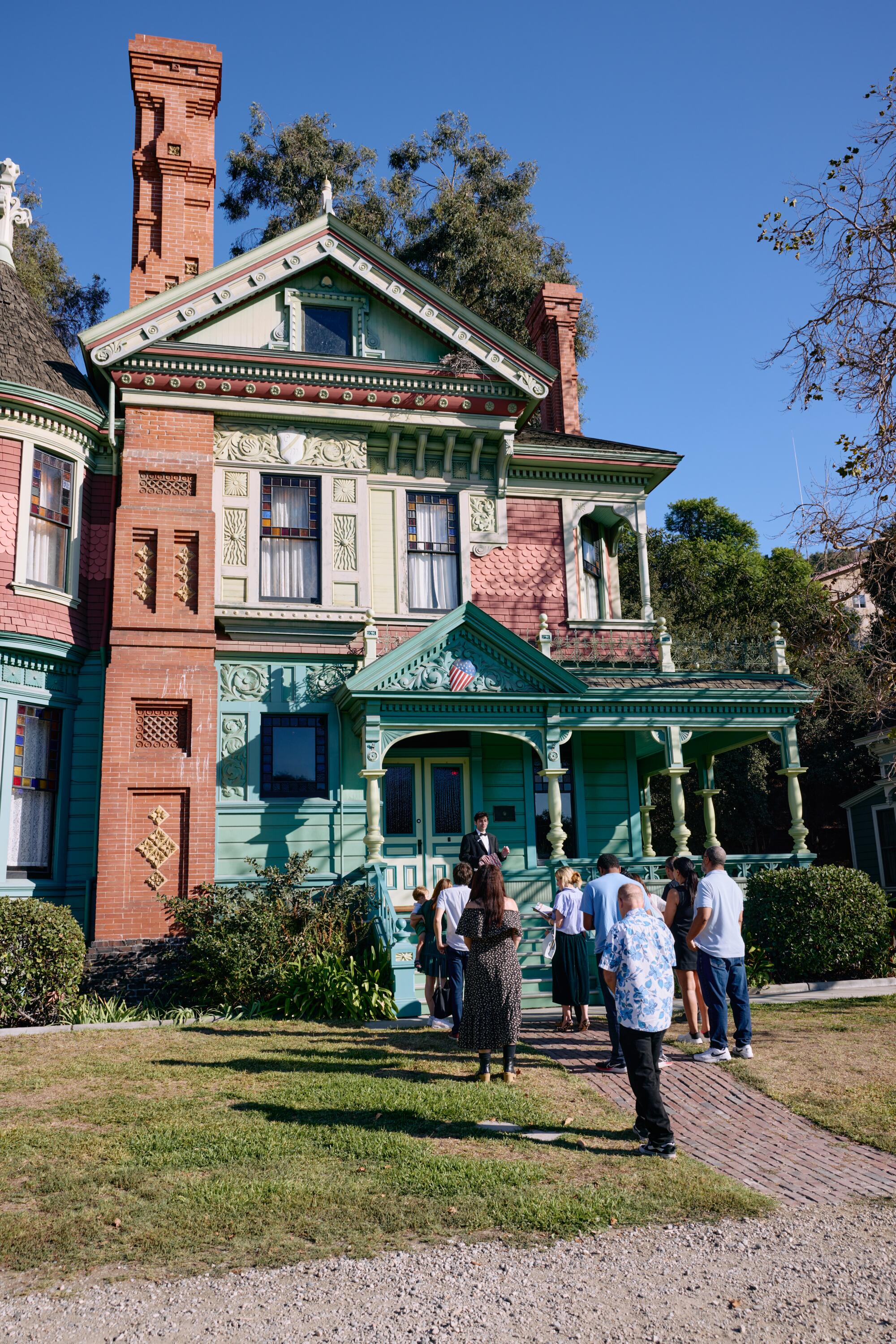
Guests congregate outside of one of the Victorian buildings that comprise L.A.’s Heritage Square Museum.
The Pasadena native graduated from UC Irvine in 2020 with a BFA bachelor of fine arts degree in choreography and a minor in literary journalism. After the pandemic hit, Andres moved back to Pasadena and became manager of Pasadena Civic Ballet, helping it build several outdoor dance studios to keep dance going live. “Even though I was really happy to be coming back, it was very difficult having all of our students on Zoom. But luckily we transitioned back to live pretty quickly,” said Andres.
It was during that time that she first conceived of the idea for a “Little Women”-themed ballet. Cooped up inside, she watched Greta Gerwig’s 2019 take on the classic work and soon after screened all three previous feature-length film adaptations (from 1933, 1949 and 1994) and read the book.
“I’m glad I [first] read it when I was older because I feel like I related to it way more than I would have as a child,” Andres said. “I feel like translating it into a ballet is a way that younger audiences can really relate to it and the emotions of the characters and their personalities.”
She began by crafting a six-minute summation of the book for Pasadena Civic Ballet in 2021, featuring students at the school. “I tried to target key points in their lives,” she said. “I went directly into Jo meeting Laurie and then directly from there, the relationship between John and Meg. Because when Meg starts to fall in love, that’s the first time that Jo really sees that their family could come apart when people start growing up.”
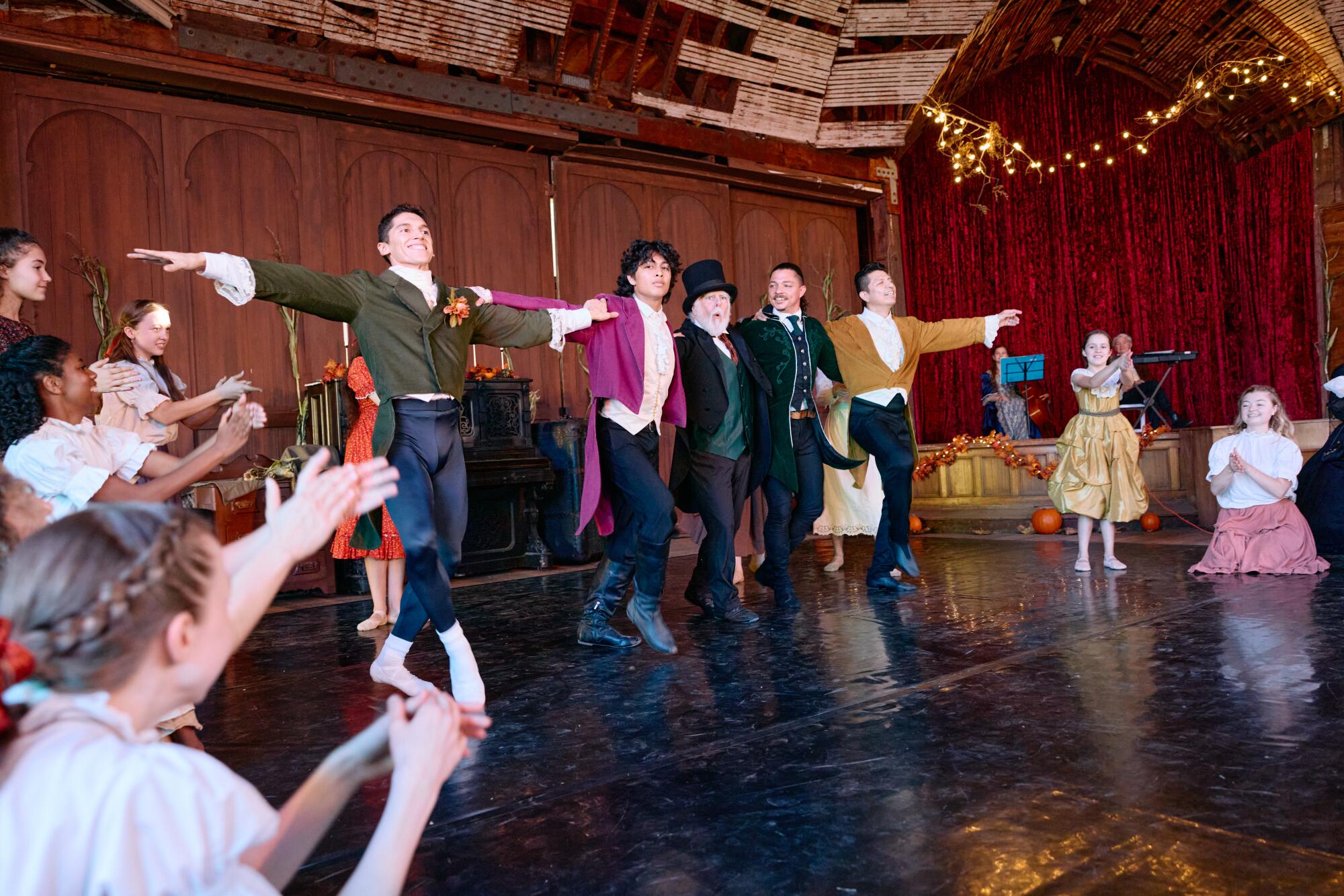
From left, Chris Flores, Evan Hernandez, Ross Clark, Jacob Robleto and Alberto Hernandez perform in the immersive “Little Women Ballet.”
She established each character’s personality visually by creating recognizable dance motifs for each of the sisters, which live on in the current production. “Each of the sisters has a pose that they do that symbolizes their interests and personality,” Andres said. “Jo holds her hands up like she’s reading a book, Amy like she’s painting a canvas with a paintbrush, Beth’s on a piano and then Meg’s are up by her face to symbolize an acting mask.”
Dance sequences were created to illustrate scenes in the girls’ lives including Amy and Laurie’s courtship in Paris, Beth’s final days with Jo and Jo’s romance with professor Fredrick Bhaer.
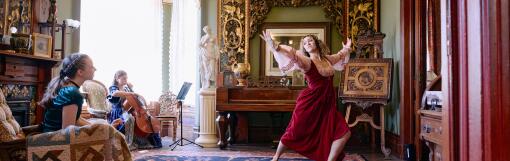
‘Little Women Ballet’ returns for two performances this winter
The winter immersive runs Nov. 22-24 at Heritage Square Museum. Tickets are $60. The full-length ballet will be held Dec. 7 at Wilshire Ebell Theatre. Tickets start at $28. For more information, visit littlewomenballet.com
Andres made a deliberate choice for all the sisters to dance on pointe — except for Jo, a character who is unconventional in her tomboyishness. Jo dances with flexed feet.
“Some of our dancers are not pointe dancers, but they are excellent ballet dancers,” she said. “If I feel that someone will play the character really well, that is more important to me than them doing pointe. But my hope for the full-length is that it will just be Jo not wearing them, to emphasize the idea that she’s not only breaking societal norms as a woman of the time, but she’s also breaking ballet norms.”
The show itself is doing the same.
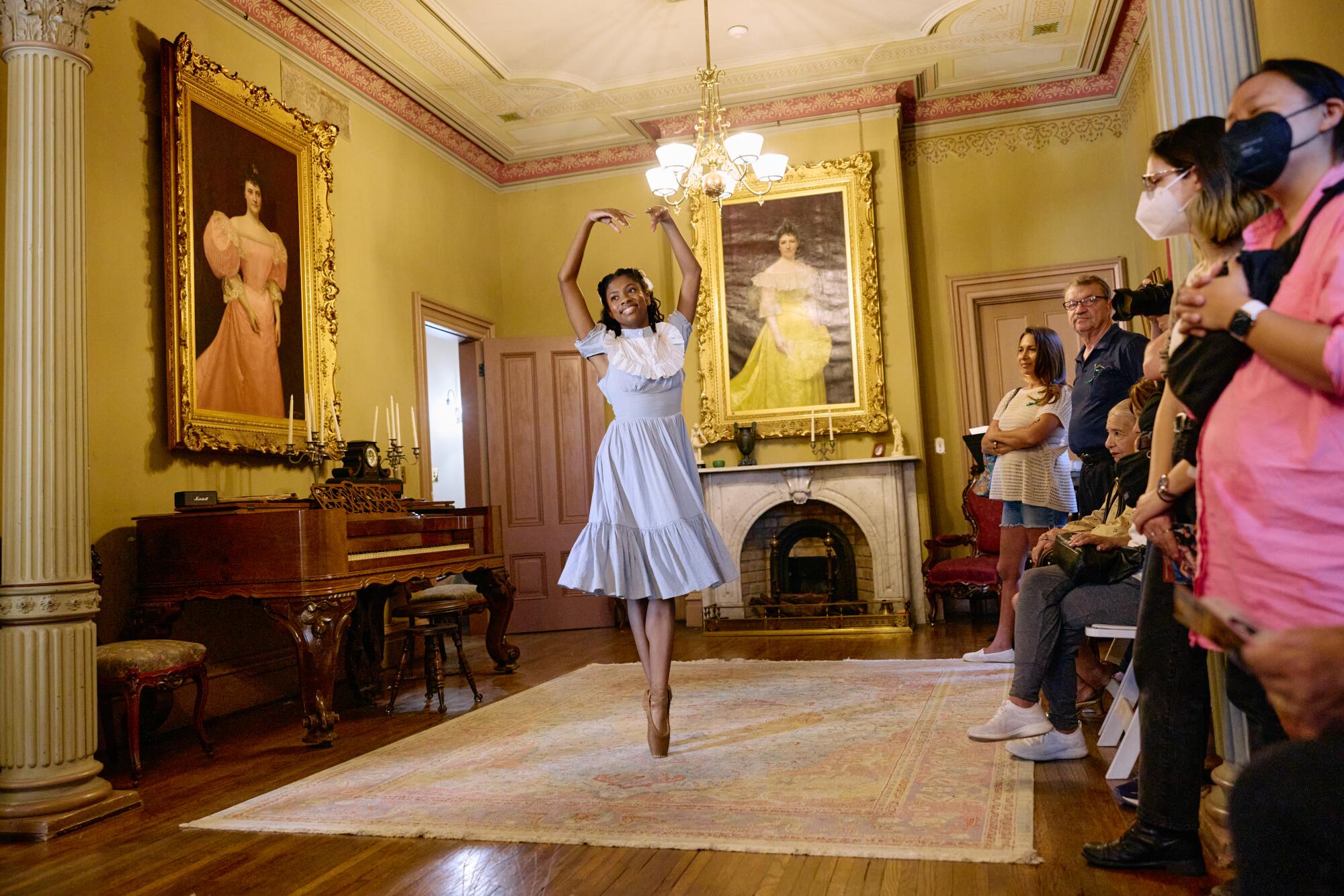
Madison Marsh performs as Amy March. Dance sequences were created to illustrate scenes in the sisters’ lives.


Students walk on the Stanford University campus on March 14, 2019, in Stanford, Calif.
Ben Margot/AP
hide caption
toggle caption
Ben Margot/AP
When Theo Baker arrived at Stanford University a few years ago, he joined the student newspaper, following the path of his journalist parents, Peter Baker, a White House correspondent for The New York Times, and Susan Glasser, a writer for The New Yorker.
Through his reporting as a student journalist, he eventually broke a story about manipulated data in Stanford President Marc Tessier-Lavigne’s neuroscience research that helped lead to the university president’s resignation.
Theo Baker’s book, How to Rule the World: An Education in Power at Stanford University was released May 19. In it, Baker describes Stanford as a place where proximity to Silicon Valley gives rise to a parallel system of influence, recruitment and money, with investors looking to identify promising students almost as soon as they arrive on campus.
He told Morning Edition host Steve Inskeep there was “a sort of Stanford inside Stanford,” where elite students are drawn into an “alternate reality” of excess and access to cut corners.
In the interview, he discusses how Stanford is not just a university but also a pipeline where status and power can matter as much as ideas.
We reached out to Stanford University for comment and have not heard back.
Listen to the interview by clicking play on the blue box above.


The scoreboard shows the results of the women’s singles final match between Iga Swiatek of Poland and Amanda Anisimova of the U.S. at the Wimbledon Tennis Championships in London, Saturday, July 12, 2025.
Kirsty Wigglesworth/AP
hide caption
toggle caption
Kirsty Wigglesworth/AP
Fifteen points in tennis? Nice. Thirty, 40 — even better. Advantage — that sounds good. “Love” — that also must be great, right? Well, not quite.
As the French Open rolls on and Serena Williams has announced her return to the sport, maybe you’ve been paying a little more attention to tennis. The sport’s scoring system is notably distinct, and can sometimes be hard to grasp for newcomers. But even tennis aficionados might not know why, or how, “love” became the unmistakable callout for zero points. For this installment of NPR’s Word of the Week, we’re exploring how a word that signifies trailing behind got such a sweet name.
“Love” comes from the heart — or an egg?
It’s hard to pinpoint when the first tennis ball went over the net. Tennis is a derivative of lots of other sports, such as “jeu de paume,” a handball game played in France, said JT Buzanga, the collections manager at the International Tennis Hall of Fame museum.

But tennis became a patented, official sport in 1874, said Steve Flink, a journalist whose tennis coverage got him inducted into the International Tennis Hall of Fame. It has retained its unique, mysterious scoring system ever since.
“By and large, the original system has held up almost entirely,” Flink said.
The use of “love” goes back to the late 18th century, said Jesse Sheidlower, a lexicographer. But it was used earlier than that in card games such as whist and bridge. Before the term made its way to tennis, the sport favored plain old “nothing,” or “nil,” he said.
Why love in the first place, though? Historians don’t really know for sure, but there are a few theories.
The French could have something to do with it. Some historians believe “love” derives from “l’oeuf,” which means “the egg” in French. Because eggs are shaped like zeros, terms such as “goose egg” and “duck’s egg” have been used in other contexts to mean zero, Sheidlower said.
It’s also possible English speakers mispronounced l’oeuf as “love.” But Sheidlower isn’t convinced that’s the answer.
“It’s the French equivalent of an English expression. But since that expression doesn’t appear in French, the French word wouldn’t have been used,” he said.
To be sure, France has had a lot of influence on tennis culture, Buzanga said. For example, “deuce” or a game tied at 40 points, comes from the French word for “two”: “deux.” But he prefers another prominent theory: that “love” comes from the idiom “for the love of the game.” Even if a player hasn’t scored, it doesn’t matter, because their heart is in it. It’s the theory Sheidlower said is the most plausible, because the idiom was used by the English before tennis was popularized.

Another variation of the “love of the game” theory is that the word could have come from the Dutch “lof,” or “honor” — or the Latin “amare,” meaning “to love,” Flink said.
But if tennis’ “love” doesn’t come from a French word, the theory at least has a French sensibility.
“I think the ‘for the love of the game’ is kind of romantic,” Buzanga said.
“Love” probably isn’t going anywhere
Tennis used to be a sport of leisure. The style of play has changed a lot over the years; players are more athletic and competitive, for instance, Flink said. But the rules of the sport are more steadfast, he said.
“There’s this incredible, enduring respect for tradition in tennis,” he said. “Changes are not made easily.”
There has been one major change in modern history: the tie-break. Matches can go on and on because players have to score two consecutive points to break a deuce, or by two games to break a tied set. But the onset of television meant matches would have to get shorter if the sport wanted to capture a larger audience, Flink said.

Change even came for “love.” An alternative sprouted up in the 1970s, and is still used today: “bagel,” named for its zero shape, Sheidlower said. Novices may say “zero,” and insiders will understand what they mean, but they “will needle them about it,” Flink said.
But “love” still prevails.
“People kind of like it,” Flink said. “It’s different. Why say zero when you can say love?”
-

 Iowa3 minutes ago
Doctor fights sanctions, saying he’ll be ‘run out of practice’ by Iowa board
-

 Kentucky13 minutes ago
Kentucky sees improvement in drought conditions
-

 Louisiana18 minutes ago
Louisiana Tech launches Center for Literacy and Learning to support students, educators
-

 Maine25 minutes ago
Pilots aboard hydrogen balloon are attempting to cross Atlantic Ocean from Maine
-

 Maryland28 minutes ago
Maryland troopers attend high school graduation of student whose dad died in line of duty
-

 Michigan33 minutes ago
Michigan football beats out Alabama, Texas for 4-star DB Blake Jenkins
-

 Massachusetts40 minutes ago
Cheers! Mass. House passes proposal to extend bar hours to 3 a.m. during World Cup, putting bill on fast track. – The Boston Globe
-

 Minnesota43 minutes ago
The Scoop – June 4

