Entertainment
Review: In 'Sugar Daddy,' comedian Sam Morrison spins grief into stand-up if not quite theater


In “Sugar Daddy,” comedian Sam Morrison sets out to convert tragedy into stand-up comedy. A form of self-therapy, the show (at the Wallis through Oct. 13) recounts the story of how he met the “daddy” of his dreams, only to lose him a few years later to COVID.
Morrison wasn’t necessarily looking for long-term romance when he traveled to the gay mecca of Provincetown for the Spooky Bear festival. He was certainly eager to meet men, preferably older, with large bellies and generous dispositions. But young, handsome and on vacation, he was raring to sample the menu.
“I’m a diabetic,” he explains at the top of the show. “My type is Type 1 but my type is Type 2.” He doesn’t mind if you label him a “chubby chaser,” but he’ll call you a “golden retriever” for being turned on by bones.
The production, directed by Stephen Brackett, who was nominated for a Tony for his staging of “A Strange Loop,” features an egg-like object on Arnulfo Maldonado’s set. This odd-shaped sculpture transforms through Alex Basco Koch’s video design into a massive hairy belly that Morrison rubs affectionately. He likes what he likes, and if you think his taste is weird, he finds conventional heterosexuality to be even weirder.
His meet-cute with Jonathan is assisted by a Category 3 hurricane. Morrison was staying in a hammock on a campground that was good for an orgy but not ideal for a natural disaster. He needed shelter, which meant that he needed to find a hook-up before the bars closed.
Surely there must be a lonely bear willing to rescue a 20-something fetishist in distress. But before Morrison knew it, the clubs had closed and he was stranded under a metal awning at a pizzeria in a state of growing panic. “I’m an anxious, asthmatic, ADHD, gay, diabetic Jew,” he shrieks, repeating the list so that the audience can register the gravity of the situation.
Salvation comes when a man slams into him. Morrison was about to scream but changes his mind when he saw how good-looking the guy was. “You’re the hottest daddy in Ptown,” he said with a drunken effusiveness that earned him an invitation to a tiny Airbnb.
Nora Ephron probably wouldn’t haven’t been tempted to turn this story into a rom-com. The transactional nature of the affair isn’t especially heartwarming. The words “old” and “fat,” while spoken lustfully by Morrison in his setup, reflect a pattern of mind that reduces gay people to physical and sexual stereotypes. Morrison, who punctuates lines with the exclamation “slay!,” sounds at times like Grindr sprung to life.
The Wallis presents “Sugar Daddy” starring comedian Sam Morrison.
(Jason Williams)
Despite their many differences, the two men start dating in New York. Jonathan worships Liza while Morrison idolizes Lizzo, but they both love to laugh and have sex, and what more does a couple need?
When Jonathan suggests that Morrison move into his apartment, Morrison gets cold feet. But a few months later, after COVID upended the world, they decided to quarantine at Morrison’s grandmother’s house in Rockland County, N.Y. Hiding out with his older lover at his grandmother’s during a global crisis seems like a ripe opportunity for comedy, but Morrison doesn’t give us many details other than that they developed their own affectionate form of nonsense talk.
As tensions arose a few months into their confinement, they took off for a now eerily empty Provincetown. The exact chronology of events is blurred by the way Morrison jumps around in time, but when Jonathan tests positive for COVID, no one suspects that in two weeks he’ll be on a ventilator.
“Sugar Daddy” does something that I haven’t seen much despite the extraordinary number of COVID deaths. It makes a record of one person’s sudden loss.
Jonathan is lovingly remembered, though his portrait is only sketched. Morrison misses his late partner’s gigantic belly laugh that would engulf everything in its orbit. The first time he heard it, Morrison assumed that Jonathan was on Molly, but he was just naturally high on humor.
Morrison’s observations of Jonathan take the form of quips. We’re told that Jonathan liked to order “no less than 400 appetizers for the table” when out with friends and that he left a generous mound of ashes that was easily divided by loved ones. Not wanting to be maudlin, Morrison sometimes comes off as shallow.
He is determined to stay true to his stand-up calling. Everything is fair game for laughs, including his glucose monitor, which in an interesting twist turns out to be a legacy of his relationship (and the unexpected meaning behind the show’s title).
There’s talk of “Sugar Daddy” moving to Broadway. The show is presented by some high-powered names, including Alan Cumming and Billy Porter. But comedy is subjective: What one person may find a laugh riot, another may dismiss as grating attention-seeking.
A self-described “millennial comedian,” Morrison doesn’t strike me as the cleverest crafter of jokes. He doesn’t have Hannah Gadsby’s verbal finesse, Alex Edelman’s zeitgeist radar or Mike Birbiglia’s off-beat wryness.
The strained delivery of punchlines made me wonder if Morrison had honed his stand-up act in noisy gay clubs over drink orders. I’m touched by his story and applaud his resilience, but “Sugar Daddy” didn’t provoke many memorable belly laughs from this sympathetic critic.
‘Sugar Daddy’
Where: Wallis Annenberg Center for the Performing Arts, Lovelace Studio Theater, 9390 N. Santa Monica Blvd., Beverly Hills
When: Check the theater for schedule. Ends Oct. 13
Tickets: Start at $35
Contact: (310) 746-4000 or TheWallis.org
Running time: 1 hour, 10 minutes (no intermission )


Comedy is a matter of taste and preference — it’s a deeply personal thing. Which makes it hard for a critic to give a blanket assessment of a specific kind of comedy, especially if it didn’t work for them, but clearly worked for others (the laughter or lack thereof is the indication). “It’s not funny,” the critic says, “well I had fun,” someone else can reply, and then we’re at an impasse.
Which is the dilemma one finds oneself in with “Gail Daughtry and the Celebrity Sex Pass,” a very strange and shaggy Hollywood satire of sorts from David Wain and The State crew, still riding the goodwill of “Wet Hot American Summer” after all these years. If only this were as funny.
“Gail Daughtry” lives in the same world as that iconic summer camp spoof, as well as Wain’s 2014 rom-com parody, “They Came Together,” in that he’s playing with genre convention and expectation, taking well-known norms to the goofiest extremes. But those films hewed more closely to their respective genres, while “Gail Daughtry” is totally scattered, combining crime and spy movie tropes with a fish-out-of-water comedy and a Hollywood send-up. It has far too many ideas for its own good, and yet no ideas that are good enough to sustain this bizarre curio of a comedy.
What’s ironic is that one of the problems driving this wacky plot forward is the characters have to come up with a movie idea to pitch to star Jon Hamm (playing himself of course), leading them to do some pretty inane and shockingly violent things. It’s almost as if Wain and co-writer and co-star Ken Marino had no idea for a movie, then baked their search for an idea into their script, and then turned it into a madcap adventure about a woman on a quest to have sex with Jon Hamm. What an ouroboros!
OK, about the sex quest. Gail Daughtry (Zoey Deutch) is a chipper hairdresser from Kansas born without the part of the brain that recognizes sarcasm or irony. She’s a cheerful, Pollyanna-ish naïf whose literal-mindedness is almost as extreme as Amelia Bedelia. Her childhood sweetheart and fiancé Tom (Michael Cassidy) is the same. She tells him about the concept of the “celebrity sex pass” as a joke, and he promptly boinks Jennifer Aniston at local book reading.
(Nitpicky aside: why didn’t they use the common nomenclature “hall pass”? Is it copyrighted? “Celebrity sex pass” is clunky and sounds like an off-brand version of the well-known slang.)
That infidelity crisis is how Gail ends up in Los Angeles determined to bang Hamm, collecting a motley crew of similarly clueless helpers along the way. There’s her best friend Otto (Miles Guttierez-Riley), her salon bestie; Caleb (Ben Wang), an overly ambitious intern at Creative Artists Agency; Vince (Marino), a screenwriter turned paparazzo with a heart of gold; and John Slattery, as John Slattery, down on his luck. An accidental briefcase swap has a pair of thugs on their tail, in a forgettable and underdeveloped B-plot.
With a parade of celebrity cameos and collaborators in bit parts, “Gail Daughtry” at times feels like an excuse for Wain and co. to make something at home with all of their friends. Fair enough, it’s great to see all these people employed, but what about what we’re watching? Behold, the Los Angeles of the middle-aged working comedian: the CAA lobby, the Chateau Marmont, Griffith Park, etc. And the plot is as half-baked as the pitch they present to Hamm.
What’s actually interesting about this comedy is the distinct streak of despair and even resentment that reveals itself at the climax, a feeling of helplessness and uselessness. Everyone’s been striving to make it in this crazy town: the intern, the actor, the paparazzo. But not even Jon Hamm can help them get a movie made; even he feels inherently powerless. There’s an unexplored anxiety vibrating there that feels the most thematically fruitful, about what it means, some 25 years after bursting onto the scene with a generation-defining comedy, about maintaining the work, the drive, a sense of purpose, after years of strikes, and in the face of a constricting industry. Do they still have it? Is the dream still alive?
Maybe that’s why Wain and Marino need to invent a dreamer stand-in with Gail, a guileless eternal optimist who knows nothing of the craven Los Angeles and accepts everything at face value (though she is filled with a scary bit of rage too). She might behave like she has a head injury, but she’s going to achieve her goal, dammit. “Gail Daughtry and the Celebrity Sex Pass” might not be as funny as “Wet Hot American Summer” (for this critic), but reframed, it serves as a fascinating status update on life in La La Land for this troupe.
‘Gail Daughtry and the Celebrity Sex Pass’
2 stars (out of 4)
MPA rating: R (for sexual content, violence/bloody images and language)
Running time: 1:33
How to watch: In theaters July 10
Entertainment
Emily Ratajkowski’s viral essay on sex life as a single mom scores her a seven-figure book deal
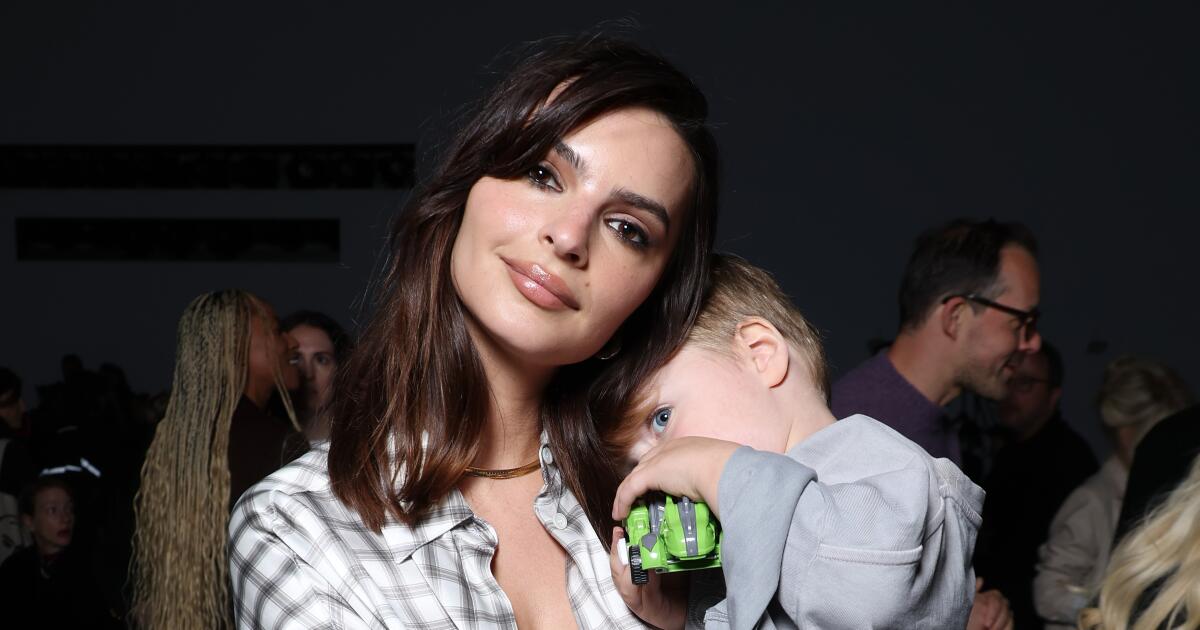
Emily Ratajkowski’s viral essay detailing her sex life as a single mom just landed her a seven-figure book deal.
According to Page Six, the model’s essay in the Cut had publishers champing at the bit in a 12-way bidding war that culminated in the hefty pay day. Editor Helen Rouner at Penguin Press — who also edited Lauren Christensen’s memoir “Firstborn” and Michael W. Clune’s novel “Pan” — reportedly landed the deal.
Penguin Press did not immediately respond to The Times’ request for comment Friday.
Publishers Marketplace announced the forthcoming memoir, describing it as “an examination of modern female identity through the story of the author’s own efforts as a newly single mother in New York City to discover what really constitutes a good life for a woman.”
The essay, which dropped a month ago and quickly broke the internet, drops the veil on EmRata’s sexual adventures (or maybe misadventures) since she and her former husband, Sebastian Bear-McClard, split in 2022.
“It was a violent transition into a new reality of screaming baby on my aching tit and ring on my swollen finger,” Ratajkowski writes of new motherhood. “And then, in a time period that felt both instant and excruciatingly slow, my marriage collapsed. Six months after my son was born, my husband and I stopped having sex. Less than a year later, we separated.”
In the missive, the model interrogates her sexuality — is she a Madonna or a whore? — while untangling bigger questions around gender, power and self-actualization. If Carrie Bradshaw wrote about “Sex and the City,” then Ratajkowski is writing about sex, the city and single motherhood. And naturally, her fleeting paramours have vague monikers: “Vegan Graffiti Artist,” “Spanish Gen-Zer” and “Son of a Billionaire.”
“And then there was the Elder Millennial: obsessed with dental hygiene, psychedelics, and dirty talk,” she writes. “He had approached the subject coyly at first, like it was something he was kind of embarrassed about — the way a kid will test you to see if you’ll talk to them about their dorky obsession of the moment. Do you like Godzilla? What about Star Wars?”
Would-be sleuths with Ratajkowski’s essay and a gossip rag handy will have their work cut out for them.
This will be Ratajkowski’s second book. The first, “My Body,” dropped in 2021 and was a bestselling collection of essays exploring gender, power dynamics, sexuality and the commodification of female beauty in the modeling and entertainment industries.
Ratajkowski’s foray into the spotlight came more than a decade ago when Robin Thicke’s controversial “Blurred Lines” music video made the model an overnight star. She was cast in David Fincher’s adaptation of “Gone Girl,” which hit theaters the following year, and catapulted to top fashion runways — Marc Jacobs, Versace, Victoria’s Secret and Dolce & Gabbana, to name a few. She she’s been romantically linked to Harry Styles, Eric Andre, Shaboozey, Brad Pitt and Pete Davidson, among others.
In 2023, she moonlighted as the host of the “High Low With EmRata” podcast, where she interviewed sex workers, investigated ethical nonmonogamy and pondered the etymology of the word “toxic.” The same year, she told The Times that she was coming into herself post-divorce, “Being able to assert what I want — that feels like it just started: My life as a creator and not as a muse.”

Wainheads will be delighted to see his alums in cameos: Kerri Kenney-Silver, Michael Ian Black, Thomas Lennon, and supporting roles for Zickel and Truglio. A large portion of the cast are his homies. But with Deutch, Gutierrez-Riley, Wang, Slattery, Impacciatore, and yes, Hamm, it’s as if they’re being inducted into a new mad family. Wain and Marino are basically catching Pokémon and hoping they can hold onto the roster (by that logic, yes, Paul Rudd is a legendary Pokémon). The film is anchored by Zoey — everything everywhere all this summer with Voicemails From Isabelle to Minions & Monsters — Deutch in the Dorothy Gale role, exuding a high level of perkiness consistent with the character’s can-do, wide-eyed, midwestern charm and heart.
A major standout, Ben Wang finally gets to show off his comedic abilities, portraying a self-assured, quick-witted agent who makes me laugh every time he reveals his sheltered upbringing in snappy whines at every inconvenience. Sabrina Impacciatore, who has proven to be a comedic juggernaut in The Paper, is having so much fun hamming it up as the mob boss-esque wicked witch counterpart, torturing her henchmen and deliciously chewing up the scenery whenever onscreen. I don’t think they use her to the height of her comedic prowess, but she’s a delight nonetheless. John Slattery is the film’s comedic MVP. The way the writers use his over-the-top character for comedy is downright hilarious every time. They use him as either a punchline or a force of nature, and he’s great. This movie is like Mad Men propaganda, and by God, it works. As someone who’s never seen it, Gail allowed me a better appreciation for Slattery and Hamm.
Man, we don’t deserve Jon Hamm. This is the second time I’ve seen him play a silly, fictionalized version of himself this year (the other being the SXSW crowd-pleasing rom-com Wishful Thinking, which Gail distributor Sony Pictures Classics acquired), and he also voice-acted in his comedic Mayor Jerry role in Hoppers. Maybe working with Wain in 2007’s The Ten was the canon event, but I consider his weird little sex scene with Kristen Wiig in Bridesmaids his awakening. Since then, I’ve only seen him as unserious, and it’s delightful. Oz-like in appearance, he’s funny and befitting the film’s overall light, joyful nature.
LAST STATEMENT
Ultimately, Gail Daughtry and the Celebrity Sex Pass is a campy, delightful romp that succeeds as both a distinctive Hollywood‑centric riff and a Wizard of Oz reimagining, retaining a loving, twisted, demented charm. It’s a weird description, but it’s so high‑spirited and light‑hearted despite being strangely ultraviolent. It might as well be a live‑action episode of Smiling Friends (RIP), yet it’s everything the theatrical market needs today. Ten years ago, this would’ve been a studio production rather than an indie Sundance acquisition, but thank God it exists for the big screen. More absurdist Gail Daughtrys for cinemas (not streaming), please, because this is the most fun to be had in a theater all summer, if not the year thus far.
-

 New Hampshire1 minute ago
Man From Northwood Arrested On Driving Under The Influence Charge: Concord Police Log
-

 New Jersey3 minutes ago
NJ firefighter dies after crash responding to fire call
-

 New Mexico14 minutes ago
Isolated storm chances continue for parts of New Mexico this weekend
-

 North Carolina16 minutes ago
A 4-year-old boy’s simple habit of waving to his neighbors transformed his North Carolina community
-

 North Dakota21 minutes ago
West Fargo attorney named to North Dakota Ethics Commission
-

 Ohio29 minutes ago
Struggling Ohio county seeks funds to care for 16 kids rescued from squalor and prosecute their family
-

 Oklahoma32 minutes ago
Martha Lillard, last US polio patient using iron lung, dies at 78 in Oklahoma
-

 Oregon37 minutes ago
Greater Idaho effort seeks federal help as Oregon lawmakers keep border plan stalled

