Politics
Harris and Trump campaigns are targeting Black men, but many say they feel neglected

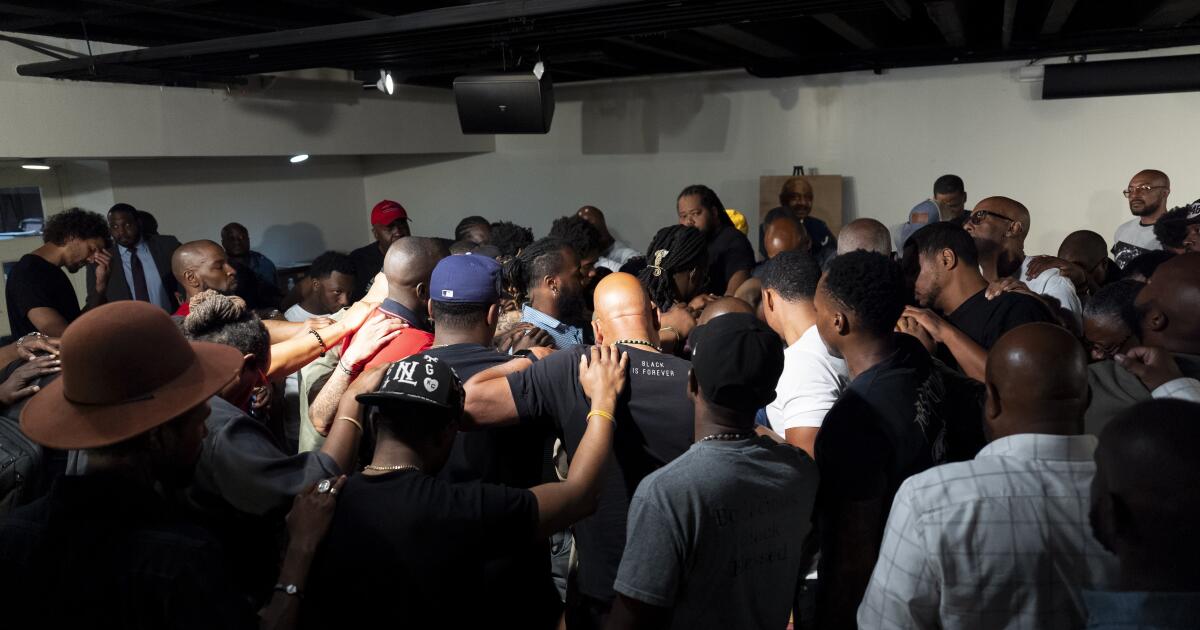
Three construction foremen taking a break in an alleyway on a recent Wednesday are among the most coveted voters in the country: middle-aged Black men and union members, living in Pennsylvania, the largest battleground state.
They don’t sound excited about it.
“Whatever president we’ve had in office for the past 42 years, they’ve never affected anything in my household,” said Desmond Chandler, who is 43 and lives in Philadelphia.
Vice President Kamala Harris must win big in large cities with large Black populations to overcome Donald Trump’s advantages with rural white voters. Above, Philadelphia’s Independence Hall in 2022.
(Ryan Collerd / Getty Images)
His friend Mike Gray was just as disillusioned. Vice President Kamala Harris is a “puppet for the white people,” but he would never vote for former President Trump, who manufactured his neckties in China, used nonunion labor for construction projects and carves up the electorate with terms like “Black jobs,” he said.
Interviews in recent weeks with more than two dozen Black men across two of the most critical battleground states — Pennsylvania and Georgia — offer a broader context for what polls have shown. Harris is likely to win a commanding majority of Black voters, despite extensive efforts by the Trump campaign to entice Black men in particular.
But Harris still has work to do in what is expected to be an exceedingly tight election. She needs to expand her majority among Black voters even more, to match President Biden’s winning formula from 2020. As importantly, she also has to motivate people like Chandler and Gray to show up and cast ballots.
A recent Howard University survey of Black voters in seven battleground states showed Harris leading Trump 82% to 12%. Other surveys found Harris with slightly smaller leads, including an August Pew poll showing a 77%-to-13% lead at the national level and a Suffolk University survey of Black voters in Pennsylvania conducted in August showing a 70%-to-9% lead.
No credible survey shows Trump within striking distance. But Biden won Black voters by an even larger margin in 2020 — 92% to 8% at the national level, according to a post-election analyis by Pew.
The biggest gap? Black men between the ages of 18 and 49 are Harris’ weakest link, according to the Howard survey, which found they supported her 75% to 16%.
The difference may seem small but could be decisive, given the close margins in the states that decided the 2016 and 2020 elections, and the need for Harris to win big in Philadelphia, Atlanta, Detroit and other big cities with large Black populations to overcome Trump’s advantages with rural white voters. Black voters have tended to make their choices closer to the election in prior elections, giving Harris room to grow.
Biden and Harris won in 2020 with focused efforts to drive up Black voter turnout in the final weeks, especially in Pennsylvania and Georgia, where the state also elected Raphael Warnock as its first African American senator. Black voters made up about a third of the eligible voters in Georgia and about a tenth in Pennsylvania.
In interviews, Harris’ supporters most often cited Trump’s character and the belief that Harris’ economic policies would be better for working-class people. Those who expressed doubts about Harris were most likely to bring up inflation and, in some cases, Harris’ career as a prosecutor or questions about her racial identity, which Trump has brought up in an attempt to divide her support.
Harris, whose father was from Jamaica and mother was born in India, has written that she was raised by her mother to identify as Black. She attended Howard, a historically Black university, and has emphasized her ties to the powerful Black sorority network.
Gray, the 49-year-old construction foreman, has voted for Democrats in prior elections, including Biden in 2020, but said he is not sure whether he will cast a vote this time. He is frustrated with inflation, especially child-care expenses.
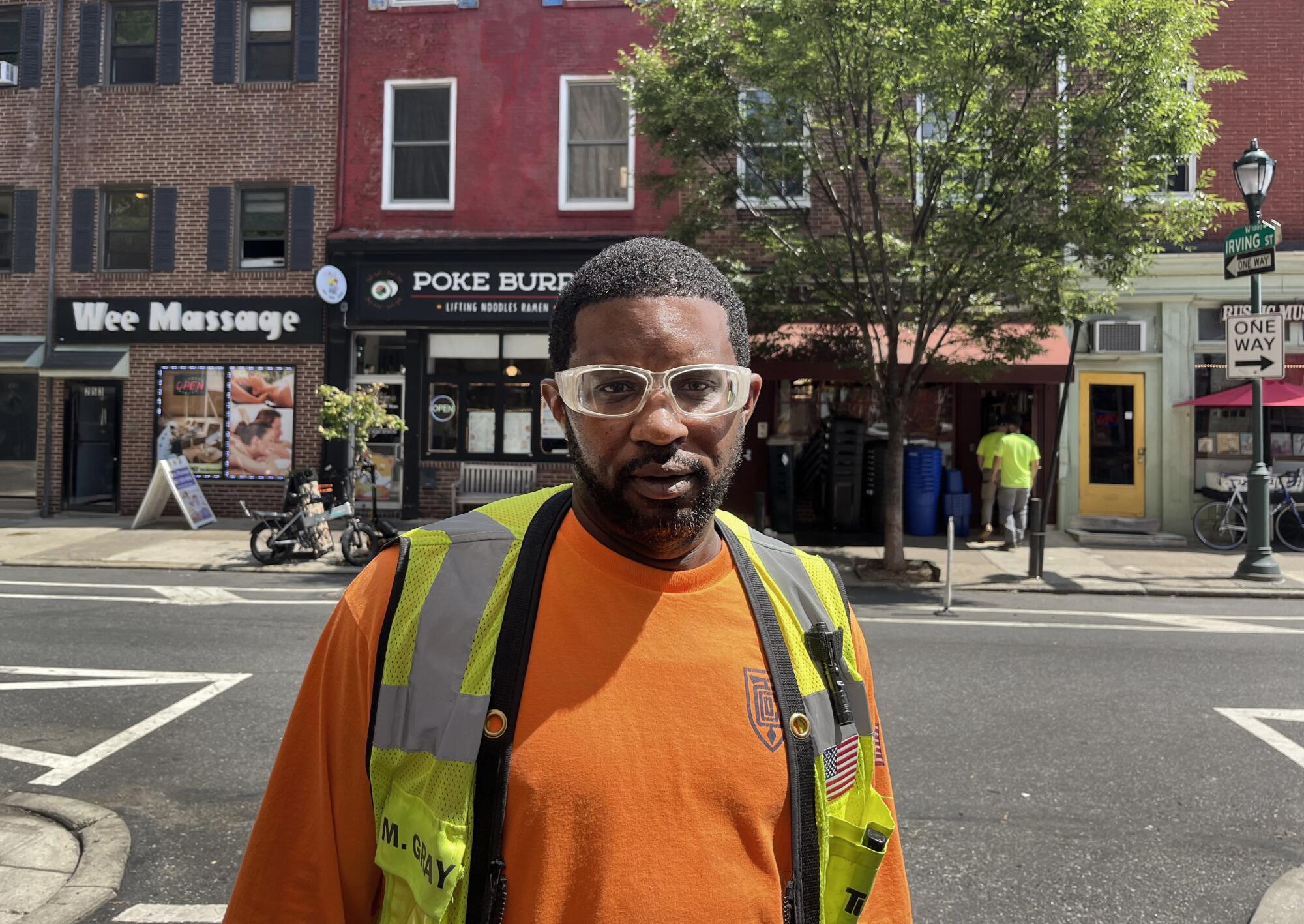
Mike Gray, a 49-year-old labor foreman in Philadelphia, said he is uncertain whether he will vote for Harris but definitely won’t vote for Trump.
(Noah Bierman / Los Angeles Times)
Like most voters, he hears the news in snippets.
For example, he did not know about Biden’s and Harris’ failed efforts to cap childcare expenses at 7% of income as part of their signature 2021 spending bill. Harris is trying to get the word out, pledging in a rare interview with the National Assn. of Black Journalists in Philadelphia last week to revive the plan if she is elected.
Nor was Gray excited by the potential history of electing the first Black female president. “Man, we already had one Black president,” he said, referring to Barack Obama. “If we have another one, great.”
More than a fifth of Black Americans, especially younger people, are “rightfully cynical” — detached from politics because their experience makes them feel like government cannot improve their lives — and are the least likely group of Black Americans to vote, according to the 2024 Black Values Survey, which measured views on social trust, perceptions of power and racial solidarity.
“It’s like a big game,” said Brian Clark, a 32-year-old security guard in Philadelphia who said he prefers Trump but will not vote for either candidate.
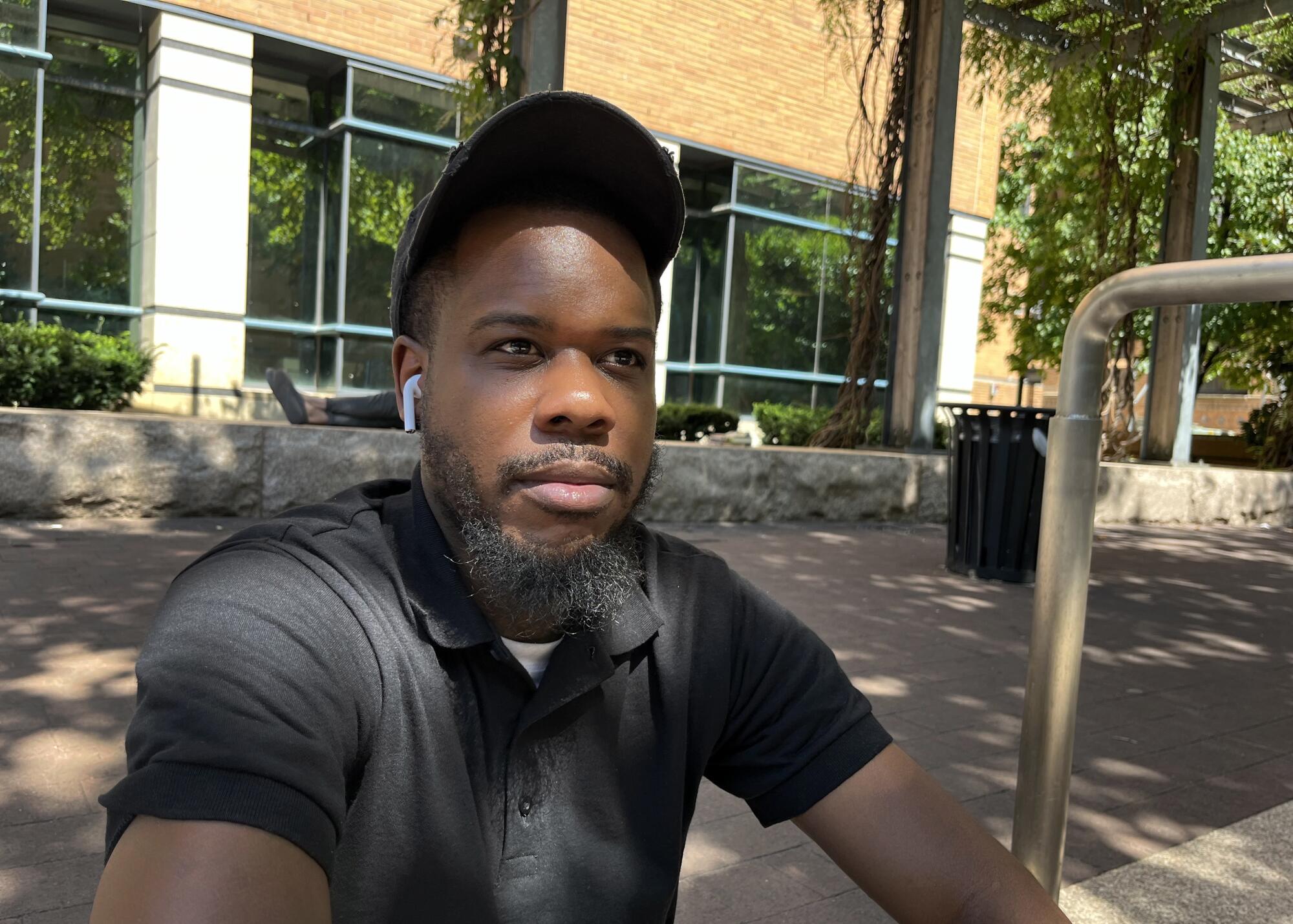
Brian Clark, a 32-year-old security guard from Philadelphia, said he prefers Trump but likely won’t vote because it’s all “a big game.”
(Noah Bierman / Los Angeles Times)
“It’s just about one placebo or the other placebo,” said Cassius Martello, a 23-year-old social media consultant from Gwinnett County, who said he will vote for Harris.
Harris is on firmer footing with older and more educated Black voters, especially those who identify with the legacy of the civil rights era. Many are especially turned off by Trump’s character and rhetoric, and expressed excitement about the prospect of a Black woman leading the nation.
Robert Mitchell, a 65-year-old human resources director in Atlanta, finds it shocking that any Black man would consider Trump, who is running ”to keep himself out of jail,” or that any voter could say they are undecided at this point.
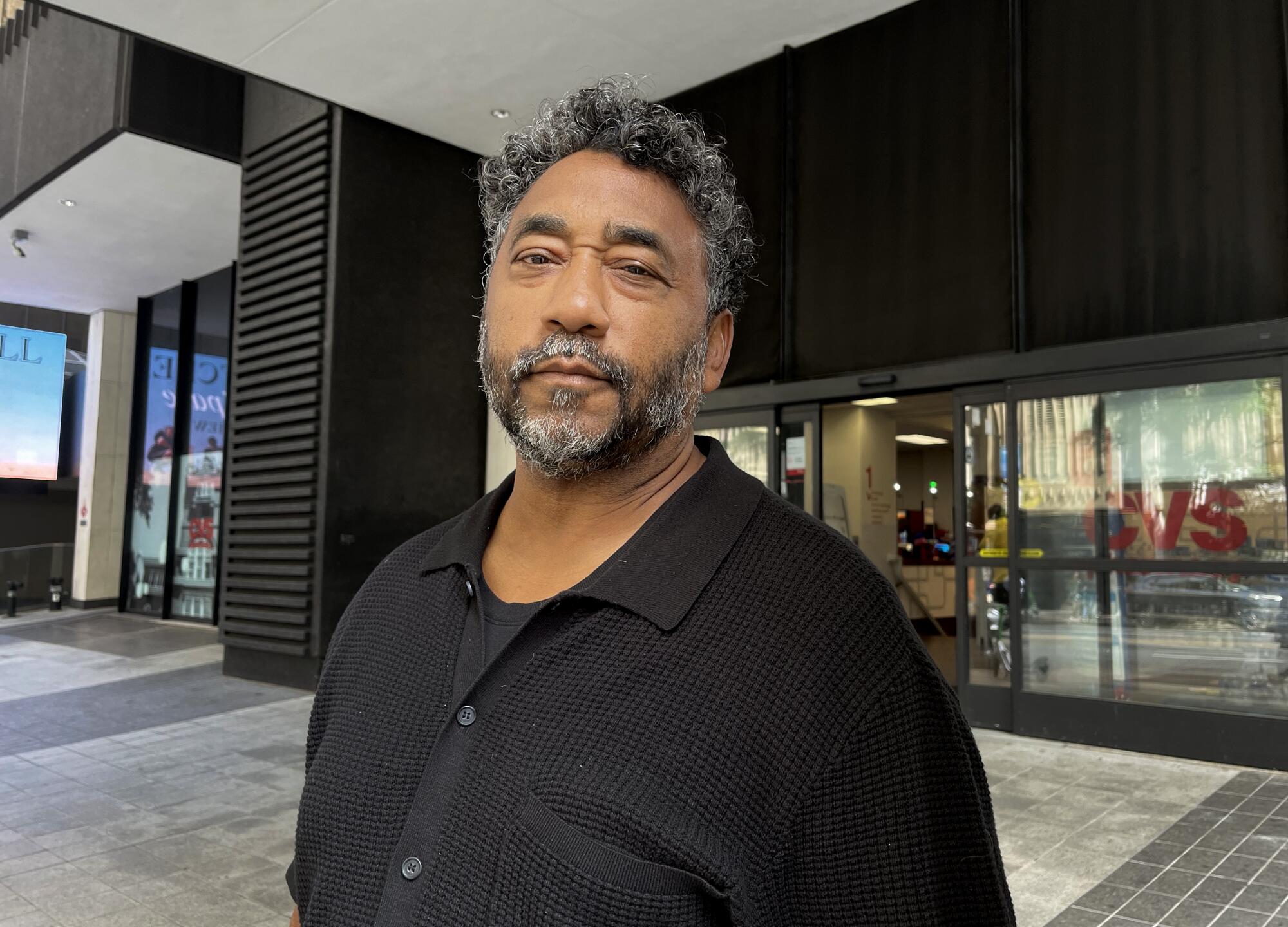
Robert Mitchell, 65, a human resources director in Atlanta, is excited to vote for Kamala Harris.
(Jenny Jarvie / Los Angeles Times)
“I don’t know if it’s the thing where — being misogynistic — men just not seeing a woman in charge,” he said. “I do not get it. I’m looking so forward to a woman being president!”
He talked about abortion access for his daughter and granddaughter “if something ever happened to them” and about Trump’s own history of racial incitement, pointing to the full-page ad Trump took out in 1989 demanding the death penalty for five Black and Latino boys who were wrongfully convicted of raping a woman jogging in New York.
Ivan Turnipseed, a 55-year-old hospitality professor in Philadelphia, is less surprised at the resistance to Harris, despite his own enthusiastic support. He sees it in his own family in Mississippi.
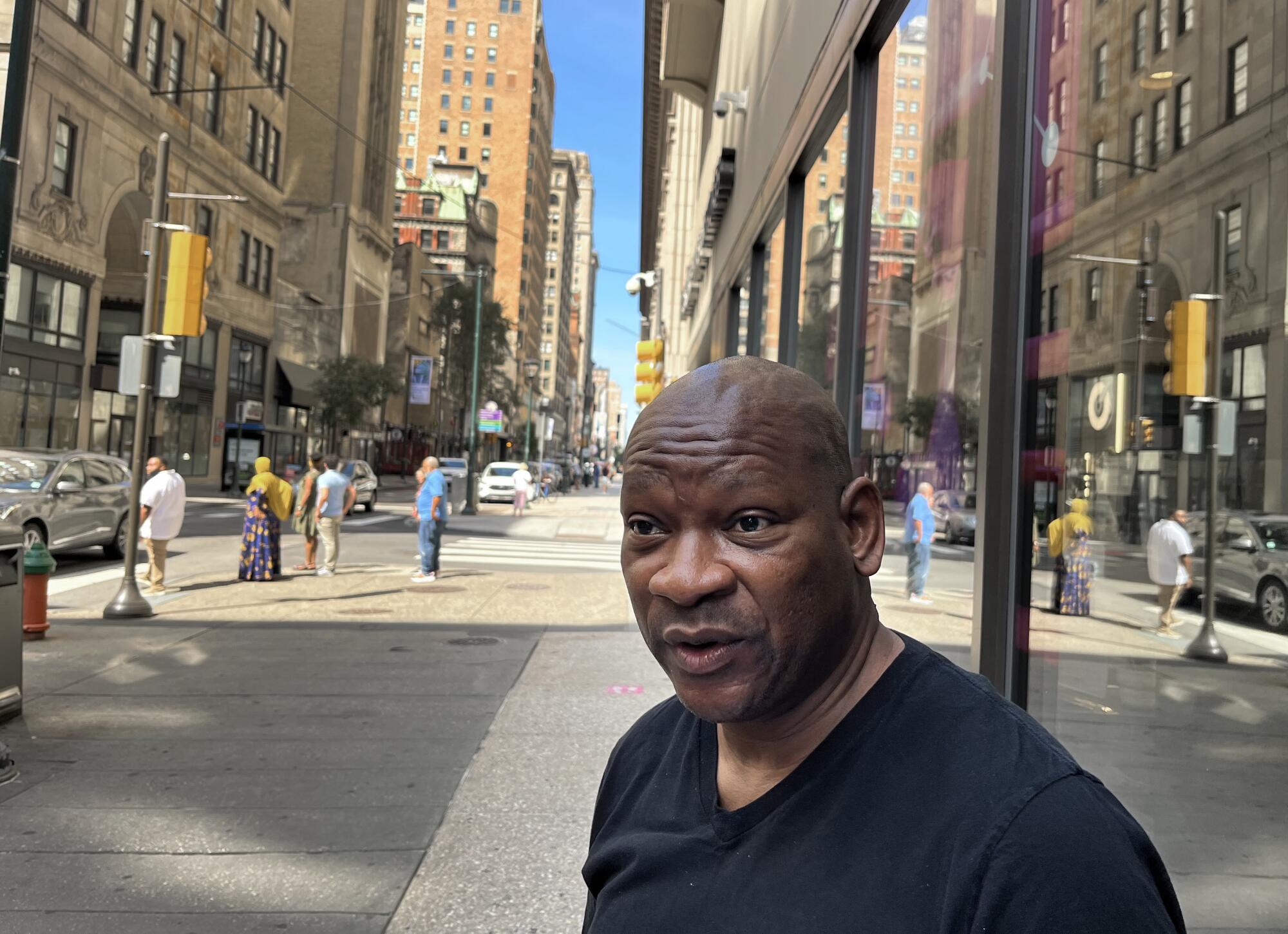
Ivan Turnipseed, 55, a hospitality professor in Philadelphia, comes from a conservative family. He supports Harris but believes his father, a pastor in Mississippi, will likely vote for Trump.
(Noah Bierman / Los Angeles Times)
“I don’t know whether it’s just the whole idea of a man being head of the household from a religious perspective, again, from a father, who’s a minister,” who he expects will vote for Trump, he said.
He noted that Black men won the right to vote and served on the Supreme Court before women of either race had the chance.
“This is what we do as a country,” Turnipseed said. “We can get past like, ‘OK, well, maybe, you know, this Black guy will be OK,’ but it’s hard for us. We have whole institutions that don’t allow women to lead.”
Misogyny, however, doesn’t altogether explain Black men’s resistance to voting for Harris. Some Black men who expressed reservations about voting for Harris this year also held back from voting for Biden in 2020.
Polls show Trump is unlikely to capture a large swath of Black male support where it matters, in key battleground states. His comment questioning Harris’ racial identity appeared more geared toward depressing turnout than winning votes. But even a handful of Democratic defections could matter.
And the reasons Black voters are open to supporting Trump sound almost identical to those of other supporters.
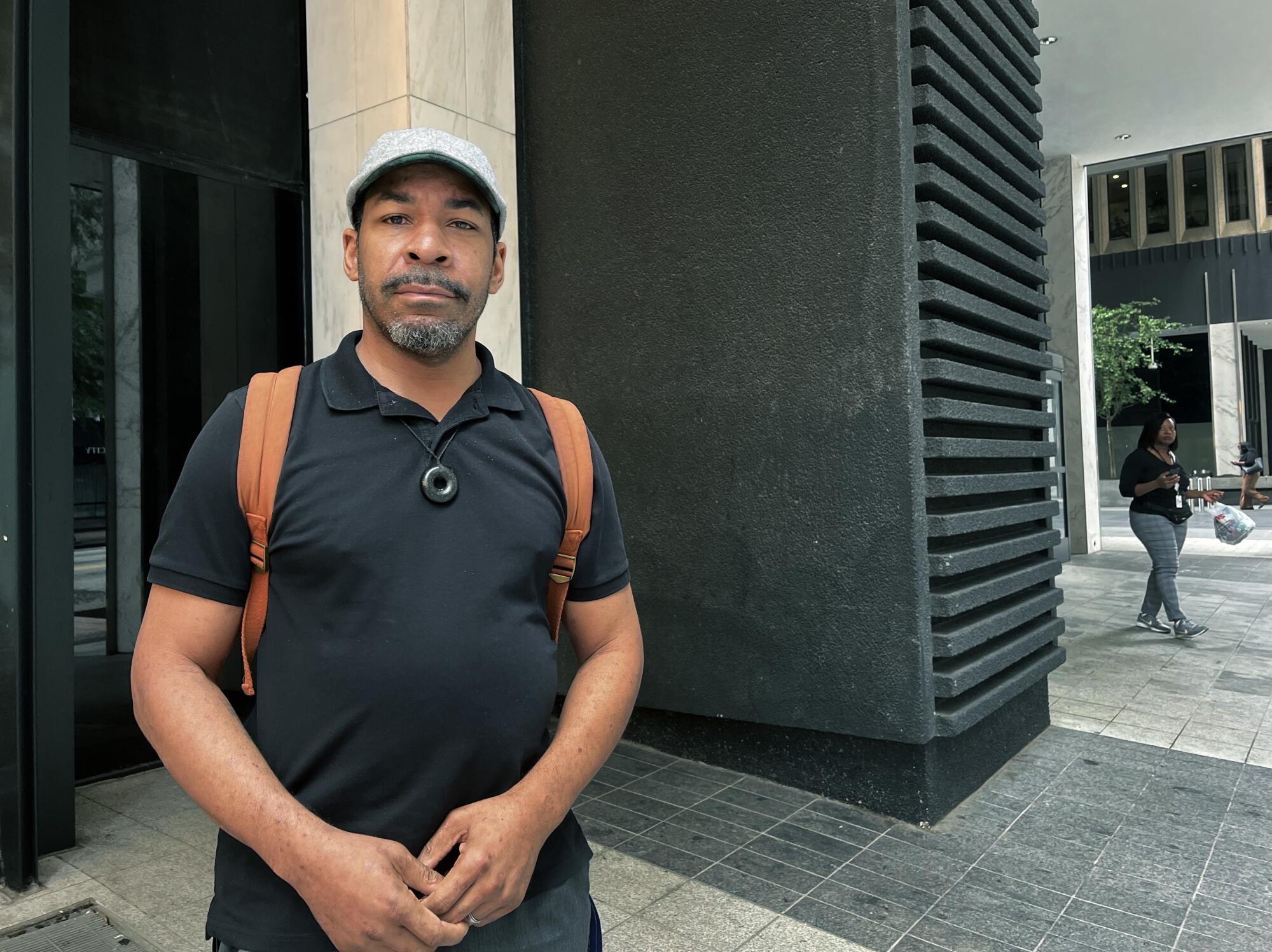
Bobby Wilcox, 47, a tax appraisal clerk in Atlanta, is voting for Trump.
(Jenny Jarvie / Los Angeles Times)
“American citizens, we did very well under the Trump administration,” said Bobby Wilcox, 47, a tax appraisal clerk in Atlanta. “Prices weren’t as high, and people could afford housing. Now people — particularly seniors — are struggling.”
“He’s for the people,” said Sam Williams, 37, a manager at a Chick-fil-A in downtown Atlanta who also works at Jersey Mike’s Subs. He took on a second job in the last year as he struggled to pay his $1,800 monthly rent.
He’s not interested in Harris, he said. “I just don’t feel her vibes.”
Bierman reported from Philadelphia, Jarvie from Atlanta.



Politics
Trump takes unusual step, lets bipartisan housing bill become law unsigned amid SAVE pressure campaign

NEWYou can now listen to Fox News articles!
A bipartisan housing bill became law Saturday at midnight after President Donald Trump declined to sign it, capping a weeks-long saga over whether the president would veto the measure amid frustrations with Congress over his stalled agenda.
Trump refused to sign the 21st Century ROAD to Housing Act — legislation aimed at expanding the nation’s housing stock and lowering costs — in an attempt to pressure Congress to pass the SAVE America Act, despite the housing bill clearing both chambers with overwhelming majorities.
“I will not sign the Housing Bill, which has been fully approved by Congress and sent to the White House, in PROTEST over the fact that the United States Senate is not capable of passing THE SAVE AMERICA ACT, which is polling at 97% with the Republican Party, and very high with the non-politician Dumocrats,” he declared on Truth Social Friday morning.
The Trump-backed election measure, which would require proof of citizenship to vote in federal elections and impose voter ID requirements, has struggled to overcome the Senate’s 60-vote threshold.
Meanwhile, the House has not passed a version of the bill that includes the president’s proposed crackdown on mail-in voting and banning men from women’s sports.
President Donald Trump speaks in the Oval Office of the White House, Wednesday, June 3, 2026, in Washington. (Alex Brandon/AP)
HOUSE CONSERVATIVES DERAIL GOP AGENDA IN SAVE AMERICA ACT SHOWDOWN
Under the U.S. Constitution, Trump had 10 days, not including Sundays, to sign or veto the housing measure after the House formally transmitted the legislation to the White House in late June. The president ultimately chose neither option, allowing the measure to become law without his signature.
Though Trump declined to veto the legislation, he sharply criticized elements of the bill and argued it should not have been a legislative priority in recent weeks.
“It’s so unimportant … compared to the SAVE America Act,” Trump told reporters in the Oval Office in late June. “I think the SAVE America Act is exactly what it says. It’s saving America from crooked elections.”
Trump went on to call the housing bill “a yawn,” adding, “compared to the SAVE America Act, just about everything is a big yawn.”
It would have taken a two-thirds majority in both chambers to override a veto — a margin the House and Senate exceeded when they passed the legislation. However, it remains unclear whether so many Republicans would have defied the president had he vetoed the bill.
Trump also appeared to criticize the bill over a provision restricting Wall Street investors from purchasing single-family homes — a policy he first proposed during his January State of the Union address and later urged Congress to pass. Trump previously argued the investor ban would give individual homebuyers a leg up against private equity firms in the housing market.
“I don’t want to hurt people that own houses, too,” Trump later told reporters, appearing to reference the provision. “These people, for the first time in their lives, they have valuable houses. They’ve become rich. I don’t want to hurt them either. What you want to do is what’s good for everyone, get the interest rates down.”
The law also aims to boost housing supply by streamlining federal environmental reviews, loosening rules around the construction of factory-built homes, and incentivizing local governments to modify their zoning laws to allow more housing, among roughly 60 provisions.
Trump’s souring on the legislation created headaches for Republicans, who touted the bill as an affordability win as voters grapple with high housing costs.
“It’s irresponsible to postpone signing the Housing bill due to the SAVE Act,” Sen. Bill Cassidy, R-La., a retiring lawmaker who lost re-election to a Trump-backed challenger, wrote on social media. “We need to start delivering relief to people for the high cost of housing ASAP!!”
Construction workers stand on the roof of homes under construction at a new housing development on June 24, 2026, in Valencia, Calif. (Justin Sullivan/Getty Images)
WARREN TELLS TRUMP TO ‘SIGN THE DAMN BILL’ AS BIPARTISAN HOUSING PACKAGE REMAINS STALLED IN WASHINGTON
Trump abruptly canceled a signing ceremony for the legislation at the U.S. Capitol in June with GOP leaders. The stage had already been set, with at least one senior Republican arriving unaware the president had called off the event shortly before it was scheduled to begin.
The president then declared he would not sign the legislation until Congress passed the SAVE America Act, despite Senate GOP leaders insisting the votes do not exist to advance the measure.
Trump has also expressed frustration with the Republican-controlled Senate for declining to weaken the legislative filibuster, which requires 60 votes to advance most legislation in the upper chamber.
“GET SMART REPUBLICANS, IF YOU DON’T, YOU WON’T BE IN OFFICE FOR LONG!” Trump wrote in a Truth Social post on Sunday.
Before Trump came out against the bill, White House Press Secretary Karoline Leavitt called it “one of the most significant pieces of housing affordability legislation in American history” and said it included an array of policies “long championed” by Trump.
House Speaker Mike Johnson, a Republican from Louisiana, speaks during a news conference at the U.S. Capitol in Washington, D.C., on Oct. 15, 2025. (Eric Lee/Bloomberg via Getty Images)
Meanwhile, Trump political operative James Blair touted the legislation for including the president’s Wall Street investor ban, which he referred to as a “signature commitment.”
House Speaker Mike Johnson, R-La., has argued that Republicans will still promote the landmark housing bill ahead of November.
CLICK HERE TO DOWNLOAD THE FOX NEWS APP
“We’ll still celebrate it, but he’s trying to make a point, and I think he’s making it very effectively,” the speaker recently told reporters, referring to Trump. “And the fact that you all ask me every three steps down the hallway illustrates that he has achieved the desired objective, and that is to make SAVE America the number one thing, because if we don’t get that right, everybody’s concerned about what happens next.”

The Trump administration has signed off on a company’s plan to convert an oil and gas pipeline to pump groundwater from the Mojave Desert to thirsty California cities for the first time, a lucrative venture that critics say threatens natural springs and wildlife.
The federal Bureau of Land Management released documents Thursday saying that Cadiz Inc.’s plan to repurpose 162 miles of the pipeline to transport water “will not significantly affect” the environment.
“We’re excited to achieve this pivotal milestone. After many years of planning and environmental review, the project has now reached the construction stage,” said Susan Kennedy, chair and chief executive of Cadiz.
Environmental advocates and leaders of Native tribes, who have been fighting the project, criticized the decision.
“This groundwater mining proposal would drain the desert and rob the Mojave of its rare springs and wildlife habitat,” said Chance Wilcox, California desert associate director of the National Parks Conservation Assn. “It’s indefensible that the Trump administration would once again try to revive the pointless Cadiz project, by defying decades of scientific warnings and refusing to conduct an environmental review of the groundwater mining.”
The application for the federal authorization was filed by the Fenner Gap Mutual Water Co. The documents say the company plans to build seven pump stations, three of them located on federal land managed by the agency.
The 30-inch steel pipeline runs underground from Cadiz’s desert property, near the town of Amboy, northward to the town of Mojave.
The BLM said in its authorization that repurposing the pipeline for water “would comply with all applicable statutes and regulations.” The agency said it has “reasonably determined that the impacts of groundwater withdrawal associated with Cadiz’s groundwater extraction project are outside the scope of analysis.”
Cadiz’s attempts to export water from its property 200 miles east of Los Angeles have drawn controversy for decades.
In 2019, Gov. Gavin Newsom signed legislation that requires the project to undergo scientific study and gain approval from the State Lands Commission before it can take water from the Mojave and sell it to California cities.
Activists opposing the company’s plans include civil rights leader Dolores Huerta.
“Cadiz spells destruction for water, sacred lands, and the desert economy,” Huerta said in a statement. “It is exactly this type of greed and injustice that I have dedicated my life to oppose.”
Leaders of nearby tribes have also objected to Cadiz’s plans to pump from the desert aquifer near the Mojave Trails National Monument and Mojave National Preserve.
“It is the living heart of the desert,” said Daniel Leivas, chairman of the Chemehuevi Indian Tribe. “To drain it would be to drain the life out of the entire desert. No profit is worth such desecration.”
Chairman Timothy Williams of the Fort Mojave Indian Tribe said the company’s plan “to pump and sell 25 times more groundwater each year than the aquifer can replenish would desecrate our traditional territories.”
“Pumping more groundwater than is sustainably replenished is not only negligent, but dangerous to the American Desert Southwest,” he said in the joint statement with other opponents of the project.
For years, while pursuing its plan to sell water far away, the company has been using wells on its property to irrigate nearly 2,000 acres of farmland growing lemons, grapes and other crops. It has drilled more wells in anticipation of being able to export water once the government approved its pipeline.
The company intends to pipe water to communities in San Bernardino County and says it’s “expected to provide one of the lowest-cost sources of new water in the drought-plagued Southwest.” It says the federal permit “marks a key milestone as we finalize project financing with prospective investors.”
Cadiz bought the 220-mile pipeline from El Paso Natural Gas in 2020. Once construction is completed, the company says the pipeline will be able to transport up to 25,000 acre-feet of water per year — about 5% of what Los Angeles uses each year.
The Los Angeles-based corporation is also seeking to build a new pipeline along a railroad right-of-way to transport water to the south.
Environmental groups have repeatedly filed lawsuits challenging the project.
Ileene Anderson, a senior scientist at the Center for Biological Diversity, called the Trump administration’s decision “a green light for environmental destruction.”
She said six of the proposed pumping stations slated to be built are in the habitat of desert tortoises, a species in decline.
“We’ve successfully fended off this project before and we’ll continue to fight to stop this zombie from coming back,” Anderson said.
In 2021, the Biden administration reversed a Trump administration decision that had cleared the way for Cadiz to pipe water across public land. In 2022, a federal judge scrapped the pipeline permit that the Trump administration had issued.
But during President Trump’s second term, the company has again made headway on its plans. In February, Cadiz announced that the federal Environmental Protection Agency had invited it to submit an application for a $194-million low-interest loan for the northern pipeline project.
The company said in May that it reached an agreement with the federal Bureau of Reclamation to provide funding for a review of its potential role in “augmenting water supplies” along the shrinking Colorado River.
The company has also been lobbying the Trump administration. The group Public Citizen said in a recent report that Cadiz, through its nonprofit Fenner Gap Mutual Water Co., enlisted former Interior Secretary David Bernhardt’s new lobbying firm, the Bernhardt Group, and has spent at least $330,000 on lobbying in 2025 and 2026.
Records show lobbyist Luke Johnson has repeatedly accompanied Kennedy at meetings with Interior Department officials.
“The extensive influence of David Bernhardt’s boutique lobbying firm on the agency he formerly led highlights how insider firms staffed with former Trump officials have grown in recent years,” said Alan Zibel, a research director with Public Citizen. He said Bernhardt and his lobbyists “have learned how to master influence-peddling in the anything-goes era of Trump 2.0.”
Earlier this month, an Arizona water agency announced it signed an initial “memorandum of understanding” agreement to buy up to 10,000 acre-feet of water per year from Cadiz’s Mojave Groundwater Bank. The Central Arizona Irrigation and Drainage District provides water to farmlands in Pinal County, where growers are dealing with water cutbacks.
The company said that for this to happen, it would need to build pipelines and reach deals to exchange water across state lines.
Members of California’s congressional delegation have raised concerns. In a recent letter to Interior Secretary Doug Burgum, California Sens. Adam Schiff and Alex Padilla called for a thorough environmental review, saying that federal agencies and peer-reviewed scientific analyses have “warned of the significant and irreversible impacts that Cadiz’s project could have on federal lands and surrounding communities.”
Rep. Raul Ruiz (D-Indio) said in a letter to Burgum that he is concerned about the company’s long-standing effort to extract and export groundwater.
“The area I represent cannot afford to absorb the long-term costs of a commercially driven groundwater export scheme,” Ruiz said.
President Trump has promoted a chain of newly rebranded gas stations across the Philadelphia area with lower gas prices. The New York Times has not been able to get detailed information about who is behind the stations. The Trump administration says it did not fund or subsidize the company.
-
Crypto1 minute ago
Trump’s crypto grift spins into its own industry
-

 Finance13 minutes ago
New changes to financial aid will be minor for UND students, bigger for loan borrowers in repayment
-

 Fitness16 minutes ago
The NHS has reignited the hybrid working debate – but WFH isn’t the health risk, this is
-

 Movie Reviews28 minutes ago
‘Only Beautiful Things to Look At’ Review: A Handsome but Muffled Portrait of State-Sanctioned Cruelty
-

 World36 minutes ago
Colombia Adds Massive Soundstage as Bogotá Audiovisual Market Attendance Soars and ‘Narcos’ Star-Led ‘Rookies’ Cleans Up in Project Prizes
-
News43 minutes ago
How a Beer Hall Keeps Up With a World Cup Crowd
-
 Lifestyle1 hour ago
Shy on the dance floor? Virtual reality ‘partners’ aim to help you find your groove
-

 Technology1 hour ago
Are you filthy enough for a $700 portable shower?

