Science
Why AI is better than humans at talking people out of their conspiracy theory beliefs

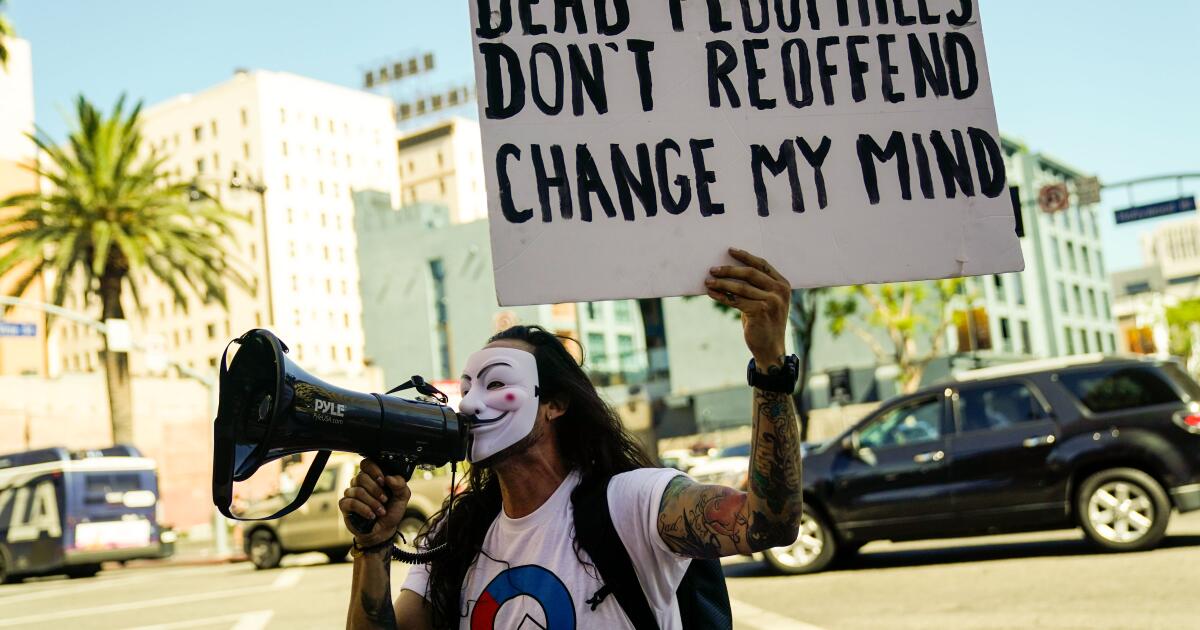
Roughly half of Americans subscribe to to some sort of conspiracy theory, and their fellow humans haven’t had much success coaxing them out of their rabbit holes.
Perhaps they could learn a thing or two from an AI-powered chatbot.
In a series of experiments, the artificial chatbot was able to make more than a quarter of people feel uncertain about their most cherished conspiracy belief. The average conversation lasted less than 8½ minutes.
The results were reported Thursday in the journal Science.
The failure of facts to convince people that we really did land on the moon, that Al Qaeda really was responsible for the 9/11 attacks, and that President Biden really did win the 2020 election, among other things, has fueled anxiety about a post-truth era that favors personal beliefs over objective evidence.
“People who believe in conspiracy theories rarely, if ever, change their mind,” said study leader Thomas Costello, a psychologist at American University who investigates political and social beliefs. “In some sense, it feels better to believe that there’s a secret society controlling everything than believing that entropy and chaos rule.”
But the study suggests the problem isn’t with the persuasive power of facts — it’s our inability to marshal the right combination of facts to counter someone’s specific reasons for skepticism.
Costello and his colleagues attributed the chatbot’s success to the detailed, customized arguments it prepared for each of the 2,190 study participants it engaged with.
For instance, a person who doubted that the twin towers could have been brought down by airplanes because jet fuel doesn’t burn hot enough to melt steel was informed that the fuel reaches temperatures as high as 1,832 degrees, enough for steel to lose its structural integrity and trigger a collapse.
A person who didn’t believe Lee Harvey Oswald had the skills to assassinate President John F. Kennedy was told that Oswald had been a sharpshooter in the Marines and wouldn’t have had much trouble firing an accurate shot from about 90 yards away.
And a person who believed Princess Diana was killed so Prince Charles could remarry was reminded of the 8-year gap between Diana’s fatal car accident and the future king’s second wedding, undermining the argument that the two events were related.
The findings suggest that “any type of belief that people hold that is not based in good evidence could be shifted,” said study co-author Gordon Pennycook, a cognitive psychologist at Cornell University.
“It’s really validating to know that evidence does matter,” he said.
The researchers began by asking Americans to rate the degree to which they subscribed to 15 common conspiracy theories, including that the virus responsible for COVID-19 was created by the Chinese government and that the U.S. military has been hiding evidence of a UFO landing in Roswell, N.M. After performing an unrelated task, participants were asked to describe a conspiracy theory they found particularly compelling and explain why they believed it.
The request prompted 72% of them to share their feelings about a conspiracy theory. Among this group, 60% were randomly assigned to discuss it with the large language model GPT-4 Turbo.
A screenshot of the chatbot used by researchers to test whether AI could help change people’s minds about conspiracy theories.
(Thomas H. Costello)
The conversations began with the chatbot summarizing the human’s description of the conspiracy theory. Then the human rated the degree to which he or she agreed with the summary on a scale from 0 to 100.
From there, the chatbot set about making the case that there was nothing fishy going on. To make sure it wasn’t stretching the truth in order to be more persuasive, the researchers hired a professional fact-checker to evaluate 128 of the bot’s claims about a variety of conspiracies. One was judged to be misleading, and the rest were true.
The bot also turned up the charm. In one case, it praised a participant for “critically examining historical events” while reminding them that “it’s vital to distinguish between what could theoretically be possible and what is supported by evidence.”
Each conversation included three rounds of evidence from the chatbot, followed by a response from the human. (You can try it yourself here.) Afterward, the participants revisited their summarized conspiracy statements. Their ratings of agreement dropped by an average of 21%.
In 27% of cases, the drop was large enough for the researchers to say the person “became uncertain of their conspiracy belief.”
Meanwhile, the 40% of participants who served as controls also got summaries of their preferred conspiracy theory and scored them on the 0-to-100 scale. Then they talked with the chatbot about neutral topics, like the U.S. medical system or the relative merits of cats and dogs. When these people were asked to reconsider their conspiracy theory summaries, their ratings fell by just 1%, on average.
The researchers checked in with people 10 days and 2 months later to see if the effects had worn off. They hadn’t.
The team repeated the experiment with another group and asked people about their conspiracy-theory beliefs in a more roundabout way. This time, discussing their chosen theory with the bot prompted a 19.4% decrease in their rating, compared with a 2.9% decrease for those who chatted about something else.
The conversations “really fundamentally changed people’s minds,” said co-author David Rand, a computational social scientist at MIT who studies how people make decisions.
“The effect didn’t vary significantly based on which conspiracy was named and discussed,” Rand said. “It worked for classic conspiracies like the JFK assassination and moon landing hoaxes and Illuminati, stuff like that. And it also worked for modern, more politicized conspiracies like those involving 2020 election fraud or COVID-19.”
What’s more, being challenged by the AI chatbot about one conspiracy theory prompted people to become more skeptical about others. After their conversations, their affinity for the 15 common theories fell significantly more than it did for people in the control group.
“It was making people less generally conspiratorial,” Rand said. “It also increased their intentions to do things like ignore or block social media accounts sharing conspiracies, or, you know, argue with people who are espousing those conspiracy theories.”
In another encouraging sign, the bot was unable to talk people out of beliefs in conspiracies that were actually true, such as the CIA’s covert MK-Ultra project that used unwitting subjects to test whether drugs, torture or brainwashing could enhance interrogations. In some cases, the chatbot discussions made people believe these conspiracies even more.
“It wasn’t like mind control, just, you know, making people do whatever it wants,” Rand said. “It was essentially following facts.”
Researchers who weren’t involved in the study called it a welcome advance.
In an essay that accompanied the study, psychologist Bence Bago of Tilberg University in the Netherlands and cognitive psychologist Jean-Francois Bonnefon of the Toulouse School of Economics in France said the experiments show that “a scalable intervention to recalibrate misinformed beliefs may be within reach.”
But they also raised several concerns, including whether it would work on a conspiracy theory that’s so new there aren’t many facts for an AI bot to draw from.
The researchers took a first pass at testing this the week after the July 13 assassination attempt on former President Trump. After helping the AI program find credible information about the attack, they found that talking with the chatbot reduced people’s belief in assassination-related conspiracy theories by 6 or 7 percentage points, which Costello called “a noticeable effect.”
Bago and Bonnefon also questioned whether conspiracy theorists would be willing to engage with a bot. Rand said he didn’t think that would be an insurmountable problem.
“One thing that’s an advantage here is that conspiracy theorists often aren’t embarrassed about their beliefs,” he said. “You could imagine just going to conspiracy forums and inviting people to do their own research by talking to the chatbot.”
Rand also suggested buying ads on search engines so that when someone types a query about, say, the “deep state,” they’ll see an invitation to discuss it with an AI chatbot.
Robbie Sutton, a social psychologist at the University of Kent in England who studies why people embrace conspiracy beliefs, called the new work “an important step forward.” But he noted that most people in the study persisted in their beliefs despite receiving “high-quality, factual rebuttals” from a “highly competent and respectful chatbot.”
“Seen this way, there is more resistance than there is open-mindedness,” he said.
Sutton added that the findings don’t shed much light on what draws people to conspiracy theories in the first place.
“Interventions like this are essentially an ambulance at the bottom of the cliff,” he said. “We need to focus more of our efforts on what happens at the top of the cliff.”


new video loaded: NASA Announces Artemis III Crew
transcript
transcript
NASA Announces Artemis III Crew
NASA announced the crew of Artemis III mission, which will fly to low-Earth orbit to test rendezvous and docking maneuvers with one or two lunar landers.
-
“I am excited to welcome you as the next crew in the Artemis journey to successfully return to the moon — this time to stay.” “I’m honored by the role that I’ve been given. I’m also very humbled by the task in front of us. But first and foremost, I’m grateful.” “So with that, the Artemis II crew, comrade, hands you the baton. You got the controls.” “As you know, we had a significant anomaly at our Launch Complex 36A on May 28. We’ve redoubled our efforts and are moving forward.”
By Alisa Shodiyev Kaff
June 9, 2026
Science
Santa Monica Mountains’ last steelhead trout survived the Palisades fire — and even had babies

Scientists feared the Santa Monica Mountains’ last remaining steelhead trout were dead, smothered by debris flows unleashed by the Palisades fire.
But the endangered fish surprised them: A team of biologists recently spotted 30 of the rare trout — and 21 babies — in Topanga Creek.
“There was a lot of happy dancing in the creek,” said Rosi Dagit, principal conservation biologist for the Resource Conservation District of the Santa Monica Mountains, which works with public and private landowners to conserve natural resources.
That’s because the steelhead here are endangered, at both the state and federal levels. Once, they swam in most streams of the Santa Monicas, but their numbers plummeted amid overfishing and coastal development. Increasingly frequent wildfire has further stressed their habitat. Topanga Creek, a biodiversity hot spot, is home to their last known population in the mountains that stretch from the Hollywood Hills to Point Mugu in Ventura County.
The trout that were spotted, including this one, are part of a distinct Southern California population that’s listed as endangered at the state and federal levels.
(RCDSMM Stream Team)
The California Department of Fish and Wildlife spearheaded a complex mission to rescue trout threatened by the Palisades fire that sparked in January 2025.
Time was of the essence. The fire hadn’t yet been fully contained. But rain was on the way, which would sweep massive amounts of sediment from the denuded hillsides into the water. Fish are often killed this way.
Crews stunned the fish with electricity, scooped them up in buckets, trucked them to a hatchery and ultimately moved them to Arroyo Hondo Creek in Santa Barbara County.
Within days, Topanga Creek was choked with mud. Some assumed the fish left behind were goners.
But in March, the conservation district’s team found four. The following month, when water conditions were clearer, they saw more.
“These fish continue to amaze me,” said Kyle Evans, environmental program manager for the state Department of Fish and Wildlife, who had seen the damage to the creek. “I had seen populations get wiped out in similar situations. So when I heard, I was thrilled.”
Evans surmises the fish that survived were in an area of the creek where less charred material and sediment were swept in.
“These fish likely hunkered down, were hiding under some rocks or places to try to get away from the main concentration of flow,” he said. “And luckily they weren’t buried.”
The ones that were spotted were fairly small, around 6 to 14 inches. Rainbow trout and steelhead trout are the same species, but with different lifestyles. If the fish remain in freshwater, they’ll be considered rainbows. However, they can migrate to the ocean and become steelhead, where they typically grow larger before returning to their natal waters to spawn.
Topanga Creek hasn’t fully recovered from the damage it sustained, but scientists say it’s looking better. Surveys last year were “so depressing,” Dagit said, with very few animals, and stretches that were essentially transformed into flat roads from all the sediment buildup. Some of the riparian canopy burned right down to the creek.
Then came 32 inches of rain over the last nine months, scouring out and moving sediment, creating deeper pools. Dagit said they recently found newt egg masses for the first time in years, as well as a few adult newts and many frogs. Plants that provide cover are starting to recover.
She provided photos comparing certain pools last year and this year, some dramatically transformed. In September 2025, the Shrine Pool could have been an overgrown hiking trail. This April, it was filled with shallow water.

The Shrine Pool in September 2025, left, and the same location in April 2026, right, with RCDSMM’s Isaac Yelchin donning a wetsuit.
(RCDSMM Stream Team)
Topanga Creek is home to another endangered fish, the small but hardy northern tidewater goby, often described as cute. Not long before the trout operation, Dagit led a rescue of hundreds of these fish too. Many were repatriated to the lagoon at the mouth of the creek in a moving ceremony last June.
There’s still the matter of what to do with the trout that were moved to Santa Barbara County last year. Evans would like to bring them home to the Santa Monicas at some point, but isn’t sure if it will happen. On one hand, they could bolster the small, genetically isolated surviving population. On the other, they might inadvertently bring in a disease or bacteria. There is some time to decide. Evans estimates the creek still needs to recover for two to three more years.
For now, the fish are functioning fine in their adopted creek. Experts worried the trauma wrought by the move would disrupt their spawning process, but they had babies that spring. This year, they spawned again.

The Pacifica Municipal Pier was shut down and taped off Thursday after city workers noticed cracks running through the landmark structure and concrete chunks falling into the ocean.
It’s just one of many coastal California structures that have recently crumbled under pressure from a rising and relentless ocean.
Officials from the small, beach city south of San Francisco said the pier was closed due to “cracking, separation, and displacement of the concrete walkway and structural elements.”
It will stay closed while structural engineers asses its safety.
Photos taken by city employees show a wide crack that runs from top to bottom and across the structure as well. Other photos show a large horizontal crack under the foundation of a small restaurant on the pier, the Chit Chat Cafe.
The cafe was also shut down.
This is not the first time the 53-year-old pier has shown signs of stress. In 2021, part of it was shut down after handrails along the edge collapsed. And in 2023, after a series of storms pummeled the Central California coast, damaging parts of the pier, the structure was partially closed for more than year.
Those same storms caused extensive damage in Aptos and Capitola, 70 miles south, where piers and waterfront infrastructure were swept away or damaged.
In 2024, a 150- to 180- foot section of the Santa Cruz wharf was ripped off by powerful waves.
At least 10 of the state’s dozens of coastal public piers were closed for part or all of 2024 due to structural damage sustained in winter storms since 2022. At least five others have longer-term upgrades planned to address structural issues.
“These things are costly to maintain,” said Zach Plopper, senior environmental director at Surfrider. “They are a part of our California coastal culture in many ways, but we’re going to need to reckon with, one, the state that they’re in, and two, the continuous and worsening threats they’re going to experience,”
He said most of the piers were constructed in the early 1900s, and they weren’t built to withstand decades of rough seas, storms and rising sea level.
“With this incoming El Niño, which is forecasted to be significant, and this marine heat wave we’re in the midst of, we’re kind of in uncharted waters as far as what this winter could bring in terms of storms and swells to the California coast, and we’re likely going to see a lot more damage,” he said. “Not just piers, but roads and other coastal infrastructure up and down the state.”
There was no storm in Pacifica earlier this week, so no single event could be blamed for the destruction.
However, a 2025 report from an outside engineering firm, GHD, found that several sections of the pier were in “poor” or “serious” condition, and they recommended closure before anticipated storms or events that could “subject the piles to high winds, swells and large waves.”
The firm found several areas of the pier where concrete was missing and rebar was exposed and corroding.
“The pier has continued to experience high winds and large waves in a harsh marine environment,” the engineers wrote in the report, noting that continuous exposure to seawater or marine spray was “detrimental” to the structure.
A 2023 city report estimated it would cost $19 million to repair.
That same year, a state law was enacted to require local governments along the California coast to plan for sea level rise in the coming decades.
Sea level has risen some 8 inches, on average, along the coast in the past 150 years, Plopper said, and researchers anticipate another foot in the next 25 years.
“We’re going to see profound shifts on our coastline, none that we have ever experienced before, and building static structures on the coast just doesn’t work all that well,” he said. “We’re going to have to make some really hard decisions.”
-

 Maryland3 minutes ago
Alert Days Wednesday through Friday for severe weather risk, intense heat in Maryland
-

 Michigan10 minutes ago
Trieu: For Michigan State targets, visits, in-state decisions loom
-

 Massachusetts13 minutes ago
Make Father’s Day memorable with these 10 activities in Massachusetts
-

 Minnesota18 minutes ago
Strong winds, downed trees hit Twin Cities, cutting power to 50,000 in Minnesota
-

 Missouri23 minutes ago
New West Boulevard Elementary School principal announced
-

 Mississippi25 minutes ago
How Britain Became as Poor as Mississippi
-

 Montana33 minutes ago
DEQ to host Big Hole River water quality open house in Divide
-

 Nebraska40 minutes ago
Nebraska pitcher enters transfer portal

