Advocates say it is a modest law setting “clear, predictable, common-sense safety standards” for artificial intelligence. Opponents say it is a dangerous and arrogant step that will “stifle innovation.”
California
California’s governor has the chance to make AI history


In any event, SB 1047 — California state Sen. Scott Wiener’s proposal to regulate advanced AI models offered by companies doing business in the state — has now passed the California State Assembly by a margin of 48 to 16. Back in May, it passed the Senate by 32 to 1. Once the Senate agrees to the assembly’s changes to the bill, which it is expected to do shortly, the measure goes to Gov. Gavin Newsom’s desk.
The bill, which would hold AI companies liable for catastrophic harms their “frontier” models may cause, is backed by a wide array of AI safety groups, as well as luminaries in the field like Geoffrey Hinton, Yoshua Bengio, and Stuart Russell, who have warned of the technology’s potential to pose massive, even existential dangers to humankind. It got a surprise last-minute endorsement from Elon Musk, who among his other ventures runs the AI firm xAI.
Lined up against SB 1047 is nearly all of the tech industry, including OpenAI, Facebook, the powerful investors Y Combinator and Andreessen Horowitz, and some academic researchers who fear it threatens open source AI models. Anthropic, another AI heavyweight, lobbied to water down the bill. After many of its proposed amendments were adopted in August, the company said the bill’s “benefits likely outweigh its costs.”
Despite the industry backlash, the bill seems to be popular with Californians, though all surveys on it have been funded by interested parties. A recent poll by the pro-bill AI Policy Institute found 70 percent of residents in favor, with even higher approval ratings among Californians working in tech. The California Chamber of Commerce commissioned a bill finding a plurality of Californians opposed, but the poll’s wording was slanted, to say the least, describing the bill as requiring developers to “pay tens of millions of dollars in fines if they don’t implement orders from state bureaucrats.” The AI Policy Institute’s poll presented pro and con arguments, but the California Chamber of Commerce only bothered with a “con” argument.
The wide, bipartisan margins by which the bill passed the Assembly and Senate, and the public’s general support (when not asked in a biased way), might suggest that Gov. Newsom is likely to sign. But it’s not so simple. Andreessen Horowitz, the $43 billion venture capital giant, has hired Newsom’s close friend and Democratic operative Jason Kinney to lobby against the bill, and a number of powerful Democrats, including eight members of the US House from California and former Speaker Nancy Pelosi, have urged a veto, echoing talking points from the tech industry.
So there’s a strong chance that Newsom will veto the bill, keeping California — the center of the AI industry — from becoming the first state with robust AI liability rules. At stake is not just AI safety in California, but also in the US and potentially the world.
To have attracted all of this intense lobbying, one might think that SB 1047 is an aggressive, heavy-handed bill — but, especially after several rounds of revisions in the State Assembly, the actual law does fairly little.
It would offer whistleblower protections to tech workers, along with a process for people who have confidential information about risky behavior at an AI lab to take their complaint to the state Attorney General without fear of prosecution. It also requires AI companies that spend more than $100 million to train an AI model to develop safety plans. (The extraordinarily high ceiling for this requirement to kick in is meant to protect California’s startup industry, which objected that the compliance burden would be too high for small companies.)
So what about this bill would possibly prompt months of hysteria, intense lobbying from the California business community, and unprecedented intervention by California’s federal representatives? Part of the answer is that the bill used to be stronger. The initial version of the law set the threshold for compliance at $100 million for the use of a certain amount of computing power, meaning that over time, more companies would have become subject to the law as computers continue to get cheaper. It would also have established a state agency called the “Frontier Models Division” to review safety plans; the industry objected to the perceived power grab.
Another part of the answer is that a lot of people were falsely told the bill does more. One prominent critic inaccurately claimed that AI developers could be guilty of a felony, regardless of whether they were involved in a harmful incident, when the bill only had provisions for criminal liability in the event that the developer knowingly lied under oath. (Those provisions were subsequently removed anyway). Congressional representative Zoe Lofgren of the science, space, and technology committee wrote a letter in opposition falsely claiming that the bill requires adherence to guidance that doesn’t exist yet.
But the standards do exist (you can read them in full here), and the bill does not require firms to adhere to them. It says only that “a developer shall consider industry best practices and applicable guidance” from the US Artificial Intelligence Safety Institute, National Institute of Standards and Technology, the Government Operations Agency, and other reputable organizations.
A lot of the discussion of SB 1047 unfortunately centered around straightforwardly incorrect claims like these, in many cases propounded by people who should have known better.
SB 1047 is premised on the idea that near-future AI systems might be extraordinarily powerful, that they accordingly might be dangerous, and that some oversight is required. That core proposition is extraordinarily controversial among AI researchers. Nothing exemplifies the split more than the three men frequently called the “godfathers of machine learning,” Turing Award winners Yoshua Bengio, Geoffrey Hinton, and Yann LeCun. Bengio — a Future Perfect 2023 honoree — and Hinton have both in the last few years become convinced that the technology they created may kill us all and argued for regulation and oversight. Hinton stepped down from Google in 2023 to speak openly about his fears.
LeCun, who is chief AI scientist at Meta, has taken the opposite tack, declaring that such worries are nonsensical science fiction and that any regulation would strangle innovation. Where Bengio and Hinton find themselves supporting the bill, LeCun opposes it, especially the idea that AI companies should face liability if AI is used in a mass casualty event.
In this sense, SB 1047 is the center of a symbolic tug-of-war: Does government take AI safety concerns seriously, or not? The actual text of the bill may be limited, but to the extent that it suggests government is listening to the half of experts that think that AI might be extraordinarily dangerous, the implications are big.
It’s that sentiment that has likely driven some of the fiercest lobbying against the bill by venture capitalists Marc Andreessen and Ben Horowitz, whose firm a16z has been working relentlessly to kill the bill, and some of the highly unusual outreach to federal legislators to demand they oppose a state bill. More mundane politics likely plays a role, too: Politico reported that Pelosi opposed the bill because she’s trying to court tech VCs for her daughter, who is likely to run against Scott Wiener for a House of Representatives seat.)
Why SB 1047 is so important
It might seem strange that legislation in just one US state has so many people wringing their hands. But remember: California is not just any state. It’s where several of the world’s leading AI companies are based.
And what happens there is especially important because, at the federal level, lawmakers have been dragging out the process of regulating AI. Between Washington’s hesitation and the looming election, it’s falling to states to pass new laws. The California bill, if Newsom gives it the green light, would be one big piece of that puzzle, setting the direction for the US more broadly.
The rest of the world is watching, too. “Countries around the world are looking at these drafts for ideas that can influence their decisions on AI laws,” Victoria Espinel, the chief executive of the Business Software Alliance, a lobbying group representing major software companies, told the New York Times in June.
Even China — often invoked as the boogeyman in American conversations about AI development (because “we don’t want to lose an arms race with China”) — is showing signs of caring about safety, not just wanting to run ahead. Bills like SB 1047 could telegraph to others that Americans also care about safety.
Frankly, it’s refreshing to see legislators wise up to the tech world’s favorite gambit: claiming that it can regulate itself. That claim may have held sway in the era of social media, but it’s become increasingly untenable. We need to regulate Big Tech. That means not just carrots, but sticks, too.
Newsom has the opportunity to do something historic. And if he doesn’t? Well, he’ll face some sticks of his own. The AI Policy Institute’s poll shows that 60 percent of voters are prepared to blame him for future AI-related incidents if he vetoes SB 1047. In fact, they’d punish him at the ballot box if he runs for higher office: 40 percent of California voters say they would be less likely to vote for Newsom in a future presidential primary election if he vetoes the bill.



Donald Trump has alleged without evidence that Democrats are cheating in California’s primaries and claimed in a late-night social media post that the US attorney’s office in Los Angeles was investigating.
As counting continues in the most populous state in the US, the president’s unfounded remarks are likely to further alarm election observers, who have warned of the risk of escalating misinformation in the absence of a final result.
Trump has a history of undermining election results that don’t go in his favor. He has repeatedly alleged that Democrats “stole” the 2020 presidential election, which he lost to Joe Biden, despite privately admitting his defeat, according to aides.
At 12.48am on Thursday, Trump posted: “The Dumocrats are at it again! They are trying to STEAL THE GOVERNOR OF CALIFORNIA PRIMARY, AND THE MAYOR OF LOS ANGELES, PRIMARY, AWAY FROM TWO GREAT REPUBLICAN CANDIDATES. Here we go with the very late and massive numbers of MAIL IN BALLOTS.”
“There’s BIG cheating by the Dumocrats in California,” he said 17 minutes later in another post on his Truth Social platform. “Votes are all tied up. May not be in for weeks. Under investigation by the U.S. Attorney’s Office in Los Angeles. Why the vote counting DELAY??? President DJT”.
The US attorney’s office said it had no comment on Trump’s claim that his allegations of cheating are “under investigation” by US attorneys. The Department of Justice in Washington DC did not immediately respond to a request for comment.
The president presented no substantive basis for questioning the legitimacy of the election.
Mail-in ballots factor heavily in California political races – typically about 80% of votes cast – and those ballots can be counted up to a week after election day, as long as they are postmarked before election day.
California uses a “jungle” primary process, in which the two candidates with the most votes advance to a runoff – regardless of their political party – unless one candidate wins an outright majority. A huge field of 61 candidates fragmented the vote in the race for governor, but Republicans have coalesced around Steve Hilton. Together with Xavier Becerra and Tom Steyer, the three are in a contest that remains too close to call as votes are tallied.
Mail-in ballots tend to favor Democrats, which implies the possibility that Hilton – whom Trump has endorsed – may drop into third place by the time all the ballots are counted.
The last Republican to win the California gubernatorial race was Arnold Schwarzenegger in 2006. Republicans have polled just under 40% in each of the last four contests.
Last month Gavin Newsom sent a letter to elections officials to thank them for their work while warning that a long process invites disingenuous accusations of misconduct.
“We must acknowledge that the longer the vote count takes, the more mis- and dis-information spreads,” wrote the California governor. “That means we must do all that we can to tabulate votes quickly and accurately. Time is of the essence in preventing election lies from taking root.”
On Wednesday evening, election observers echoed those concerns. “Conducting elections with integrity and ensuring that every eligible vote is counted are fundamental to maintaining public confidence in our democracy,” said Mike DuHaime of the Democracy Defense Project, a bipartisan effort to combat election misinformation.
“At the same time, prolonged delays in ballot tabulation, such as those that have become increasingly common in California, can undermine public trust and create unnecessary uncertainty around election outcomes,” DuHaime added. “The longer election results remain unresolved, the greater the opportunity for misinformation and speculation to spread online, eroding confidence in our electoral process. Accuracy must always remain the highest priority, but accuracy and timeliness are not mutually exclusive.”
California
California man charged with bringing explosives to Sacramento airport after repeatedly calling FBI tip line | CNN

A California man was charged Tuesday after authorities say he brought an explosive device and other weapons through a security checkpoint at Sacramento International Airport.
Kimani Osayande Jones, who also uses the last name Jackson, attempted to bring an improvised explosive device, a knife and other bladed weapons, a torch lighter and zip ties through a TSA security checkpoint on May 30, according to court documents filed Tuesday in the Eastern District of California.
Officials believe Jones, 49, repeatedly called the FBI tip line to report he was being threatened and intimidated in the months leading up to the incident.
Sacramento County Sheriff’s Office bomb technicians safely removed the explosive device and tested its powder and fuse, both of which were determined to be “viable and energetic,” officials say.
Investigators said the device had the potential to damage an aircraft and cause a loss of cabin pressure.
Jones’ other luggage, which had already been through security and loaded onto an American Airlines flight to Charlotte, North Carolina, was hand-searched and examined by a canine unit upon arrival, and investigators said nothing “illegal or concerning” was found.
Jones has been charged in federal court with unlawful possession of explosive material at an airport. He faces up to five years in prison and a $250,000 fine if convicted.
His attorney, Meghan McLoughlin, told CNN in a statement: “There is often more to these cases than the government’s allegations, and that the criminal process will reveal Mr. Jones’ story as well.”
Multiple cell phones and repeated FBI tip line calls
The Sacramento resident went through security on May 30 wearing a face covering and blue latex gloves, court documents say.
When officers found the explosive device and other items in Jones’ carry-on bag, he told them he was unaware the items were in his possession and said “he would be okay with just discarding them.” When authorities informed him that explosive material could not simply be thrown away, he denied ownership of the backpack.
Jones also had five mobile phones in his possession. The cameras on each phone had been covered with painter’s tape, which authorities believe was intended to prevent his surroundings from being recorded.
One phone contained a 15-minute timer ready to start and another had a message from an unknown number on the screen stating, “we will be awaiting your call,” according to court documents.
An individual police believe to be Jones made approximately 13 calls to the FBI tip line leading up to the incident, beginning in March.
On May 24, the caller reported being followed to and from a doctor’s appointment and described what he said were threats and intimidation by another individual.
He said he was “being coerced in sleep to say certain phrases through digital media” and described “hearing sounds coming through walls, window panes, or even outside, attributing the outside sounds to drones,” court documents say. The call was ultimately terminated because of its “nonsensical nature.”
On the day of the incident, the same caller again contacted the FBI tip line, alleging that several individuals were threatening him throughout the past year through “cyber means.” He also referenced exercising his Second Amendment rights while denying any intention to harm others.
The Sacramento County Sheriff’s Office also noted it had prior contact with Jones, “wherein he had a history of being paranoid.”


Hilton, Becerra lead California governor primary results
Vote counting continued after California’s primary election for governor with just over half of the results in.
Although results from California’s primary election began rolling in on Tuesday, June 2, it could take days or even weeks before the final counts are certified.
“This is normal … We have a process that by law ensures both voting rights and the integrity of elections, so I would call on all Californians to be patient,” Secretary of State Shirley N. Weber said in a June 2 news release.
The Golden State’s lengthy vote-counting process has “become a national narrative about California elections,” according to Thad Kousser, a professor of political science at the University of California, San Diego.
“In California, it takes a long time to certify votes, to verify the signatures, to then count the ballots; all of that process takes a while,” Kousser said in an interview last week. “It may take a while for us to learn who the top candidates who emerge are.”
Here are some factors behind California’s lengthy vote-counting process.
Mail-in ballots come with added verification step
With each mail-in ballot cast, elections officials must compare the signature on a returned vote-by-mail envelope to the voter’s signature on their voter registration card. Various factors go into determining whether the signatures match, including the slant of the signature, whether it is printed or written in cursive, and the size, proportions, or scale.
Vote-by-mail ballots were Californians’ preferred voting method in both the 2024 primary and general elections, with drop-off locations — such as ballot drop boxes and voting centers — the most popular way to return mail-in ballots.
During California’s 2024 primary, more than 7.7 million votes were cast statewide, and 90 percent of those were mail-in ballots. This means election officials had to verify the signatures on more than 6.8 million ballots before they could be counted. For the November 2024 general election, 80% of cast ballots, or about 13 million, were vote-by-mail.
Reviewing conditional voter and provisional ballots
California also allows for same-day voter registration, also known as conditional voter registration. Voters who need to register, or re-register, within 14 days of an election can do so at their county elections office, polling place, or vote center. These ballots will be processed and counted after the county elections office has completed the voter registration process.
In addition to conditional voter ballots, there are provisional ballots that must be verified before they are counted. Voters cast provisional ballots for a wide array of reasons, including if their name does not appear at a polling place or if they’ve made a mistake on their ballot. After a voter casts a provisional ballot, it will not be counted until election officials have confirmed that the voter is registered to vote in that county and has not already voted in that election.
Vote-by-mail ballots can be sent on Election Day
Though state officials recommend voters mail their ballots sooner rather than later, state law allows vote-by-mail ballots postmarked by Election Day to be counted if they arrive within a specified window afterward, thereby extending the tallying process.
For the primary, ballots needed to be postmarked on or before June 2 and received by county elections office no later than June 10.
California is, well, big
California is the most populous state in the nation. And, as of May 18, a record total of 23,155,447 Californians were registered to vote.
While not all registered voters are expected to have voted, county election officials estimate that more than 5 million ballots were cast statewide.
When to expect final results
Under state law, county elections officials are required to report the results for most ballots by June 15, or 13 days after the election, according to Weber. However, some ballots can take counties up to 30 days to count every ballot and then conduct a post-election audit.
State law requires county elections officials to report final official results to state officials July 3. State officials then have until July 10 to certify the results of the election.
-

 Los Angeles, Ca15 minutes ago
Overnight military training brings loud flash bangs, simulated gunfire to quiet Pasadena neighborhood
-

 Detroit, MI37 minutes ago
Detroit Lions add UDFA rookie WR during OTAs
-

 San Francisco, CA44 minutes ago
How to watch San Francisco Giants vs. Milwaukee Brewers
-

 Dallas, TX52 minutes ago
3 different Cowboys 53-man roster projections pinpoint contested roster spots
-

 Miami, FL55 minutes ago
Jeff Hafley suggests Miami Dolphins entertain Malik Willis Tush Push
-

 Boston, MA60 minutes ago
Karen Read sues the police agencies that investigated her Boston police boyfriend’s death
-
 Denver, CO1 hour ago
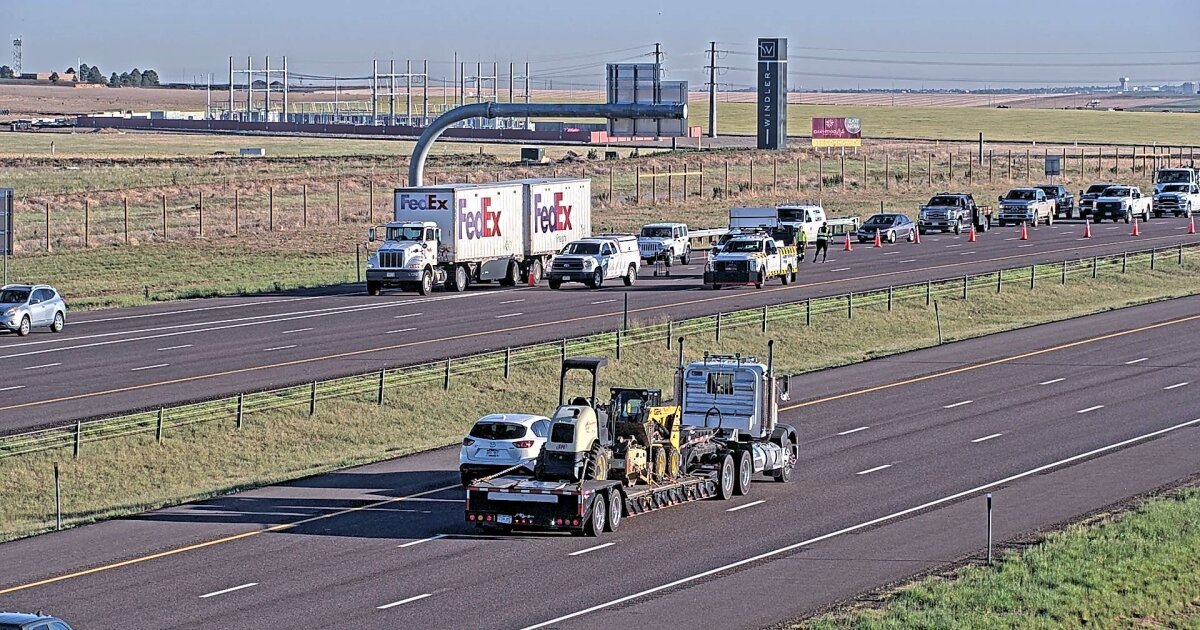
Pedestrian dies after hit by car on southbound E-470, Aurora police say
-

 Seattle, WA1 hour ago
Seattle paying $2.6M to settle sexual harassment lawsuit filed by four female SPD officers – MyNorthwest.com

