Nevada
Three friends drowned together in a Sierra Nevada whirlpool. How dangerous is the trail?

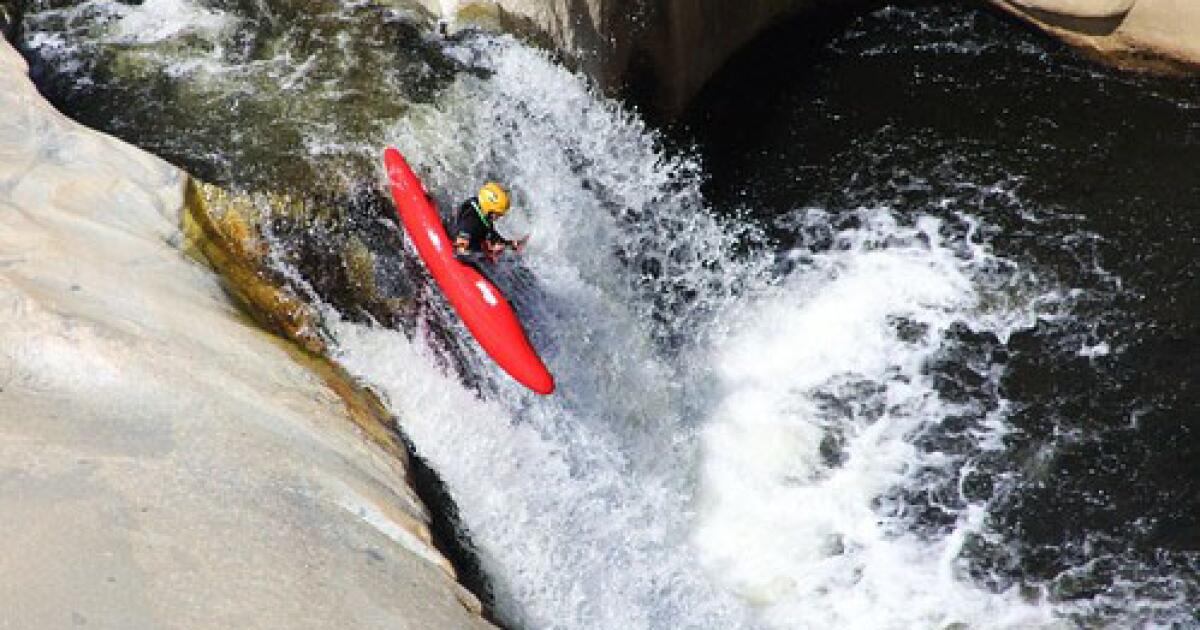
The Seven Teacups trail in the Sierra Nevada where three friends tragically lost their lives trying to save one another last week is known for its stunning views, including a series of descending pools and waterfalls that give the trail its name.
But the water that contributed to its beauty also could make the trail risky — even deadly.
Tulare County fire officials responded to a report of a drowning at the trail near Johnsondale around 5:20 p.m. Friday and discovered three people dead at the scene, according to local media reports.
The three victims — identified as Utah residents David Bell, 48, Jeannine Skinner, 34, and Peter On, 48 — were part of a group of 13 who had gone hiking and climbing through the canyons (“canyoneering”). They were approaching the end of the trail when tragedy struck.
The Seven Teacups trail spans about 4 miles and follows Dry Meadow Creek. The trail goes through a rock canyon that contains “teacups,” or pools, before ending along the Kern River.
Reviewers describe the trail as hot, hard and technical, meaning it can’t be traversed just on foot — you’ll need to know how to use ropes to rappel down some parts of the canyon or to climb back up. Yet “the technical descent is relatively short and, because the terrain is relatively forgiving with short jumps and multiple escape points, this canyon makes for a perfect practice ground before attempting longer and more difficult Class C Sierra canyons,” according to the climbing site Ropewiki.
The American Canyoneering Assn. rates the Seven Teacups as Class 3C, meaning that it requires intermediate technical skills and that it has flowing water with strong currents. It takes about a full day to complete.
An AllTrails review posted Aug. 26 details the potential dangers hikers face on the Seven Teacups trail. The reviewer noted that they completed the hike unaware that three people had drowned there the day before.
“Many pools are bowls with walls of smooth rock that provide no purchase,” according to the review. “Use a stick, an arm or leg to try and assess currents. These circular pools form due to circular currents. Look for bubbles and how they move below the surface. If you can’t see the bottom, be extra careful.”
David Bell’s sister, Cyndi Bell Miller, wrote on Facebook that Skinner was rappelling into a pool when she got caught in a whirlpool. On and Bell both jumped in to try to rescue her, but they got caught as well.
Tragically, all three drowned in the process.
“They were able to get their bodies out in about seven minutes and they did CPR on them immediately and kept doing CPR for about 20 minutes but they were not able to revive any of them,” Miller wrote.
Family members and loved ones of the three friends have also posted about the victims online.
“Pete’s love for the outdoors was infectious — surfing, canyoneering, skiing, volleyball, soccer, and golfing were just a few of the activities that filled his active life,” according to his online obituary. “But more than his adventures, it was his love for family and friends that defined him. Pete cherished his relationships, always putting those he cared about first.”
According to a GoFundMe page created to cover Skinner’s funeral costs, Skinner loved to be outdoors.
“She was always the first to intervene on behalf of others and establish peace in the face of conflict,” according to the page. “Perhaps it was the sparkle in her eye, or her natural smile that brought the best out of everyone. She will leave a void in the hearts of all who knew and loved her.”
Bell was the co-founder of the nonprofit Harrington Center for the Arts. The organization posted a tribute to Bell on social media after finding out about his passing.
“David brought joy to hundreds of thousands of runners through the races he organized at his company, Runtastic Events, and through the events at Harrington Center for the Arts,” the post said. “His unmatched creativity shaped every detail, knowing that his work was providing lasting memories for families and unforgettable moments of creativity and triumph as individuals reached new heights.”


The expected vote is the total number of votes that are expected in a given race once all votes are counted. This number is an estimate and is based on several different factors, including information on the number of votes cast early as well as information provided to our vote reporters on Election Day from county election officials. The figure can change as NBC News gathers new information.
Source: Vote data via the Associated Press. Projections by the NBC News Decision Desk.

LAS VEGAS (AP) — Nevadans are choosing their party nominees Tuesday for two closely watched congressional seats and the governor’s race, among others, as the state grapples with an affordable housing shortage, exploding energy demand from data centers and federal cuts to key state programs.
The state has a closed primary, meaning only registered Democrats and Republicans will vote in party contests after an effort to open them up failed in 2024.
Several primaries feature matchups between candidates backed by party leaders and political outsiders promising change. Come November, the governor’s race is considered one of the most competitive in the country, and holding on to the 3rd Congressional District is considered crucial for Democrats’ hope of retaking the U.S. House.
Here’s a look at the most prominent races:
Democrats seek a rival for Lombardo
Gov. Joe Lombardo, a Republican, is considered one of the most vulnerable governors in the country this fall.
The Democrats vying to challenge him include state Attorney General Aaron Ford, who has the backing of the Democratic congressional delegation and former Vice President Kamala Harris, and Alexis Hill, a county commissioner in northern Nevada who campaigned as a candidate willing to shake things up.
They focused their campaigns on affordability, as the state continues to see a shortage of affordable housing, some of the highest gas prices in the country and cuts to federal healthcare and food assistance programs.
Ford largely ignored Hill, instead directing his attacks at Lombardo and arguing that both the governor and Trump are responsible for Nevadans’ economic woes. He is trying to become Nevada’s first Black governor.
2nd Congressional District
In the Republican contest to replace longtime Rep. Mark Amodei, who is retiring, President Donald Trump has endorsed David Flippo, a loyalist of the president who has never held elected office. Amodei and Lombardo have backed James Settelmeyer, a former state senator with a long political track record.
The district covers northern Nevada and includes Reno and Carson City, the capital, along with an immense rural expanse.
Trump-endorsed candidates have seen successful in primaries elsewhere, underscoring his unrivaled power over the Republican Party as he enters the last years of his presidency. He easily won the district in the 2024 presidential election.
The GOP nominee has a good chance of winning in November, as registered Republicans outnumber Democrats by 70,000 in the 2nd District. A Republican has held the seat since the district was created in the 1980s.
Still, Democrats hope to entice the large number of nonpartisan voters in the district this fall. Their candidates include Teresa Benitez-Thompson, a former majority floor leader of the Nevada Assembly, and Greg Kidd, an investor who ran in the last cycle as a nonpartisan.
3rd Congressional District
Nevada’s other three members of Congress, all Democrats, are expected to win their primaries easily.
In the 3rd District, Republicans are battling to determine who will face Democratic Rep. Susie Lee in what is considered the most competitive congressional district in Nevada because of its narrow Democratic registration advantage, its high number of nonpartisan voters and a history of razor-thin election margins. In 2024 both Lee and Trump won narrowly.
Candidates include Trump-backed Marty O’Donnell, a composer who worked on the “Halo” video game series and ran unsuccessfully for the seat in 2024; Jeff Gunter, a dermatologist and former ambassador to Iceland; neurosurgeon Aury Nagy; and businessperson Tera Anderson.
The candidates ran on border security, energy independence and decreasing the federal debt.
Attorney general
With Ford term-limited and running for governor, the opening has prompted competitive primaries for the state’s top law enforcement post.
The Democratic side features state Senate Majority Leader Nicole Cannizzaro and Treasurer Zach Conine. Both campaigned on promises to take on the Trump administration, following in the footsteps of Ford, who filed numerous lawsuits against the federal government.
For the Republicans, Trump-backed attorney Adriana Guzmán Fralick faces Douglas County commissioner Danny Tarkanian. Tarkanian, son of legendary University of Nevada, Las Vegas basketball coach Jerry Tarkanian, previously ran unsuccessfully in multiple congressional races.
Both candidates campaigned on “election integrity,” casting doubt on voting security. Nevada is one of the swing states in which Trump falsely claimed the 2020 election was stolen, despite officials finding no evidence of widespread fraud.
Tarkanian promised to investigate voter fraud allegations, while Guzmán Fralick vowed to seek passage of the SAVE Nevada Act, which would be similar to changes Trump has sought at the federal level.
Her legislation would require all votes to be counted on Election Day, end universal mail ballots and eliminate automatic voter registration. It would almost certainly hit a dead end in the Democratic-controlled Legislature.
GOP secretary of state candidates question Nevada’s elections
Several Republicans are running for secretary of state, the office that oversees elections, including some who falsely claimed the 2020 election was stolen from Trump. The winner of the primary will take on Democratic Secretary of State Cisco Aguilar.
The GOP candidates include Jim Marchant, a former state lawmaker and perennial candidate who has said the 2020 election “was probably stolen”; Sharron Angle, a former state lawmaker who was part of an effort to block the certification of Nevada’s 2020 election results; and Shirley Folkins-Roberts, an attorney who received Lombardo’s endorsement and has denied there is widespread fraud in Nevada’s elections.
All the candidates support implementing voter ID, which will be on the ballot for the second time in November after the question passed by a wide margin in 2024.
Angle promises to enforce voter ID if voters pass it and supports Trump’s executive order seeking to require documentary proof of citizenship to vote. The courts have so far halted that order, issued last year, from taking effect.
Marchant wants to eliminate electronic voting machines and end the state’s universal mail ballot system. He also wants to require paper ballots, which would be counted by hand, according to his campaign website.
Folkins-Roberts said she will work to keep voter rolls accurate and up-to-date, require voter ID and ensure that election results are delivered on time. She also wants to reverse the automatic voter registration system. In an interview with News 4 Reno, Folkins-Roberts said she believes Nevada’s elections are “good,” but wants to improve voters’ confidence by making changes.

LAS VEGAS (KSNV) — We’ll start the week with a heightened fire danger with dangerous heat later this week.
TODAY
Expect mostly sunny skies with winds picking up again on Monday. High temperatures will reach 98 degrees in Las Vegas with south winds 10-20 mph and wind gusts up to 30 mph.
A RED FLAG WARNING is in place from 10am to 9pm Monday for gusty winds and dry weather, so if a fire started, it would spread quickly.
Winds are estimated to be 20-25 mph with gusts around 40 mph at times with relative humidity of 5%-15%.
Air quality is ranked ‘good’ to ‘moderate’ for dust and tree pollen. The most common pollens are juniper, cedar, willow, sycamore and palm.
TONIGHT
We’ll see variable clouds this evening with skies going from mostly cloudy to mostly clear overnight.
Wind gusts will pick up again before midnight with gusts 30-40 mph possible downslope of the Spring Mountains in the west valley.
Elsewhere, gusts will be 20-30 mph. Breezes will eventually back down to 5-15 mph overnight. Valley lows will drop to around 74 degrees.
WHAT’S NEXT
We have reached 109 consecutive days without measurable rain in Las Vegas.
No rain is in sight, but for perspective, June is the driest month of the year in Las Vegas. Fingers crossed on a hopefully more active monsoon season!
High pressure builds next with highs 5-10 degrees above normal. Temperatures will reach around 108 degrees in Las Vegas by Friday. The last time we hit a high temperature of 108 degrees was back on August 20th of last year.
Not much relief is in sight by the weekend with highs around 107 degrees and temps at or above 105-106 degrees NEXT Monday through Wednesday.
-

 Minneapolis, MN4 minutes ago
Minneapolis standoff: Deputies fired at while serving arrest warrant
-

 Indianapolis, IN11 minutes ago
Very humid through Thursday night with more storms on the way
-

 Pittsburg, PA14 minutes ago
Pirates Place Top Prospect on Taxi Squad
-

 Augusta, GA19 minutes ago
New system launches in Augusta, offering noninvasive brain tumor treatment
-

 Washington, D.C26 minutes ago
Trayon White censured and fined for missing financial disclosure deadlines
-

 Cleveland, OH29 minutes ago
New York Yankees vs. Cleveland Guardians prediction, pick for Tuesday 6/9/26
-
 Austin, TX34 minutes ago
Texas rule targeting smokable hemp is back in effect
-

 Alabama41 minutes ago
Alabama Football Recruiting Update: Crimson Tide Picks Up Second RB Commit

