West
Harley-Davidson 'woke' European CEO created culture clash with US biker 'brotherhood,' say critics
Harley-Davidson’s CEO Jochen Zeitz was Germany’s fresh-faced corporate wunderkind when he took over Puma in the 1990s.
Lately, he’s faced questions and concern from bikers and woke-exhausted consumers in the U.S.
Zeitz is seen as a proponent of far-left ideology who, some critics say, has tarnished the legendary all-American Harley-Davidson brand since taking it over in 2020.
HARLEY-DAVIDSON BOARD OF DIRECTORS SILENT ON FUTURE, FATE OF ‘WOKE’ CEO AND CHAIRMAN
“They lost their human touch. That’s the best way to put it,” longtime Harley-Davidson biker “Horseshoe” Johnny Hennings told Fox News Digital at the end of the Sturgis Motorcycle Rally in South Dakota last week.
“Harley was like a brotherhood. … Now it’s just a ghost.”
Jochen Zeitz, chief executive officer of Puma AG, is shown speaking at the International Herald Tribune’s Techno Luxury conference in Berlin on Nov. 17, 2009. (Michele Tantussi/Bloomberg via Getty Images)
But Zeitz’s supporters see it another way.
They say claims of Harley’s demise are vastly overstated by aging riders.
The Milwaukee-based motorcycle maker reported $5.4 billion in revenue in 2019, part of a decade-long downward trend. Revenue climbed to $5.8 billion last year, the third straight year of growth under the German-born CEO.
HARLEY-DAVIDSON SLAMS BRAKES ON ‘WOKE’ POLICIES AFTER SPARKING BIKER AND SOCIAL-MEDIA OUTRAGE
“He’s a smart dude and since he’s taken over, Harley has made more money for its investors,” the general manager at a Texas dealership told Fox News Digital.
“It’s simple as that.”
“He’s just all about being a new world order globalist.”
Harley’s iconic image, however, has been under the spotlight amid what appears to be a clash of cultures.
Old-time U.S. riders who fueled and embraced Harley-Davidson’s muscular image of rugged, flag-waving American independence are pitted against the European globetrotter with famous friends and left-leaning aims who today heads the brand.
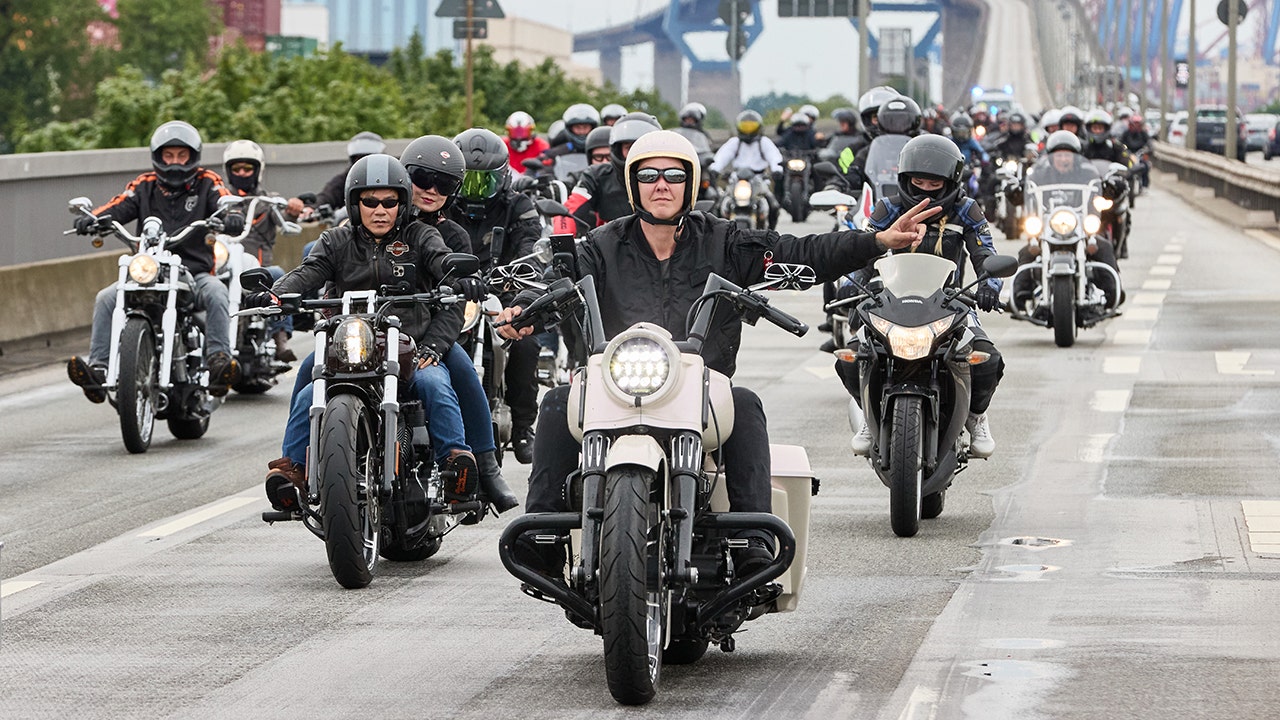
Participants in the Hamburg Harley Days Parade ride over the Köhlbrand Bridge in Hamburg, Germany, on June 30. (Georg Wendt/picture alliance/Getty Images)
“He’s just all about being a new world order globalist,” Vinny Terranova, the owner of Pappy’s Vintage Cycles in Sturgis, South Dakota, told Fox News Digital.
“He brought in bean counters and minions from Europe and they don’t care where Harley came from or the history of it. There’s no more service, no more customer interaction.”
HARLEY-DAVIDSON CEO COMPARES HIMSELF TO ‘TALIBAN’ IN EFFORT TO REMAKE MOTORCYCLE BRAND
Fox News Digital reached out to Harley-Davidson, Zeitz and members of the company’s board of directors for comment.
The unhappiness with Harley-Davidson’s drift away from core consumers came to a head in recent weeks when Zeitz’s “woke” agenda became the center of social media and consumer outrage.
Festival participants are shown on their Harley-Davidson bikes at the big ride in Saxony, Dresden, Germany, in July 2023. (Matthias Rietschel/picture alliance/Getty Images)
“We are trying to take on traditional capitalism and trying to redefine it,” Zeitz said at a 2020 conference in Switzerland just as he was gripping the handles of Harley-Davidson.
The video was brought to daylight last week by anti-woke social-media warrior Robby Starbuck.
Zeitz also added, in a stunning reference to terrorism, that he was “the sustainable Taliban.”
Salma Hayek and Jochen Zeitz, the chair and CEO of Puma, attend the unveiling of the Puma Ocean Racing Boat on May 12, 2008, at Boston’s Institute of Contemporary Art. (Gail Oskin/WireImage)
Harley-Davidson changed amid public outrage earlier this week, announcing that it was scaling back some of its more controversial programs and refocusing on core consumers.
HARLEY-DAVIDSON ‘USED’ BIKERS BEFORE ‘WOKE’ CONTROVERSY, FORMER OUTLAW RIDER CLAIM
All of this has fueled questions about the man behind the plan.
Prior successes
Sparkling tributes to Zeitz in various media outlets describe his success at Puma and jaunts across the playgrounds of the rich and famous.
“Jochen Zeitz saved Puma. Now he’s trying to fix global business,” reads the celebratory headline of a Wired magazine tribute in 2018.
Cindy Crawford sits on a Harley-Davidson motorcycle on the set of a Pepsi commercial wearing a black leather jacket surrounded by actors dressed as police officers in 1992 in Los Angeles. (Roxanne McCann)
Zeitz launched Puma Ocean Racing, with Salma Hayek christening the first boat in Boston, in 2008; founded The B Team with Richard Branson, based in London and New York City, in 2013, with a mission to define business by social agenda; and opened the Zeitz Museum of Contemporary Art in South Africa in 2017.
While his professional career has been publicly celebrated, Zeitz’s family history is largely unknown.
Little is publicly known about the CEO’s family.
He was raised in Heidelberg, Germany, to parents in the medical profession, according to rare bits of information from profiles, including in Women’s Wear Daily and other publications, found online. Little else is publicly known about his family.
For more Lifestyle articles, visit foxnews.com/lifestyle
A search of records and archives in the U.S. and Germany found no mention of family history.
What is known is that he was just 30 when he took the reins of Puma in 1993, the youngest CEO of a publicly traded company in Germany’s history, according to several reports.
Puma Ocean Racing powered by BERG, skippered by Ken Read from the USA, is followed by a spectator fleet into Itajai in the final miles of leg 5 from Auckland, New Zealand, to Itajai, Brazil, during the Volvo Ocean Race 2011-12 on April 6, 2012. (Paul Todd/Volvo Ocean Race via Getty Images)
He turned the discount sneaker brand into a high-priced fashion statement, and cemented his status in global couture as a board member of Kering, the French parent company of luxury brands Bottega Veneta, Gucci, Puma and Saint Laurent, among others.
Regardless of mystery or history, Zeitz has rubbed some of Harley’s most loyal consumers the wrong way in recent years.
Jochen Zeitz, CEO of Puma, in Nuremberg, Germany, in 2008. (Alexander Hassenstein/Getty Images)
“Harley-Davidson was our God and we were its disciples,” Marc Wilson of Colorado, a longtime Harley-Davidson rider who worked for one of its dealerships for 21 years, told Fox News Digital.
“Then that God we worshiped stabbed us in the back,” he said — a reference to both the company’s wokeness in recent years and the way some customers feel the company has treated them.
Read the full article from Here

West
550-pound bear finally evicted from California home after bizarre strategy ends monthlong ordeal
NEWYou can now listen to Fox News articles!
A 550-pound bear that had been living beneath a California man’s home for over a month has finally left after a bizarre strategy ended a long streak of failed removal attempts by state officials.
The male black bear was reportedly removed from the crawl space Tuesday after bear-removal experts from Tahoe traveled to the Altadena home. One team member crawled inside and fired paintballs filled with vegetable oil, wildlife organization BEAR League told Fox News Digital on Thursday.
According to surveillance video, the large bear has been wedging itself in and out of a small crawl space beneath Ken Johnson’s house since late November. Johnson said that the animal caused extensive damage to his home, costing tens of thousands of dollars. It also created a dangerous, unlivable situation involving structural and gas line issues.
“Right after surviving the Eaton fire, I lost my job, and shortly after that the bear began tearing into the structure of my home,” Johnson said in a GoFundMe page. “I have video footage of it twisting gas pipes, which created an extremely dangerous situation and forced me to shut off my utilities just to stay safe.”
BEAR REMAINS UNDER CALIFORNIA HOME AFTER WEEKS OF FAILED REMOVAL ATTEMPTS
A 550-pound bear finally scurries away after a wildlife expert crawls under the home to flush it out. (BEAR League)
The bear eviction finally took place after Johnson contacted BEAR League, an organization that specializes in bear removal emergencies in Lake Tahoe, located seven hours north of Altadena.
BEAR League told Fox News Digital on Thursday that the organization was “pleased to have helped Ken Johnson with this bear.”
“A Southern California homeowner had a large male bear living under his house for more than a month before reaching out to the BEAR League for help,” the organization added in a post on Facebook on Thursday.
BEAR League told Fox News Digital that the league used paintballs filled with vegetable oil that hit the bear in the backside. The wildlife rescue group reportedly finished the job in less than 20 minutes.
WILD BEAR MAKES ‘VERY POLITE’ SURPRISE VISIT TO CALIFORNIA ZOO BEFORE RETURNING TO FOREST
Surveillance video has captured a large bear squeezing itself into a new home. (Ken Johnson via Storyful)
“After earlier removal attempts by state wildlife officials were unsuccessful, BEAR League first responders Scott and Dave traveled to the Los Angeles area to assist,” the organization added. “Scott, one of our most experienced responders, crawled beneath the home—fully aware the bear was still there—to get behind him and encourage him to exit through the crawl space opening.”
To prevent the bear from denning in the crawl space again, the organization said it “loaned electric unwelcome mats to give the homeowner time to make repairs and secure the crawl space to prevent another visit.”
CLICK HERE TO DOWNLOAD THE FOX NEWS APP
According to social media footage posted by the organization, the mat worked just as designed, and the bear scurried away when it returned.
BEAR League emphasized that residents should be cautious about having open crawl spaces, noting that properly securing them helps people coexist safely with wildlife.
“We remind those who live in bear country that a poorly-secured crawl space is an open invitation for a winter visitor like this bear,” the league said to Fox News Digital. “BEAR League responds multiple times per day at this time of year to evict bears from under homes in the Lake Tahoe region, and we’ve done so for 30 years without cost to the homeowner. We work hard to educate people who share space with the bears that if humans take some very simple steps, they can live in harmony with the bears.”
Tuesday’s success ended a long streak of failed eviction attempts by the California Department of Fish and Wildlife, which had been trying to remove the bear for over a month. At one point, a trap even caught the wrong bear. Efforts that included bait, noisemakers and even a trap that caught the wrong bear all failed.
Read the full article from Here
San Francisco, CA
Philadelphia Eagles-San Francisco 49ers: Picks, odds for NFC Wild Card
The San Francisco 49ers (12-5) visit the Philadelphia Eagles (11-6) at Lincoln Financial Field in Philadelphia for a Wild Card round showdown as the NFL playoffs get underway. USA TODAY’s panel of NFL experts have locked in their picks and predictions for the action. Here’s everything you need to know before kickoff on Sunday, January 11, including live updated odds and injury report news.
Name
Week 18
2025 Season
Blake Schuster
11-5
141-111-7
Jon Hoefling
11-5
137-128-7
Tyler Dragon
6-10
128-137-7
Chris Bumbaca
7-9
115-121-6
Lorenzo Reyes
8-8
119-131-6
Jordan Mendoza
8-8
113-123-6
Richard Morin
N/A
47-34-3
Eagles vs. 49ers live odds, moneyline, over/under
Opening Lines
- Spread: Eagles (-3.5)
- Moneyline: Eagles (-190), 49ers (+155)
- Over/Under: 46.5
Get the edge with our exclusive NFL betting picks
Eagles vs. 49ers picks against the spread
Jon Hoefling: San Francisco 49ers (+4.5)
The Eagles feel like a lesser version of the Seattle Seahawks, and SF had several opportunities to win against Seattle in Week 18.
Tyler Dragon: Philadelphia Eagles (-4.5)
San Francisco has too many injuries. The 49ers will compete, but the Eagles are the best team in the tournament.
Lorenzo Reyes: San Francisco 49ers (+4.5)
This season, it was San Francisco’s defense that let it down. The lack of a pass rush and lack of turnovers kept games closer. The thing is, Philadelphia’s offense was also underwhelming, which was surprising given the talent on the roster. I think this is a case where the Niner offense carries the day, though injuries on defense are a concern. Either way, this line feels too big.
Christopher Bumbaca: Philadelphia Eagles (-4.5)
This is a “go with the best unit on the field” play. The one I’m talking about? The Philadelphia Eagles’ defense. Kyle Shanahan vs. Vic Fangio should be a treat though.
Jordan Mendoza: San Francisco 49ers (+4.5)
The defending champions have been up-and-down this season, and that gives San Francisco to catch the Eagles off guard. Brock Purdy finds his form to deliver a stunner.
Blake Schuster: Philadelphia Eagles (-4.5)
All San Francisco had to do was beat Seattle in Week 18 and it wouldn’t have had to leave home once during the postseason. Now the Niners have to go to Philly and face an Eagles team that’s probably furious after their season finale letdown. The Bay is about to experience some intense whiplash.
Eagles vs. 49ers updated injury report
NFL Playoffs Wild Card picks, predictions, odds
Super Bowl 60 updated odds
Denver, CO
Denver’s historic neon signs are in danger. And these are the people trying to save them.
When Matuszewicz looks at the historic sign in Aurora, he sees a soft blue glow that spells out “Riviera” in a flowing script with the word “Motel” in blue block letters below. An orange triangle resembling an airplane wing juts upward, punctuating “Riviera” and offering space-age vibes to those who drive by. The sign, he said, is unique because of the man who designed it, its construction from larger glass tubes that create a bigger glow, and the history it — and the Riviera — represent in metro Denver.
It’s hard for Matuszewicz, an old neon tube bender with a newly minted master’s degree in historic preservation, to pick a favorite. But the Riviera just might be it.
When the preservationist describes his love of neon signs, he speaks of the cosmos. Neon, he said, provides warmth to the people who observe it.
“When we hold a neon tube in our hands or see a neon sign, we are seeing our cosmic selves illuminated,” Matuszewicz said. “Nothing in the world does that except for neon signs. And that’s why we need to save them.”
Neon signs are in critical danger in Denver and other parts of Colorado because of low-cost alternatives in LED lights, restrictive building codes and a lack of awareness of their history in the Centennial State. But Matuszewicz and a handful of other neon enthusiasts are on a mission to save as many old signs as they can. And they are preaching the gospel of neon to all who will listen.
Colfax Avenue is the best example of the disappearance of funky neon signs that once advertised motels and restaurants with glowing cacti, blinking Native Americans and other illuminated Western iconography. But the avenue lost its neon luster as times changed. And a piece of history went missing when neon burned out and was abandoned, said Chris Geddes, a lecturer in the University of Colorado Denver’s historic preservation graduate program and a historic preservation specialist in Aurora.
“When you would drive down Colfax in the 1950s and 1960s, it was a neon alley,” Geddes said. “There’s so little of it left. The architecture of that time was fun and funky. It speaks to a different time.”
The Riviera Motel, including its neon sign, was designed by Richard Crowther, who worked as a neon light designer before moving to Denver to start his architecture career. Crowther is best known locally for designing the neon-lit ticket booths and signs for the Cyclone, Wild Chipmunk and other rides at Lakeside Amusement Park.
But there’s so much more to Denver’s neon history than the motels and restaurants that used to line Colfax, once dubbed the country’s “wickedest street.”
And Matuszewicz is leading the charge with the help of a small but dedicated group of neon enthusiasts.

Old and new neon
British chemists discovered neon gas in 1898 and, by 1910, a French engineer began producing and selling neon tubes for advertising signs. The first neon signs were introduced in the United States in the 1920s, and they quickly became a popular way to get the public’s attention. But the shine faded in the 1960s as cheaper alternatives emerged.
Over the years, neon’s popularity has ebbed and flowed with changes in taste and pop culture.
In Denver, a few old signs remain visible, including Jonas Bros Furs on Broadway, Davie’s Chuck Wagon Diner on West Colfax, Bonnie Brae Ice Cream on University Boulevard and the Branding Iron Motel on East Colfax.
But new signs are being created.
At Morry’s Neon Signs, Glen and Tina Weseloh create new neon signs every week for locations in Denver and surrounding areas. On Dec. 17, the Morry’s crew installed a 7-foot-tall skeleton drinking margaritas in a restaurant on downtown’s 16th Street.
Their sign shop opened in 1985 when Glen Weseloh’s father, Morry Weseloh, aged out of his tube-bending job with the International Brotherhood of Electrical Workers and started his own company. Morry Weseloh taught his son how to create neon signs, and the work continued after he died in 2003 at the age of 85.
“I had no idea I would continue after he was gone, but it got into our blood,” Glen Weseloh said.

Inside their shop in Denver’s Athmar Park neighborhood, Glen and the other craftsmen work with graphic artists to sketch out designs. Once a design is agreed upon, they heat glass tubes to bend them into the shapes that will make the sign. The colors are made with neon gas, which glows when electricity runs through it. Tube benders also use stained glass, phosphorus and mercury to create other colors.
The Morry’s crew is often called to restore old, fading signs, including the marquees of the Oriental and Federal theaters, the Olinger sign in the Highland neighborhood, the Ironworks sign on Larimer Street and the glowing covered wagon sign outside the Frontier Drive-Inn in Center, Colorado.
The Weseloh family can also claim credit for Matuszewicz’s preservation work.

On again, off again
In 1987, Matuszewicz decided to go to neon school in Minneapolis after his wife, Emily Matuszewicz, mentioned that she had met a woman whose son was doing it. On a whim, he decided that was what he wanted to do, too.
“I didn’t have a favorite neon sign when I was a kid,” he said. “I knew nothing about it.”
So the Matuszewiczes left Denver so he could attend the Minneapolis School of Neon.
After working jobs in Minneapolis and Albuquerque, Matuszewicz made it back to Denver, and, in 1993, went to work at Morry’s Neon Signs. He stayed until 2020, when he decided the manual labor had taken its toll.
“No matter how long you do it, you get burned. You get cut,” he said. “It’s just hard to do it for a long time.”
So Matuszewicz traded a neon warehouse for a classroom and spent the next 15 years teaching first through eighth grades at the Denver Waldorf School.
Matuszewicz went back to college and earned bachelor’s degrees in chemistry and history at Metropolitan State University of Denver in 2017 — he had started in 1983 and refers to his college career as the “35-year plan.” He studied fermented beverage residues in archaeological pottery shards as an undergraduate project. So he thought the kombucha industry would be an interesting next-career step.
He got interviews. But he wasn’t hired.
“Maybe I’m making it up, but it seemed to me that as soon as I showed up, it was shocking that a 56-year-old man showed up,” Matuszewicz said. “You could see it in their face, ‘Like what?’ I don’t know it as a fact to be ageism, but it sure felt like it.”
Frustrated over a lack of opportunity, Matuszewicz was at a loss over his third act.

But his old friends in neon came calling. The Weselohs invited him to come back to the shop to help restore older neon signs.
His first project was the Independent Order of Odd Fellows sign on South Broadway.
“It’s a lovely, lovely sign,” he said. “We just started doing more and more and more of them.”
Along the way, Matuszewicz met Corky Scholl, a 9News photojournalist who documented neon signs in his spare time, and J.J. Bebout, who owns coffee businesses in Denver and Westminster, and who makes neon signs as a side gig.
Together, the three set about trying to save more neon.
“What’s up needs to stay up and what’s up and not functioning needs to be revived,” Bebout said.
Scholl was a walking catalogue who brought his journalistic objectiveness to preservation, Matuszewicz said. Scholl created and maintained the Save the Signs Facebook page, posting pictures and writing short histories of neon signs in Colorado.
“He let the history speak for itself,” Bebout said.
Scholl died unexpectedly in August, and it has been a blow to neon preservation in Denver, both men said.
“He was an encyclopedia of signs,” Matuszewicz said.
Bebout got into neon after looking for an art medium that also incorporated his knack for building things. He learned the craft in Cincinnati and then returned to Colorado.
Neon opportunities in Denver are rare, he said. Morry’s, along with Yesco, are the only two companies making neon in town.
“It’s a really small community here,” Bebout said. “The pool of folks who can teach is pretty small, and they just don’t because they’re all really old, and I say ‘old’ relative to the end of the lifespan of one’s career. They’re all at the end of it.”
Matuszewicz has been instrumental in helping Bebout perfect his skills, which he uses in his Westminster shop.
When Matuszewicz rekindled his interest in neon, he and his neon buddies started knocking on doors around the Front Range, asking property owners with dilapidated signs if they could help restore them.
One project was the Rossonian Hotel in the Five Points neighborhood. Matuszewicz brainstormed the idea to invite neon artists from across the country for a one-day “bendapalooza” to restore the hotel’s sign.
“It’s just sitting there rotting and we can’t just let it rot,” Matuszewicz said. “I went on this whole crusade to save it.”
But his pitch fell through.
“It was super discouraging to me. People wouldn’t listen to me,” he said. “I’m just a guy in a neon shop.”
Meanwhile, Matuszewicz had enrolled in CU Denver’s Change Makers program, in which participants explore new career options later in life. At first, he said he tossed out the idea of becoming a world-renowned busker of murder ballads. His classmates scoffed.
Then, once again, his background in neon shone. Everyone loved the idea of a historic preservationist who specialized in neon.
“The stars aligned,” he said.
Now that Matuszewicz has his master’s degree in historic preservation from CU Denver, his crusade is getting more attention. He’s become an in-demand speaker at historic preservation conferences around the United States.
“I’m like, ‘Oh my God, 300 people get to hear about neon,’” he said. “I’m so excited.”
Still, Matuszewicz’s focus is on Denver.

Neon versus LED
The Weselohs and their neon business are in a constant battle with LED.
The newer technology is pitched as more cost-efficient because it needs less electricity and, therefore, is less detrimental to the environment.
Two years ago, the iconic Benjamin Moore Paints sign at 2500 Walnut St. in Denver was replaced with LED by the building’s owners. At the time, Denver’s Landmark Preservation office told the Denver Gazette that the old neon was too deteriorated to restore.
The neon enthusiasts despise the new sign, especially since the old neon letters were destroyed and recycled.
Bebout describes the new Benjamin Moore sign as “flat and lifeless.”
“Benjamin Moore is a clean-looking sign but it lacks the character of neon,” Bebout said.
LED, which stands for light-emitting diode, became more common in the early 2010s as people looked for more efficient light bulbs. LED bulbs’ reputation as being cheaper to burn started pushing neon out of favor just as it was experiencing a sort of revival.

But neon fans argue that those who believe LED is less expensive are misinformed.
Neon, they say, lasts longer. An old neon sign can go for 100 years or longer with the right maintenance. And all the materials used to make it can be recycled, Matuszewicz said. Its elements are more readily available on the planet.
“It’s not a bunch of plastic and precious earth metals,” Bebout said. But he admitted one disadvantage for neon, “Now one thing is for sure, they do take more power. That’s one thing that can be argued.”
Neon also can’t be manufactured by a machine and requires skilled craftsmen to be created, Tina Weseloh said. LED, on the other hand, fades over time, and the plastic signs become more junk in a landfill because they cannot be repaired, they said.
City code departments also create barriers for neon signs, the Weselohs said.
Some towns outlawed flashing signs years ago in an attempt to modernize their codes and their cities’ appearances. Neon signaled “degenerate neighborhood,” Bebout said.
Centennial and Westminster are among the cities in Colorado that don’t allow blinking neon lights outside of businesses, Glen Weseloh said.
“That’s crazy! Why?” he said. “I don’t get it.”
In Aurora, Bebout restored the old Branding Iron Motel’s neon sign on East Colfax. That project almost didn’t happen because the city made the hotel owner pay a large egress fee because the sign stretched over the sidewalk, he said.
“You want to talk about discouraging preservation,” he said. “Most people are going to tear it up and put up a flat, lifeless LED sign.”
So the neon preservation crowd has its work cut out.

‘We need more Todds’
Matuszewicz’s next big neon preservation project is to get an art piece at 1350 Lawrence St. listed on the Colorado State Register of Historic Properties. It will be considered by the state’s Historic Preservation Review Board in January.
The Incomplete Square by neon artist Stephen Antonakas was installed on the side of the 11-story apartment building in 1982 and showcases 8-foot lengths of red neon mounted on the building’s exterior.
If approved, the piece will become the first time in Colorado that neon attached to a building will be designated historic when the building itself is not, Matuszewicz said.
Matuszewicz also received a prestigious Harrison Goodall Preservation Fellowship with the National Park Service and Preservation Maryland, and is creating an artificial intelligence model that can identify historical features on buildings. That program will help Historic Denver finish a decades-long project to document all 160,000 buildings in the city.
If the AI model is successful, Matuszewicz hopes to turn its capabilities to neon to create a registry of authentic neon in the state.
The Weselohs are glad Matuszewicz returned to the neon world to help preserve its presence in Colorado.
“We need more Todds to speak for the neon world,” Tina Weseloh said. “We’re all little mom-and-pop shops.”
As for Matuszewicz, he finally settled on a calling.
“Most people know where they work, when they work and how they work. But they don’t know the why of the work,” he said. “It is spiritual for us as human beings when we see neon. We are seeing cloud nebula when we see neon. We really are seeing the heavens.”
Get more Colorado news by signing up for our daily Your Morning Dozen email newsletter.
-
Detroit, MI1 week ago2 hospitalized after shooting on Lodge Freeway in Detroit
-
Technology5 days agoPower bank feature creep is out of control
-
Dallas, TX3 days agoAnti-ICE protest outside Dallas City Hall follows deadly shooting in Minneapolis
-
Dallas, TX6 days agoDefensive coordinator candidates who could improve Cowboys’ brutal secondary in 2026
-
Delaware2 days agoMERR responds to dead humpback whale washed up near Bethany Beach
-
Iowa5 days agoPat McAfee praises Audi Crooks, plays hype song for Iowa State star
-
Health1 week agoViral New Year reset routine is helping people adopt healthier habits
-
Nebraska4 days agoOregon State LB transfer Dexter Foster commits to Nebraska