Politics
Why her abbreviated campaign has helped Harris pull into the lead, for now

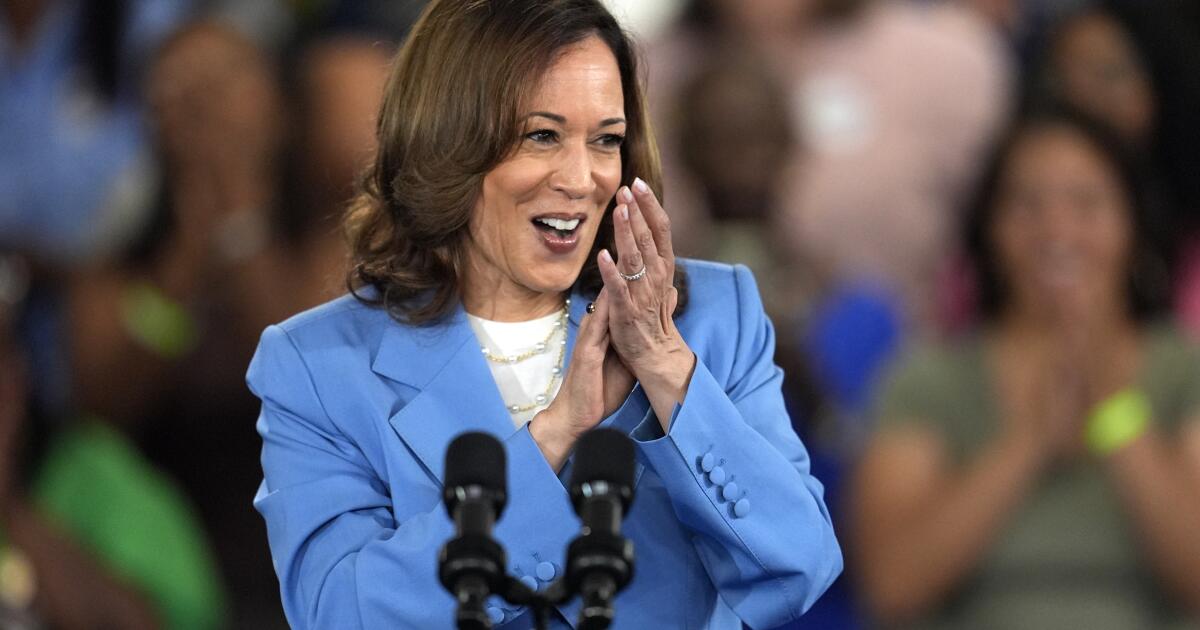
Vice President Kamala Harris enters this week’s Democratic National Convention in Chicago with a small lead over former President Trump in national polling averages that few would have thought likely even a month ago.
The truncated nature of the race — initially thought by many to present an added hurdle — has played to Harris’ strengths, while minimizing her flaws.
The Nov. 5 election will take place just 75 days after the convention ends on Thursday. Voting begins even earlier in many states, including prized battleground Pennsylvania, where some counties will begin handing out ballots next month.
Before President Biden dropped out of the race in July, many Democrats saw Harris as a risky candidate, while also worrying that anyone taking his place on the ballot would face logistical challenges.
Here’s why the snap election, unprecedented in modern American politics, has been helpful to Harris so far, and how Trump could reclaim a contest that is still up for grabs:
No primary, no problem with defining core beliefs
Harris started her race for her party’s 2020 nomination with the type of excitement she is drawing from Democratic voters today. More than 20,000 people showed up for her January 2019 announcement rally in Oakland, and she raised big dollars as she established herself as a top-tier contender.
By December of that year, before ballots were cast or caucuses held, she had dropped out. Harris had trouble defining her core beliefs compared with those of others in a big field of Democratic hopefuls. As a result, voters lacked a sense of what she stood for.
Was she a lefty competing for progressive populist votes with Sens. Bernie Sanders of Vermont and Elizabeth Warren of Massachusetts? Was she a centrist sparring with Biden and Pete Buttigieg, who is now Biden’s transportation secretary?
“She’s not necessarily easy to pigeonhole as being a progressive or centrist or moderate,” said Brian Brokaw, a former Harris advisor who ran a group supporting Harris in the primary. “She’s confounded people.”
Her attempts to straddle the party’s ideological divides — with her own universal healthcare plan and a partial embrace of the movement to reform or abolish the Immigration and Customs Enforcement agency — failed to win over her party.
She doesn’t have to worry about those fights now that the race is a binary choice — with brighter lines between her and Trump on issues such as abortion, democracy and the economy.
“She’s benefiting so much from being a foil against Trump, in a particularly compelling and positive way, that everyone’s looking at her differently,” said Faiz Shakir, a senior advisor to Sanders.
“In a primary process, voters would be asking, ‘Could she be the nominee? Should she be? Is she the best?’” Shakir added. “Here, you’re either for Trump or Harris.”
Less need for an ‘Etch-A-Sketch’
Mitt Romney’s 2012 presidential campaign was famously undermined when a top advisor said the Republican could erase some of the conservative positions he espoused in the GOP primary with an “Etch-A-Sketch” to appeal to a more moderate electorate in the general election.
Harris is doing a bit of that now, leaving behind her support four years ago for a universal health plan and a ban on fracking as she tries to win votes in Pennsylvania and other swing states. Republicans are trying to remind voters of her more liberal stances, but it’s harder than it would be if her shifts were more recent, and if Harris didn’t have her Biden administration record to run on.
She’s also facing less pressure from the left in her party than she would if she‘d competed in the primaries, when interest groups tend to use their leverage. She’s been leaning into her support for Biden’s bipartisan border enforcement deal, for example, avoiding some of the criticism from within the Democratic Party that Biden faced this year when he negotiated it with Senate Republicans. Trump pressured Republican lawmakers to kill the deal because he wants to keep the border as a political issue.
A turnkey operation
Harris inherited Biden’s entire campaign apparatus, avoiding the management clashes and staff turnover that hampered her 2020 campaign and early tenure as vice president.
The campaign was designed around Biden’s strengths and loyalties, which presented a challenge. But the tone has shifted quickly toward Harris’ style, which is more confrontational yet lighter as she tries to contrast her sense of joy with Trump’s grievances. The campaign was also built around a ground game, in anticipation of a tight race in which turning out core voters will be crucial.
Catching Trump off guard
Trump designed his campaign around Biden’s weaknesses, including his advanced age. Now Trump is the candidate facing some of the same questions.
Donald Trump’s campaign hadn’t planned to go up against Kamala Harris, but he still stands a chance.
(Julia Nikhinson / Associated Press)
Trump’s advisors believe Harris is a ripe target and have urged him to focus attacks on immigration and the economy — two areas where he holds polling advantages over her. But he has so far been unable to avoid distractions.
“I think I’m entitled to personal attacks” on Harris, Trump said Thursday at a news conference.
The calendar has kept the honeymoon going. Can it last?
Harris has lucked into great timing. She got a boost of excitement from relieved Democrats when Biden withdrew, and again with the announcement of Minnesota Gov. Tim Walz as her running mate, and is now entering a convention that will bring media focus including four nights of network airtime.
She’s been on the road almost the entire time, avoiding sit-down interviews and other unscripted encounters, which have given her trouble in the past.
Trump’s allies have been furious over what they see as an unfair glide path.
“The only thing that’s in Harris’ favor — the only thing — is the nonstop gusher of adoring coverage she’s getting from the media, who don’t seem inclined to wonder why she won’t answer a single question or explain the radical, leftist record she’s running from,” said Tim Murtaugh, Trump’s 2020 communications director, who recently joined his 2024 campaign. “She’s a weak vice president from a failed administration, but the media chooses to write about her ‘vibe’ instead.”
Trump’s 2020 campaign manager, Bill Stepien, said he was dubious that Harris’ momentum could continue, arguing that the dust had yet to settle following the Democratic campaign shake-up. Harris’ perceived advantages could backfire, he argued.
“She’s been offered a honeymoon period, which has certainly put some wind in her back,” Stepien said. “On the other hand, going through a primary process, running the gamut against a slate of opponents, tests you. It tests you on the debate stage. It tests you on the stump. It allows you to tweak and refine messaging.”
The pressure is still on
For all of Harris’ good fortune, polling shows that the race remains winnable for either candidate — tighter than it was eight years ago, when Trump defeated Hillary Clinton in the electoral college despite losing the popular vote. That gives Trump plenty of room to rebound and Harris time to stumble.
Her lack of sit-down interviews or full-scale news conferences since winning the nomination will increase the stakes when she does agree to one, or holds her first debate with Trump, on Sept. 10. She could also suffer from a twist in the news, such as a national economic setback or a shift in the war between Israel and Hamas.
“You have no room for error,” said Karen Finney, a Harris friend who served in a senior communications role for Clinton’s 2016 presidential campaign. “Everybody is always bringing your A-game to an election. This is your A-plus-plus game. There isn’t time.”
Finney argues that Harris has more than just luck and timing: She worked as vice president to build a message and a political coalition that would not have been there had another Democrat stepped in for Biden. But if she makes an error in a debate, she will have less time to rebound, Finney said.
“Joe Biden stepped down so we could have our best chance to beat Donald Trump,” she said. “Of course that creates pressure.”



Construction workers unfurled a large printed tarp to cover scaffolding installed at the White House’s front entrance. Doug Burgum, the interior secretary, said President Trump had ordered the repairs after noticing damage to columns.
Politics
WATCH: Trump’s Energy chief reveals what escalating Iran tensions could mean for gas prices

NEWYou can now listen to Fox News articles!
Energy Secretary Chris Wright is telling Americans not to be concerned about the possibility of another surge of sharp increases in gasoline prices as tensions with Iran have started to escalate once again.
Asked whether Americans should worry about higher prices at the pump and how the Trump administration is preparing to keep the economy stable if the conflict continues to worsen, Wright told Fox News Digital: “It has not been any good behavior from Iran that’s allowed oil to flow. It’s been the United States military.”
“That’s not changing,” he assured, speaking from the Great American State Fair on the National Mall this week.
US CLAWS BACK KEY CONCESSION TO IRAN AFTER FRESH ATTACKS ON COMMERCIAL SHIPS IN STRAIT OF HORMUZ
(Mario Tama/Getty Images) (Mario Tama/Getty Images)
With Iran striking three commercial vessels transiting the Strait of Hormuz on Monday and Tuesday, Wright doubled down in urging citizens to not credit Iran for the U.S. military’s work to ensure oil shipments continue flowing through the strait.
“Look, the U.S. Military has been the key asset here,” he said. “They have assured the flow of oil and gas through the Strait of Hormuz throughout. Not at the beginning of this conflict, but through the last six weeks.”
Wright said the administration is closely monitoring global oil supplies as the tentative ceasefire with Iran seemingly came to come to a halt, with President Donald Trump telling Secretary-General Mark Rutte the call for peace with Iran is “over” at the NATO Summit in Turkey on Wednesday.
But, he pointed to the continued shipping through the Strait as evidence that markets should remain stable.
TRUMP SAYS IRAN CEASEFIRE IS ‘OVER’ AFTER IRANIAN ATTACKS TRIGGER MASSIVE US RESPONSE
President Donald Trump speaks at the White House on Tuesday, April 22. (AP/Alex Brandon)
“We’re of course constantly watching the supply of oil, the supply of refined products and what’s going on there,” Wright said. “And I think still all positive trends.”
Beyond geopolitical concerns, Wright also praised the new chain of discounted gas stations across Pennsylvania and New Jersey, Freedom Fuel, which promises customers prices below the national average.
The Trump administration, though not involved with the network, has heavily endorsed the new chain and its 25 locations.
“We love it,” Wright said when asked about Freedom Fuel. “I mean, look, any mechanism we can to lower energy costs for Americans of all kinds, we’re all in on.”
“With Freedom Fuels, they’re just lowering it down to their wholesale price of gasoline,” Wright said. “So they’re not making any money selling gasoline, but they’ve got convenience stores. That’s how most gas stations make money.”
NEWSOM UNDER FIRE AS CALIFORNIA GAS TAX HIKE SENDS PUMP PRICES EVEN HIGHER
Gasoline costs are a known concern for many Americans, and amid surging prices there has been a considerable increase in those opting to purchase electric vehicles to save money long-term at the pump — with Tesla dominating the market for these types of models.
Wright argued one of the benefits to living in America is having the option to choose what type of vehicle you drive.
CLICK HERE TO DOWNLOAD THE FOX NEWS APP
“We just want people to buy what they would prefer,” he told Fox News Digital when asked his thoughts on increasing calls for support of the electrification of cars. “Consumer choice — you wanna buy an electric car, you wanna buy a gas powered car, diesel powered car, buy a big truck. That’s the choice.”
“That’s why you live in America. You get the choice of all those.”

In 2023, California regulators levied more than $100,000 in fines against the private operator of a federal immigration facility, kicking off a three-year battle over whether detainees who do work at the facilities should be considered employees.
The question went beyond semantics: If considered employees, the detainees would be subject to state worker protection laws.
A legal settlement announced this week now affirms that private immigrant detention facilities are subject to California’s workplace safety and health requirements.
“Every worker deserves a safe and healthy workplace and should be able to report workplace hazards without fear of retaliation,” said Denisse Gómez, spokesperson for the California Division of Occupational Safety and Health or Cal/OSHA.
“Individuals who perform work in these facilities are entitled to workplace safety protections, and this settlement reinforces Cal/OSHA’s commitment to enforcing those protections and safeguarding vulnerable workers,” she added.
Under the settlement between California and the GEO Group, a Florida-based private prison company, the company recently withdrew its legal challenges and agreed to pay more than $100,000 in the fines.
The GEO Group did not respond to requests for comment.
Back in 2023, Cal/OSHA issued $104,510 in fines against the GEO Group. The agency had found six violations of state code by the company after detainees complained about a lack of protective equipment and proper training while cleaning the facility for $1 per day.
Detainees alleged they routinely wiped black mold off shower walls at the facility, saw black dust spew from air vents and used cleaning solutions that lacked instructions during the COVID-19 pandemic.
The biggest fine levied against the GEO Group was for failure to establish and maintain “effective written procedures to reduce employee risk of exposure to aerosol transmissible disease.”
Advocates viewed Cal/OSHA’S recognition of the detainees as workers as a victory that could pave the way for future labor rights fights at other detention centers in the state.
But the GEO Group appealed, arguing that detainees participating in ICE’s voluntary work program make their own schedules and aren’t employees, so hazard exposure couldn’t be “as a result of assigned duties,” as California law states. Plus, the company argued, there wasn’t enough evidence that detainees were exposed to any hazard.
Early last year, the state’s Occupational Safety and Health Appeals Board rejected the GEO Group’s argument and found that detainees should be considered “affected employees.”
The GEO Group sued, but three days before a California Superior Court hearing in May, the company and Cal/OSHA reached the settlement.
Along with paying the fines, the GEO Group agreed to draft plans for avoiding aerosol transmissions at 12 secure and reentry facilities in California, including five detention centers that hold immigrants.
“GEO ensures detainees are afforded the necessary tools, equipment, and personal protective equipment … to safely and effectively perform any necessary tasks,” the settlement states.
Gómez said the settlement also leaves intact the appeals board’s ruling that civil immigration detainees who participate in work programs can participate in proceedings anonymously, “acknowledging the potential for retaliation when individuals raise workplace safety concerns.”
But the question of whether detainees are employees and deserve certain protections isn’t entirely resolved — at least not for the federal government.
Last month, U.S. Immigration and Customs Enforcement released new standards for detention facilities across the country. The revised guidelines “emphasize that detainee volunteers participating in the voluntary work program are not considered facility and/or government employees” and thus not entitled to labor regulations.
Attorney Mariel Villarreal said the timing of the new detention standards made her question whether the GEO Group had asked ICE to specify in its standards that detainees are not workers in response to its battle with Cal/OSHA.
“To me, it’s a reaction to this very settlement,” she said. Villarreal works for the California Collaborative for Immigrant Justice, which filed the original complaint on behalf of detainees who said they worked in unsafe conditions.
Villarreal pointed to a Washington Post report that GEO Group executives privately asked ICE to specify that detainees are not employees of the facilities where they work. Two top Trump administration officials, border czar Tom Homan and acting ICE director David Venturella, previously worked for the GEO Group.
New versions of ICE detention standards take effect as contracts are established or modified, so this year’s rules won’t immediately apply to every facility.
An ICE spokesperson did not comment about the settlement. The spokesperson, who did not provide their name in an emailed statement Wednesday, said the agency has begun transitioning detention facilities to meet the 2026 standards, “building on its longstanding commitment to safe, secure, and professional detention operations.”
“ICE has consistently implemented many of these best practices independently, reinforcing its role as the leader in detention operations,” the spokesperson added.
The GEO Group and other immigrant detention center operators have faced other legal battles over workers’ rights, including lawsuits in Washington, Colorado and California over the $1-per-day payment.
Villarreal said she’s confident that the Cal/OSHA settlement would continue to hold even if California facilities incorporated the new standards. But she said she believes the statements are an attempt by the GEO Group to “sidestep responsibility” and avoid the possibility of being fined under similar circumstances in other states.
“These statements in the new standards are a way for them to try and preserve profits as much as possible,” she said. “GEO and ICE are so intertwined at this point that they have the same motives.”
-

 Boston, MA5 minutes ago
Red Sox face lengthy travel issues ahead of series vs. Mets
-

 Denver, CO12 minutes ago
What’s going on with the Nuggets? Unpacking an NBA offseason on hold
-

 Seattle, WA15 minutes ago
Seattle Kraken Sign Goaltender Victor Östman and Defenseman Ville Ottavainen to One-Year Deals | Seattle Kraken
-

 San Diego, CA20 minutes ago
An executive shuffle at San Diego’s Sempra
-
Milwaukee, WI27 minutes ago
Survey finds less than half of Jews in Milwaukee identify as Zionists | The Jerusalem Post
-

 Atlanta, GA30 minutes ago
Atlanta Hawks Showing Interest In Denver’s Peyton Watson, But Is The Price Too High?
-

 Minneapolis, MN35 minutes ago
Uptown businesses push to delay Lyndale Avenue project
-

 Indianapolis, IN42 minutes ago
Data center moratorium proposed by Indianapolis City-County Council president

