Entertainment
Opinion: Tempted to vote for Jed Bartlet in 2024? 'The West Wing' was always a fantasy

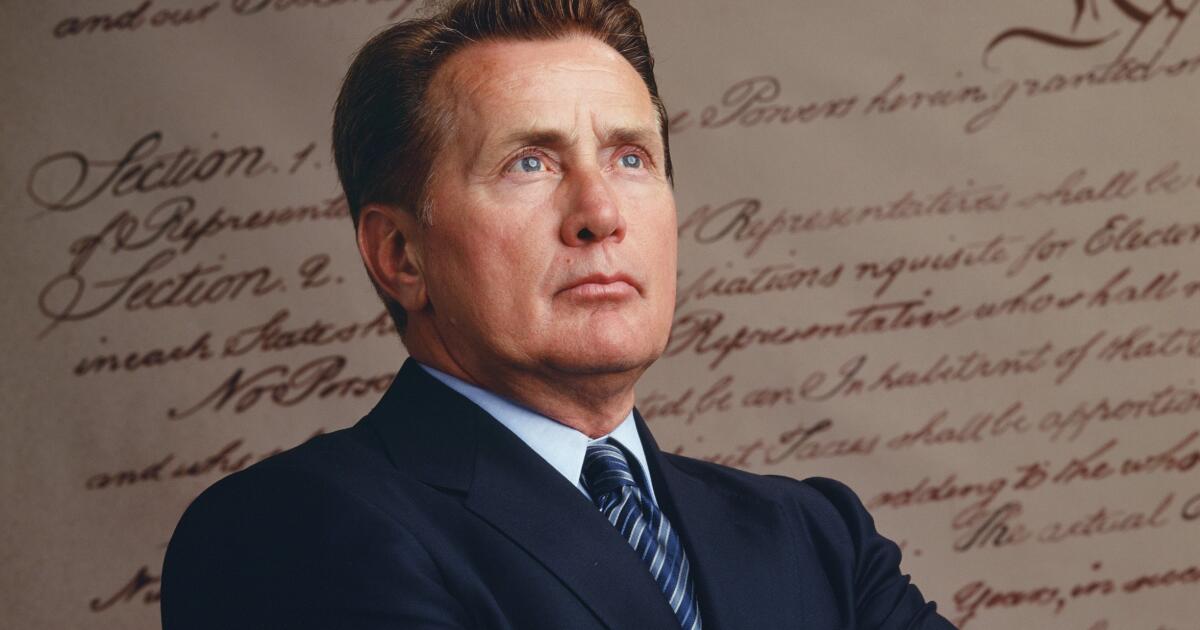
As another terrifyingly significant presidential election nears, it’s hard not to fantasize about how different things could be. Imagine, for instance, having a president who put deeply held values above the pressures of their biggest donors. Imagine one who was able to truly listen and learn when faced with issues they didn’t understand rather than adhere to whatever stance happened to be the most politically convenient at the time. Imagine, even, a president who inspired you, who made you feel a glow of patriotism, skeptical as you might be of the concept. In short, imagine Josiah Edward “Jed” Bartlet, president of the United States as envisioned by Aaron Sorkin and brought to life by Martin Sheen across seven seasons of the award-winning and critically acclaimed NBC series “The West Wing.”
Two of the show’s cast members, Melissa Fitzgerald (who played Carol Fitzpatrick, assistant to the White House press secretary) and Mary McCormack (who played deputy national security advisor Kate Harper), certainly still believe in the show’s sticking power as well as its overall positive framing of politics. They have written a book about it that is plainly geared toward existing fans of the show: “What’s Next: A Backstage Pass to the West Wing, Its Cast and Crew, and Its Enduring Legacy of Service.”
Look, it’s true: Every so often, I make hot chocolate in my “Bartlet for America” mug and sip it wistfully, imagining a world in which we’d had a President Bartlet instead of a second President Bush, perhaps followed by a President Santos — the character played by Jimmy Smits who had sweeping, truly inspired education reform plans. It’s a lovely dream, a White House that’s more “West Wing” and less “Veep,” functional and nearly scandal-free, earnestly dedicated to bettering the lives of everyday Americans by doing the slow yet essential work of policy change.
Yes, I know this is extremely naive; yes, I’m aware that Bartlet was problematic in plenty of ways, as were his staffers; and yes, I know that “The West Wing” was, in many ways, a liberal fever dream that bought into American exceptionalism and the ideals of patriotism. But that’s just it: The show was a fantasy, one that gestured at an idea of how things could be, but that wasn’t trying to claim that this was how things really were. Sorkin himself insisted that “first and foremost, if not only, this is entertainment. ‘The West Wing’ isn’t meant to be good for you. … Our responsibility is to captivate you for however long we’ve asked for your attention.”
And entertain us it did, across more than 150 episodes, some more memorable than others, but all including at least one rousing monologue that made this viewer, at least, believe in the possibility of a government that really works, or that really tries to work, or that really wants to work. It helps that I first watched bits of it as a tween, long before I’d moved to the States, when my trips to California were strictly family visits during which I was loved and spoiled by my grandparents and aunts with as much frozen yogurt as I wanted, unrestricted TV time during which I enjoyed more channels than I knew what to do with and endlessly fascinating commercials for toys I would never get, and best of all, bookstores so large I could get lost in them. It felt like a more innocent time.
But, of course, it wasn’t. “The West Wing” was airing as George W. Bush took office following a close and contested election. It was on TV when 9/11 happened, as the Patriot Act was signed, and as the wars in Afghanistan and Iraq were launched. The show offered a rosy alternative, which appealed especially to a certain income bracket; its biggest chunk of viewers, according to a 2001 study, were earning more than $70,000 a year — or, in today’s money, more than $120,000. Largely sheltered from systemic injustices contributing to and caused by poverty, affluent people experienced fewer of our government’s shortcomings and probably found the show’s vision more plausible than it was.
As a (rather sheepish) devotee of the show, I bought into it too, especially the first couple of times I watched it front to back, in my late teens and early 20s. It managed to make the American political process — which I found deeply baffling, having never learned how it worked in school — exciting. Partially, I’m sure, it was the speed of the quippy dialogue, which Sorkin is famous for, as well as the way the show was shot, its long walk-and-talk scenes lending a sense of urgency to matters of dry policy. The humor was helpful too, and sometimes educational. I’ll never forget the Big Block of Cheese Day episode during which deputy communications director Sam Seaborn is required to meet with a ufologist — and Press Secretary C.J. Cregg and Deputy Chief of Staff Josh Lyman learn (along with the rest of us) that the maps we’ve all grown up with are both imperialistic and frankly just wrong.
But as funny and inspiring (often at the same time, as in the brilliant two-parter “20 Hours in America”) as the show can be, there are glaring issues in it. When I rewatched it more recently, I was incredibly disturbed, for instance, by the dynamic between Lyman and his assistant, Donna Moss. What was framed as a cute “will they/won’t they” relationship between boss and devoted employee now read to me as not only extremely unprofessional but even downright abusive, with Donna bearing the brunt of Josh’s temper tantrums and putting up with being constantly belittled by him. But it’s more than the interpersonal dynamics; the show’s occasionally over-the-top optimism and sincere belief in the United States as the greatest nation on Earth — not to mention its very white casting and casual yet consistent sexism — has, speaking anecdotally, made it feel cringey to many leftists of my generation.
The old critiques about the show’s idealism still ring true. Cynicism about and frustration with the slow gears of government have likely always existed throughout the left-right spectrum. Now, with social media adding a second-by-second commentary on an already speedy 24-hour news cycle, these sentiments feel much louder and more visible.
The authors of “What’s Next” don’t address the ways the show has aged poorly. They’re instead relentless in pointing to its positives, and to be fair, when it was originally airing there was no other TV show depicting government functions, and so the policies that “The West Wing” explored were likely eye-opening to many of its viewers. An episode in the first season, for instance, includes a compelling argument for financial reparations for the descendants of enslaved Black people, a concept as old as abolition but which plenty of the show’s viewers might have never encountered before.
This particular example isn’t mentioned in the book, though, which focuses instead on the broad idea of service and lionizes the show’s cast members for their various social and political activism. Many have worked to support veterans and treatment courts, which emphasize rehabilitation for individuals with substance use disorders. “What’s Next” is a cheerleading text, a fun and breezy read that doesn’t delve into any cringe aspects or difficulties on set.
But “The West Wing” would, like almost any piece of enduring media, only suffer from an insistence that it’s perfect. The show is a messy piece of very entertaining — and occasionally educational — television, full of extremely talented actors giving incredible performances, but it’s not a road map for reality, nor should it be.
After President Biden’s debate debacle this summer, the show’s creator, Sorkin, penned a bizarre op-ed suggesting that the Democrats nominate Mitt Romney, a moderate Republican, for president, a strategy to poach enough conservative voters to keep former President Trump from regaining power. But when Biden stepped out of the race, Sorkin quickly took back the suggestion. His op-ed was, depending on whom you asked, a frustrating or entertaining thought experiment, but it should never have been seen as real advice for the real world. Like “The West Wing,” it was a break from reality.
Ilana Masad is a books and culture critic and author of “All My Mother’s Lovers.”


Lots of disturbing movies take place at summer camps. “Friday the 13th,” “Sleepaway Camp,” “Care Bears Movie II: A New Generation,” the list goes on, and it just keeps going because shoving dozens of kids into an emotional pressure cooker at the edge of civilization with minimal supervision and no escape is usually a bad idea. And that’s before you give them all bows and arrows.
Avalon Fast’s sophomore feature isn’t a typical summer camp horror movie. It’s a trippy, melancholic tragedy about healing psychic wounds, and finding out they’re already infected. Try to imagine an angsty, indie teen drama that’s parasitically burrowing its way into a Florence + The Machine music video. Now imagine it’s in theaters now and it’s called “Camp.”
“Truth or Dare” is a crappy game, even on “Love Island,” but it’s even crappier at the start of “Camp.” The halfhearted young friends of Emily (Zola Grimmer) can barely muster enough gusto to come up with a dare, and when they give up, their fallback “truth” is just asking her for her biggest regret. It may have been a haircut. It may have been the time she ran over a four-year-old with her car. Either way it’s a lousy icebreaker.
As if her night couldn’t get any worse, Emily’s best friend overdoses in her car, sending her spiraling into grief and misery. Months go by and her father arranges to get her a camp counseling gig, looking after other troubled youths at a place called only “Camp.” (I’d say the least plausible part of Fast’s film is that the domain name “camp.net” wasn’t already taken, but shut my mouth, because it really isn’t.)
The kids are non-entities, a vague distraction from her worries, but her fellow counselors are badasses. They smoke. They drink. They say things like, “I feel like doing drugs” and look, you gotta give ‘em credit, when they say they’re going to do something they do it. I can’t even take the recycling downstairs most of the time and here these girls are, saying they feel like doing drugs and then doing the damn drugs, making me feel like a lazy jerk.
There’s just one problem. Or maybe there isn’t. Emily’s new cohort, led by the alluring and oddly motherly Clara (Alice Wordsworth), begins each summer with a ritual to make their wishes come true. Nev (Lea Rose Sebastianis) wishes to have sex with their boss, Dan (Austyn Van De Camp), “really, really hard” and wouldn’t you know it, her wish was essentially a command.
Avalon Fast knows that’s wrong, but she knows her characters don’t care very much. Dan starts trudging across the camp grounds, confused and disturbed. He was saving himself for marriage, the poor guy, and looks like he’s on the verge of something terrible. But sacrificing Dan’s virginity gave Emily and her friends a taste of power, and it manifests in sparkly animated hand flourishes, which do nothing, it seems, except look cool. But it’s their power and they’re taking it, and they’ll take a lot more.
The problem with describing the plot of Fast’s “Camp” is that it places way, way too much emphasis on the plot. This movie doesn’t run from scene to scene, it gradually sinks into emotional rot. Emily thinks she’s getting better, finding friends and — in her own way — finding her spirituality. It’s just a selfish, detached spirituality and sees no value in anyone else’s feelings. Or anything else about them. What looks like a film about finding your way back from the darkness is, instead, a labyrinth that Emily probably can’t solve. She may not even want to.

“Camp” is a dreary, disturbing day dream of a movie, the kind you have when you’re all in your feels and close to getting heatstroke. It’s not about getting better, it’s about getting worse, and how that sometimes feels like getting better. You may not have worked through your baggage, you may not have processed your trauma, but at least everything looks simple. You can just while away your days with excess, abandoning all empathy, even for yourself.
It’s a sad film, “Camp,” and it’s a little tricky. Fast is working with familiar horror movie clichés, and falling into the old routine where witchcraft is initially empowering, then horrifying, and that probably doesn’t do real-life witches many favors. Then again, neither do a lot of the classic witch films — especially “The Craft,” the goth 1990s elephant in the room — and most of them aren’t as emotionally salient as Fast’s interpretation, although they’re typically more “fun.”
“Camp” isn’t a fun movie. That’s not a criticism, it’s just the way it is. Avalon Fast’s gloomy, lo-fi aesthetic occasionally segues into ornate, gorgeous imagery, proving the filmmaker — and cinematographer Eily Sprungman — are in total creative control. Fast wants us to feel Emily’s despair and the futile moral ambiguity of her distractions. It’s a cautionary tale, perhaps, about not hanging out with the wrong crowd, or taking solace in mind-altering experiences, but more than anything it’s a sympathetic mirror, and it’s pointed at anyone who ever got lost.


As La Cruz continues to break down barriers for the LGBTQ+ community in reggaeton, the rising Venezuelan star enjoys living out his gay fantasies in his music videos. Take the sultry video for his 2023 breakthrough single, “Quítate La Ropa,” which sees shirtless men perreando (twerking) before him in a locker room.
But at the same time, La Cruz has come to understand that his platform as a gay reggaeton artist coincides with a time when conservatism is sweeping the globe — and queer rights are receding.
“It fills me with happiness to represent a community that has been denigrated, treated badly and pushed into a corner for many years,” a bedheaded La Cruz says over Zoom from his New York City hotel room. (He had just performed at a Pride event the night before.)
“It’s a fact that [LGBTQ] rights are becoming progressive, but they’re rolled back even faster than they advance,” he adds. “This is very painful and concerning. This is happening in every country in different ways. During these difficult times, I’m going to keep putting my heart into my music more than ever.”
La Cruz is the stage name of Alfonso La Cruz. The native of La Guaira, a coastal city in Venezuela, pursued a music career after relocating to Spain in 2015. Following a brief stint on the singing competition “Operación Triunfo” three years later, La Cruz was closeted and found his momentum stifled. In 2022, he took the brave step of singing about his affection and lust for other men in his debut album, “Hawaira.”
Venezuelan reggaeton singer La Cruz released his new EP, “El Nene, Vol. 2,” on June 11.
(Maria Camila Pinzon)
Backed by the beats of reggaeton, a genre that had historically excluded the LGBTQ+ community, La Cruz found both his groove and his tribe with hits like “Te Conocí Bailando” and “Quítate La Ropa.” Early supporters included Colombian superstar Karol G, as well as Mexican American R&B singer Omar Apollo.
Alongside Puerto Rican provocateurs like Young Miko and Villano Antillano, La Cruz has continued to queer the heteronormative urbano space. He has also pushed his sound to broader horizons in his new EP, “El Nene, Vol. 2,” which includes “Sírveme,” a Brazilian funk banger with drag pop star Gloria Groove — and “Te Perdí,” a touching tribute to the victims and survivors of the 2016 Pulse nightclub shooting in Orlando, Fla.
La Cruz’s EP dropped on June 11, the day before the 10th anniversary of that tragedy, which largely impacted the queer Latino community. In an interview with The Times, he opened up about being a gay reggaetonero and “Te Perdi,” his tribute to the 49 people lost at Pulse.

It’s been three years since you first went viral with “Quítate La Ropa.” What have you learned about yourself during that time?
There are songs that have brought me a lot of love and I’m thankful to my fans that consider that song to be a classic. It’s brought me a lot of blessings. At this moment, I feel like I have the best opportunities in my life. However, I feel like the industry is a bit uncomfortable with an artist that’s openly gay and wants to be a part of this. That hasn’t stopped me at all. It’s the gasoline in my motor. It’s what pushes me to keep working hard. My fans are what’s building my career and I won’t let them down. I’m sticking with this until the end.
You connected with Karol G early in your career. Did she give you any advice when you met her?
I want to say publicly that I would love to open for her concerts on her Viajando Por El Mundo Tropitour. I’m very close to her. I love her so much. She has always treated me with so much love. I hope that something between me and her can happen sometime. I know everything happens in due time. I told her that I love the way she is and how she connects with her fans. When I see her singing and performing, I feel like she’s a sister to me. A big piece of advice that she gave me and that I’ll always carry with me is to never lose the humility and closeness that I have with my fans. The key to success is humility. I never want to be out of reach. I want people to see me and say, “I want to achieve my dreams like he has.”
How did your collaboration “Sírveme” with Gloria Groove come together?
I love her so much! I’ve always been a big fan of hers. I’ve gotten close to a lot of artists in Brazil and Gloria has been one of them. We didn’t think twice about making this song. Gloria was coincidentally traveling to the amusement parks in Orlando. I told her: “Baby, let’s go! I’m ready for you in Miami.” She told me: “Baby, I’m going to Miami!” We met one afternoon to create this song. She paused her vacation to go to the studio with me. It was very beautiful. I love my Brazilian fans.
With “El Nene, Vol. 2,” why was it important for you to also shed a light on the 10th anniversary of the Pulse nightclub shooting?
In 2016, when I recently arrived in Spain and my brother recently arrived in the U.S., we had a call with our family. My brother said, “There was a shooting close to where I live and it was in a gay club.” My family has supported me since I first told them about my sexuality. I thought that that could’ve happened to me.
I’m following up on this tragedy because it shaped my life. As the years go on, information about this attack has faded away. Each day people are talking less about it. It’s a tragedy that’s super important to remember, like 9/11 and the [2017] Las Vegas shooting, because it’s one of the worst attacks in U.S. history. Why are we not talking about it anymore? We have to keep talking about things so that they don’t happen again.
What inspiration did you pull from the Pulse tragedy for your song “Te Perdí”?
On this path, I’ve gotten to know the stories of people that survived that shooting. For example, there was a boy with his mother that lost her life and he survived. There’s a lot of stories of love from that club that have [since] come out. When I went to the studio, I was inspired by loss, or a love that’s gone away, with respect and love for the community that supports me. It is my gift, to be a voice for this situation that should never be repeated. There are people that don’t know about this tragedy and I want to let the world know that this happened. I hope that the victims’ families and the people that survived are living lives of peace and calm.

RICHMOND, Va. (WRIC) — In this episode of 8News Reel Talk, Julia Broberg sits down with Hekla Petursson and Catori Ryan to talk about “Toy Story 5.”
The hosts gave their reviews and provided the following star ratings:
Catori: ★★★★
Hekla: ★★★★★
Julia: ★★★★.2
To watch more livestreams and digital video content, head to the WRIC+ Originals page. You can also watch full on-demand videos on your smart TV using the WRIC+ app.
-

 Nebraska3 minutes ago
HealthierU opens wellness coaching program to employees
-

 Nevada6 minutes ago
Shaquille O’Neal Foundation donates 260 supply-filled backpacks to Nevada students
-

 New Hampshire11 minutes ago
Police: Man stabbed during domestic dispute in Nashua, NH
-

 New Jersey18 minutes ago
1 injured after vehicle hits tree in West Deptford, NJ
-

 New Mexico21 minutes ago
1 dead following shooting involving Rio Arriba County Sheriff’s Office
-

 North Carolina26 minutes ago
Former Madison County chief deputy in North Carolina custody after Arizona arrest
-

 North Dakota33 minutes ago
North Dakota composer launches statewide virtual choir project
-

 Ohio36 minutes ago
UC Bearcats baseball playing Ohio State, Vanderbilt in Nashville in 2027

