
Connect with us

West

2 hikers in Yosemite National Park reported missing

Published

on

2 hikers in Yosemite National Park reported missing

A search is underway at Yosemite National Park in California after two hikers failed to return to a campground on Saturday, officials said.

The two hikers, identified as 63-year-old Miguel Delgado and 40-year-old Ana Rodarte, were last seen setting off from Bridalveil Creek Campground around 10 a.m., the National Park Service (NPS) said in a statement on Sunday.

The pair were believed to be going on a day hike toward Ostrander Lake and were expected to return within a couple of hours, according to officials. The hikers have yet to return as of Monday morning.

Fox Digital has reached out to the NPS for additional information about the search for the hikers and their suspected route but did not immediately hear back.

BASE JUMPER DIES AFTER 500-FOOT FALL AT GRAND CANYON

Advertisement

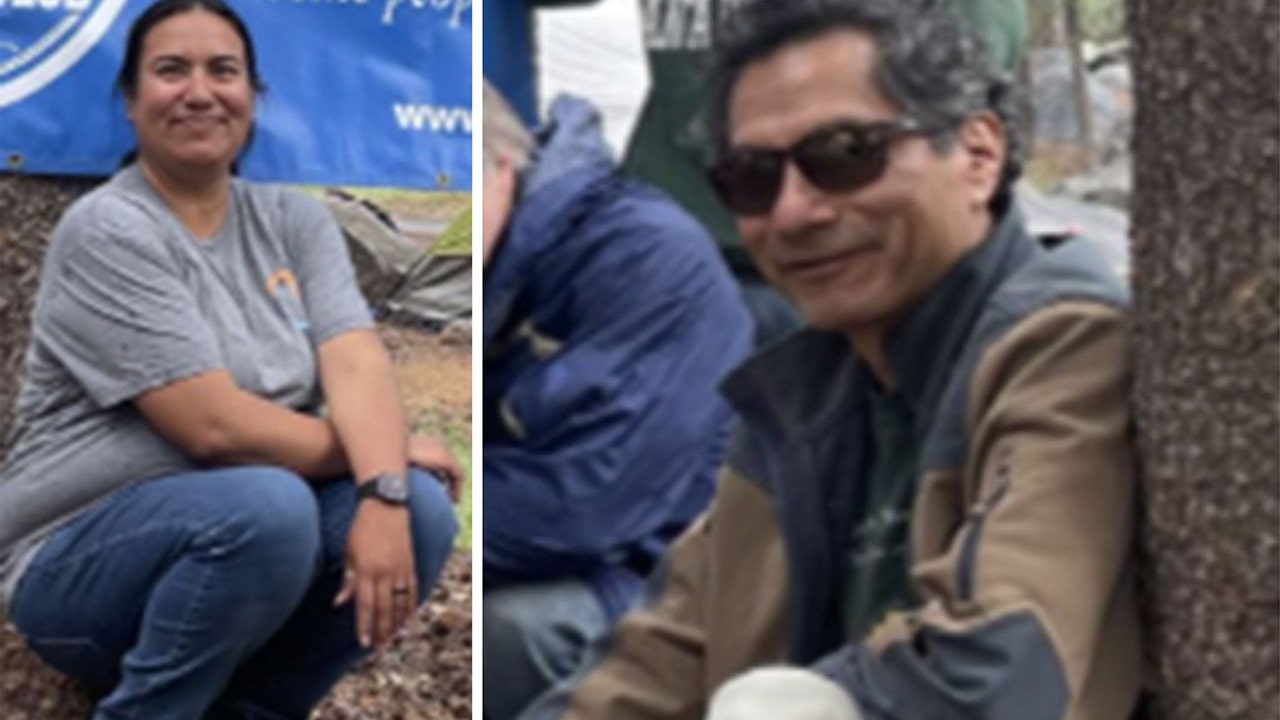
Ana Rodarte, 40, and Miguel Delgado, 63, were reported missing at Yosemite National Park after failing to return from a day hike on Saturday, officials said. (National Park Service)

Rangers described Delgado as a Hispanic male, about 6 feet, 1 inch tall and weighing 160 pounds with black hair and brown eyes. He was last seen wearing a brown jacket with blue accents, an orange t-shirt, tan pants and a backpack.

Delgado and Rodarte set off Saturday morning from the Bridalveil Creek Campground, but never returned, officials said. (National Park Service)

Rangers described Rodarte as a Hispanic female, 5 feet, 7 inches tall and weighing 198 pounds with brown hair and brown eyes. She was last seen wearing a gray windbreaker jacket, green pants or jeans and a blue ball cap.

Bridalveil Creek Campground, which is surrounded by a forest of red fir and lodgepole pine, has numerous hiking trails located nearby. (National Park Service)

Advertisement

HIKER’S DEATH IN UTAH SPOTLIGHTS NEED FOR SAFETY PROTOCOLS ON THE TRAIL

The Bridalveil Creek Campground sits at an elevation of 7,200 and is surrounded by a forest of red fir and lodgepole pine, according to the NPS website. Numerous hiking trails are located along the nearby Glacier Point Road, and the website warned there were no services available in the area.

CLICK TO GET THE FOX NEWS APP

Rangers asked anyone with information about the missing hikers to contact the NPS at 888-653-0009 or by emailing nps_isb@nps.gov. 

Read the full article from Here

Advertisement
Continue Reading
Click to comment

Leave a Reply

Your email address will not be published. Required fields are marked *

This site uses Akismet to reduce spam. Learn how your comment data is processed.

Colorado

Colorado governor fires two clemency board members who spoke out about Tina Peters’ commutation | CNN Politics

Published

on

Colorado governor fires two clemency board members who spoke out about Tina Peters’ commutation | CNN Politics


Colorado Gov. Jared Polis on Wednesday fired two members of the state’s clemency board after they spoke out against his controversial decision to grant clemency to Tina Peters – an election denier whose sentence was cut in half by the outgoing Democratic governor in May.

Azra Taslimi and Hannah Seigel Proff told CNN they were fired after speaking out publicly, including in a New York Times article in June, in which they revealed secret details about the clemency process and criticized the governor for overruling the board. They told the Times the clemency board twice voted unanimously behind closed doors to reject Peters’ application for an early release from prison.

Polis’ decision in May to release Peters came after President Donald Trump waged a long pressure campaign against Colorado to free her. Peters – who was released from prison in June – was the last Trump ally still in prison for 2020 election-related crimes.

In letters to Taslimi and Proff obtained by CNN, Polis said the two members breached confidentiality by speaking out.

Advertisement

“Specifically, you breached the required duty of confidentiality by publicly divulging Board members’ votes pertaining to a clemency application which you obtained only through your official position on this Board,” Polis wrote in the letters.

The two women told CNN they are disappointed they were fired — but not surprised.

“I’m not upset that he overrode our decision. I think what’s upsetting is that we understand why he did it, which is that you know Tina Peters had a powerful ally behind her,” Taslimi said. “She had political pressure applied in her name, and the governor capitulated to it, and that is what makes this unfair, and that is why I call it selective mercy, because you are giving her the benefit that you don’t give or apply to anyone else.”

Eric Maruyama, a spokesperson for the governor, told CNN in a statement Wednesday, “Publicly disclosing board recommendations and how members vote on any case threatens the credibility of the board, colors future deliberations by the board and breaks clearly stated confidentiality policy articulated in the Executive Order which establishes this board.”

Proff, who served on the board for nearly eight years, said she understood the state rules around the closed-door clemency recommendation process “more as the confidentiality to protect the people who apply for clemency, not to protect the governor.”

Advertisement

The governor primarily justified his decision to release Peters by citing a recent Colorado appeals court ruling that found the trial judge violated Peters’ First Amendment rights by improperly punishing her for her protected speech about the 2020 election.

“It was a straightforward decision because, after reviewing the facts, and reading the Appeals Court decision, I concluded that her sentence was simply too long,” Polis wrote in a Substack post, where he condemned Peters’ crimes.

Now that they’ve been terminated, Proff worries there will be less transparency.

“I worry now that we’ve been terminated from the board what comes of this is that people are less likely to speak out … that politicians will go unchecked on these sort of decisions,” Proff said.

Advertisement


Source link

Continue Reading

Hawaii

BBC Audio | Witness History | Hawaii becomes the 50th American state

Published

on

BBC Audio | Witness History | Hawaii becomes the 50th American state


On 18 March 1959, Hawaii was brought into the United States of America as the 50th state with the passing of the Hawaiian Admission act.

Five months later, on 21 August it was officially proclaimed the 50th state by President Eisenhower.

Former governor of Hawaii, John Waihe’e, tells Jen Dale his memories of statehood and why Hawaii’s history with America means it has become a divisive issue.

Eye-witness accounts brought to life by archive. Witness History is for those fascinated by and curious about the past. We take you to the events that have shaped our world through the eyes of the people who were there.

Advertisement

For nine minutes every day, we take you back in time and all over the world, to examine wars, coups, scientific discoveries, cultural moments and much more.

Recent episodes explore everything from how the Excel spreadsheet was developed, the creation of cartoon rabbit Miffy and how the sound barrier was broken.

We look at the lives of some of the most famous leaders, artists, scientists and personalities in history, including: the moment Reagan and Gorbachev met in Geneva, Haitian singer Emerante de Pradines’ life and Omar Sharif’s legendary movie entrance in Lawrence of Arabia.

You can learn all about fascinating and surprising stories, like the invention of a stent which has saved lives around the world; the birth of the G7; and the meeting of Maldives’ ministers underwater. We cover everything from World War Two and Cold War stories to Black History Month and our journeys into space.

(Photo: President Eisenhower signs the proclamation admitting Hawaii as the 50th state. Credit: Getty/Bettmann)

Advertisement


Source link

Continue Reading

Idaho

Idaho State Board appoints David W. Hahn as eighth president of Boise State University

Published

on

Idaho State Board appoints David W. Hahn as eighth president of Boise State University


BOISE, Idaho — The Idaho State Board of Education unanimously voted Wednesday to appoint Dr. David W. Hahn as the eighth president of Boise State University, officially ending a prolonged national search for the university’s top leader.

Hahn’s appointment follows his selection as sole finalist on June 16 and the completion of the 10-business-day waiting period required under Idaho law before a final vote could be taken. His appointment is effective July 1.

He will begin transitioning into the role immediately, performing presidential duties remotely as he prepares to relocate to Idaho. Under the terms of his contract, Hahn is expected to be on campus no later than Aug. 10, ahead of the start of the fall semester.

“This vote reflects the confidence of the full Board in the process we undertook and in the leader we have selected,” Idaho State Board of Education President Kurt Liebich said. “Today’s vote is the culmination of a rigorous process, and I have every confidence that Boise State and the state of Idaho are well served by this appointment. Dr. Hahn is the right person to lead Boise State into its next chapter.”

Advertisement

Hahn most recently served as dean of the College of Engineering at the University of Arizona. He will succeed interim president Jeremiah Shinn, who led Boise State after former President Marlene Tromp departed in 2025 to take the presidency at the University of Vermont.

The search for Boise State’s next president has been closely watched across Idaho and within higher education circles, stretching more than a year and drawing attention for its shifting timeline and changes in state law governing how public university presidents are selected.

RELATED | Boise State announces restructuring that includes a merger and one college closure

Initially launched as a national search, the process was paused in 2025 as the Idaho State Board of Education reviewed search procedures and lawmakers debated revisions to Idaho’s presidential search law. During that period, no finalists were publicly announced, and the university continued operating under interim leadership.

The Idaho Legislature later approved changes to the process that significantly limited public disclosure of candidates, requiring only a single finalist to be named before a final appointment vote. Supporters of the change said it would help attract stronger candidates by protecting confidentiality during recruitment. Critics argued it reduced transparency for leadership decisions at Idaho’s public universities.

Advertisement

Following the adoption of the new rules, the search resumed in 2026. According to the State Board, dozens of candidates applied for the position, and semifinal interviews were conducted before Hahn emerged as the final selection.

Boise State has continued to navigate major institutional priorities during the leadership transition, including its move into the Pac-12 conference, ongoing research expansion, and campus development projects.

With Wednesday’s vote, the State Board said the search process has concluded and leadership stability has been restored at one of Idaho’s largest public universities.

Hahn will now assume responsibility for guiding Boise State into its next academic and athletic chapter, overseeing academic programs, university operations, fundraising, and strategic planning as he prepares to formally take the helm on campus in August.

This story was initially reported by a journalist and has been, in part, converted to this platform with the assistance of AI. Our editorial team verifies all reporting on all platforms for fairness and accuracy.

Advertisement

Send tips to neighborhood reporter Allie Triepke

Have a story idea from your neighborhood? Share it with Allie below —


Source link

Continue Reading
Advertisement

Trending
