Movie Reviews
The Borderlands Movie: The Kotaku Review


An hour after leaving a screening of the new Borderlands movie, directed by Eli Roth (Hostel) and starring Cate Blanchett, Kevin Hart, Jamie Lee Curtis, and Ariana Greenblatt, I’m staring at a blinking cursor in a blank Google Doc, urging inspiration to strike.
Surely a live-action movie based on the wildly successful edgelord video game franchise from 2K and Gearbox would inspire a couple hundred words, right? Surely the star-studded cast, which includes several Oscar winners (and Jack Black), would prompt a spark of creativity. Surely the vibrant visuals, cacophonous explosions, and poop and pee jokes would destroy the writer’s block dam, sending forth a surge of witty words and succinct sentences. But I’m at a loss.
Borderlands is not just bad, it’s depressing.
On the border of a breakdown
I saw Borderlands at an early screening at Alamo Drafthouse, during which cosplay was encouraged. No one wore costumes, and the theater was solemnly silent, as if we were about to watch archival video of the deadliest WWII battle or found footage from 9/11. R-rated trailers aired before it, prompting me to question if this movie, directed by Roth (known for his gory, gross violence), was rated R (it’s not).
Before I have a chance to double-check the rating, Cate Blanchett’s voice echoes through the theater. “Long ago, our galaxy was ruled by an alien race,” she intones, sounding bizarrely flat for an incredibly talented actor who endeavored to deliver a fun, frenetic performance in another superficial flick: 2017’s Thor: Ragnarok. I’m immediately assaulted by aggressive, slap-dash cuts and shimmery CGI images of guns, neon signs, and Psychos, as Blanchett (who plays Lilith, a character who inspired early-twenties me so much I got one of her quotes tattooed) gives us the plot overview with as much energy as a ‘50s housewife who regularly mixes mood stabilizers and martinis.
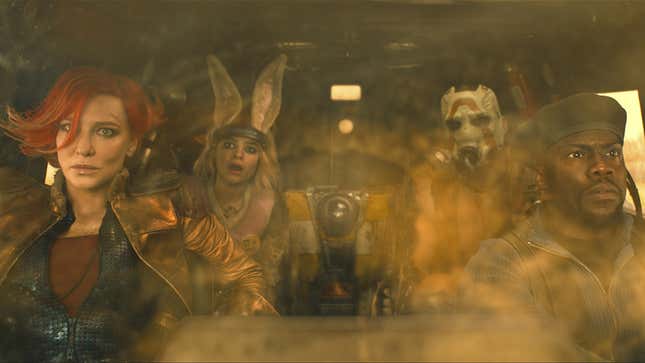
Lilith tells us that the Eridians laid the foundation of this galaxy, then disappeared, leaving behind a secret vault hidden on the planet Pandora, inside of which are powerful relics of the long-lost civilization. “That sounds like some wacko B.S., huh?” Blanchett asks. I stifle a groan with a huge bite of my burger. Rather than giving moviegoers the free-wheeling wanderlust that the Borderlands games offer, the film is incredibly linear and straightforward: Lilith, a bounty hunter, is hired by the head of arms manufacturer Atlas Industries to track down his daughter Tiny Tina on the planet Pandora.
We’re introduced to almost all of the main cast rather quickly: Hart as Roland, Greenblatt as Tiny Tina, Florian Munteanu as a Psycho named Kreig. Roland breaks Tiny Tina out of some kind of facility by way of a fairly bland action sequence, during which he punches a guard and calls him a “fake Stormtrooper-ass bitch.” I guess that means Star Wars exists in the Borderlands universe? It doesn’t improve after this.
If you told me Borderlands used AI for its dialogue, I’d believe you without question. Nearly every line that’s uttered with the kind of fake peppiness I’d reserve for my elementary school cheer competitions is either a limp-dicked “edgy” joke that wouldn’t warrant a single Reddit upvote or a cliche phrase like “I’m too old for this shit” and “This has been a really long day.” I could count on one hand the lines that were thoroughly genuine—or at least not dripping with so much snark they were almost sticky. There is no humanity here, just humorless humans.
When a needle-drop of Muse’s “Supermassive Black Hole” bleeds into a scene in which it’s playing over the speakers in a Pandoran bar, I nearly slam my head onto the table. What are we doing here?
We need to talk about Tina
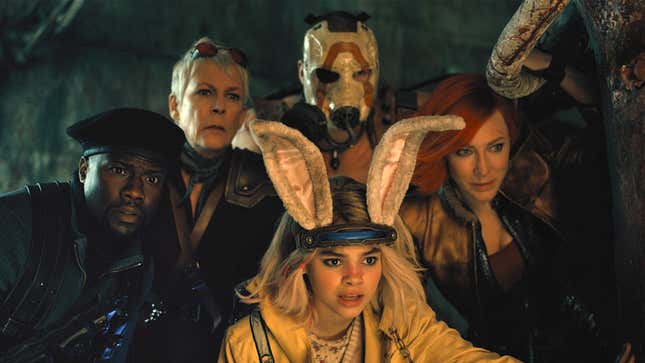
Blissfully, Borderlands isn’t that long of a movie, and the breakneck speed at which the film is paced means we meet Jamie Lee Curtis’ Tannis just before I need a pee break (I chugged a beer). Curtis plays her with a socially awkward twitchiness that I didn’t expect from the actor, and while it’s at least an attempt at imbuing the character with a personality, it is incredibly grating. But again, she tried—Blanchett is phoning it in, Hart has no business playing the straight man, and Greenblatt is doing the best she can with material that’s based on a white character doing a blaccent (which the film, thankfully, avoids). But even she can’t save a line read that requires her to say “badonkadonk” in the year of our lord 2024.
And also, not to be ageist, but why the fuck is everyone so old? Lilith is 22 years old in the original Borderlands game and Tannis is in her thirties—aside from the star power afforded by casting Blanchett and Curtis, the only reason for aging up these characters is so they can play matronly figures to Greenblatt’s Tina.
And therein lies the main problem: centering Tina. The plot revolves around her believing she is the child of Eridia and the key to opening the vault, and the film hinges all of the emotional weight on a character who wears a bunny-ear headband and throws explosive teddy bears at people while spewing one-liners like a sugar-crazed 11-year-old in a Fortnite lobby. She does not inspire any sort of empathy, even with Greenblatt’s valiant efforts and Blanchett’s only real acting taking place in their scenes together. It’s like making a Gears of War movie with a Carmine brother at the center—it’s going to be annoying from the jump.
All of this takes place in a weird CGI world that occasionally looks decent but is more often an illegible green-screen mess of explosions or muddy, dark, murky nonsense. Lilith’s flame-orange hair and comic book costume set against a dusty, bland landscape and broken-down industrial buildings is visually and tonally jarring—it’s like the filmmakers got halfway to making a movie inspired by the cel-shaded world of Borderlands and then dumped it all onto the sets used for the Halo series. Speaking of costumes, I’d love to know what the budget was for push-up bras. Tannis, Mad Moxxi, and Lilith all have their breasts pushed up so high they’re nearly in their throats—it is so desperately 2006, so reminiscent of the Victoria’s Secret Fashion Show, that I couldn’t help but giggle. Boobs, am I right?
By the time the film ends and Jack Black’s Claptrap pops up on screen during the credits to lament the loss of his Easter egg, I am ready to go home and cleanse my palate. I need some proper aughts trashiness, some expensive needle drops, and some questionable costumes. I get home, plop down on the couch, and turn on Gossip Girl. At least this has personality.
The Borderlands movie isn’t so good it’s surprising, and it’s not so bad it’s worth a hate-watch. It is simply sad. It feels like the result of a bunch of suits who sat around a glossy mahogany table (like in that one Key and Peele sketch) and reminisced about the early aughts, a time before the financial crisis, a time when the term “cancel” was reserved only for television shows, a time when Muse was one of the biggest rock bands on the planet.
It is devoid of humanity and personality, despite trying very, very hard to establish that it is quirky. It is the woman with frozen peas on her head in the grocery store aisle—she’s so crazzzzzyy, love her! It should not exist.
.



Movie Reviews
‘Night Nurse’ Review: A Caretaker Explores Her Kink for Elder Abuse in the Year’s Strangest Erotic Thriller

There are any number of erotic thrillers in which rich old men are robbed blind and/or left for dead, but Georgia Bernstein’s admirably bizarre “Night Nurse” might be the first movie of its kind where elder abuse is the source — and possible subject— of its erotic thrills. If there are others, I’m not sure I want to know.
But this woozy debut feature doesn’t rely on its audience being turned on by the relationship between a nubile caretaker and her dementia-addled patient. Their psychosexual bond, meanwhile, hinges on cold-calling vulnerable old people under the guise of a grandchild in financial distress. (“I’m in trouble, nana, send me $10,000 or I’ll be left to rot in jail!” That sort of thing). With its slim wisp of a premise stretched into a Strickland-esque dreamscape that substitutes kink for conflict, the film itself hardly seems convinced by its own wrinkled lust — all desperate kisses and non-touching poses of subservience. More important to Bernstein is what that lust reveals about her characters’ deepest needs, specifically how their need to care and be cared for can be as easily perverted as any other form of desire.

As moody and weightless as the noir-accented score that blows through the movie like a curlicue gust of wind in an old cartoon (credit to musicians Sam Clapp and Steven Jackson), “Night Nurse” lacks the pulse required for its stray feelings to come alive. Still, the film ambiently taps into the latent eroticism of teasing out the distance between how you see yourself and who you really are. Bernstein plays with that distance like a telephone cord wrapped around her fingers, and Eleni — played by the excellent newcomer Cemre Paksoy, powerfully helpless — only frays even more as the receiver is brought near the hook. “Everything I did before today wasn’t me,” the nurse tells co-worker Mona (Eleonore Hendricks) after starting a new job at an Illinois retirement home. “It was somebody else.”
What she did before today remains unexplored (specifically, what she did to get herself fired from her last gig), but I’m guessing she’s probably changed less than she thought. There’s a faraway flicker in her eyes the moment she catches the vibe between Mona and Douglas (a ribald and elusive Bruce McKenzie), a white-haired seventysomething who shows early signs of dementia but still commands an undiminished sexual energy. “I’m not an invalid,” he coos as Mona bathes him in the tub, to which she replies, “yes, you are,” in a supplicant tone that hints at a rich history of power games between them.
Later that same night, Douglas will force Eleni to call a stranger, pretend that she’s their granddaughter, and ask for money — he’ll wrap the phone cord around the nurse’s body as she talks and shove her against the wall as they kiss. She’s into it. So into it that he has to clarify the terms of his whole deal: “If you’re looking for a pogo stick, I’m really not your guy.” But Eleni isn’t looking for anything to bounce on. She just wants to be needed, and maybe to need someone in return. Someone who will see her for who she really is and allow her the fantasy of pretending she isn’t being herself when she cons vulnerable strangers out of their money — when she exploits how enthralled those strangers are by the care they have for their loved ones.
“Night Nurse” doesn’t belabor the psychology, as Bernstein prefers to express her story through heavy-lidded suggestion. Somnambulating from the moment it starts, the film moves through a series of beautifully arranged poses that stretch their latent meaning thin across the surface (Lidia Nikonova’s cinematography lacquers every shot with a seductive dreaminess). We see Douglas smoking in a lawn chair with Mona and Eleni curled around his feet. Eleni riding in the backseat of a convertible as the wind blows through her curls. The full staff of nurses — all of them under Douglas’ sway — stumbling around his condo in a state of zonked out bliss as they roll on the prescription drugs they’ve stolen from the residents.
Once you’ve seen one shot of this movie, you’ve practically seen them all, at least until things escalate during a rushed and unsatisfying third act that forces Eleni into an honest confrontation with herself. People will do just about anything to feel needed — they’ll give whatever degree of care allows them to receive it in return. “Night Nurse” understands that desire, but remains far too numb to treat it.
Grade: C+
The Independent Film Company will relase “Night Nurse” in theaters on Friday, July 10.

Last year’s “Superman” ended with Iggy Pop singing “Because I’m a punk rocker, yes I am” — an ironic coda for a superlatively square hero. But it rings straightforwardly true for Superman’s cousin.
Milly Alcock’s Kara Zor-El, or Supergirl, sports not a spandex suit but a Blondie T-shirt. When we meet her in Craig Gillespie’s “Supergirl,” she’s been on an interstellar bender for days. She’s more Courtney Love than Clark Kent.
Nonchalant and sarcastic, Kara is also a little Han Solo-ish, you might say, given that she moves capriciously through the galaxy in her junky spaceship while getting in fights in extraterrestrial bars. She’s a welcome, jagged riff on more buttoned-up superheroes, and Alcock is terrific in the role. If only “Supergirl” was as good as she is.
While the latest DC release, and second under James Gunn’s stewardship, has its moments, “Supergirl” struggles to match Kara’s punk-rock energy with an equally spirited supporting cast and story.
Skepticism seems to have gathered for “Supergirl” ahead of its release. Many fans have argued it wasn’t the right next step for DC Universe. But I’m not so sure. Alcock’s breezy cameo in “Superman” was one of that movie’s highlights. Handing the follow-up to her, and her faithful floating dog Krypto, strikes me as an extremely natural next step. When in doubt, follow the dog.
And much of “Supergirl” is winning. It resides almost entirely in space, touching down only momentarily on Earth. In its consistently creative production design, clever needle drops and underdog story arc, “Supergirl” resides a little closer to Gunn’s “Guardians of the Galaxy” movies than other DC entries. Its outer space is filled with cosmic detritus, mean characters and cute critters. Seth Rogen as the voice of a tiny alien co-piloting a space bus is an inspired concoction, as is a shabbier sci-fi realm with rest stops along the intergalactic highway.
Movie Reviews
‘The Guest’ Review: Trine Dyrholm Gives a Scorcher of a Performance in a Gutsy Danish Party-Gone-Wrong Drama

A family and friends gather for a naming-day ceremony at a Danish seaside hotel, but an unexpected appearance by one uninvited attendee (Trine Dyrholm) ruptures the veil of bland, happy-clappy familial unity in director Mads Mengel’s gutsy, well-wrought debut feature, The Guest.
The most audacious move here may be Mengel and co-screenwriter Christian Bengtson’s choice to write something that will inevitably invite comparisons with Festen (The Celebration), arguably the most notorious Danish-language film of the last 30 years, which similarly revolved around a bougie gathering disrupted by angry revelations. But there’s a savvy 2026 vibe about the way the film refuses to create florid melodrama out of quotidian crisis, and instead observes with generosity as the characters grope awkwardly toward emotional détente and mutual forgiveness.
The Guest
The Bottom Line When wetting the baby’s head goes too far.
Venue: Karlovy Vary Film Festival
Cast: Simon Bennebjerg, Trine Dyrholm, Josephine Park, Peter Gantzler, Petrine Agger, Mette Klakstein Wiberg, Kristine Kujath Thorp, Buster Lund Luscher
Director: Mads Mengel
Screenwriter: Christian Bengtson, Mads Mengel
1 hour 40 minutes
Festen-alumnus Dyrholm, having a bit of a career moment with outstanding performances both here and in the recent The Girl With the Needle among others, leads a uniformly excellent cast in a work that deserves celebration on the festival circuit and beyond.
Dyrholm’s Vibeke is technically the first person we meet, although she’s seen only in shadow at first as she smokes and drives while her unattached seatbelt, caught outside by a closed door, clatters on the road. This is the kind of unsafe driving her son Karl (Simon Bennebjerg) so deplores, a point of contention later on in the story when he will steal her car keys in interest of her own safety and that of others.
But well before we get to that flashpoint, the film introduces Karl, effectively the film’s protagonist, as he arrives at the swanky resort with his wife Emilie (Mette Klakstein Wiberg) and their infant son Elliot (Buster Lund Luscher). The young family, who’ve chosen this new, secular tradition instead of a christening to welcome their child to the world, are there a day before the ceremony to meet up with core family members.
As this advance party settles down for dinner, a table that includes Karl’s sister Rikke (Josephine Park) and Emilie’s parents Frank (Peter Gantzler) and Kirsten (Petrine Agger), there’s a surprise: Vibeke is coming, courtesy of Rikke’s invitation. Karl is quietly furious and seems determined to turn her away, even when she shows up minutes later. Poor Frank and Kirsten look on confused, determinedly polite in their insistence that all family members should be welcome.
Bengtson and Mengel’s economical script carefully dripfeeds backstory as the film unfolds to explain that Karl hasn’t spoken to his mother in years, that Rikke has taken over all the daily mom management and that she’s very worn out by it. Even so, she insists Vibeke is regularly taking her medication and isn’t a problem these days, although to Karl every weird anecdote and moment of emotional intensity is an augur of impending chaos. Rikke counters that their mother is just “big, that’s her personality not her condition.”
Interestingly, that specific condition is never named throughout, although armchair diagnosticians might spot many of the signs of bipolar disorder. But the film’s emotional focus on the person and her actions rather than the label is also very contemporary, reflecting a more holistic, inclusive mindset and approach to dealing with mental health issues.
Which is all fine and dandy, until Vibeke duly does skip a dosage and starts getting manic. One of the first signs of chemical imbalance arrives during the ceremony on the beach, when Vibeke carries little Elliot much further away from the shore than anyone wants, creating a panic. From there it just gets worse as Vibeke picks up on the censorious feeling emerging from the other party guests, who had found her so charming the night before when she’d led everyone to the casino to play roulette and diverted a bunch of partying teenagers from the room next to Karl and Emilie so they could get some sleep. When the toasts at the formal dinner begin, Vibeke’s mood darkens much further, and if we’ve all learned one thing from Festen, it’s be very afraid when a Dane gets up to make a toast.
Cinematographer David Bauer’s nimble-footed lensing and use of natural light does indeed hark back considerably to the look of those Dogme 95 movies back in the day, as does the naturalistic editing style deployed by Louis Emil Ramm Seeberg. But there are plenty of sins against the rules of cinematic chastity that marked that movement, such as the ample space made for Lasse Aagaard’s affecting, low-key score that amps up the anxiety as Vibeke starts to spiral.
That said, Mengel keeps things simple in sonic terms when it really counts, letting the musicality of Dyrholm’s deep, sonorous voice ring out on its own in the big monologue scenes. She is, as ever, utterly mesmerizing but the performance is made even more powerful by the muted, expressive reactions of the rest of the cast as they look on, frozen like deer in the headlights of the car crash of pseudo-christening. Moments of levity puncture the gloom, but the final feeling is one of numbed sorrow and pity for all these kind, fallible people, just trying to do their best.
-
Vermont2 seconds ago
OUTDOOR ACCESS FOR DISABLED IN VERMONT
-
 Virginia5 minutes ago
4 indicted in Virginia double homicide; second victim ID’d as grandmother of 6
-

 Washington12 minutes ago
Washington Commanders are retiring Hall of Famer John Riggins’ No. 44
-

 Wisconsin15 minutes ago
Wisconsin State Patrol rides with truck and bus drivers to spot violations in five areas
-

 West Virginia20 minutes ago
West Virginia town fires entire police force after chief resigns, sergeant alleges evidence room break-in
-

 Wyoming27 minutes ago
WHP: July 5 single-vehicle rollover north of Riverton resulted in one death, one injury
-

 Crypto30 minutes ago
British Airline Jet2 Shares Jump 9% After $536M Fuel Hedge Gain Offsets Middle East Travel Fears
-

 Finance35 minutes ago
Treasury Pick Queried on Iran War Fallout to Face Senate Finance

