
Connect with us

Movie Reviews

The Borderlands Movie: The Kotaku Review

Published

on

The Borderlands Movie: The Kotaku Review

An hour after leaving a screening of the new Borderlands movie, directed by Eli Roth (Hostel) and starring Cate Blanchett, Kevin Hart, Jamie Lee Curtis, and Ariana Greenblatt, I’m staring at a blinking cursor in a blank Google Doc, urging inspiration to strike.

Surely a live-action movie based on the wildly successful edgelord video game franchise from 2K and Gearbox would inspire a couple hundred words, right? Surely the star-studded cast, which includes several Oscar winners (and Jack Black), would prompt a spark of creativity. Surely the vibrant visuals, cacophonous explosions, and poop and pee jokes would destroy the writer’s block dam, sending forth a surge of witty words and succinct sentences. But I’m at a loss.

Borderlands is not just bad, it’s depressing.

On the border of a breakdown

I saw Borderlands at an early screening at Alamo Drafthouse, during which cosplay was encouraged. No one wore costumes, and the theater was solemnly silent, as if we were about to watch archival video of the deadliest WWII battle or found footage from 9/11. R-rated trailers aired before it, prompting me to question if this movie, directed by Roth (known for his gory, gross violence), was rated R (it’s not).

Advertisement

Before I have a chance to double-check the rating, Cate Blanchett’s voice echoes through the theater. “Long ago, our galaxy was ruled by an alien race,” she intones, sounding bizarrely flat for an incredibly talented actor who endeavored to deliver a fun, frenetic performance in another superficial flick: 2017’s Thor: Ragnarok. I’m immediately assaulted by aggressive, slap-dash cuts and shimmery CGI images of guns, neon signs, and Psychos, as Blanchett (who plays Lilith, a character who inspired early-twenties me so much I got one of her quotes tattooed) gives us the plot overview with as much energy as a ‘50s housewife who regularly mixes mood stabilizers and martinis.

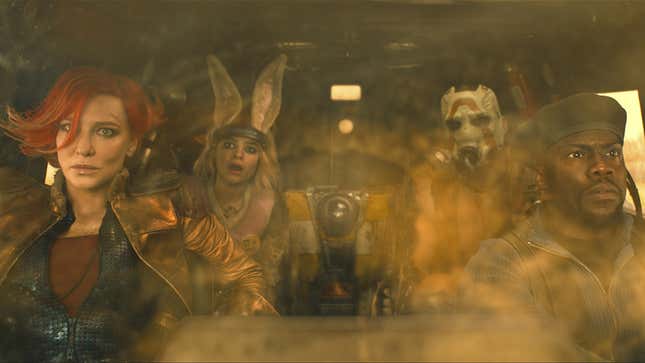
Lilith, Tiny Tina, Claptrap, Krieg, and Roland sit in a car.

Image: Lionsgate / 2K

Lilith tells us that the Eridians laid the foundation of this galaxy, then disappeared, leaving behind a secret vault hidden on the planet Pandora, inside of which are powerful relics of the long-lost civilization. “That sounds like some wacko B.S., huh?” Blanchett asks. I stifle a groan with a huge bite of my burger. Rather than giving moviegoers the free-wheeling wanderlust that the Borderlands games offer, the film is incredibly linear and straightforward: Lilith, a bounty hunter, is hired by the head of arms manufacturer Atlas Industries to track down his daughter Tiny Tina on the planet Pandora.

We’re introduced to almost all of the main cast rather quickly: Hart as Roland, Greenblatt as Tiny Tina, Florian Munteanu as a Psycho named Kreig. Roland breaks Tiny Tina out of some kind of facility by way of a fairly bland action sequence, during which he punches a guard and calls him a “fake Stormtrooper-ass bitch.” I guess that means Star Wars exists in the Borderlands universe? It doesn’t improve after this.

Advertisement

If you told me Borderlands used AI for its dialogue, I’d believe you without question. Nearly every line that’s uttered with the kind of fake peppiness I’d reserve for my elementary school cheer competitions is either a limp-dicked “edgy” joke that wouldn’t warrant a single Reddit upvote or a cliche phrase like “I’m too old for this shit” and “This has been a really long day.” I could count on one hand the lines that were thoroughly genuine—or at least not dripping with so much snark they were almost sticky. There is no humanity here, just humorless humans.

When a needle-drop of Muse’s “Supermassive Black Hole” bleeds into a scene in which it’s playing over the speakers in a Pandoran bar, I nearly slam my head onto the table. What are we doing here?

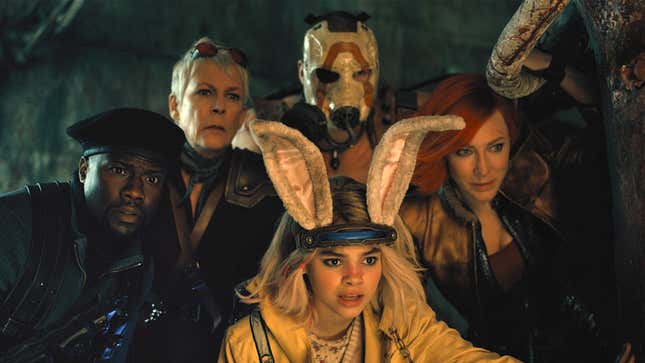
Roland, Tannis, Krieg, Tina, and Lilith look off-camera.

Image: Lionsgate / 2K

We need to talk about Tina

Blissfully, Borderlands isn’t that long of a movie, and the breakneck speed at which the film is paced means we meet Jamie Lee Curtis’ Tannis just before I need a pee break (I chugged a beer). Curtis plays her with a socially awkward twitchiness that I didn’t expect from the actor, and while it’s at least an attempt at imbuing the character with a personality, it is incredibly grating. But again, she tried—Blanchett is phoning it in, Hart has no business playing the straight man, and Greenblatt is doing the best she can with material that’s based on a white character doing a blaccent (which the film, thankfully, avoids). But even she can’t save a line read that requires her to say “badonkadonk” in the year of our lord 2024.

Advertisement

And also, not to be ageist, but why the fuck is everyone so old? Lilith is 22 years old in the original Borderlands game and Tannis is in her thirties—aside from the star power afforded by casting Blanchett and Curtis, the only reason for aging up these characters is so they can play matronly figures to Greenblatt’s Tina.

And therein lies the main problem: centering Tina. The plot revolves around her believing she is the child of Eridia and the key to opening the vault, and the film hinges all of the emotional weight on a character who wears a bunny-ear headband and throws explosive teddy bears at people while spewing one-liners like a sugar-crazed 11-year-old in a Fortnite lobby. She does not inspire any sort of empathy, even with Greenblatt’s valiant efforts and Blanchett’s only real acting taking place in their scenes together. It’s like making a Gears of War movie with a Carmine brother at the center—it’s going to be annoying from the jump.

All of this takes place in a weird CGI world that occasionally looks decent but is more often an illegible green-screen mess of explosions or muddy, dark, murky nonsense. Lilith’s flame-orange hair and comic book costume set against a dusty, bland landscape and broken-down industrial buildings is visually and tonally jarring—it’s like the filmmakers got halfway to making a movie inspired by the cel-shaded world of Borderlands and then dumped it all onto the sets used for the Halo series. Speaking of costumes, I’d love to know what the budget was for push-up bras. Tannis, Mad Moxxi, and Lilith all have their breasts pushed up so high they’re nearly in their throats—it is so desperately 2006, so reminiscent of the Victoria’s Secret Fashion Show, that I couldn’t help but giggle. Boobs, am I right?

By the time the film ends and Jack Black’s Claptrap pops up on screen during the credits to lament the loss of his Easter egg, I am ready to go home and cleanse my palate. I need some proper aughts trashiness, some expensive needle drops, and some questionable costumes. I get home, plop down on the couch, and turn on Gossip Girl. At least this has personality.


The Borderlands movie isn’t so good it’s surprising, and it’s not so bad it’s worth a hate-watch. It is simply sad. It feels like the result of a bunch of suits who sat around a glossy mahogany table (like in that one Key and Peele sketch) and reminisced about the early aughts, a time before the financial crisis, a time when the term “cancel” was reserved only for television shows, a time when Muse was one of the biggest rock bands on the planet.

Advertisement

It is devoid of humanity and personality, despite trying very, very hard to establish that it is quirky. It is the woman with frozen peas on her head in the grocery store aisle—she’s so crazzzzzyy, love her! It should not exist.

.

Movie Reviews

The Breadwinner (Christian Movie Review) – The Collision

Published

on

The Breadwinner (Christian Movie Review) – The Collision

About the Film 

Advertisement

On the Surface

For Consideration

Advertisement

Advertisement

Beneath The Surface

Engage The Film

Family Dynamics

Advertisement

  • Daniel holds a PhD in “Christianity and the Arts” from The Southern Baptist Theological Seminary. He is the author/co-author of multiple books and he speaks in churches and schools across the country on the topics of Christian worldview, apologetics, creative writing, and the Arts.

    Advertisement

    View all posts


Advertisement
Continue Reading

Movie Reviews

‘Blast’ movie review: An unlikely family packs a punch in this largely gripping but patchy film

Published

on

‘Blast’ movie review: An unlikely family packs a punch in this largely gripping but patchy film

A Karate master father, a homemaker mother, and a pharmacist uncle. The life of IT professional Nila (a fantastic Preity Mukundhan) seems quite simple and benevolent — she goes to her office, plays video games on her mobile, and spends time in her uncle’s medical shop, grudgingly looking at an old television set he refuses to let go. Nila’s life, to an unassuming viewer, may not seem anything too extraordinary. Still, one key piece of information reveals that perhaps this must be the kind of ‘family life’ backdrop that most assuredly camouflages a superhero origin story. Nila isn’t just any other ordinary human, and neither is that Karate master, homemaker, or pharmacist. Blast, directed by Subash K Raj, is a martial arts actioner pegged around one very potent Drishyam-esque idea — what if a family of martial arts pros is forced to step out of their normal lives to fight against injustice when nefarious men find their door? And director Subash comes off in flying colours by conceptualising a terrific set-up that makes use of this idea.

The beating heart of the story is Preity Mukundhan’s Nila, who avoids becoming a merely gender-swapped routine action hero. There’s real moral and emotional backing to why Preity is the way she is, and Subash allows her the time to make her case. Nila’s quest started when she was a child. As she fumed with rage due to a ragging incident, her father, Rajaram (Arjun), told her, “fight back if you are in the right” and “fight against injustice even if the victims are strangers.”

Preity Mukundhan in a still from ‘Blast’

Preity Mukundhan in a still from ‘Blast’
| Photo Credit:
Special Arrangement

And the introductory scene to the now-grown-up Nila’s bravado is inherently gripping. A goon is sent flying into a rowdy’s den, and a perplexed henchman walks out to find the “man who hit” his colleague, urging Nila to step aside, because it can’t be a woman, isn’t it? Nila enters, and so does mayhem. In fact, one of the smartest choices Subash makes is in how he retains this inherent, normalised sexism in how the men see Nila throughout. In a later instance, a villain looks past Rajaram and Nila because they seem like an ordinary father and daughter. Where Subash takes a misstep is in how he treats a sexual harassment arc featuring Nila and her abusive manager; it makes way for a good masala cinema moment, but Subash laces it with humour, and it neither reveals anything new nor does it seem to care to extend the idea that the world Nila lives in is already calibrated to look down on women and feast on their vulnerabilities. Also, you begin to get slightly impatient as the film keeps revelling in the idea that a woman is bringing all the action — when will the conflict arise?

Blast (Tamil)

Director: Subash K Raj

Cast: Preity Mukundhan, Arjun, Abhirami, Vivek Prasanna

Runtime: 144 minutes

Advertisement

Storyline: A fiercesome woman, along with her martial artist parents, vows to take down a corrupt syndicate

Nila constantly gets into trouble as she refuses to bow down in the face of injustice, to the pride of her father, but to the dismay of her mother, Neelaveni (Abhirami, too, can kick some bottoms). And it doesn’t take much to guess where the setting is headed. We simultaneously begin to follow the making of a Black Opal mining scam that an evil businessman, Varun Dhayalan (John Kokken), is spearheading. The project, which puts the hillside village of Keelakadu in danger, would bring in ₹7000 crores worth of minerals, of which a minister (PL Thenappan) takes ₹1000 crores. This whole arc operates like a rather convoluted spiral of villainy — helping Varun move the money needed to bribe the minister is a dreaded assassin named Abraham (Arjun Chidambaram), and helping Abraham is a gangster named Kirubhakaran (Pawan), and under him works a henchman whose friend is a low-life chain snatcher, Toby (Vinod Sagar), and Toby gets caught in a station where Inspector Arunagiri (Dileepan) is investigating Abraham’s identity, and under Arunagiri works a corrupt cop who wants Kirubha’s help to save his job. I guess you could already see where Blast might have derailed.

A lion’s share of screentime is accorded to explain each step in this often yawn-inducing villain saga, all while you are patiently waiting to see the tip of the whirlpool land on Nila’s doorstep and suck her martial arts family in. When it does, it is as explosive as you expect, at least until the intermission mark. While these unidimensional villains test your patience — only Arjun Chidambaram is written and presented with flair — you are left waiting for the next high moment, especially since Subash seems to have a knack for staging such mass-y scenes. But again, how much can Preity and Arjun do when the writing begins to dip into cliches and conveniences? After a point, Blast turns out to be quite tedious in the final act, making you wonder how a leaner, crisper, and more anchored screenplay could have been.

Arjun and Abhirami in a still from ‘Blast’

Arjun and Abhirami in a still from ‘Blast’
| Photo Credit:
Special Arrangement

All that aside, however, what truly fascinates one is how, despite Blast being helmed by a male director and starring an action star like Arjun, it moves around its female protagonist, Nila, and every major decision is made keeping the two central women as opposing but counterbalancing poles — Neelaveni’s moral anchor prioritising the family’s peaceful life above all, and Nila’s moral anchor pushing them to be knights of justice. In fact, even in one of the most pivotal moments of the film, the choice to decide a villain’s fate is placed rightfully on Nila’s shoulders. It is great to see Arjun take a step back to let Abhirami and Preity shine, while Vivek Prasanna, as Nila’s pharmacist uncle, gets a Jailer-esque moment that is sure to become a highlight in his career. Helping all of them are the able technicians, be it the sharp, slick cinematography, innovative and adrenaline-pumping action choreography, and Ravi Basrur’s assured music choices.

That said, Blast is a Preity Mukundhan show all along, and the Star-actor knows how to pack a punch, alright! In a different film, where more ingenious ideas are spring-loaded for mass elevations, Blast would have truly become her career-defining big bang.

Advertisement

Blast is currently running in theatres

Published – May 29, 2026 02:50 pm IST

Continue Reading

Movie Reviews

‘The Blow’ Review: A Gripping, Feverishly Performed French Drama Explores Incest With Candor and Emotion

Published

on

‘The Blow’ Review: A Gripping, Feverishly Performed French Drama Explores Incest With Candor and Emotion

For his bracing first feature, The Blow (La Frappe), writer-director Julien Gaspar-Oliveri chose a subject so bleak, many filmmakers wouldn’t touch it with a ten-foot pole. And yet this raw and grippingly honest incest drama manages to find a bit of light in the darkness, showing how it’s possible to live with the traumas of sexual abuse. Feverishly performed by newcomer Diego Murgia, who stars alongside César award winner Bastien Bouillon, Gaspar-Oliveri’s moving debut reveals that he’s not only a talented director to watch, but one who’s unafraid to tackle tough scenarios.

The Blow focuses on a disarmingly troubled young man, Enzo (Murgia), who tries so hard to find affection in the eyes of his dad, Anthony (Bouillon), he’s willing to ignore the worst thing a father could ever do to his own son. Enzo spends much of the film in a crushing state of denial, hoping against hope that love will somehow emerge from this mess. He’s so vulnerable that you can’t help feeling his pain — even when he winds up inflicting that pain on others.

The Blow

The Bottom Line

A powerful debut tackles a tough subject.

Advertisement

Venue: Cannes Film Festival (Critics’ Week)
Cast: Diego Murgia, Bastien Bouillon, Romane Fringeli, Héloïse Volle
Director: Julien Gaspar-Oliveri
Screenwriters: Julien Gaspar-Oliveri, Claudia Bottino

1 hour 46 minutes

Per the press notes, Gaspar-Oliveri (who co-created the successful high school series, Those Who Blush) partially based the story (co-written with Claudia Bottino) on his own life, which seems evident given the emotional authenticity of his characters. Murgia’s portrayal of Enzo is the movie’s breakthrough performance, although Romane Fringeli, who plays the 19-year-old’s abrasive older sister, Carla, is also a standout. Bouillon, meanwhile, continues a string of strong turns (including in The Birthday Party, which screened in Cannes’ main competition this year) that began back in 2022 with Dominik Moll’s thriller The Night of the 12th.

The opening scene, lensed by Martin Rit in grainy close-ups, shows Enzo and Carla carelessly sleeping in bed together, their bodies subtly rising and falling with each breath. It seems like a blissful moment between the two siblings, who share a tight if volatile bond. But as the film progresses and we learn more about their childhood, that scene takes on a very different meaning: one in which proximity can breed both affection and contempt.

Advertisement

With no parents in the picture and Carla moving out to a college dorm, Enzo’s whole life seems to be in front of him. It helps that he has a burgeoning and very loving relationship with new girlfriend Laura (Héloïse Volle), whose parents run a go-kart track that seems to be the main source of entertainment in their working-class suburb of Marseille.

But the state of independence Enzo has achieved at such a young age is broken when his dad returns home after a five-year stint in prison. A scene in which the two discuss Anthony’s future with a parole officer underlines to what extent Enzo has become the man of the household, hiring his own father to help sell kitchen appliances at local flea markets.

Bouillon creates a charming if menacing presence from the get-go, portraying Anthony as a father who’s been out of the loop for too long with regards to both family and civilian life, yet still wants to be in charge. In one sequence foreshadowing what’s to come, Enzo hides in a closet while his dad brings a woman home from the bar, witnessing some awkward and then off-putting sexual behavior. A latter scene in which the boy climbs in bed with Anthony reveals much worse, although it takes Gaspar-Oliveri a while to explain what exactly went down in the past.

What’s most moving about The Blow — whose French title can mean both a physical hit and a young hoodlum — is the way it charts Enzo’s gradual awakening from a kid who’s still too attached to his father, mostly for terrible reasons, to an adult who finally steps back and sees the truth, at which point the trauma is so overwhelming that it takes over. This happens during several explosive scenes in which Enzo lashes out at those who truly love him (his girlfriend; his sister, who wants nothing to do with their dad), searching in vain for someone to quell the suffering.

Murgia is a revelation here, playing a loose cannon who’s also deeply wounded, like a battered dog occasionally showing his teeth and sometimes biting those who feed him. The early moments in the drama, when Enzo is trying his best to please Anthony after he gets out of jail, offering to cook dinner or lending him a few bucks, will just about break your heart. Because deep down, Enzo knows that by getting closer to his dad, he’s also getting further away from his own recovery. It’s the constant push and pull between trauma and salvation that makes The Blow such a powerful experience.

Advertisement
Continue Reading
Advertisement

Trending
