Culture
Lost Grounds: Bradford Park Avenue – the forgotten England international venue


Once an integral part of the towns and cities they called home, dozens of the nation’s Football League grounds have disappeared over the past 30 or so years. All took with them a wealth of memories for generations of supporters.
But what happened next? The Athletic has travelled the country to find out, taking in an array of housing estates, retail parks and even the odd hospital along the way.
Kicking off our four-part series, running each Tuesday in August, is perhaps the most poignant of the lot, Bradford Park Avenue. Home to a League club for 62 years and county cricket for more than a century, Park Avenue sits forgotten and forlorn, with one of its few visitors in the past decade being an archaeological dig…
Looking up at a row of turnstiles that once led to a football ground where England played an international match, it is as if time has stood still.
Painted high on the wall is ‘5/-’, indicating an admission price of five shillings in old money. Another couple of bricked-up entrances can be found around the corner, along with a giant rusting iron gate topped with spikes to deter anyone trying to get in for free.
A gents’ toilet block can also clearly be seen towards the back of a banking where supporters last stood more than 50 years ago, while a stroll inside reveals two massively overgrown terraces and a crumbling perimeter wall staring out over the bumpy remains of a pitch once graced by greats such as Stanley Matthews and Len Shackleton.
(Richard Sutcliffe/The Athletic)
Also buried amid the shrubbery that has been allowed to run wild are two floodlight pylon bases, plus a mountain of sporting memories. Welcome to Park Avenue, Bradford, the forgotten home of the former Football League club who went by the same name that is now the ghostly preserve of Mother Nature.
In an age when the demolition crews seem to move in almost the moment the gates close for the final time at great sporting cathedrals such as Highbury, Roker Park and White Hart Lane, this one-time sporting mecca really is a throwback.

Not only does the cricket ground where Yorkshire played for more than a century until 1996 remain, albeit in a semi-derelict state, but enough survives on the adjacent football side — the two sports shared a main stand, designed by leading architect Archibald Leitch — to leave supporters of a certain vintage misty-eyed.

Cricket at Bradford Park Avenue in the summer of 1949 (S&G/Getty Images)
Park Avenue was always regarded locally as superior to Valley Parade, the home of Bradford City — once of the Premier League and now of League Two. For a start, it had cover for 14,000 and a capacity of 37,000. The railway station and tram spur that could be found where the ornate Grand Mosque now stands just across Horton Park Avenue meant thousands of fans could also be ferried to and from the area in hardly any time at all.
Then there was the corner pavilion, nicknamed the ‘Dolls’ House’ by visitors. This charming two-storey building served a similar purpose to Fulham’s Craven Cottage, housing the football club’s dressing rooms and committee room with officials able to watch matches from an upstairs balcony.
This, though, could not save it as Bradford’s fortunes declined markedly as the Swinging Sixties morphed into the next decade.
Voted out of the League in 1970, the club stumbled on in the Northern Premier League for another four years before folding amid debts of £57,652 ($73,580 in today’s exchange rates). By then, the football ground had been sold to a property developer, with Avenue playing their final season across the city at Valley Parade.

Bradford Park Avenue, as seen in 1955 (George W. Hales/Getty Images)
A restrictive covenant that dictated the land could only be used for sport and recreation pursuits meant the football ground ended up being left to wither and die, even after the local council stepped in to purchase the site with grandiose plans to build a sports complex.
By 1980, Leitch’s ornate main stand had become so unsafe it had to be demolished. The news sparked a wave of nostalgia across the city, as hundreds of fans streamed to the old ground for one last look.
A pensioner was even helped onto the weed-infested Canterbury Avenue End and left, leaning unsteadily on a rusting crash barrier, to stare silently over what must have felt like an unkempt grave.
Tim Clapham, a supporter since 1963 and now the club historian, was among those making one last pilgrimage before the wrecking ball claimed not only the 4,000-seat main stand and its distinctive three gables, but also the Dolls House and the Horton Park End roof.

“Only the half-time scoreboard was left standing, with even the old social club sold to a local pig farmer,” Clapham says. “Such a sad time. So many turned up, hoping to take a keepsake, something to remember the ground by.
“Some wanted the ‘BFC’ letters etched on the middle gable of the stand, while others fancied the two coats of arms at either end. But, when they came down, these things were much bigger than they had looked. You’d have needed a truck to carry them away!”
As Bradford mourned for a second time the loss of a venue that had hosted not only an England versus Ireland international in 1909 but also what remains the fastest-ever Football League goal (four seconds, Jim Fryatt against Tranmere Rovers in 1964), cricket at least survived.
GO DEEPER
‘The noise will be deafening’ – An interview with the American who designed Everton’s new home
That was until 1996, when Yorkshire County Cricket Club opted to focus primarily on Headingley as their home with a small number of games every season also played in Scarborough. Others to lose their status as out-grounds were Middlesbrough, Harrogate and Hull, where part of the MKM Stadium now sits on the old Circle cricket ground as the dual home of Hull City and rugby league club Hull FC.
Park Avenue had become a shell of its former self long before that final County Championship match against Leicestershire in 1996.

(Richard Sutcliffe/The Athletic)
Just what anyone able to remember Park Avenue in its heyday would make of the old place in 2024 is anyone’s guess. The cricket square has, in recent years, been brought back to first-class standard, allowing Yorkshire’s second XI to return and play the odd match.
But the surroundings are in a sorry state. Where the grand-looking pavilion once stood until the late 1980s is now just a wasteland and where Fred Trueman, Ray Illingworth et al would plot the downfall of visiting batsmen now sits 10-foot bushes. Time is a formidable opponent when sports arenas are left to rot.
Just in front sit a few dilapidated rows of seats, a good number vandalised and all doing battle with the weeds gradually creeping through the concrete steps. It’s a similar story elsewhere, with fenced-off sections of crumbling terraces interspersed with banks of vegetation.
The only bright spot is a mural depicting England spin bowler — and local hero — Adil Rashid that was painted to mark the launch of the Hundred competition in 2021. Even that, though, is fading to add to the rundown feel of a ground once regarded as the jewel in Yorkshire’s cricketing crown.

(Richard Sutcliffe/The Athletic)
What remains of the old football ground is no less depressing, even allowing for how its abandoned state allowed an archaeological dig in 2015 that unearthed all manner of fascinating artefacts.
The haul, captured for posterity by the Breaking Ground art project, included boot studs, coins, marbles, goal hooks and even a nappy pin. The latter, it transpired, related to the elastic on goalkeeper Chick Farr’s shorts snapping during one match, forcing the trainer to perform an emergency repair. Farr never lived the episode down, regularly finding himself showered by pins when standing between the posts.
GO DEEPER
‘I visualised the stadium enclosed by rock’: How they carved Braga’s home into granite
Hopes of Bradford ever returning to their spiritual home ended when a cricket school (now a gym) was built on half of the old football pitch in 1988. A new Park Avenue club was formed in the same year and their home for almost three decades has been Horsfall Stadium, an athletics venue that sits a couple of miles away from this old ground.

(Richard Sutcliffe/The Athletic)
On the cricket side, however, grand plans were unveiled just a few years ago to bring Yorkshire back to their old stomping ground via an ambitious £5.5million revamp.
Stage one saw a state-of-the-art changing facility, outdoor nets and a score-hut open in 2017, with England and Yorkshire team-mates Joe Root, Jonny Bairstow and Rashid among those cutting the ribbon. The nets, built between what was the halfway line and roughly the penalty area of what remained of Avenue’s old pitch, were converted to an indoor facility last year.
The rest of the original scheme — a community pavilion with changing rooms that were to be located to the side of where the original stood, a restaurant catering for 250 diners, 1,000 seats for spectators and security fencing — never materialised. As a result, the mooted return of county cricket to the city of Bradford never became reality. Instead, York joined Leeds and Scarborough on the roster of Yorkshire’s home grounds.
That may be the final nail in the coffin for any hopes of bringing professional sport back to this corner of Bradford. Now, all that’s left behind is the ghostly presence of the past to go with the abandoned turnstiles and terraces that, for the past five decades, have been home to just the worms and the weeds.
GO DEEPER
We ranked every Premier League stadium so you could shout at us
(Top photo: Richard Sutcliffe, Tim Clapham)



Welcome to Literary Quotable Quotes, a quiz that tests your recognition of classic lines. This week’s installment highlights observations from future or alternate worlds depicted in popular science fiction. In the five multiple-choice questions below, tap or click on the answer you think is correct. After the last question, you’ll find links to the books if you’re intrigued and inspired to read more.

Welcome to Lit Trivia, the Book Review’s regular quiz about books, authors and literary culture. This week’s challenge tests your memory of books that made huge impacts on society after they were published — some of them even spurring changes to American laws. In the five multiple-choice questions below, tap or click on the answer you think is correct. After the last question, you’ll find links to the books if you’d like to do further reading.

Where do you turn when you need advice? A chatbot? A life coach? A wise and trusted friend?
How about a poet? Poets may not be famous for making the best life choices, but because they subject the mess of human existence to the discipline of language, they can be as helpful as any therapist or mentor.
Good poets know the rules and when to break them, which is something they can teach the rest of us.
To wit:
Giving advice is a peculiar literary undertaking. It flourishes in certain popular genres — graduation speeches, newspaper columns, country and western songs and poems like this one — but what, in these contexts, is it really for?
I’m thinking of situations when you don’t urgently need help but nonetheless enjoy reading answers to questions you may not have thought to ask. What interests you isn’t the content of the advice — you could get all the life hacks you want from A.I. — so much as the voice of the person dispensing it.
Wendy Cope is an English poet, born in 1945, who has been a fixture of her country’s literary scene since the 1980s. More recently, her short, buoyant poem “The Orange” has been widely memed online, bringing her to the attention of new readers beyond Britain.
Cope favors rhyme, meter, brisk jokes and tart aperçus. She addresses romance, friendship and the petty absurdities of modern life with disarming good humor. The last line of “The Orange” is “I love you. I’m glad I exist.” Somehow she makes it the opposite of cringe.
This isn’t the kind of poetry you would describe as “confessional.” And yet …
Question 1/7
Stop, if the car is going “clunk”
Or if the sun has made you blind.
Don’t answer e–mails when you’re drunk.
Tap a word above to fill in the highlighted blank.Want to learn this poem by heart? We’ll help.
Fill in the missing words below. You can always refer to the reading by A.O. Scott and full
text above.Let’s start with the first stanza.
-
 Entertainment4 minutes ago
Glen Walker is returning to broadcast news, months after being cut from KTLA
-
 Lifestyle11 minutes ago
A new L.A. Times feature: Now you can save our expert recs for your next adventure
-
 Politics14 minutes ago
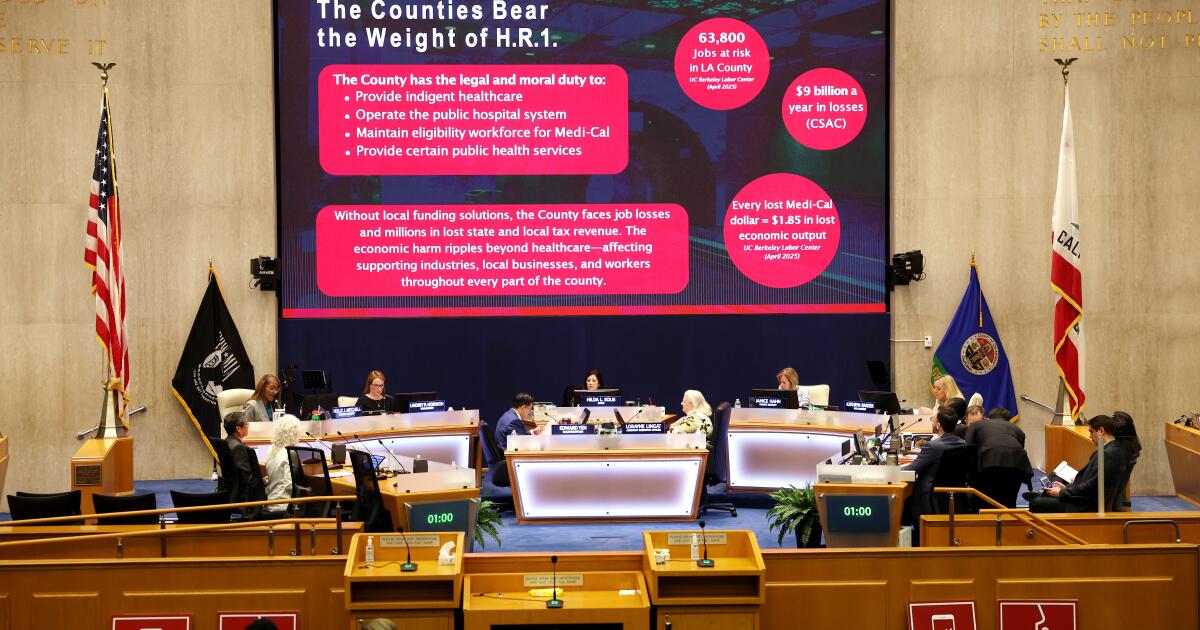
Supporters cheer new L.A. County healthcare sales tax: ‘It’s a lifesaver’
-
 Science19 minutes ago
Why new dads shouldn’t panic about low testosterone
-
 Sports26 minutes ago
World Cup referee, denied entry to U.S. because of suspected ties to terrorists, hailed in return to Somalia
-

 World34 minutes ago
US military chief Hegseth warns Cuba against acquiring military arms
-
 News59 minutes ago
July 1 brings big student loan changes. Here’s what you need to know
-

 Los Angeles, Ca2 hours ago
Los Angeles High School locked down as police search for armed juvenile

