Politics
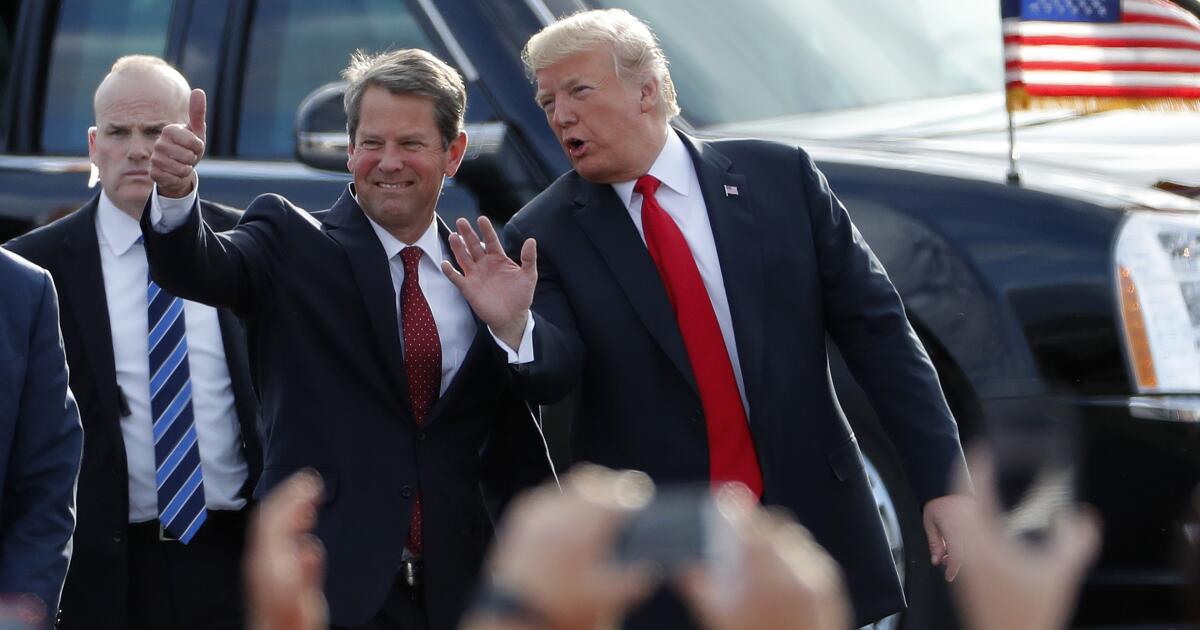
Granderson: Top Republicans know better than to back Trump

When it comes to disaster movies, my biggest pet peeve is the sex scene. As soon as a Diane Warren song starts playing in the background, the male and female leads will lock eyes and suddenly decide they have time to cuddle. “Saving the planet” loses all sense of urgency.
Opinion Columnist
LZ Granderson
LZ Granderson writes about culture, politics, sports and navigating life in America.
That’s what it feels like watching Republicans today refuse to endorse Kamala Harris because of the optics. They can see as well as anyone else that former President Trump is a threat to democracy. He says it openly. But apparently when members of the GOP look at their chances of holding on to power, the romantic music in their heads just sweeps them away.
Take Georgia Gov. Brian Kemp. If anyone knows how far Trump will go to grab power, it’s him. Trump has been harassing him ever since losing the state to President Biden by 11,779 votes back in 2020. We heard Trump’s phone call with Republican Secretary of State Brad Raffensperger. We saw the indictment (though whether the Fulton County district attorney can continue to prosecute it remains in limbo). Trump’s allies tried to use fake electors to pretend he won the state.
Kemp followed the law and common sense and certified the real electors, which gave Biden the state’s 16 electoral votes.
We’re still hearing about Trump’s grudge, most recently in a long rant at a campaign stop in Georgia.
“He’s a bad guy. He’s a disloyal guy. And he’s a very average governor,” Trump said on Saturday about Kemp, who has a 63% approval rating in his state — and whom Trump endorsed for governor in 2018.
If anyone knows of the danger that Trump represents, it’s Kemp. And yet the governor responded to that latest barrage with a social media post supporting Trump’s campaign: “my focus is on winning this November and saving our country from Kamala Harris and the Democrats — not engaging in the petty personal insults, attacking fellow Republicans, or dwelling on the past.”
That’s how he characterized Trump’s attempt to overturn the election. Dwelling on the past. His wife, Marty Kemp, is so worried about what Trump would do if he regained power that she said she is going to write in her husband’s name for president instead of voting for Trump. Oh, great. Such bravery.
Kemp is expected to run for Senate, so perhaps what we’re seeing is that his political future matters more to him than the country’s future does. He wouldn’t want to be seen endorsing a Democrat, even when the alternative is a felon whom Kemp has personally seen attempting to overthrow American democracy.
The public spat between Kemp and Trump prompted Sen. Lindsey Graham (R-S.C.) to beg the two to work things out. As if there’s some sort of acceptable middle ground between democracy and a failed coup d’etat.
The political maneuverings from folks who used to say “never Trump” — such as Graham and Trump’s running mate, Sen. JD Vance of Ohio — would not be possible without a healthy dose of cowardice.
Harris, like most politicians, will have to answer for positions she has taken in the past and may no longer support. But one stance she hasn’t changed is on the importance of protecting a free and fair election. On the day of the Jan. 6 attack, Harris’ motorcade came within 20 feet of the pipe bomb planted the day before outside the Democratic National Committee’s office. Authorities still don’t know who placed that one or the similar device found at the Republican National Committee’s headquarters.
We are not in ordinary times. Many conservatives know this firsthand. And yet despite understanding the urgency that the moment calls for, they continue to make time to play politics, like the romantic leads in a doomsday flick. At least most of them do.
This week a new group launched, called Republicans for Harris. It’s an effort to make it OK for conservatives to do all that they can to stop someone who tried to overturn the election from having another crack at becoming king. Among the most important strategies, of course, is voting for Trump’s opponent. Many Americans who tend to vote Republican will be reluctant.
The Kemps of the world aren’t helping, but consider the record of Sen. Mitt Romney (R-Utah). He has waffled at moments but mostly seems to have seen Trump for what he is and been bold enough to say so.
During the primary in 2016, Romney recorded robocalls in support of Marco Rubio and John Kasich, encouraging voters to vote for “a candidate who can defeat Hillary Clinton and who can make us proud.” After Chris Christie endorsed Trump, Romney reportedly wrote Christie him an email saying Trump is “unquestionably mentally unstable, and he is racist, bigoted, misogynistic, xenophobic, vulgar and prone to violence.”
In 2018, Romney accepted Trump’s endorsement for the Senate. But in 2021 he voted for impeachment. Outlining his reasoning in a statement, Romney said the former president “attempted to corrupt the election by pressuring the Secretary of State of Georgia to falsify the elections results in his state” and “incited the insurrection against Congress by using the power of his office.”
Romney and Christie are like many Republicans who knew the danger of Trump before he became president but chose party over country. Members of Republicans for Harris, and the half-dozen former Trump Cabinet members who refuse to endorse him, have decided not to make that mistake twice. Other politicians, such as Graham and Kemp, do not care what happens to democracy as long as their careers survive.


Habitual marijuana users cannot be barred from owning guns, Supreme Court rules
Fox News host Sean Hannity reports the Supreme Court unanimously limits a federal gun law, ruling habitual marijuana users cannot be banned from owning guns. Legal Analyst Gregg Jarrett explains the 9-0 decision, distinguishing between recreational use and serious addiction, contrasting it with Hunter Biden’s crack cocaine and gun charges.
NEWYou can now listen to Fox News articles!
FIRST ON FOX: A powerful House committee is escalating its probe into the Biden administration for alleged collusion with gun control activists.
House Oversight Chairman James Comer, R-Ky., is demanding that the Bureau of Alcohol, Tobacco, Firearms and Explosives (ATF), the federal agency responsible for enforcing gun laws, hand over documents detailing Biden aides’ communications with Everytown for Gun Safety, an influential gun control group founded by billionaire Michael Bloomberg.
Comer’s panel has argued that a now-defunct Biden office may have collaborated with Everytown to help facilitate its lawsuit with the city of Chicago against the gunmaker Glock Inc.
“These records will inform the Committee as to whether the Biden Administration and Everytown colluded to attack private gun manufacturing companies through lawfare to circumvent Second Amendment rights,” Comer wrote in a letter Wednesday to the ATF that was reviewed by Fox News Digital.
Rep. James Comer arrives at the U.S. Capitol in Washington, D.C., on June 10, 2026. (Tom Brenner/Getty Images)
CITY OF CHICAGO SUES GLOCK INC. OVER ‘FACILITATING’ ILLEGAL GUN CONVERSIONS
Chicago’s lawsuit, listing Everytown’s legal arm as the plaintiff’s counsel, was filed in March 2024 and alleges Glock sold pistols that the firearms manufacturer knew could be easily modified to fire like machine guns.
“Glock knows that it takes little effort to convert its pistols into illegal machine guns and that criminals frequently do so,” the lawsuit alleged. “Glock also knows it could fix the problem, but has chosen not to, putting profits over public safety and violating the law.”
In the letter, Comer cited a 2023 meeting between the White House Office of Gun Violence Prevention (WHOGVP) and representatives from Glock, during which Biden officials pressed the gun manufacturer to modify its pistol designs.
When Chicago sued Glock three months later, John Feinblatt, president of Everytown, wrote on X, “Federal officials recently contacted Glock to discuss implementing new ways to modify Glock pistols to make it harder for Glock switches to be installed. Rather than help, Glock has falsely insisted there is nothing they can do.”
Comer argues Feinblatt “appears to have had insider information regarding the WHOGVP’s private meeting with Glock, which raises questions about whether the Biden Administration colluded with Everytown to initiate their lawsuit against Glock,” according to the letter.
The lawsuit is still moving through the court system, with a Cook County judge denying Glock’s motion to dismiss the case in September 2025.
Members of Everytown for Gun Safety rally outside the U.S. Capitol in Washington, D.C., on May 26, 2022. (Chip Somodevilla/Getty Images)
STATES’ TOP COPS GANG UP ON LETITIA JAMES IN CRUSADE WITH POTENTIAL NATIONWIDE CONSEQUENCES
The Kentucky lawmaker has also highlighted close ties between the Biden White House and Everytown. The letter notes that Biden aide Rob Wilcox worked at Everytown for eight years prior to his employment with the WHOGVP.
Biden also headlined Everytown action fund’s annual training conference, known as Gun Sense University, in June 2024, during which he reiterated his support for a nationwide ban on so-called assault weapons.
Wednesday’s letter comes after the GOP-led panel asked the National Archives and Records Administration (NARA) in April for communications between the Biden White House and Everytown.
House Oversight Republicans previously subpoenaed the Biden ATF and Everytown for all communications related to their “potential collaboration efforts,” but neither party complied with the request.
President Joe Biden speaks about gun safety at Everytown’s Gun Sense University at the Washington Hilton in Washington, D.C., on June 11, 2024. (Saul Loeb/AFP)
CLICK HERE TO DOWNLOAD THE FOX NEWS APP
Comer has also argued that the committee’s probe will help lawmakers evaluate whether new legislation is needed to combat officials violating recordkeeping requirements or using their roles to leak private information to politically aligned third parties.
A spokesperson for the ATF did not immediately respond to a request for comment.

The June 16 appearance by Vance gave the program its most-watched episode since November 2024.
The first appearance by Vice President JD Vance on ABC’s “The View” delivered the most-watched edition of the talk show since November 2024.
The June 16 program averaged 3.3 million viewers, according to Nielsen data. The figure was well above the average of 2.6 million viewers for “The View” in the 2025-26 season.
Vance appeared on the liberal-leaning program to promote his new book on his decision to become a Catholic. While the co-hosts mostly questioned him on the Trump administration’s policies on immigration and race, the discussion was cordial.
The panel of co-hosts — Whoopi Goldberg, Joy Behar, Ana Navarro, Sunny Hostin and Alyssa Farah Griffin — did not ask Vance to address the program’s ongoing tension with the Federal Communications Commission.
FCC Chairman Brendan Carr has questioned whether “The View” should have the status of news programs, which are exempt from giving equal time to the opponents of political candidates who appear as guests.
ABC has asked the FCC to rule on the status of “The View,” which received an exemption from the rarely enforced equal time provision in 2002. ABC has maintained that “The View” books politicians based on newsworthiness and not partisanship.
The FCC is currently taking comments from the public on the matter. ABC is running on-air spots urging viewers to support the program.
“‘The View’ has welcomed your favorite guests and covered the issues you care about for nearly 30 years,” the spot says. “Now the FCC wants to control who is allowed to appear on the show.”
The National Republican Senatorial Committee and the National Republican Congressional Committee submitted comments Monday, asserting that “The View” takes advantage of its exemption and favors Democratic candidates and permits “only rare appearances by Republican-aligned figures.”
ABC has told the FCC that “The View” has invited politicians from both sides of the aisle to appear on “The View,” including Health Secretary Robert F. Kennedy Jr., Secretary of State Marco Rubio and entrepreneur Elon Musk. They have declined the invitation as did Vance before his appearance last week.
The letter from the GOP committees also cited the ideological leanings of the co-hosts, saying they are “not selected for their journalistic talent or excellence in commentary, but for their partisan tilt.”
Over the last two decades, “The View” has used five liberal hosts and filled one seat designated for a conservative voice. The right-leaning co-host role has had the most turnover.
“The View” has been the most-watched daytime program for the last nine years. As a live, topical program, it has remained an important media platform while the rest of the talk show genre has largely faded due to diminishing audiences.
Carr’s targeting of “The View” is part of his ongoing criticism of broadcast platforms that annoy President Trump, who has urged that TV station licenses be pulled when he’s been unhappy with coverage.
Politics
Trump to kick off Great American State Fair as 250th anniversary celebrations take over National Mall

Washington DC to host Great American State Fair for America250
Ambassador Monica Crowley discusses the Great American State Fair, set to transform the National Mall in Washington D.C. from June 25 to July 10. Celebrating America’s 250th anniversary, the 16-day event will feature pavilions from all 50 states and six territories, a 110-foot Ferris wheel, traditional games, and rodeo competitions, aiming to unite the country.
NEWYou can now listen to Fox News articles!
President Donald Trump will kick off the Great American State Fair Wednesday evening as part of celebrations surrounding the nation’s 250th anniversary.
“President Trump promised the greatest 250th birthday celebration in American history, and Freedom 250 is proud to help deliver it for the American people,” Freedom 250 CEO Keith Kranch told Fox News Digital.
“This celebration is about what makes America exceptional—our freedom, our faith, our optimism, and our people. We are honored to welcome President Trump as he helps kick off these historic festivities tomorrow and begin a nationwide celebration of our Nation’s 250th birthday,” Krach added.
The fair brings together all 50 states and six U.S. territories for a national celebration stretching from the Capitol to the Washington Monument featuring military flyovers, musical performances and civic programming. Trump announced he will deliver remarks after a handful of musical artists pulled out of their musical performances, turning the bash into a “Make America Great Again Rally.”
TRUMP FLOATS REPLACING 250TH ANNIVERSARY CONCERT WITH MASSIVE MAGA RALLY AFTER ARTISTS PULL OUT
Organizers describe the Great American State Fair as a modern-day World’s Fair celebrating America’s 250th anniversary. (Aaron Schwartz/Bloomberg via Getty Images)
The event is scheduled to run from June 25 through July 10, 2026, celebrating patriotism to bring together the nation for a celebration of unity.
TRUMP’S DC BEAUTIFICATION PUSH WINS RARE DEM PRAISE AS PRESIDENT SNAPS LANDMARKS BACK TO LIFE
U.S. President Donald J. Trump watches the UFC lightweight championship fight during the UFC Freedom 250 event on the South Lawn at the White House on June 14, 2026 in Washington, DC (Jeff Bottari/Zuffa LLC)
Trump’s anticipated remarks follow his signature last week on a Memorandum of Understanding with Iran, launching a 60-day negotiating period aimed at preventing Tehran from ever obtaining nuclear weapons capability.
The world’s fair-scale event will have pavilions touching on five national themes: Made in America, American Heartland, American Innovates, The American Canvas, and Faith & Family.
There will also be a 110-foot Ferris wheel and the refurbished Smithsonian carousel for families to enjoy.
Rending of 110-foot ferris wheel coming to National Mall for “Great American State Fair.” (Freedom250)
The U.S. has hosted over two dozen variations of the world’s fair since first hosted in Philadelphia in 1876, according to the State Department.
CLICK HERE TO DOWNLOAD THE FOX NEWS APP
Freedom250, the nonpartisan group helping coordinate the broader America250 effort, said the fair will feature food, games, exhibits and themed attractions designed to showcase the country’s culture, history and innovation.
-

 Washington4 minutes ago
Inside Woodlawn Cemetery’s mission to preserve history
-

 Vermont6 minutes ago
Vermont Attorney General will not prosecute state trooper who fatally shot unarmed Putney man – VTDigger
-

 Virginia9 minutes ago
Virginia Tech introduces Brian White as new Athletics Director
-

 Wisconsin21 minutes ago
Top 100 Prospect Visiting Wisconsin on Wednesday
-

 West Virginia24 minutes ago
Yeager Airport director receives four percent pay increase – WV MetroNews
-

 Wyoming29 minutes ago
Speedy Cow community-owned internet service goes live in Wyoming County
-

 Crypto36 minutes ago
14 AI Models Including Claude, ChatGPT and Grok Predict Bitcoin’s Price Outlook
-

 Finance39 minutes ago
G7 Recommits to Development, Investment Finance to Drive Shared Prosperity

