Entertainment
Box office: ‘Deadpool & Wolverine’ continues strong box office run during second weekend

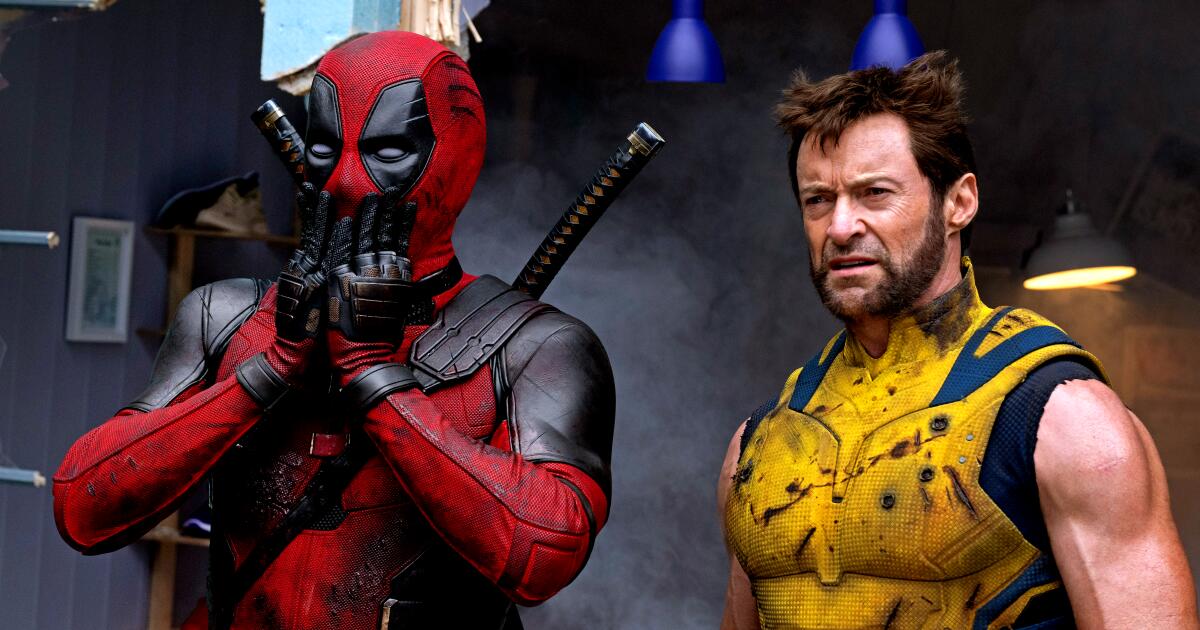
Marvel’s “Deadpool & Wolverine” extended its domination of the box office, bringing in $97 million in its second weekend of release, making it the second-biggest movie of the year, behind “Inside Out 2.”
The comic book franchise sequel, starring Ryan Reynolds and Hugh Jackman, already broke the record for the biggest domestic opening for an R-rated movie, with a $205-million first weekend, according to Comscore estimates.
The movie took the eighth spot for the biggest sophomore weekend opening in domestic box office history, eclipsing last year’s summer phenomenon “Barbie,” which earned $93 million in its second weekend outing, according to Variety.
At a time of concern over superhero fatigue, “Deadpool & Wolverine” has given a jolt to the genre, grossing $395 million domestically, overtaking the first two “Deadpool” installments. It is largely expected to cross the $1 billion threshold within days. “Inside Out 2” has grossed more than $1.55 billion worldwide, after eight weekends in release.
“Twisters,” Universal’s reimagining of the 1996 blockbuster, starring Glen Powell, Daisy Edgar-Jones and Anthony Ramos, took the No. 2 spot domestically with $22 million during its third weekend, grossing $195 million to date.
Not screened for critics, M. Night Shyamalan’s new thriller “Trap” opened in third place with $15 million. Sony’s “Harold and the Purple Crayon,” adapted from the children’s book of the same name, earned a disappointing $6 million, placing sixth.
This weekend, Walt Disney Studios became the first studio to cross the $3 billion mark globally during a year’s ticket sales — a success fueled by the 2024 releases of “Inside Out 2,” “Deadpool & Wolverine,” “Kingdom of the Planet of the Apes” and “The First Omen.”
Overall, the box office had its strongest week of the year to date, a robust $418 million. Per Comscore analysis, July alone generated $1.2 billion in domestic revenue, making it the first billion-dollar-plus month since July 2023.


Minions & Monsters, 2026.
Directed by Pierre Coffin and Patrick Delage.
Featuring the voice talents of Pierre Coffin, Trey Parker, Allison Janney, Christoph Waltz, Jeff Bridges, Jesse Eisenberg, Zoey Deutch, Bobby Moynihan, Phil LaMarr, and George Lucas.
SYNOPSIS:
Follows the Minions in 1920s Hollywood as they search for frightening creatures for their monster movie, partner with a green creature, and must save the planet after unleashing monsters.

Minions & Monsters comes with a genius creative choice to reinvigorate a tired schtick. The slapstick antics of the mischievous Minions have always felt partially inspired by comedic stuntwork from the likes of Buster Keaton (at one point, a house comes down over a Minion, paying homage) and Charlie Chaplin, so it’s seamless for director Pierre Coffin (who continues to voice all of them) to place them in the Golden Age of Hollywood. Yes, these movies are critic-proof and will crack one billion dollars regardless, and a case could be made that the filmmakers could have made bank once again going down an artistically bankrupt path, so it is refreshingly welcome that he (directing alongside Patrick Delage and crafting the screenplay with Brian Lynch) chooses to insert these yellow goofballs into a Hollywood love letter that doubles as an avenue for children and anyone else to develop an interest in the era.
Generally, when nostalgia-pandering is discussed or Easter Eggs flood a cinematic experience, it’s about placating fans and giving them what they want out of corporate obligation to put a film in the best position to succeed financially. Minions & Monsters is an animated feature that begins by rewinding the Universal Pictures logo all the way back to when it was The Trans-Atlantic Film Company, with an opening scene that uses The Horse in Motion, the earliest example of photography resembling a motion picture. From there, it’s an adventure involving Minions and Hollywood, giddy to reference anything it possibly can, from classic monsters to Humphrey Bogart to Westerns to Citizen Kane to a plot point that feels ripped out of the recent more cynical and vulgar Babylon, with the red-hot popular Minions struggling and failing to adjust to the transition from silent-era flicks to talkies.

There is a narrative here (more so than in the first two installments, which is a huge part of why this film works in addition to its sincerity) in that a present-day Hollywood museum tour guide (voiced by Allison Janney) educating kids about E.T. the Extra-Terrestrial, The Matrix, George Lucas (voicing himself while locked inside a glass casing), and more, eventually comes across a pair of Minions named James and Henry with quite the sweet friendship and story worth telling. Its initial stages aren’t too far off from what we already know about Minions in that they have always existed looking for evildoers to serve, this time coming across a cyclops, a wizard, a mummy, a viking, and others that they inadvertently kill through slapstick means.
The chaotic up-and-down history leads them to Hollywood, disrupting the shooting of an intense train robbery scene, which sends its director Max (voiced by Christoph Waltz) into a neurotic panic until studio executives, the Bright Brothers (voiced by Jeff Bridges), express that they find these yellow demons utterly hilarious and captivating to watch as they wreak havoc. As previously established, good things don’t last forever, and the Minions find themselves shoved aside in a new movie-making landscape, but not before a montage celebrating numerous genres across silent-era films and leaving James and Henry with a dream to make “the best movie ever”, Minions y Monsters.

This is where the film slightly loses its way, transitioning into a more familiar animated feature/Minions story, as they bust out the sorcerer’s spellbook they found ages ago to summon Cthulhu as their monstrous antagonist. Instead, they conjure up a tiny blob named Goomi (Trey Parker, voicing a different character in the franchise this time while sounding like an amalgamation of about five different South Park characters with plenty of Cartman coming through) who can’t be what they need for the movie but can help find other suitable monsters, all while joined by sidekicks Philips and Howard (voiced by Bobby Moynihan and Phil LaMarr).
While James and Henry (who are joined by Ed as their cinematographer) try to make this dream happen, the other minions search for another villain to serve, stumbling across robot Dort (Jesse Eisenberg voicing a character riffing on Gort from The Day the Earth Stood Still), who turns out to suck at being evil even though he desperately wants to break bad. Rather amusingly, he befriends a suffragette (voiced by Zoey Deutch) in a completely bizarre, random subplot that mostly works because of how out-of-left-field it is. Nevertheless, it’s mostly filler material until the Minions meet their match in the climactic showdown that, unfortunately, has more in common with modern blockbusters than the classical Hollywood it’s trying to imitate, even if the enormous blob they’re up against looks icky, with gross animation details that deserve applause.

Setting that aside, it is noteworthy that even if there are still plenty of jokes with the Minions here that don’t land, it is also funnier when they are interacting with not only recognizable scenes, genres, and movies, but also what shouldn’t be forgotten. There is also a joyous friendship at the center holding it together, whereas I couldn’t tell you a damn thing about the Minions from previous movies other than that one of them was named Bob. Minions & Monsters is still more of the same, while also a testament and celebration of the beauty and magic of making and watching movies, with earnest love for the era that shines through. For the first time, the brain isn’t turning to mush watching one of these.
Flickering Myth Rating – Film: ★ ★ ★ / Movie: ★ ★ ★
Robert Kojder
https://www.youtube.com/watch?v=embed/playlist
Entertainment
Alannah Keyser is latest fired ‘Love Island USA’ contestant to apologize for using a racist slur

Another former bombshell has apologized for past use of a racist slur that got her ousted from the villa.
Fired “Love Island USA” contestant Alannah Keyser posted a video to TikTok on Saturday addressing a past video that showed her using the N-word as she sang along to the Roddy Ricch song “The Box.” On Friday, Peacock confirmed to The Times that Keyser had been dismissed from the hit reality dating show after the resurfaced video began circulating online.
“I do want to begin by addressing the video of me singing along to a Roddy Ricch song that contains a racial slur,” Keyser says in her video. “I’m sorry to whoever has seen that video and has been offended by it; that was never my intention. The video is from six years ago, and that word is just not in my vocabulary anymore.”
A USC film student from Miami, Keyser also addressed some of the other social media chatter about her that had been making the rounds prior to her dismissal. Included were accusations of racism due to screenshots of her alleged use of the racist slur on Snapchat and Instagram as well as observations that alleged she had interacted less with Black men on the show.
She said those screenshots had been “falsified.”
“What has been shared does not reflect the truth, and it’s never been in my character to discriminate against anybody’s skin color,” Keyser said. “I do want to say directly that I do not support racism or discrimination of any kind, and I never have.
“When I first found out that these things were going around online, it really broke my heart, and I couldn’t do anything about it. But this has definitely been a learning lesson for me, and it sucks that I didn’t get a chance to really show my personality and who I am,” she added.
In the caption of her TikTok video, Keyser wrote that “reality tv is HEAVILY edited & [her] chats/kisses with the other boys were unfortunately not aired.”
Keyser was the second “Love Island USA” contestant who was dismissed from the show this season after video of them using the N-word surfaced on social media. Earlier this month, Peacock axed Oregon-based beauty technician Vasana Montgomery just days after it announced its slate of Islanders for the show’s eighth season. She has since apologized, saying, “There is no excuse” for her use of the slur.
Last year, contestants Cierra Ortega and Yulissa Escobar were dismissed from the show for their use of racist slurs. Ortega had been caught repeatedly using a derogatory slur for Chinese people (and Asian people in general) on social media, while Escobar had used the N-word in a couple of podcasts. Both have since apologized.

The Invite is a remake of the Spanish film The People Upstairs, itself based on a play by the same director Cesc Gay. With all remakes, the question is: What’s this version bringing to the table. In this case, it’s a rock solid cast with great chemistry and some very snappy direction by Olivia Wilde.
Joe (Seth Rogen) and Angela (Olivia Wilde) are a dysfunctional couple with some noisily amorous upstairs neighbours. They invite Hawk (Edward Norton) and Piña (Penélope Cruz) to dinner and hijinks ensue.
There’s a lot to like about The Invite. Each member of the cast is funny in their own way. Rogen plays his usual schlub but his character is more nuanced than usual, with the rapid-fire jokes masking a deep frustration and melancholy. Wilde‘s Angela is a persnickety neurotic, but it’s not hard to see why. Cruz plays a sultry therapist who’s in permanent flirt mode but is also holding something back. Norton steals the show with a quietly hilarious performance as a retired firefighter who is all too eager to share his new age insights. The way each person interacts with the other results in a rollercoaster of cringe comedy, acerbic satire and genuine gut-busters. This is a film that relies entirely on performance and actually succeeds.
The story itself is a little masterpiece. Adapted from Gay’s original by Rashida Jones and Will McCormack, the dialogue is quick, laden with not-very-subtextual motivations and always up to something. It’s very even-handed, and all the characters are sympathetic but flawed in amusing ways. Watching the increasingly desperate Joe and Angela bouncing off the Hawk and Piña is both funny and excruciating. Joe’s attraction to Piña is played fairly straight, but Angela’s attraction to Hawk becomes side-splitting as she pours out her soul to his Zen-calm ears and gets responses that make her even more attracted to him and by the end she’s practically hyperventilating.
The Invite does take something of a turn towards the end, although the film is in a state of continual twist throughout. This final shift throws the couples’ dysfunction into stark terms but doesn’t ruin anything. In the end, it moves from a somewhat misanthropic tone to a sincere and compassionate one. It skillfully makes you complicit in Joe and Angela’s spatting and then forces you to reconsider. The comedy is so intense throughout the film that when this happens it might lose some viewers, but it’s well-earned, true to the characters and it’s a very satisfying payoff.
The Invite is a small film that feels like a return to a better era in cinema. It’s a remake that is worth watching for its performances, and it’s very, very funny. It’s the sort of film that can be watched at home given its confined setting, but it generates enough laughs that seeing with an audience is a real pleasure.
-

 Florida6 minutes ago
Fast-growing South Florida wildfire consumes over 4,000 acres
-

 Georgia9 minutes ago
Aleks Arwood named runner-up at Miss Georgia – Thomasville Times-Enterprise
-

 Hawaii9 minutes ago
Maunakea Access Road proposals include toll booth, cultural center | Honolulu Star-Advertiser
-

 Illinois19 minutes ago
Serial Springfield Township sex offender faces public indecency charge
-

 Idaho21 minutes ago
Idaho man seriously injured in western Kansas motorcycle crash
-

 Indiana29 minutes ago
Indiana faces high odds of backyard fireworks accidents
-

 Iowa36 minutes ago
Laid-off Iowa state IT workers receive offers from private company
-

 Kansas39 minutes ago
2 rescued from roof as house fire breaks out in Kansas City

