South Dakota
In rare bipartisan vote, U.S. Senate passes package aimed at protecting kids online • South Dakota Searchlight


This story mentions suicide. If you or a loved one are experiencing a mental health crisis or thoughts of suicide, please dial 988 or chat with a live counselor at 988lifeline.org.
WASHINGTON — Legislation aimed at protecting children online sailed through the U.S. Senate Tuesday, marking what could be the first update since the late 1990s for companies who interact with minors on the internet.
Senators approved the package of two bills in a 91-3 vote (including yes votes from South Dakota Republicans John Thune and Mike Rounds). It was a rare bipartisan landslide in the tightly divided body, despite loud and fervent opposition from civil liberties and LGBTQ organizations that say the measures would hand the government power to subjectively censor content.
The three no votes were cast by Mike Lee of Utah, Rand Paul of Kentucky and Ron Wyden of Oregon.
If passed by the House, the legislative package would require producers of platforms popular among children and teens to follow new rules governing advertising, algorithms and collection of personal data.
GET THE MORNING HEADLINES DELIVERED TO YOUR INBOX
House Speaker Mike Johnson, R-La., has expressed interest in “working to find consensus in the House.”
President Joe Biden released a statement Tuesday calling the Senate vote a “crucial bipartisan step forward” and said the bill dovetails with measures he advocated for in his first State of the Union Address.
“There is undeniable evidence that social media and other online platforms contribute to our youth mental health crisis. Today our children are subjected to a wild west online and our current laws and regulations are insufficient to prevent this. It is past time to act,” Biden said, adding that tech companies need to be “accountable for the national experiment they are running on our children for profit.”
Families asked for federal help
The package contains two bills moving together: the Children and Teens Online Privacy Protection Act, which is mainly targeted at regulating the collection of personal data, and the Kids Online Safety Act, a bill that has been a lightning rod of criticism from outside groups.
A bipartisan group of senators points to years of hearings and meetings with tragedy-struck families — including those whose children struggled with eating disorders and died by suicide — as the motivation behind the proposals.
Sen. Marsha Blackburn, of Tennessee, one of the Kids Online Safety Act’s original sponsors, said the legislation is a “safety by design bill, a duty of care bill that gives kids and parents a toolbox so that they can protect themselves.”
“A message that we’re sending to big tech: kids are not your product, kids are not your profit source, and we are going to protect them in the virtual space,” Blackburn, a Republican, said at a press conference following the vote.
‘Firehose’ of information confronts legislators studying internet use by children and AI
Blackburn co-led the bill dubbed the Kids Online Safety Act with Democratic Sen. Richard Blumenthal of Connecticut.
Sen. Ed Markey, who championed the last protections passed by Congress in late 1990s, said “back in 1998 only birds tweeted, a gram was a measurement of weight, and so we need to update the law.”
The Massachusetts Democrat joined Republican Sen. Bill Cassidy of Louisiana in co-sponsoring the Children and Teens’ Online Privacy Protection Act.
Markey likened addictive social media products to those of the tobacco industry in previous decades, and cited public health warnings attributing increasing childhood mental health issues to the platforms.
“So we have to give the tools to parents and to teenagers and children to be able to protect themselves, and that would be my message to my colleagues in the House. We cannot avoid this historic moment,” Markey said at the press conference.
Senate Majority Leader Chuck Schumer praised the legislation’s passage in the Senate and said the parents of affected teens are “the reason we succeeded today.”
“I’ve heard the terrible stories: children, teenagers, perfectly normal, then some algorithm captures them online by accident, and they end up committing suicide shortly thereafter,” the New York Democrat said in a statement. “You imagine being a parent and living with that.”
New rules for platforms
The original two bills, rolled into one legislative vehicle, respectively outline “duty of care” rules requiring platform creators to consider broad mental health categories when designing and operating their products as well as a prohibition of the use of personal data for targeted marketing.
The legislation would also mandate that platforms create an “easy-to-understand privacy dashboard” detailing how a minor’s personal information is collected, used and protected.
Other measures would include a prohibition on hidden algorithms, mechanisms for minors or parents to remove data, parental controls to restrict financial transactions and annual public reports from the platforms on “reasonably foreseeable” harms to children and teens and efforts underway to prevent them.
Enforcement
The new policies, if enacted, would be enforced by the Federal Trade Commission and any civil actions would be prosecuted by states in U.S. district court with advance notice to the FTC.
The legislation defines the online platforms as public-facing websites, social media applications, video games, messaging applications or video streaming services that are “used, or reasonably likely to be used, by a minor.”
Snap, the company behind the popular platform Snapchat, issued a statement specifically praising the Senate’s passage of the Kids Online Safety Act.
“The safety and well-being of young people on Snapchat is a top priority,” a Snap spokesperson said in a statement provided to States Newsroom. “That’s why Snap has been a long-time supporter of the Kids Online Safety Act. We applaud Senators Blackburn, Blumenthal and the roughly 70 other co-sponsors of this critical legislation for their leadership and commitment to the privacy and safety of young people.”
Opponents see ‘dangerous’ measure
A coalition of organizations advocating for First Amendment rights, privacy and the interests of LGBTQ minors urged the House to vote no on the legislation, criticizing it as “blatantly unconstitutional.”
Evan Greer, director of the tech policy group Fight For the Future, also lambasted the bill as “dangerous and misguided” and “wildly broad.”
The coalition largely takes issue with the Kids Online Safety Act’s “duty of care” provision that requires companies to “prevent and mitigate” harms associated with anxiety, depression, eating disorders, substance use disorders and suicidal behaviors.
During a joint virtual press conference hosted by the groups during the Senate vote, Greer described the provision as “a blank check for censorship of any piece of content that an administration could claim is harmful to kids.”
“What that means in practice, is that for example, a Trump administration FTC would get to dictate what types of content platforms can recommend or even show to younger users,” Greer said, referring to Republican presidential nominee and former President Donald Trump.
Jenna Leventoff, senior policy counsel at the American Civil Liberties Union, said the Kids Online Safety Act is “nothing more than a thinly veiled effort to censor information that some consider objectionable”
“If enacted, KOSA could lead to information about health care, gender, identity, politics and more being removed from social media. And kids note that censorship will make them less and not more safe,” Leventoff said. “As one student recently told me, they don’t get sex education in school, and if information about sex is removed from the internet because platforms fear liability for hosting it, how else can they learn about sex?”
Teens in opposition
The ACLU brought roughly 300 teens to Capitol Hill Thursday to lobby against the legislation.
Dara Adkinson, of the organization TransOhio, said the legislation is “truly terrifying.”
Adkinson questioned whether state and federal authorities could argue that content about climate change or the nation’s history of slavery causes anxiety and should therefore be regulated.
Regarding content about transgender youth, Adkinson said: “We know there (are) people out there that would like us to not exist and having the lack of visibility of the kinds of resources found on the internet is the first step for many of these folks.”
Greer said the coalition is concerned about the role of “big tech” in society. Advocates would support a “heavily modified” version of the Kids Online Safety Act that focuses on regulating business practices, including targeted advertising or videos that automatically play and encourage continuous, addictive scrolling habits.
Greer said their organization is neutral on the legislation targeted at protecting children’s privacy, but that they would like to see comprehensive legislation that protects minors and adults alike.
“Censorship and privacy do not go together, and these should not be moving together,” Greer said.



NEMO, S.D. – South Dakota Mines is planning to build a more than 9,000-square-foot geology field station in Nemo. The new facility will give students a dedicated space to live and collaborate while completing required field camps.
The project is being completed in conjunction with the South Dakota Mines Center for Alumni Relations and Advancement (CARA). Currently, geology students have to commute from the Rapid City campus to remote locations every day to complete their field camps.
The new center is aimed at making the study of Black Hills geology more accessible while providing late-night mentorship and a better space for students to hang out and work together.
“Several years ago we received the generous gift of land in Nemo, and at that moment, you know, that gift of land opened up some opportunities and allowed us to think about what might be possible,” said Marc Vaillancourt, Chief Executive Officer for CARA at South Dakota Mines.
South Dakota Mines Center for Alumni Relations & Advancement
Vaillancourt says the Black Hills are one of the greatest natural geology classrooms in the world, giving students the opportunity to climb rugged terrain, map complex formations, and wrestle with folds, faults, and intrusions. He emphasized that the field camp is a rigorous requirement, where students spend their days in the field conducting research and geological mapping alongside professors.
“The field station and the field camps… that really is the capstone for a student,” Vaillancourt said, “They’ve spent four years studying the work and what it takes to be a geologist or a geological engineer, and now the last thing, the capstone, is that field camp experience, being there in the weeds, so to speak, in the rocks.”
The new 9,415-square-foot facility will feature dormitories and collaboration spaces, functioning as a classroom embedded in the Black Hills. The project is estimated to cost just over $6 million and will be entirely funded by private donors.
The Center for Alumni Relations is hosting a public meeting Monday evening to share their vision and answer questions from Nemo residents. The meeting starts at 6:30 p.m. on Monday, June 8, at the Nemo Community Hall.

Per grew up in Sioux Falls and graduated from South Dakota Mines. He found his passion for weather reporting by the impact it has on the community, both in how people work and how it brings people together through severe weather preparation. He also has a passion for preventing health issues with Air Quality Index awareness. Per can be found enjoying outdoor activities in the Black Hills when the weather allows.
The South Dakota Lottery offers multiple draw games for those aiming to win big.
Here’s a look at June 6, 2026, results for each game:
Winning Powerball numbers from June 6 drawing
16-32-55-59-64, Powerball: 03, Power Play: 3
Check Powerball payouts and previous drawings here.
Winning Lotto America numbers from June 6 drawing
08-22-24-37-47, Star Ball: 05, ASB: 02
Check Lotto America payouts and previous drawings here.
Winning Dakota Cash numbers from June 6 drawing
05-09-13-14-23
Check Dakota Cash payouts and previous drawings here.
Winning Millionaire for Life numbers from June 6 drawing
03-13-18-35-48, Bonus: 04
Check Millionaire for Life payouts and previous drawings here.
Feeling lucky? Explore the latest lottery news & results
Are you a winner? Here’s how to claim your prize
- Prizes of $100 or less: Can be claimed at any South Dakota Lottery retailer.
- Prizes of $101 or more: Must be claimed from the Lottery. By mail, send a claim form and a signed winning ticket to the Lottery at 711 E. Wells Avenue, Pierre, SD 57501.
- Any jackpot-winning ticket for Dakota Cash or Lotto America, top prize-winning ticket for Lucky for Life, or for the second prizes for Powerball and Mega Millions must be presented in person at a Lottery office. A jackpot-winning Powerball or Mega Millions ticket must be presented in person at the Lottery office in Pierre.
When are the South Dakota Lottery drawings held?
- Powerball: 9:59 p.m. CT on Monday, Wednesday, and Saturday.
- Mega Millions: 10 p.m. CT on Tuesday and Friday.
- Lucky for Life: 9:38 p.m. CT daily.
- Lotto America: 9:15 p.m. CT on Monday, Wednesday and Saturday.
- Dakota Cash: 9 p.m. CT on Wednesday and Saturday.
- Millionaire for Life: 10:15 p.m. CT daily.
This results page was generated automatically using information from TinBu and a template written and reviewed by a South Dakota editor. You can send feedback using this form.

The 2026 SDHSAA State Softball Championships concluded Saturday from Sioux Falls and Aberdeen. Congrats to Dakota Valley (A), Castlewood (B) and Sioux Falls Jefferson (AA) on taking home state championships.
Saturday Scores
Class AA
7/8th Place
Sioux Falls Lincoln 10, Bishop O’Gorman 8
5/6th Place
Brandon Valley 4, Rapid City Stevens 2
3/4th Place
Harrisburg 10, Sioux Falls Roosevelt 4
Championship
Sioux Falls Jefferson 11, Sioux Falls Washington 0
Class A
7/8th Place
Lennox 11, Madison 7
5/6th Place
Sioux Valley 9, Beresford 5
3/4th Place
West Central 11, Tri-Valley 1
Championship
Dakota Valley 9, Elk Point-Jefferson 6
Class B
7/8th Place
Avon 13, Florence/Henry 3
5/6th Place
Freeman/Marion/Freeman Academy 9, Redfield 3
3/4th Place
Gayville-Volin 7, Hanson 0
Championship
Castlewood 9, McCook Central/Montrose 2
-

 Health10 minutes ago
Scientists reveal surprising brain benefit of laughter: ‘It’s a mental workout’
-

 Sports13 minutes ago
Ketel Marte frustrating Diamondbacks by opting to take days off with trade deadline looming: report
-

 Technology18 minutes ago
Antares reaches reactor criticality under Trump pilot program, marking major nuclear milestone
-
 Business25 minutes ago
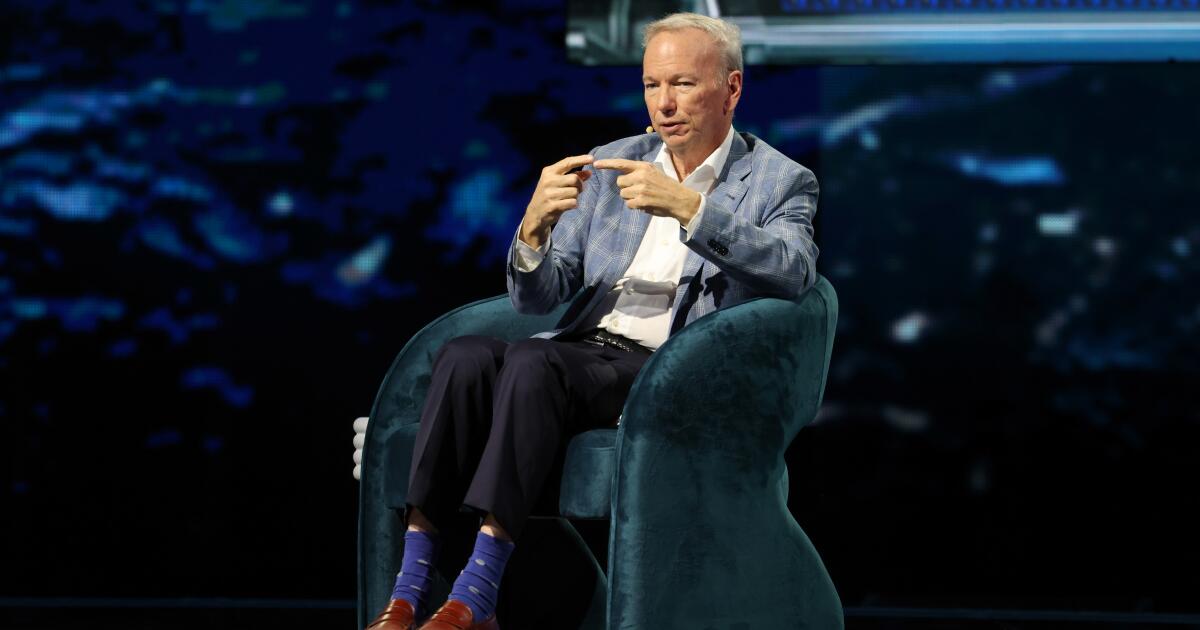
Ex-girlfriend of former Google CEO Eric Schmidt ordered to pay him $10 million after rape accusations
-
 Entertainment28 minutes ago
Tony Awards 2026: “Schmigadoon!” wins best musical in a season saved by revivals
-
 Politics40 minutes ago
Mainstream California Democrats survived election night, but their brand remains challenged
-
 Sports48 minutes ago
The Times’ softball coach of the year: Katie Stith of JSerra
-

 World58 minutes ago
Peru’s Sanchez visits jailed ex-president as votes are counted

