Northeast
Trump assassination attempt in Butler, Pennsylvania, has chilling ties to George Washington, first president

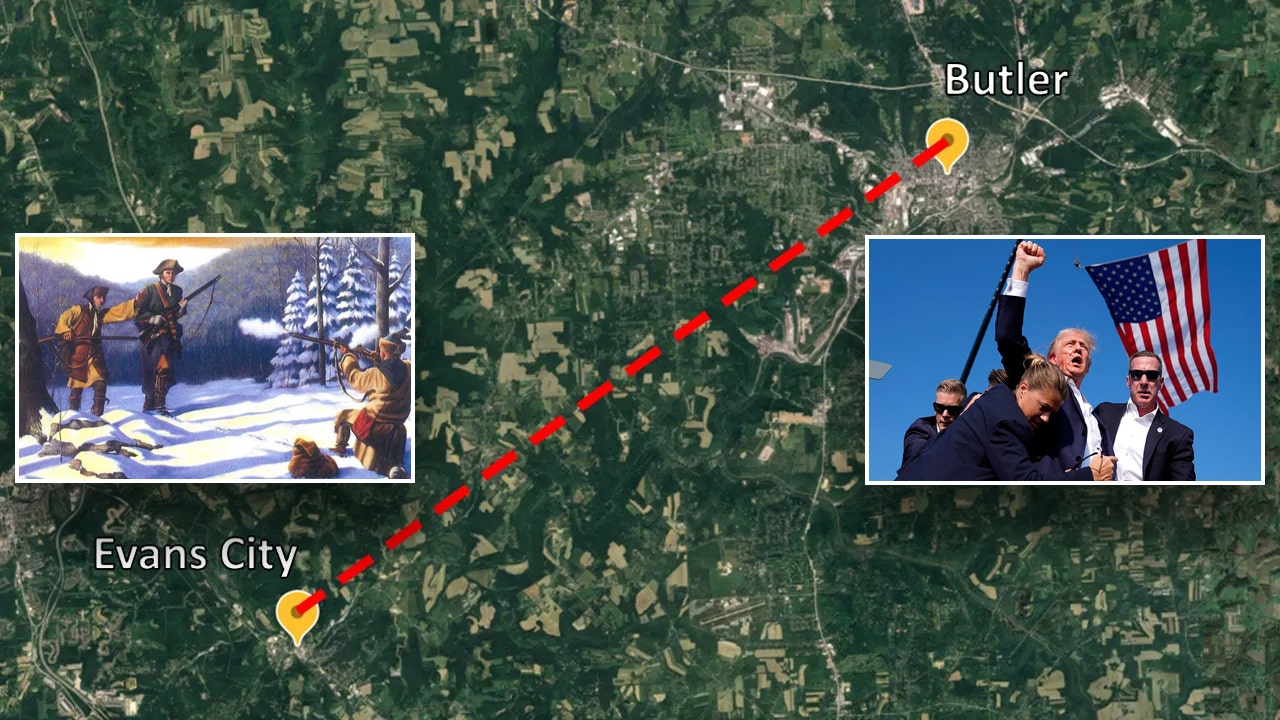
An important figure in American history once narrowly escaped with his life after an assassination attempt in western Pennsylvania – but it wasn’t former President Donald J. Trump.
George Washington, just 21 years old when it happened, was a major in the British Army.
The year was 1753.
TRUMP FLAG PHOTO JOINS PANTHEON OF IMAGES THAT CAPTURE AMERICAN RESOLVE, ERASE POLITICAL DIVIDES
The United States did not yet exist — and young Washington was traveling from Virginia to western Pennsylvania.
His goal? Preventing war.
A monument in Evans City, Pennsylvania, recounts the assassination attempt on George Washington’s life in Dec. 1753. (Derek Shook for Fox News Digital )
Washington “was on his way to go up to Fort Le Boeuf, which would be close to Erie,” Jack Cohen, president of Butler County Tourism and board member of the 1753 George Washington Trail, told Fox News Digital in a phone interview this week.
There, he would meet with French troops “to see if he could stop the French and Indian War,” Cohen said.
Washington had been tasked with delivering a letter from Virginia Gov. Robert Dinwiddie, requesting that the French leave the area.
FAITH LEADERS SHARE URGENT PRAYERS FOR FORMER PRESIDENT DONALD TRUMP AFTER PENNSYLVANIA RALLY SHOOTING
But the French balked at the thought of leaving the area — and a full-blown war would begin about six months after Washington visited Fort Le Boeuf.
Yet even before that, on Dec. 27, 1753, Washington and his guide, a surveyor named Christopher Gist, were following the Venango Indian Trail on their way back to Virginia when they stopped for the night at Connoquenessing Creek in Pennsylvania, Cohen relayed.
The attempt on Washington’s life is memorialized by artist Deac Mong in this 2007 painting called “The First Shot.” The painting is hanging in the Butler County Courthouse. (Deac Mong)
George Washington, shown in this portrait painting by Constable-Hamilton, 1794, went on to serve as president of the United States from 1789 to 1797. (Smith Collection/Gado/Getty Images)
There, the two befriended an “Indian guide” who said he would help them through the wilderness, he said.
As it turns out, the “Indian guide” was allied with the French troops — and was not pleased to see Washington.
The man “loaded his musket and shot at Washington and just missed him.”
The man “loaded his musket and shot at Washington and just missed him,” Cohen said of the chilling murder attempt.
TRUMP SHOOTING: ‘GOD’S HAND OF PROTECTION WAS ON HIM,’ SAYS REV FRANKLIN GRAHAM, OTHERS
“They were going to chase him down and Gist said, ‘Let him go.’ And so they let him go, and they went on their way the next morning.”
Nearly 300 years after the brazen attempt on Washington’s life, the event is chronicled by two markers in what is now Evans City, Pennsylvania – which is close to the Butler Farm Show location where Trump almost lost his life recently.
Evans City, where George Washington, founding father, was nearly killed, is about six miles away from the Butler Farm Show — where former President Donald Trump was nearly killed on July 13, 2024. (Deac Mong; Google Earth; AP Photo/Evan Vucci)
Washington’s would-be assassin, the markers note, was “less than 15 paces from him” when the gunman fired the shot.
Today, Cohen and the other board members are trying to get Washington’s historic route recognized by the National Parks Service as a National Historic Trail.
There are concerted efforts by many to get the route through Pennsylvania that Washington took in 1753 recognized as a National Historic Trail by the National Parks Service. Above, part of the trail. (Derek Shook for Fox News Digital )
“It should be a national trail knowing that George Washington could have been killed here,” he told Fox News Digital.
“That happened right here in Butler County.”
A general view of the trail on which George Washington, founding father, escaped an assassination attempt in present-day Evans City, Pennsylvania on Friday, July 26, 2024. The site of the shooting is about six miles from the Butler Farm Show — where Trump survived an assassination attempt. (Derek Shook for Fox News Digital )
In president-day Evans City, Pennsylvania, George Washington — later the first president of the United States — escaped an assassination attempt when he was 21 years old. The site of the shooting is approximately six miles from the Butler Farm Show. The above photo was taken on July 26, 2024. (Derek Shook for Fox News Digital )
On July 13, 2024 — more than 270 years after Washington escaped an assassination attempt, just six miles away from his campsite in Butler County — former President Trump, too, was spared death as a bullet grazed his right ear.
The similarities between the two events were not lost on Cohen.
Former President Donald Trump suffered a gunshot wound to his right ear from a would-be assassin in Butler, Pennsylvania, on July 13, 2024. (Alex Brandon)
The attempt on Washington’s life was “pretty much like what we just had,” he told Fox News Digital, referring to what happened to Trump.
For more Lifestyle articles, visit www.foxnews.com/lifestyle
“Isn’t that crazy?” said Cohen.
Read the full article from Here

New Hampshire
From farm to… freezer? A new approach could help close N.H.’s local food gap. – The Boston Globe

“This process takes our product to a whole different level,” said Zydenbos. And, she said, it tastes delicious.
Vermont has the highest percentage of local food sales in the region (10.7 percent), followed by Maine (4.9 percent), with New Hampshire coming in third (4.6 percent), according to 2024 data from New England Feeding New England, a partnership of New England organizations advocating that the region produce 30 percent of the food it consumes by 2030. Massachusetts comes in fourth, with 3.6 percent of food spending on local items.
New Hampshire is second to last in New England when it comes to the value of vegetable sales ($23 million) and the value of agriculture ($209 million). Many farmers in the state struggle to turn a profit.
“Generally speaking, New Hampshire is a little bit behind,” said Shawn Menard, executive director of Seacoast Eat Local, a local food nonprofit, and board president at the Concord Food Co-op. Menard said other New England states have more robust infrastructure for food processing, purchasing, and distribution that supports local food production.
Since 2012, Zydenbos has operated Micro Mama’s, one of New Hampshire’s first fermented vegetable companies, sourcing local produce and transforming it into fermented vegetables sold at more than 50 locations around New England, including about 30 Whole Foods stores.

Now, Zydenbos wants to try something new, by making more processing equipment available for farmers and producers in New Hampshire and using it to introduce novel local food products. Among them: freeze-dried kimchi, a new take on a traditional Korean dish made with spicy fermented vegetables like napa cabbage and radishes.
With a $96,000 federal grant from the US Department of Agriculture in hand, she purchased new equipment, including an individual quick freezer and a freeze dryer. Food experts said the cost of the equipment is one barrier that’s prevented other small local businesses from offering similar products.
Jennifer Chadbourne, a clinical associate professor in agriculture, nutrition, and food systems at the University of New Hampshire, said freeze-dried kimchi is not widely available.
“It could be a really novel idea for the manufacturer,” she said.
Traditional kimchi and other fermented vegetables offer certain health benefits, like probiotics that can aid gut health, according to Chadbourne. She said freeze-drying can preserve the nutritional value of food since it doesn’t rely on a high heat during processing, but there’s not yet robust evidence on the nutritional profile of a new food like freeze-dried kimchi. She said flash freezing is another effective way to preserve the peak nutrients of a freshly harvested food.
For the consumer, these products are a convenient way to buy nutritious local produce outside the limited months of New England’s growing season.
“Especially here in New England, where we have such drastic seasons that impact how long we can grow food, any type of novel preservation technique is going to help us maximize our crops during the seasons where we can grow,” said Chadbourne.
The individual quick freezer Zydenbos acquired is different from a typical household freezer. It freezes produce in about 20 minutes as opposed to 48 hours, Zydenbos said. And rather than locking produce into one solid chunk, it freezes berries or broccoli as individual pieces, which makes it easier to use at home.
If freeze-dried kimchi seems a little out there, that’s a challenge Zydenbos has faced before. When she started her fermented food business in 2012, kimchi was still on the fringes of food culture in New England. Zydenbos said she had to work with state agencies as they learned how to regulate the food. Then she toured the state’s farmers markets educating consumers and evangelizing the benefits of fermented foods.
Even before that, there were her own doubts to overcome.
“When you first do it, you’re like, Oh, my god, this goes against everything that you’ve been taught,” she said. “You’re basically leaving vegetables out on the warm shelf to transform.”
“I’m going to kill somebody,” she remembers thinking while fermenting a batch for her own consumption after attending a kimchi-making workshop.


Zydenbos came to fermenting in search of healing. For years, she relied on copious quantities of probiotic supplements to ease digestive issues. When she started making kimchi, that became her new cure.
From there, a kimchi empire was born.
“In terms of somebody who really put it on the map in this region, I think Micro Mama’s is a huge player in that,” said Menard. He was the produce manager at the Concord Co-op when Zydenbos landed her account there. Menard said he hadn’t had kimchi before, but he was blown away by the flavor of her product, which was well received among the co-op’s customers.
By 2017, Zydenbos had built a facility in Weare on a property that had been in her family since the 1970s. The fermenting dens now contain 40,000 pounds of vegetables in production, all subject to strict federal and state safety regulations. She sourced stainless steel fermenting tanks from Italy and Germany to avoid using plastic containers.
When Whole Foods first came to New Hampshire, Zydenbos put her line of products forward – including kimchi, sauerkraut, and fermented carrots and beets, sourced from New Hampshire farms. The food safety work she had done with state agencies paid off, Zydenbos said, when she was able to show Whole Foods her quality control measures.
Now, with her new equipment, Zydenbos is planning to add freeze-dried kimchi to her lineup, as well as launch a spice line and food that will appeal to hikers, campers, and preppers.
“The possibilities are endless,” she said.
With the individual quick freezer, she can produce frozen carrots, beets, potatoes, and French-fry cut potatoes, which could be sold at local grocery stores or to New Hampshire restaurants.
Zydenbos views these efforts as a way to help farms access markets they haven’t been able to reach given a lack of processing equipment, licensing, or capital. She said the demand already exists.
Bruce Wooster of Picadilly Farm in Winchester, N.H., has been selling produce to Zydenbos for about five years. He said her new endeavor with flash frozen and freeze-dried produce could help growers extend their selling season.
“All the local farms have their crop coming all at once,” he said. “It can be tough to spread out those sales, but by freezing you can spread things out and not be like, ‘Hey, we’ve got to sell it this week before it spoils.’”
The Concord Food Co-op is one local grocery store that’s eager to include local frozen produce on its shelves.
“We have frozen vegetables that fly off the shelf,” said Josh Belanger, the store’s former general manager. “I think if we had them locally they’d do even better.”
Josh Marshall, assistant commissioner of the New Hampshire Department of Agriculture, Markets, and Food, said the new equipment will help make more local food available.
“For a small producer to be able to buy directly from small, New Hampshire farmers, and do this, this seems relatively cutting edge,” Marshall said.
Amanda Gokee can be reached at amanda.gokee@globe.com. Follow her @amanda_gokee.

New Jersey’s most welcoming towns pair walkable main streets with year-round arts calendars and centuries of preserved history. Some carry deep Revolutionary War legacies. Others grew up around an art museum or a resident orchestra. Free jazz fills Nishuane Park. The Mayo Performing Arts Center hosts touring Broadway shows. Expect Victorian beach streets, summer Shakespeare, and old battlefields. All places where strangers get treated like neighbors.
Cape May
Cape May built its hospitality on its bed-and-breakfast district. Longtime innkeepers remember returning guests by name. The city holds one of the largest collections of 19th-century frame buildings in the country. That Victorian architecture earned it National Historic Landmark status in 1976. Cape May stands at the southern tip of the state’s coast, where Delaware Bay meets the Atlantic Ocean.
Beach access stretches past Cove Beach and Poverty Beach to the central stretch near Beach Avenue. The Washington Street Mall handles shopping and dining inland. The 1859 Cape May Lighthouse still operates at the southern point. Visitors can climb its 199 steps for a view of the bay and ocean below.
Princeton

Princeton turned its university art museum into a public town square. The free museum opened a new building in October 2025 and holds more than 117,000 works. Princeton University began as the College of New Jersey in 1746, among the oldest in the country. Its collegiate Gothic campus stays open for self-guided architectural tours.
Bookstores and cafés line Nassau Street and Witherspoon Street downtown. Princeton Battlefield State Park preserves the ground where George Washington beat British troops in January 1777. The Delaware and Raritan Canal State Park follows the old canal corridor nearby. Level paths there suit walking and biking.
Morristown
Morristown holds the country’s first national historical park. Established in 1933, it preserves the site where the Continental Army camped through the brutal winter of 1779-1780. The town carries one of the deepest Revolutionary War legacies anywhere. The National Trust for Historic Preservation named it a Dozen Distinctive Destination. The Ford Mansion served as George Washington’s headquarters and stays open for tours. Acorn Hall, Historic Speedwell, and the MacCulloch Hall Historical Museum round out the historic-house circuit.
The Mayo Performing Arts Center on South Street books classical music, touring concerts, and Broadway shows year-round. The Morristown Green gathers the downtown restaurant and shopping scene around one public square.
Madison
Madison hosts the Shakespeare Theatre of New Jersey at Drew University. It is the state’s only professional company devoted to Shakespeare and the classics. Performances fill the F.M. Kirby Shakespeare Theatre through a long summer season. The town stands about five miles east of Morristown.
Independent cafés, bakeries, and boutiques fill Main Street and Waverly Place. The Museum of Early Trades and Crafts occupies the 1900 James Library building. Its displays show the tools New Jersey artisans used in the 18th and 19th centuries.
Montclair
The free Montclair Jazz Festival fills Nishuane Park each year. Emerging and established players make it one of the larger jazz gatherings in the region. The town rests on the eastern slope of the Watchung Mountains. It keeps one of New Jersey’s busiest arts calendars. The Montclair Art Museum on South Mountain Avenue centers its collection on American and Native American art.
The Alexander Kasser Theater at Montclair State University books dance, music, and theater all year. Restaurants and shops line Bloomfield Avenue in the Montclair Center district. The restored 1922 Wellmont Theater hosts touring concerts and comedy.
Westfield
The New Jersey Festival Orchestra calls Westfield home and plays venues around town all year. Shops, boutiques, and restaurants fill the Union County downtown along East Broad Street and Elm Street. The 1922 Rialto on East Broad Street was long the town’s movie house. It is being reborn as the Center for Creativity, a community arts venue for film, performance, and exhibitions.
Mindowaskin Park holds a pond, walking paths, and picnic spaces near downtown. The Spring Fling and FestiFall events bring music, food, and family activities to the blocks each year.
East Brunswick
Giamarese Farm and Orchards keeps a pick-your-own operation in East Brunswick. It offers seasonal fruit and vegetable picking, a corn maze, and autumn hayrides. The Middlesex County town leans toward families. Butterfly Park sets aside green space for butterfly conservation. Crystal Springs Family Waterpark gives a summer cooling-off spot.
Playhouse 22 stages community theater, plays, and concerts year-round. The East Brunswick Public Library hosts programs and exhibits as a cultural hub. Bicentennial Park and the Tamarack Golf Course cover the sports side. Route 18 puts New Brunswick and the central Jersey corridor within easy reach.
Hospitality You Can Walk To
Hospitality here shows up in small, repeatable ways. The Morristown Green fills with the same faces every weekend. Princeton opens its new art museum to everyone for free. The New Jersey Festival Orchestra tunes up in Westfield. Giamarese Farm hands East Brunswick families a basket every fall. None of it is staged for outsiders. These towns built their welcome for the people who live there. The rest of New Jersey keeps showing up anyway.
Pennsylvania
Half of child deaths left unreviewed in Pa. since 2020 as counties struggle with ‘unfunded mandate’

Many Pennsylvania counties are failing to review the death of every child in their area, despite a 2008 state law that requires them to do so.
The problem, advocates and program participants say, is a lack of both state assistance in collecting data and time for volunteers to run the local panels.
Gov. Josh Shapiro wants the legislature to approve $2.5 million to improve this work, but it’s unclear if the request will be considered a priority this year.
The effort to study the deaths of Pennsylvania children dates back about two decades, when the state passed a law mandating counties host a local board of healthcare professionals, law enforcement officials, child protective service providers, and a coroner or medical examiner to review the deaths of every resident under the age of 21. The law was one of several initiatives spurred by the murder of Berks County toddler Maxwell Fisher in 1996.
Based on the information county boards gather, members are charged with creating strategies for local and state policymakers to prevent similar deaths.
But reports shared with Spotlight PA by the Pennsylvania Department of Health show that since 2020, roughly half of childhood deaths statewide have not been reviewed. Those lapses are especially prominent in rural counties, where local teams are more likely to falter or not exist.
Policymakers have known about the program’s issues for years.
A multiyear East Stroudsburg University evaluation of the program commissioned by the state Department of Health concluded in 2024 that the Child Death Review program is “an unfunded mandate.” It issued a long list of recommendations to rectify the program’s shortcomings, including creating regional teams for rural areas.
“Staffing turnovers and pandemic disruptions were detrimental to maintaining complete teams in many regions of Pennsylvania,” researchers wrote. “Some have since begun to rebuild while other teams have yet to meaningfully reengage in (Child Death Review).”
Still, lawmakers have failed to adopt legislation — or even introduce any, according to a search of the state General Assembly’s website — to address the issues facing the 2008 law.
The status quo could change this year.
Steven Shapiro, a pediatrician and longtime member of the Montgomery County review team, told Spotlight PA that he and fellow pediatrician Erich Batra, of Lebanon County’s review board, have been urging state officials to improve the “flawed” Child Death Review system. They want a coordinated effort to improve data collection and remove some burdens from counties’ responsibilities.
“If you just unpack how the child succumbed, then you begin to learn about how you can protect other children from enduring the same fate and parents enduring the same fate,” Shapiro said.
Shapiro’s son, Gov. Josh Shapiro, happens to be in a position to help get the program some state funding. Though the elder Shapiro said he does not “try to influence” policy when speaking with his son, some topics come up “over table talk at dinner sometimes.”
Earlier this year, for the first time, the governor proposed using a new $2.5 million from the state’s general fund to support the program. The Department of Health said in an emailed April statement that the money would be used to adopt some of the report’s recommendations. Those include adding health department staff to assist county teams with data collection and prevention strategies, creating a grant that counties could use to “enhance local CDR operations,” and expanding public education campaigns geared toward preventing child deaths.
The Department of Health’s statement did not specify how many positions would be added to improve the program’s organization.
Steven Shapiro said he and Batra are also working on a “cogent, complete and cost-effective” proposal to “redo” how the state is involved in Child Death Review data collection that would not require new legislation. He wouldn’t share details on how that new system might work, but said some funding from the state is essential.
Batra told Spotlight PA the $2.5 million in state funding the governor is proposing would be a good starting point. He envisions it helping counties with data collection and funding local prevention efforts, which can include things like adding signs at dangerous intersections, leading a smoke detector campaign in neighborhoods experiencing fires, or holding fundraisers for a local Cribs for Kids branch.
“A lot of the way Child Death Review works is what I call the intangibles,” Batra said. “It’s the community coming together and working together in a way that they might not always do on a day-to-day basis.”
But Cathleen Palm, founder of the Center for Children’s Justice and a longtime advocate for improving Child Death Review, told Spotlight PA she’s not convinced Gov. Shapiro’s funding pitch alone is a game-changer.
She said that if improving Child Death Review were truly a priority for policymakers, there would be more fanfare around the funding proposal from the Shapiro administration.
Palm also criticized lawmakers for their inaction on addressing issues within the program that have been known for years.
“Why do we create a law if we don’t want to follow it?” Palm said.
In a year where so many competing interests are fighting over a limited amount of state funds, Palm worries Shapiro’s proposal may go overlooked by lawmakers.
“Investing in improvements to the CDR process will further allow the Administration to expand public education and outreach, with a focus on preventable causes of child death,” Rosie Lapowsky, Gov. Shapiro’s spokesperson, said in a statement. “The Governor is hopeful the General Assembly shares that mission of protecting children and ensuring their safety.”
The annual proportion of reviewed child deaths plummeted during COVID-19 and has not fully rebounded, even though there has also been a reduction in the total number of deaths, according to annual reports from the Department of Health.
In the history of the review requirement, county boards have never succeeded in studying every death. The closest they got was in 2013 — statewide, about three-quarters of the 1,931 child deaths that happened that year were reviewed.
That rate dropped to an all-time low in 2019, when 43% of that year’s 1,907 child deaths were reviewed. The drop is often associated with the COVID-19 pandemic, because deaths tend to get reviewed many months after the fact.
The review rate climbed back to nearly 60% in 2023 (of 1,551 deaths), the most recent year for which data are available.
However, local teams across the state left more than 600 deaths unreviewed in 2023.
Unreviewed deaths stem directly from members being “stretched thin with resources” and being “pulled in so many different directions,” according to Christina Phillips, who organized the Child Death Review program from 2018 until her retirement earlier this year.
Phillips said she worked as a “one-person project” at the state level to coordinate with counties about which deaths to review. Part of the reason the Department of Health commissioned East Stroudsburg University to do its 2022-24 study of the program is because Phillips raised concerns, she told Spotlight PA.
Most of the people who serve on local review teams are volunteers who do this work alongside their regular paid positions. Phillips said many rural counties meet as little as once or twice a year.
What they need, she said, is help from state staff to request medical records, synthesize findings into data entry, and translate any patterns they find into prevention strategies.
Phillips said she was unsure why lawmakers have not tried to address advocates’ concerns, given they have received an annual report that highlights those problems for multiple years.
“Preventing kids from dying is never a partisan issue,” Phillips said. “Preventing kids from dying is possible if there are more resources for Child Death Review.”
East Stroudsburg University researchers sorted counties into categories: ones that already have strong review programs; ones that could improve in various ways; and ones that need to be redeveloped.
They identified 20 rural counties that should at least consider organizing under regional offices to maximize their resources, and 22 counties — 6 urban and 16 rural — that must regroup because although they experienced “sufficient deaths to justify a local team,” they saw inconsistent participation from members.
The 15 “strong” counties were a mix of urban and rural, from Philadelphia to a regional operation between Susquehanna and Wyoming Counties, according to researchers. They suggested that 10 other counties, including Allegheny, build on their current processes.
Many of the program’s issues stem from data collection. Researchers at East Stroudsburg found that facilitating data collection falls onto volunteer team chairs. In other states, like Maryland and Delaware, there are paid staff at the state level who coordinate data collection efforts prior to meetings, according to researchers.
Roy Hoffman, medical director of Philadelphia’s Fatality Review Program, told Spotlight PA that even for his team of roughly 15 city employees working on death review, data collection is “a pain” and “time-consuming.”
Philadelphia has operated its own death review group since the 1990s, Hoffman said, and saw few differences following the 2008 law.
“I can imagine for some of these smaller counties with coroners, with not having done this, this must be a big pull and hard to do,” Hoffman said.
The most recent state Child Death Review annual report, analyzing 2023 data, found that Black or African American children died at twice the rate of white children — a statistic in line with national trends.
Roughly 47% of the reviewed deaths in 2023 were caused by medical conditions, including prematurity. “External causes,” including bodily force or a weapon, accounted for about 45% of deaths that year.
Palm pointed to the Department of Health’s finding that roughly one-third of child deaths in 2023 were flagged by local teams as “preventable.”
“All of us as a society want to keep our kids alive and healthy and well,” Palm said. “In order to do that, we have to study the kids who died to figure out how we prevent the next child from dying.”
Palm wants the state to foster the same level of research toward preventing gun safety, motor vehicle crashes, drowning, accidental overdoses, and abuse or violence against kids as it and other institutions direct toward studying youth cancer rates.
Researchers at East Stroudsburg recommended that lawmakers amend current law to require a minimum number of quarterly meetings for each local team, boost training for local and state team members, mandate a specific timeframe for a death review to be completed, and require local teams to include representatives from school districts and “underrepresented community groups.”
They also urged lawmakers to reduce the age cap to trigger a mandated review, from 21 to 18, and to include an “enforcement provision” to encourage counties to participate in the program.
None of the researchers’ suggested changes to Child Death Review have been proposed in the General Assembly, according to a review of introduced bills on the legislature’s website.
The original bill establishing the program was sponsored by Republican state Sen. Lisa Baker. She told Spotlight PA in response to emailed questions that it’s likely time to reevaluate the system with input from state and local stakeholders to “address evolving needs.”
“Given children are potentially falling through the cracks, a closer examination and review of the program is certainly warranted,” Baker said.
Beth Rementer, a spokesperson for Democratic state House Majority Leader Matt Bradford, noted that the chamber passed Shapiro’s budget proposal in April, which included the $2.5 million for Child Death Review.
“We are open to discussions with the administration and stakeholders about improving the program to ensure all children are safe,” she said.
A spokesperson for Republican state Senate Majority Leader Joe Pittman did not respond to questions regarding potential changes this year to Child Death Review.
___
This story was originally published by Spotlight PA and distributed through a partnership with The Associated Press.
-

 Minnesota27 seconds ago
Mille Lacs’ walleye return to same ‘hot spots’ to spawn, protections could be key to their success
-

 Mississippi7 minutes ago
Mississippi Insurance Commissioner discusses homeowners insurance, mitigation program
-

 Missouri10 minutes ago
North Harrison graduate honored when inducted into the Missouri Hall of Fame – Bethany Republican-Clipper
-

 Montana15 minutes ago
OPINION: We aren’t mad enough about PFAS in Montana’s rivers
-

 Nebraska22 minutes ago
68th Nebraska Shriners Bowl
-

 Nevada25 minutes ago
Golden Knights recover for 2OT victory against Hurricanes in Game 3 of Cup Final | NHL.com
-

 New Hampshire30 minutes ago
From farm to… freezer? A new approach could help close N.H.’s local food gap. – The Boston Globe
-

 New Jersey37 minutes ago
7 Of The Most Welcoming Towns In New Jersey

