Science
How California's weather — weird, wonderful, catastrophic — shapes the state and its people

Book Review
The California Sky Watcher: Understanding Weather Patterns and What Comes Next
By William A. Selby
Heyday Books: 384 pages, $30
If you buy books linked on our site, The Times may earn a commission from Bookshop.org, whose fees support independent bookstores.
The winter before last, my wife and I were driving back to L.A. from Mammoth when our car began veering across the lane markers as dust devils rose from the desert floor. We were in an Antelope Valley windstorm.
A barely visible 18-wheeler about 100 yards ahead of us suddenly toppled over. By the time we had crept through the storm, we had counted at least a dozen more semis lying on the shoulder like tipped cows.
What had caused such violent winds? Did we miss any warning signs? Was such strange weather in fact remarkably common?
William A. Selby’s comprehensive account of California’s varied meteorological phenomena, multitudinous microclimates and seasonal extremes, “The California Sky Watcher: Understanding Weather Patterns and What Comes Next,” solves many such mysteries of the climate that creates — and is created by — the state’s landscape and civilization.
Raised in Santa Ana, Selby is a retired Santa Monica College professor who has conducted research for the National Weather Service. His latest book, complete with helpful, dizzying and sobering diagrams and photographs, could easily serve as the text for a college earth science course. It takes a thoroughly empirical approach to California’s four seasons and their manifestation across its myriad topographies.
Selby demands a lot of his readers from the get-go: In the introduction, he offers a primer on the fundamental physics of atmospheric science, suggesting that most of what follows won’t make much sense without it. Some readers might be unpleasantly reminded of the days when they were graded on their ability (or inability) to grasp such concepts. But those who muscle through the book’s occasional pedantry — often regarding the negotiations between air masses and geographic formations — will gain a better appreciation of the epic forces contributing to California’s alternately eerie, chaotic and idyllic weather. And those most familiar with the state’s unique climate will be more likely to share Selby’s fascinations.
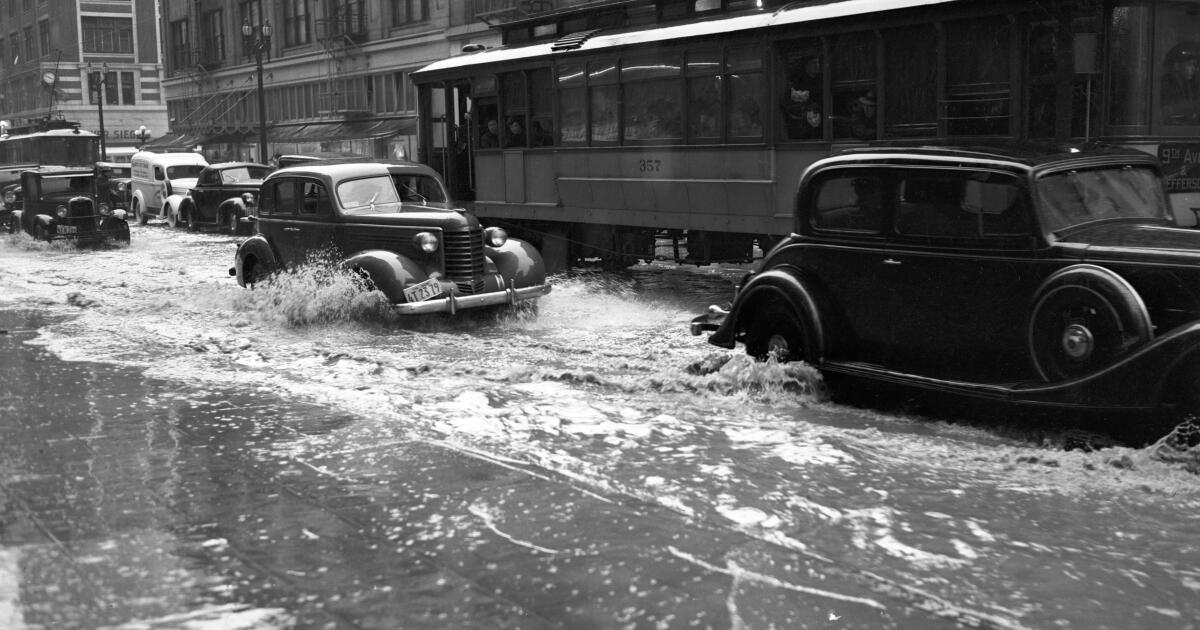
The science here is most compelling when Selby spins thermal columns, updrafts, trade winds and cloud formations into a history of California’s cities and often manmade geography. He tracks an annual winter cyclone pattern from the North Pacific all the way down to Orange County to tell the story of the 1938 flood, the consequences of which are still evident today. Up to 30 inches of rain in less than a week led to more than 100 deaths and a host of flood control measures, an overreaction that paved river channels and obliterated L.A.’s riverside habitats (and didn’t even fix the flooding problem). To this day, we’re still spending money to remove that concrete and restore lost riparian ecosystems.
Selby aims not only to explain the science of the state’s weather but also to demonstrate its ubiquitous influence on our history and society. His examples range from quotidian comedy to bizarre criminality.
He laments, for example, how San Francisco’s summertime fog and swirling winds resulted in four decades of disastrously entertaining Giants baseball, defined by freezing fans and fly balls thrown unexpectedly off course. The franchise relocated from wind-whipped Candlestick Point to a basin shielded by hills in 2000 — and finally started winning championships.
The state’s weather has also influenced its industry, including the less legitimate sectors. In Northern California’s Emerald Triangle, known for its marijuana farms, clandestine cannabis growers have taken advantage of heavy rainfall and dense forests to illegally reroute water courses. The notion might seem comical at first, but these rogues have poisoned natural ecosystems with chemicals and even murdered civilians and bandits perceived as threats.
Selby thus relates the state’s weather to its people — who may act in accordance with or, more interestingly, in defiance of it — offering respite from the book’s drier passages.
His greatest gift to readers is to reveal the climate as an indomitable equalizer. He consults great wordsmiths such as Joan Didion, Joni Mitchell and Annie Dillard to convey the fear and awe that California weather inspires. Patience and perseverance through the book’s atmospheric science pays off: When Selby concludes, “Earth’s natural rhythms, cycles, and systems will always rule our lives in the long run,” we know just how true this is. And a sky watcher should wax philosophical every once in a while.
In the book’s final chapter, on climate change, Selby juxtaposes early settlers’ primitive or nonexistent means of forecasting the weather with today’s mind-blowing technologies. He notes that although more and more Californians live on disaster-prone terrain, the number of lives lost to weather-related disasters has dropped, thanks partly to the availability of such information. If I’ve ever taken my weather app for granted, I won’t do so again anytime soon.
Now about that windstorm. A relatively stable air mass blows from southwest to northeast over the Transverse Ranges north of L.A. That air rushes down the northern side of the mountains as if on a roller coaster, reaching such velocity that it drops below its level of equilibrium and blasts across the desert floor. To compensate for this sudden change, the winds loop back toward the mountains and mix with the remaining stable air mass, creating oscillations that animate dust storms.
As dramatic and frightening as it was to experience, it’s an annual occurrence that wreaks regular havoc across the desert. Fortunately, we made it back safely to L.A. and a windless, 62-degree day in the middle of February. Behold, the Golden State.
Daniel Vitale is a writer in Los Angeles and the author of the novel “Orphans of Canland.”


new video loaded: NASA Announces Artemis III Crew
transcript
transcript
NASA Announces Artemis III Crew
NASA announced the crew of Artemis III mission, which will fly to low-Earth orbit to test rendezvous and docking maneuvers with one or two lunar landers.
-
“I am excited to welcome you as the next crew in the Artemis journey to successfully return to the moon — this time to stay.” “I’m honored by the role that I’ve been given. I’m also very humbled by the task in front of us. But first and foremost, I’m grateful.” “So with that, the Artemis II crew, comrade, hands you the baton. You got the controls.” “As you know, we had a significant anomaly at our Launch Complex 36A on May 28. We’ve redoubled our efforts and are moving forward.”
By Alisa Shodiyev Kaff
June 9, 2026
Science
Santa Monica Mountains’ last steelhead trout survived the Palisades fire — and even had babies

Scientists feared the Santa Monica Mountains’ last remaining steelhead trout were dead, smothered by debris flows unleashed by the Palisades fire.
But the endangered fish surprised them: A team of biologists recently spotted 30 of the rare trout — and 21 babies — in Topanga Creek.
“There was a lot of happy dancing in the creek,” said Rosi Dagit, principal conservation biologist for the Resource Conservation District of the Santa Monica Mountains, which works with public and private landowners to conserve natural resources.
That’s because the steelhead here are endangered, at both the state and federal levels. Once, they swam in most streams of the Santa Monicas, but their numbers plummeted amid overfishing and coastal development. Increasingly frequent wildfire has further stressed their habitat. Topanga Creek, a biodiversity hot spot, is home to their last known population in the mountains that stretch from the Hollywood Hills to Point Mugu in Ventura County.
The trout that were spotted, including this one, are part of a distinct Southern California population that’s listed as endangered at the state and federal levels.
(RCDSMM Stream Team)
The California Department of Fish and Wildlife spearheaded a complex mission to rescue trout threatened by the Palisades fire that sparked in January 2025.
Time was of the essence. The fire hadn’t yet been fully contained. But rain was on the way, which would sweep massive amounts of sediment from the denuded hillsides into the water. Fish are often killed this way.
Crews stunned the fish with electricity, scooped them up in buckets, trucked them to a hatchery and ultimately moved them to Arroyo Hondo Creek in Santa Barbara County.
Within days, Topanga Creek was choked with mud. Some assumed the fish left behind were goners.
But in March, the conservation district’s team found four. The following month, when water conditions were clearer, they saw more.
“These fish continue to amaze me,” said Kyle Evans, environmental program manager for the state Department of Fish and Wildlife, who had seen the damage to the creek. “I had seen populations get wiped out in similar situations. So when I heard, I was thrilled.”
Evans surmises the fish that survived were in an area of the creek where less charred material and sediment were swept in.
“These fish likely hunkered down, were hiding under some rocks or places to try to get away from the main concentration of flow,” he said. “And luckily they weren’t buried.”
The ones that were spotted were fairly small, around 6 to 14 inches. Rainbow trout and steelhead trout are the same species, but with different lifestyles. If the fish remain in freshwater, they’ll be considered rainbows. However, they can migrate to the ocean and become steelhead, where they typically grow larger before returning to their natal waters to spawn.
Topanga Creek hasn’t fully recovered from the damage it sustained, but scientists say it’s looking better. Surveys last year were “so depressing,” Dagit said, with very few animals, and stretches that were essentially transformed into flat roads from all the sediment buildup. Some of the riparian canopy burned right down to the creek.
Then came 32 inches of rain over the last nine months, scouring out and moving sediment, creating deeper pools. Dagit said they recently found newt egg masses for the first time in years, as well as a few adult newts and many frogs. Plants that provide cover are starting to recover.
She provided photos comparing certain pools last year and this year, some dramatically transformed. In September 2025, the Shrine Pool could have been an overgrown hiking trail. This April, it was filled with shallow water.

The Shrine Pool in September 2025, left, and the same location in April 2026, right, with RCDSMM’s Isaac Yelchin donning a wetsuit.
(RCDSMM Stream Team)
Topanga Creek is home to another endangered fish, the small but hardy northern tidewater goby, often described as cute. Not long before the trout operation, Dagit led a rescue of hundreds of these fish too. Many were repatriated to the lagoon at the mouth of the creek in a moving ceremony last June.
There’s still the matter of what to do with the trout that were moved to Santa Barbara County last year. Evans would like to bring them home to the Santa Monicas at some point, but isn’t sure if it will happen. On one hand, they could bolster the small, genetically isolated surviving population. On the other, they might inadvertently bring in a disease or bacteria. There is some time to decide. Evans estimates the creek still needs to recover for two to three more years.
For now, the fish are functioning fine in their adopted creek. Experts worried the trauma wrought by the move would disrupt their spawning process, but they had babies that spring. This year, they spawned again.

The Pacifica Municipal Pier was shut down and taped off Thursday after city workers noticed cracks running through the landmark structure and concrete chunks falling into the ocean.
It’s just one of many coastal California structures that have recently crumbled under pressure from a rising and relentless ocean.
Officials from the small, beach city south of San Francisco said the pier was closed due to “cracking, separation, and displacement of the concrete walkway and structural elements.”
It will stay closed while structural engineers asses its safety.
Photos taken by city employees show a wide crack that runs from top to bottom and across the structure as well. Other photos show a large horizontal crack under the foundation of a small restaurant on the pier, the Chit Chat Cafe.
The cafe was also shut down.
This is not the first time the 53-year-old pier has shown signs of stress. In 2021, part of it was shut down after handrails along the edge collapsed. And in 2023, after a series of storms pummeled the Central California coast, damaging parts of the pier, the structure was partially closed for more than year.
Those same storms caused extensive damage in Aptos and Capitola, 70 miles south, where piers and waterfront infrastructure were swept away or damaged.
In 2024, a 150- to 180- foot section of the Santa Cruz wharf was ripped off by powerful waves.
At least 10 of the state’s dozens of coastal public piers were closed for part or all of 2024 due to structural damage sustained in winter storms since 2022. At least five others have longer-term upgrades planned to address structural issues.
“These things are costly to maintain,” said Zach Plopper, senior environmental director at Surfrider. “They are a part of our California coastal culture in many ways, but we’re going to need to reckon with, one, the state that they’re in, and two, the continuous and worsening threats they’re going to experience,”
He said most of the piers were constructed in the early 1900s, and they weren’t built to withstand decades of rough seas, storms and rising sea level.
“With this incoming El Niño, which is forecasted to be significant, and this marine heat wave we’re in the midst of, we’re kind of in uncharted waters as far as what this winter could bring in terms of storms and swells to the California coast, and we’re likely going to see a lot more damage,” he said. “Not just piers, but roads and other coastal infrastructure up and down the state.”
There was no storm in Pacifica earlier this week, so no single event could be blamed for the destruction.
However, a 2025 report from an outside engineering firm, GHD, found that several sections of the pier were in “poor” or “serious” condition, and they recommended closure before anticipated storms or events that could “subject the piles to high winds, swells and large waves.”
The firm found several areas of the pier where concrete was missing and rebar was exposed and corroding.
“The pier has continued to experience high winds and large waves in a harsh marine environment,” the engineers wrote in the report, noting that continuous exposure to seawater or marine spray was “detrimental” to the structure.
A 2023 city report estimated it would cost $19 million to repair.
That same year, a state law was enacted to require local governments along the California coast to plan for sea level rise in the coming decades.
Sea level has risen some 8 inches, on average, along the coast in the past 150 years, Plopper said, and researchers anticipate another foot in the next 25 years.
“We’re going to see profound shifts on our coastline, none that we have ever experienced before, and building static structures on the coast just doesn’t work all that well,” he said. “We’re going to have to make some really hard decisions.”
-

 New Jersey39 seconds ago
New Jersey Food Council kicks off nationwide search for new CEO
-

 North Carolina4 minutes ago
4 charged after massive party in Alamance County ends with gunfire, stabbing, fights
-

 New Mexico4 minutes ago
The Battle of Socorro, New Mexico and the Uprising Against AI Data Centers
-

 North Dakota16 minutes ago
North Dakota election results: Latest on US House primary race
-

 Ohio19 minutes ago
$150,000 funding to be voted on for the Lisbon pool
-

 Oklahoma31 minutes ago
Oklahoma primary election guide for Bartians
-

 Oregon34 minutes ago
‘Changed my life’: Portland man warns of Facebook Marketplace dangers after robbery leaves him injured
-
 South-Carolina39 minutes ago
Evette and Wilson advance to runoff for South Carolina governor while Graham clinches nomination

