West
Democrat governors reel from Biden's Putin-Zelenskyy gaffe, implications for US leadership on world stage

SALT LAKE CITY – A handful of Democratic governors explained to Fox News Digital whether they’d prefer that President Biden step aside from his re-election bid, as the commander-in-chief once again raised eyebrows with back-to-back gaffes confusing Vice President Kamala Harris with former President Donald Trump and Ukrainian President Volodymyr Zelenskyy with Russia’s Vladimir Putin on the same day.
A day after Biden introduced Zelenskyy at the NATO conference in Washington, D.C., as “President Putin,” the Ukrainian leader was on the ground in Salt Lake City, Utah, where he addressed the attendees of the National Governor’s Association (NGA) summer meeting.
Zelenskyy on Friday described the more than two-year-long conflict as “the most transparent battle between good and evil of our time,” expressing gratitude for “American leadership” in response to what he categorized as Russia’s “unprovoked and unjust aggression.”
Fox News Digital asked Colorado Gov. Jared Polis, a Democrat and the incoming 2024-2024 NGA chair, after the speech about whether, given Biden’s confusion of Zelenskyy for Putin a day earlier, the American president is a strong enough candidate to represent the United States on the world stage.
CAMPAIGN CRISIS: DEMS WHO HAVE CALLED FOR BIDEN TO DROP OUT OR RAISED CONCERNS ABOUT HIS HEALTH
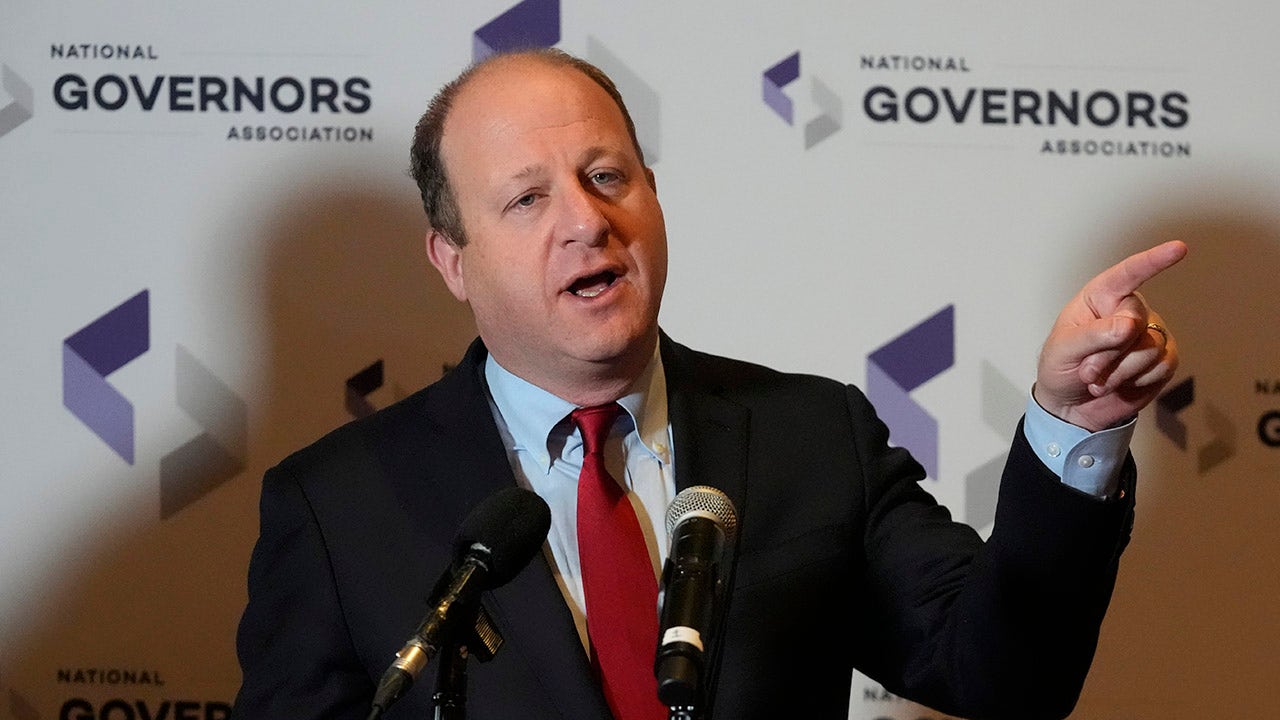
Colorado Gov. Jared Polis speaks at a news conference at the National Governors Association 2024 summer meeting on Friday, July 12, 2024, in Salt Lake City. (AP Photo/Rick Bowmer)
But Polis dodged addressing Biden’s mix-up directly. “I’ve been at this conference all day, so I’m not aware of what you’re referring to,” Polis said. “But I think President Zelensky gave a really strong case for why this is not only important for Ukraine, for Europe, but frankly, for the global world order.”
“I mean, you know, when you have a bully, you need to stand up to them. And it’s very important that Europe, America, our Asian allies, stand up to Putin’s aggression,” Polis said. He added that Zelenskyy “made it very clear” he’s not asking for U.S. boots on the ground, putting American lives at risk.
Ukraine’s President Volodymyr Zelenskyy waves after speaking at the National Governors Association summer meeting Friday, July 12, 2024, in Salt Lake City. (AP Photo/Rick Bowmer)
“They’re asking for our help. I think there was strong consensus among the governors that we want to do what we can,” Polis said. “In fact, the single biggest ask, and this really speaks to what is going on, is they need to construct more bomb shelters at their schools, at their hospitals. Russia’s been indiscriminate in their campaign of terrorism against the Ukrainian people. So it’s very important that we unite and stand up against that.”
Polis did, however, admit that there’s discussion of changing strategy, whether that be the “campaign message” or the “candidate,” to ensure Democrats stay competitive enough to win in November.
“Of course, Democrats could win in November. It’s a very close election. I think it’s also fair and objective to say, yes, that, President Biden is behind, not by a lot, but he is behind. If the election was today, we’d likely lose,” Polis said. “Which means that we need to change something as a strategy, to protect freedom, protect our democracy. We need to look at what that strategy is. Does it mean changing the campaign strategy? Campaign message? The candidate? All of these things are being discussed.”
“I want to make sure that we put our very best foot forward to protect our democracy going forward, which includes, of course, support for NATO, and, global world order, the policies and the progress you’ve achieved over the last four years,” the governor added. “When you’re behind, it doesn’t mean you give up.”
Biden again on Friday night emphatically stated that he is running and going to win.
YEARSLONG TENSIONS BOIL OVER AS EX-OBAMA STAFFERS GANG UP ON BIDEN: ‘CLOONEY WAS EXACTLY RIGHT’
Fox News Digital caught up with Hawaii Gov. Josh Green, another Democrat, on the sidelines of the conference, asking whether Biden is strong enough on the world stage or if he should bow out.
In response, Green argued that both Biden and former President Donald Trump have “limitations” due to their age — but added Trump’s “personality” was more dangerous to people of both parties.
“President Biden has been extraordinary for our state. When we had a disaster, he, within six hours, he stepped up and did the major disaster declaration,” Green said, referring to the Maui wildfires. “He has helped us recover. I heard from Republicans, as governors and congresspeople, and Democrats across the board. The only person I never heard from was Mr. Trump, except for some negativity about our state. That speaks to his personality. Mr. Biden has a good heart.”
President Biden, joined by Ukrainian President Volodymyr Zelenskyy, speaks on the sidelines of the NATO Summit in Washington, Thursday, July 11, 2024. (AP Photo/Susan Walsh)
“Older people, and I would include Mr. Trump and Mr. Biden in that category, are going to miss words and there are going to be moments,” Green told Fox News Digital. “I’m a physician. I have a very keen awareness of Mr. Biden’s limitations and Mr. Trump’s limitations. And in truth, the limitations of the latter, Mr. Trump are significant because his personality ends up making policy that really, in my opinion, hurts Republicans and Democrats alike. This is, of course, you’re asking a Democrat.”
Green also vowed that he would be “with the president until he chooses not to accept the Democratic nomination, if he chooses to go a different way because Jill or Pelosi or President Obama have a heart-to-heart with them, and they make that decision together.” “That’s their decision,” the governor said. “But we should respect our leaders if they have given us decades of service. And Hawaii should respect President Biden right now because he’s given us so much to help us recover.”
As Zelenskyy spoke of the need to rebuild in Ukraine from the war, Hawaii also must rebuild after the Maui wildfires. Green, who governs a chain of islands in the south Pacific, further argued that the Ukraine conflict hits closer to home for his state, as there have been instances of Russian warships off Hawaii’s shores, and further downfall in relations between China and Taiwan or North Korea would have an immediate impact. Given those “geopolitical considerations,” he made a case that certain “expenditures” were justified, referring to the financial backing by the United States for Kyiv’s war effort.
Hawaii Gov. Josh Green speaks at the 2024 summer meeting of the National Governors Association, Thursday, July 11, 2024, in Salt Lake City. (AP Photo/Rick Bowmer)
Green still emphasized the need for a peace deal and added whether it be Biden or Trump, that “irrespective of who’s leading, this war should end.”
“It’s critically important,” he said of U.S. support for Ukraine. “There are very real security issues off of the coast of Hawaii. There have been Russian warships that have come into the region, which we are monitoring at all times. That happens with some frequency. They’re gathering data. And so all I can say is this. We should support President Zelenskyy, period. We should support his people. Because from a humanitarian standpoint is a tragedy in that the Russian government and Mr. Putin are continuing this war. I would humbly ask that they stop the war, and we would call for a peace treaty, because it is scary to think of how many people are lost. Also on the Russian side, lost lives.”
Asked whether Biden was a strong enough candidate to face Trump in November, Green claimed the abortion issue would be enough to win the Democrat incumbent another four years.
“If women make the choice and I mean Republican women, independent women and Democratic women make the choice that their reproductive rights are important to them, enough of them will choose Biden and he would win the election,” the governor said. “Biden was bad during that debate. Trump was bad during that debate. If you really want to know the truth. So we’ll just see what happens. But there are 65 million women of reproductive age, which I think who are going to have something to say about this election. And if they choose the former president. That’s democracy. If they choose Biden, they’re probably looking out for their daughters.”
Delaware Gov. John Carney looks on during the 2024 summer meeting of the National Governors Association, Thursday, July 11, 2024, in Salt Lake City. (AP Photo/Rick Bowmer)
Delaware Gov. John Carney, a Democrat leading Biden’s home state, told Fox News Digital at the NGA summer meeting on Thursday that despite Biden’s disastrous debate performance, he feels the president should stay in the race. The 2023-2024 initiative of the outgoing NGA Chair, Republican Utah Gov. Spencer Cox was to “Disagree Better,” emphasizing the need for civility between opposing parties when discussing conflicts of opinions. Carney argued that Biden was the best candidate to continue that spirit.
“I’m on the record is that he should stay in the race. You know, I see him frequently. You know, I’ve been to the White House and, you know, I’ve known him for years and know what he stands for. He’s just this kind of person that’s tried to bring the various sides and perspectives together,” Carney said. “And I heard this whole conversation about disagreeing better. I would argue that he’s the best person to lead the country forward in that respect. With respect to the Democrats and the discussion that’s going on about that candidacy, my perception is that everyone is doing it respectfully.”
Read the full article from Here


Acres: 7,769 acres
Start Date: June 9, 2026
Location: 18 miles southeast of Quemado, NM
Personnel: 169
Containment: 100%
Cause: Lightning
Summary: Containment lines are holding, and much of the repair work is completed on the Bear Fire. The Gila Las Cruces Type 3 Incident Management Team will transfer command of the fire back to the Gila National Forest and a Type 4 Incident Commander on Wednesday morning. Firefighters will continue to patrol and secure the perimeter while repair is completed.
Remarking on the success of firefighters on the Bear Fire, Incident Commander Marcus Cornwell said, “The support from the State of New Mexico Forestry Division, local landowners, and the Village of Quemado were instrumental in helping suppress the fire. Providing firefighters access to private land and use of Quemado High School proved pivotal.”
This will be the last daily update provided by the Gila Las Cruces Type 3 Incident Management Team. Any future updates for the Bear Fire will come from the Gila National Forest.
Weather: Today’s high temperature will be in the mid 80s. Moisture moving in from the south will improve relative humidity and drop temperatures slightly. The forecast shows daily chances of thunderstorms through Friday.
Safety: A Temporary Flight Restriction is in place through this evening. If you fly, we can’t! The Gila National Forest enacted an Area Closure Order for the Bear Fire.
Evacuations: Catron County Emergency Management lifted SET status for residences within zones 2, 3 and 4 on Thursday, June 18th. For more information about the change in evacuation status, visit Catron County Emergency Management.
Smoke: Smoke may be visible in and around surrounding communities. Air quality will vary based on fire activity, weather, and wind patterns. Residents should reduce prolonged outdoor activity when smoke is present and check the Air Quality Index before recreating or working outdoors. Sensitive groups should take extra precautions to limit smoke exposure. For real-time smoke conditions, visit https://fire.airnow.gov.
Fire Restrictions: The Gila National Forest is in Stage 1 Fire Restrictions due to long term severe drought in the Gila region, increased tree mortality across the forest, and forecasted hotter, drier weather conditions. Stage 1 Fire Restrictions limit campfires on forest land to designated recreation sites and campgrounds with constructed metal fire rings. Open burning is also prohibited in the unincorporated area of Catron County and in Catron County Fire District 30.
Public Information: 2026.bear@firenet.gov
Incident Information:
Facebook: www.facebook.com/GilaNForest
InciWeb: https://inciweb.wildfire.gov/nmgnf-bear-fire
###

PORTLAND Ore. (KPTV) – Fireworks are on sale in Oregon until July 6, but state and local rules limit where they can be used and what types are allowed.
In Portland, fireworks use and sales are banned year-round.
Fireworks are also banned on beaches and in state and national parks.
Statewide, fireworks that fly into the air, explode, act unpredictably or move more than 12 feet horizontally are illegal. Banned fireworks include sky lanterns, missiles, rockets, Roman candles, firecrackers, cherry bombs and M-80s.
Fountains, sparklers, ground spinners and smoke devices are among the fireworks allowed under state rules.
Officials said people should not call 911 to report illegal fireworks. They said reports should go to the non-emergency line for the area.
First responders said there were 263 fires across Portland during last year’s fireworks season, and 27 were caused by fireworks.
For more details about fireworks regulation in Oregon, click here.
In Washington, fireworks sales legally begin Sunday and run through July 4.
Copyright 2026 KPTV-KPDX. All rights reserved.

The Utah Jazz are just hours away from the 2026 NBA Draft to determine who will be their franchise’s next cornerstone piece to add into their exciting core with their second-overall pick on the board.
And in the lead-up to the Jazz’s selection, there’s been tons of buzz surrounding who will be the one landing at that No. 2 slot. Between AJ Dybantsa, Darryn Peterson, and Cameron Boozer, each has seen various connections to Utah as being the guy they’ll end up with.
However, as we continue to get closer to when the Jazz are on the clock, we’re starting to get some clearer intel on who their selection ultimately might be. And in reality, it might just be a two-man race, rather than three.
Darryn Peterson Remains in the Driver’s Seat at No. 2
ESPN‘s Jeremy Woo recently released his final 2026 mock sorting out how each of the draft’s 60 picks are going to go. When it came to the Jazz, the pick would be none other than Kansas guard Darryn Peterson; someone that Utah has reportedly shown “strong interest” in leading up to the draft.
If Peterson ends up going first to the Washington Wizards, though, AJ Dybantsa seems like the most likely outcome for the Jazz at two.
“Sources say the Jazz have shown strong interest in Peterson throughout the process, and the expectation from rival teams has been that Utah will pick whichever of Peterson or Dybantsa falls to them,” Woo wrote.
“Peterson’s initial decision to only visit Washington was more reflective of his confidence in his security as a top pick and desire to hear his name called first.”
Despite the noise that had surrounding Peterson, his canceled workout, and any possible disinterest in landing with Utah, that buzz has since been shut down in the days leading up to Tuesday night’s first round.
Not only did Peterson confirm he has met with the Jazz before coming to New York following his canceled draft workout, but he also made it clear at Monday’s media day that he’s not dodging any team that’s willing to select him.
That, of course, would include the Jazz. So no worries on that front.
But even if Peterson does end up going ahead of the Jazz’s slot in what would be a surprise pickup for the Wizards at the first pick, Utah’s decision looks like it could be a relatively simple one. BYU’s AJ Dybantsa would be sitting up for grabs, and would be an ideal fit on the wing to Utah’s two-guard spot for the future.
So if Woo’s intel is a sign of anything, it seems like, even with the appeal that might be had in Duke’s Cameron Boozer as a potential option at number two, he’s looking more and more like the odd man out when it comes to being the guy for Utah.
Both Peterson and Dybantsa have a projected ceiling that tops what Boozer brings to the table, and fits better with this current Jazz core as their future two-guard. In a draft where all three prospects are seen as franchise-changing talents, those factors might just be what’s narrowly separated the top two as the targets to watch for Utah.
All of the chatter that’s ensued before the draft surrounding who the Jazz are going to take with their highest pick on the board in over 40 years will officially come to an end Tuesday night. But with the time quickly approaching before that decision becomes final, the writing might be on the wall for who they’ll be landing on.
Be sure to follow Utah Jazz On SI on X for daily Utah Jazz news, rumors and analysis!
 Add us as a preferred source on Google
Follow
-

 New Mexico6 minutes ago
Bear Fire Update for June 23, 2026
-

 North Dakota16 minutes ago
Timothy Paul Ganyo
-

 Ohio21 minutes ago
GALLERY: Photos of former Ohio State football coach Jim Tressel
-

 Oklahoma28 minutes ago
OHP remembers K-9 for protecting countless lives during career
-

 Oregon31 minutes ago
Fireworks on sale in Oregon until July 6
-

 Pennsylvania36 minutes ago
Pennsylvania company builds goals for US Soccer, FIFA World Cup matches
-

 Rhode Island43 minutes ago
Ethics Commission denies Shekarchi’s motion to dismiss high court bid ethics complaint
-

 South-Carolina46 minutes ago
Inside TCMU’s new SC 250 exhibit

