Uncommon Knowledge
Newsweek is committed to challenging conventional wisdom and finding connections in the search for common ground.


Officials in Texas continue to urge nearly 163,000 residents to boil their drinking water several days after Hurricane Beryl exited the state.
Beryl made landfall in Texas on Monday as a Category 1 storm near the coastal town of Matagorda, before whipping northeast to directly batter the city of Houston, where over 2.5 million in the area quickly lost their power.
The storm continued to roar through Texas and other portions of the U.S. in a northeasterly path, sparking a swarm of tornadoes in multiple states as it diminished in strength and eventually passed into Canada.
While Beryl left at least 10 people dead in Texas and inflicted significant damage to property, many residents impacted by the hurricane in the Lone Star State were also continuing to struggle with a lack of power and clean drinking water four days later.
By Friday, Texas had more than 700,000 power outages that remained unresolved, while some 162,895 residents in 22 counties were under a “Boil Water Notice” (BWN) due to drinking water systems that had been compromised by the storm.
“As of 12:30pm today, we are tracking 259 drinking water systems that are on a BWN serving a population of 162,895,” a spokesperson for the Texas Commission on Environmental Quality (TCEQ) told Newsweek via email on Friday. “The drinking water systems on BWNs are spread across 22 counties impacted by the hurricane.”
The following is a list of the affected counties, water systems and number of residents that were still being asked to boil their water as of Friday afternoon:
Residents who are uncertain about the safety of their drinking water should contact their local water utility for additional information and updates.
Water systems can be damaged by hurricanes and other powerful storms due to power outages, service line breaks or flooding, potentially allowing what would otherwise be safe drinking water to become contaminated by dangerous pathogens.
In systems under a BWN, water may not be safe to drink unless it has been boiled vigorously for at least two minutes. The TCEQ website offers a series of safe water use tips for those affected.
Newsweek is committed to challenging conventional wisdom and finding connections in the search for common ground.
Newsweek is committed to challenging conventional wisdom and finding connections in the search for common ground.


***Note: If you want the latest updates make sure to refresh the story***
First Inning:
Top: Karlyn Pickens strikes the first batter out. Texas Tech hits a single that went off the glove of Pickens. Jackie Lis comes to the plate. She advances the runner, but she grounds out to short. Pickens gets a massive strikeout to end the inning. Great job by the Lady Vols ace.
Bottom: Tennessee will now come to the plate. Kaitlyn Terry is the pitcher for the Red Raiders. Sophia Knight will start it off. Knight hits an infield single thanks to her speed. Here comes game one’s MVP, Elsa Morrison. Morrison strikes out. Ella Dodge hits a grounder to second, which gets the runner out, but she is safe at first. Emma Clarke hits a line out to Williams at second base to end the inning, as she had to make a vertical effort to bring that one down.
Second Inning:
Top: Here comes former Lady Vol Taylor Pannell. She pops out. Pickens will face the Red Raiders’ pitcher, who also hits. Pickens gets the Lady Vols off the field.
Bottom: Leach lines out to begin the inning. Makenzie Butt pops out to right field, which will be out No. 2. Gabby Leach is out to end the inning for the Lady Vols.
Third Inning:
Top: Quiroga lines out to begin the inning, and Pickens continues to move strongly. Halleman grounded out to second for out No. 2. Williams grounded out to third, which will get the Lady Vols off the field.
Bottom: Bella Faw singles to get on base. Holley grounds out, but Faw advances to second. Knight is struck by a pitch, and there are now two on base for the Lady Vols with only one out this inning. This gives Tennessee two on with a runner in scoring position. Here comes the Red Raiders’ ace, Nija Canady. Morrison fouls out. A wild pitch advances both runners. One at third and one at second now with two outs. Dodge is hit by a pitch, and bases are now loaded for the Lady Vols. Canady forced a full count for Clarke with bases loaded, and Clarke collided with Lis around first base, and the bases were left loaded. Texas Tech escapes.
Fourth Inning:
Top: Pickens forces a groundout. Lis grounds out, and the Lady Vols have put two away quickly. Pickens retires her 11th straight batter after forcing a groundout to second base.
Bottom: Leach reaches to begin the inning. It was via an error. She will be taken out of the game for a pinch runner. Saviya Morgan is on base. Makenzie Butt is up to bat. Canady strikes Butt out. Morgan gets picked off at second base. Gabby Leach hits a single to center field.
The Tennessee Lady Vols are set for their next matchup in the softball realm, as this is the second game they will play in the Women’s College World Series. In their first game, they were victorious against the Texas Longhorns, as they defeated the Longhorns by a score of 6-3 in a game in which they were viewed as the underdogs. Now they will have to play another great team with the hopes of continuing to hold on to their advantage of having no losses in a two-loss tournament. After today, only two of the eight teams that advanced and two of the six teams that remain will be able to say that.
The Lady Vols are up first out of the two games today, and they will be playing against the Texas Tech Red Raiders. The Red Raiders are entering this game with no losses after defeating the Mississippi State Bulldogs in their game. The Bulldogs entered the event as the biggest underdog, but the Red Raiders can compete with any of the teams at the event. They had to defeat a Florida Gators team that won a series against the Lady Vols to get to the Women’s College World Series.
This game will be one of the more anticipated games in the whole tournament, as this may not even be the only time that these two match up throughout the World Series. Regardless, the Tennessee Lady Vols will look for another big moment in the biggest game of their season thus far.
Follow Our Social Media Accounts
• Follow Vols on SI on X (Click HERE)
• Follow Vols on SI on Facebook (Click HERE)
• Follow Vols on SI on Instagram (Click HERE)
• Subscribe to Vols on SI on YouTube (Click HERE)
Follow Our Staff on X
• Follow Caleb Sisk on X (Click HERE)
• Follow Dale Dowden on X (Click HERE)
Follow Our Staff on Instagram
• Follow Caleb Sisk on Instagram (Click HERE)
• Follow Dale Dowden on Instagram (Click HERE)
Follow Our Staff on Facebook
• Follow Caleb Sisk on Facebook (Click HERE)
• Follow Dale Dowden on Facebook (Click HERE)
Subscribe to Our Newsletter
• You can join our newsletter (HERE)
 Add us as a preferred source on Google
Follow
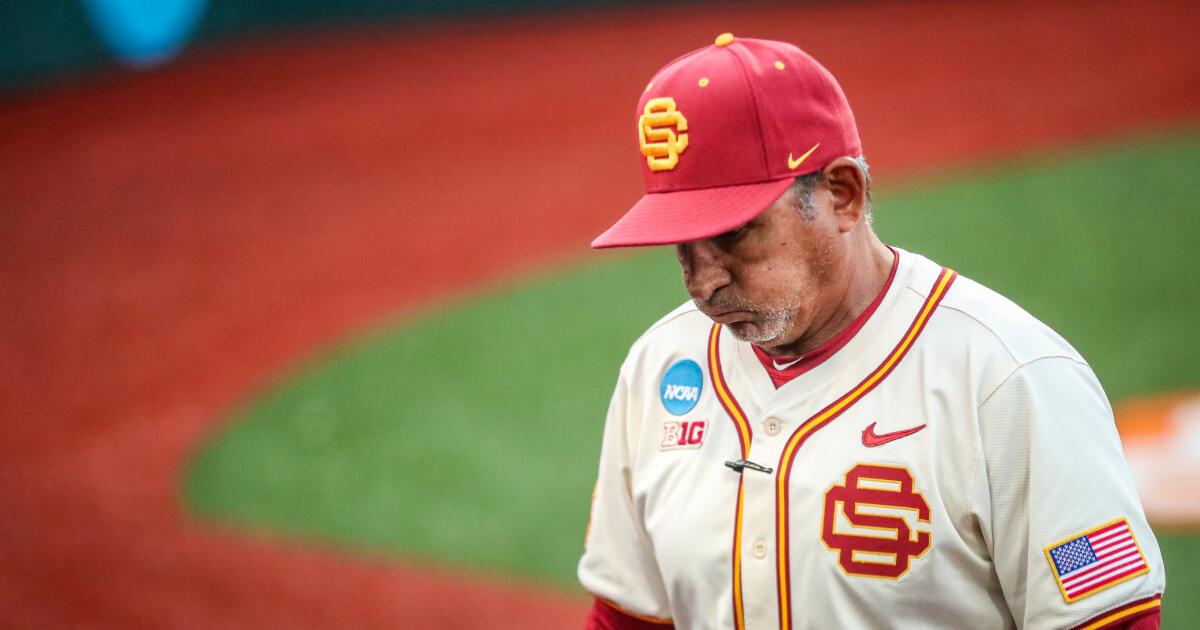
COLLEGE STATION, Texas — After spending most of Friday night wasting scoring opportunities, Adrian Lopez and his USC teammates headed into the ninth inning with plenty of confidence. Unfortunately for the Trojans, Texas State wasn’t done yet.
Lopez gave the Trojans the lead in the eighth inning with a home run at Blue Bell Park, but USC couldn’t close out the opener of the NCAA tournament’s College Station Regional.
Texas State’s Chase Mora greeted USC closer Adam Troy with a monstrous two-run home run to left field in the top of ninth, propelling the Bobcats to 5-4 upset before a crowd of 6,956.
“To take the lead right there late, we’re riding high feeling real good and confident going into the ninth,” Lopez said. “I think … the ball fell how it fell. It is what it is. But we’re pretty stoked and excited going into the ninth with the lead.”
Texas State coach Steve Trout mused that it felt as though the Bobcats were “on the ropes” all night. As trite as that might sound, he’s right.
Unfortunately for the Trojans, they never could deliver the knockout punch. Texas State wasn’t as forgiving. Mora was sitting on Troy’s fastball, and he pounced for his 11th home run of the year.
“Sure enough,” Mora said, “I got the pitch I was sitting on and made a good swing.”
Troy’s blown save was a major part of the story. He arguably wasn’t the biggest reason USC lost, though. The Trojans had plenty of chances. They wasted most of them, leaving 13 men on base on a night they struck out 12 times.
Moreover, the Trojans wasted a major bases-loaded scoring opportunity when Isaac Cadena was picked off at second base for the second out of the fifth. Walter Urbon then flew out to right to end the threat.
“We got picked off there at second base with one out,” USC coach Andy Stankiewicz said. “That was kind of a gut shot. We have to be better on the bases. We have to be a little more aware when we get off the bag there.
“I thought we executed fine to get runners where we needed to get them. The second part is we got to get them across home plate. That’s the part we didn’t do as well tonight.”
The Bobcats’ shaky defense spotted USC two unearned runs. The Trojans will surely lament, however, stranding runners in scoring position in each of the first seven innings.
The Trojans will now prepare to face Lamar University, which blew a five-run lead in a 7-5 loss to host Texas A&M earlier Friday.
If Stankiewicz’s Trojans return to the College World Series for the first time since 2001, the 12-time national champions must do it out of the losers’ bracket.
“We’re just going to battle our tails off to keep showing up,” said Abbrie Covarrubias, who gave the Trojans a 3-1 lead with a home run in the fourth inning. “We’re in the fire, so we’re just going to battle our way through and pour our hearts out really.”
USC right-hander Grant Govel, an All-Big Ten First Team selection, settled for a no-decision after giving up three runs on four hits with two walks and six strikeouts over 5 ⅔ innings.
He was relieved by freshman left-hander Sax Matson with one on and two outs in the top of the sixth. Matson escaped unscathed in the sixth, but he was relieved by right-hander Andrew Johnson with one on and two outs in the seventh.
The Trojans, who reached the Big Ten Tournament semifinals, have lost four of their last five games.
“We left some runners in scoring position,” Stankiewicz said. “I’d like to have those back. But they made some pitches when they needed to.”
Stankiewicz, Adrian Lopez and Covarrubias are adamant that they believe in Troy, who has a team-leading 12 saves this season. No other Trojan has more than three saves.
“He’s been our guy, like coach said,” Lopez said of Troy. “He has a number … of saves. We trust him with everything we have. I wouldn’t want anyone else throwing the last couple pitches of the game. Going tomorrow, everyone’s available. If he’s back in that same situation, I’m just as confident as ever.”

OKLAHOMA CITY — Mississippi State softball is playing in an elimination game at the Women’s College World Series.
The Bulldogs (43-20) are facing No. 2 seed Texas (47-12) at Devon Park on May 29 (6 p.m. CT, ESPN).
Mississippi State and its fans are doing everything they can to muster up some good luck, including using broccoli, which has become the team’s rally prop throughout the NCAA Tournament.
Some fans and parents of the players are even wearing T-shirts with images of broccoli on them that read “Broccoli Power.”
Here’s what to know about the shirts and why MSU is wearing them.
Broccoli became MSU’s good luck charm after a fan known as Broccoli Guy started cheering them on at the Eugene Regional.
He used broccoli as pom-poms while dancing in the stands. For the regional final, MSU brought broccoli for players to hold in the dugout for good luck.
This trend continued during the super regionals, with MSU bringing broccoli on the bus, holding it in the dugout and posting pictures and videos of it on social media ahead of Game 3 against Oklahoma. Broccoli Guy also showed up to support the Bulldogs again.
Now, with the Bulldogs facing elimination at the WCWS, fans, parents and players are hoping the broccoli shirts, along with their physical stalks of broccoli, will help power them to a win over the Longhorns.
All times CT
Tia Reid covers Jackson State sports for the Clarion Ledger. Email her at treid@usatodayco.com and follow her on X @tiareid65.


Michigan State Hosts Elite 4-Star Recruit Gideon Gash for Official Visit


Meteor over Massachusetts causes explosion reports, sightings from Delaware to Montreal

If Nolan Teasley is the “primary football executive” in Minnesota, Seahawks will get compensatory picks


Mississippi Miss Hospitality announces record scholarships for 2026 competition


Missouri Walk of Neurofibromatosis brings awareness to Columbia

ICE sued over “inhumane” conditions at Camp East Montana


What channel is Nebraska softball vs Alabama on today? WCWS game time, TV schedule


Traffic incident causes delays along I-15 near Nevada-California border


