Science
Doctors said cutting countertops destroyed his lungs. He had to fight for workers' comp


By the time that Dennys Rene Rivas Williams had fallen so ill that he needed new lungs, physicians at Olive View-UCLA Medical Center expressed little doubt about what was to blame for his sickness.
Doctors had diagnosed the 36-year-old with silicosis: an incurable disease caused by inhaling tiny bits of lung-scarring silica. It was an affliction that had debilitated dozens of workers in Los Angeles County like him, who had toiled cutting countertops bound for kitchens and bathrooms.
Health officials had sounded the alarm that a new epidemic of the illness was killing young laborers amid the rising popularity of engineered stone, which is typically much higher in silica than natural slabs. In recent years, more than a dozen California workers who cut countertops have lost their lives to the disease.
Rivas Williams’ medical records state that his silicosis was due to “engineered stone fabrication/cutting,” with a doctor advising him to quit his job to prevent further damage.
Yet Rivas Williams had been turned down when he applied for workers’ compensation, which is supposed to cover medical care and other benefits for laborers injured on the job. Attorneys representing the young father were galled, asking where else he would have inhaled so much silica.
Rivas Williams said that the Pacoima shop where he worked was blanketed in dust, and that he and other workers were offered only flimsy masks, rather than protective respirators. In January, he received a double lung transplant — a lifesaving surgery but one that often means only an additional six years of survival.
Silicosis has been known as an occupational illness for centuries, afflicting miners, stonecutters and others exposed to silica dust.
The overwhelming majority of cases are tied to work, said Dr. Jane Fazio, a pulmonary critical care physician and UCLA researcher. Among countertop cutters, if “someone has this job and they have silicosis, it should clearly be presumed to be work-related.”
Yet as California sees surging numbers of young workers suffering from the disease, many have not successfully tapped workers’ compensation. Assistance can include medical care, disability payments and death benefits for families.
Fazio and other researchers analyzing dozens of cases of California countertop workers suffering silicosis found that only 13% had workers’ compensation benefits when diagnosed and treated. Nearly half kept working in the industry even after getting the diagnosis.
Workers’ compensation is supposed to ensure that if workers are harmed on the job, “they don’t have to swap their livelihood for their health” and “can get access to medical care and time away from work and disability and other kinds of resources they may need to make themselves whole again,” said Kevin Riley, director of the UCLA Labor Occupational Safety & Health Program.
California employers are required to provide workers’ compensation benefits for their employees, typically by buying insurance coverage. A state fund can handle such claims if a business flouts the requirements, but advocates say many workers — especially immigrants — fear retaliation for even pursuing the benefits.
And workers’ compensation attorneys say lodging a claim is no guarantee that laborers will get aid quickly, even for a disease roundly recognized as stemming from work. Lawyer Gary Rodich said this summer that his firm was representing more than a dozen workers with silicosis who were denied workers’ compensation benefits when they applied — including Rivas Williams.
Before he got his diagnosis, Rivas Williams had filed a claim that mentioned damage to his lungs along with “repetitive work” injuries to his knees, shoulders and other parts of his body, aided by a different attorney. The denial letter from Amtrust North America said there wasn’t enough evidence that “your alleged injury resulted from your employment at Primus Marble,” the shop where he was working.
Shortly after he was diagnosed with silicosis, Rivas Williams submitted an amended application with the help of Rodich. In medical reports obtained for his case, doctors have drawn a direct line to his work cutting countertops. One wrote that his silicosis was “100% work related.”
Amtrust said in May that his case “involves several complex issues our claims team is working diligently to resolve.” It did not respond to questions from The Times about what those issues were.
Rivas Williams’ state disability payments ran out last year. In January, his attorneys accused the insurance company of “unreasonable and/or frivolous delay” in a court filing, saying it had left him on the verge of homelessness. At that point, nearly a year and a half had passed since his initial claim.
That same month, according to his attorneys, Amtrust agreed to pay temporary benefits as the two sides continued negotiating. Amtrust said in a May email that “we are confident a resolution will be reached soon.”
Rivas Williams has to take an array of pills morning and night to prevent his body from rejecting the new lungs. The medications disarm his immune system, leaving him vulnerable to other threats. His doctors warn him to avoid cigarette and marijuana smoke, so he shuts the windows of his South Los Angeles home.
Rivas Williams, 36, shows the scar from a double lung transplant.
(Al Seib / For The Times)
“I’m shut up almost all the time,” Rivas Williams said in Spanish in an April interview. “I’m afraid to go out because I have no defenses.”
He knows three men who have already died of the disease. When he went to say goodbye to one of them, “that mentally ruined me. I spiraled. I saw his kids cry. And I felt like I was seeing my own kids cry.”
The 36-year-old said his goal was to support his children, whom he brought to the U.S. from Guatemala. Rivas Williams said he burned through savings and piled up debts after falling ill.
“Not everything in this life is money,” Rivas Williams said. “But imagine if I’m not here.
“Their lives are going to change.”
In June — nearly two years after Rivas Williams first filed for workers’ compensation — the two sides reached a settlement. Rodich said his client declined to publicly disclose the amount.
Primus Marble, where Rivas Williams once worked, did not respond to messages seeking comment.
As of early July, the California Department of Public Health had identified 156 cases of silicosis related to engineered stone in recent years — more than 90 of them among residents of Los Angeles County. Nearly half of those cases were identified last year alone, amid growing awareness of the silicosis epidemic.
Public health officials believe many more cases have gone undetected as immigrant workers go without care or are misdiagnosed with other lung ailments. Outbreaks of the deadly disease have erupted worldwide as engineered stone has soared in popularity.
In Australia, where an alarming surge in cases led government officials to ban engineered stone, silicosis has been categorized among “deemed diseases” for workers’ compensation — those assumed to be caused by work unless there is strong evidence to the contrary.
If an Australian worker has silicosis, “I diagnose somebody. I fill out” the paperwork, said Dr. Ryan Hoy, lead physician for the occupational respiratory disease clinic at Alfred Hospital in Melbourne. “It goes to the regulator and they accept the claim. They can’t deny it.”
That doesn’t exist for countertop cutters here. California has granted “presumptive eligibility” for workers’ compensation for some ailments — such as COVID-19 illness suffered by health workers and first responders earlier in the pandemic — but not for silicosis claims from stonecutters.
In the U.S., workers’ compensation differs from state to state, but the problems that silicosis sufferers in California have encountered are not unique. In one study of silicosis patients in Wisconsin, researchers found many had run into problems getting workers’ compensation “and are frustrated by having to prove the work-relatedness of silicosis — a condition which seldom is acquired outside of work.”
Almost all were initially rejected because medical records lacked information about their work histories, which is not routinely gathered by many clinicians, the study noted.
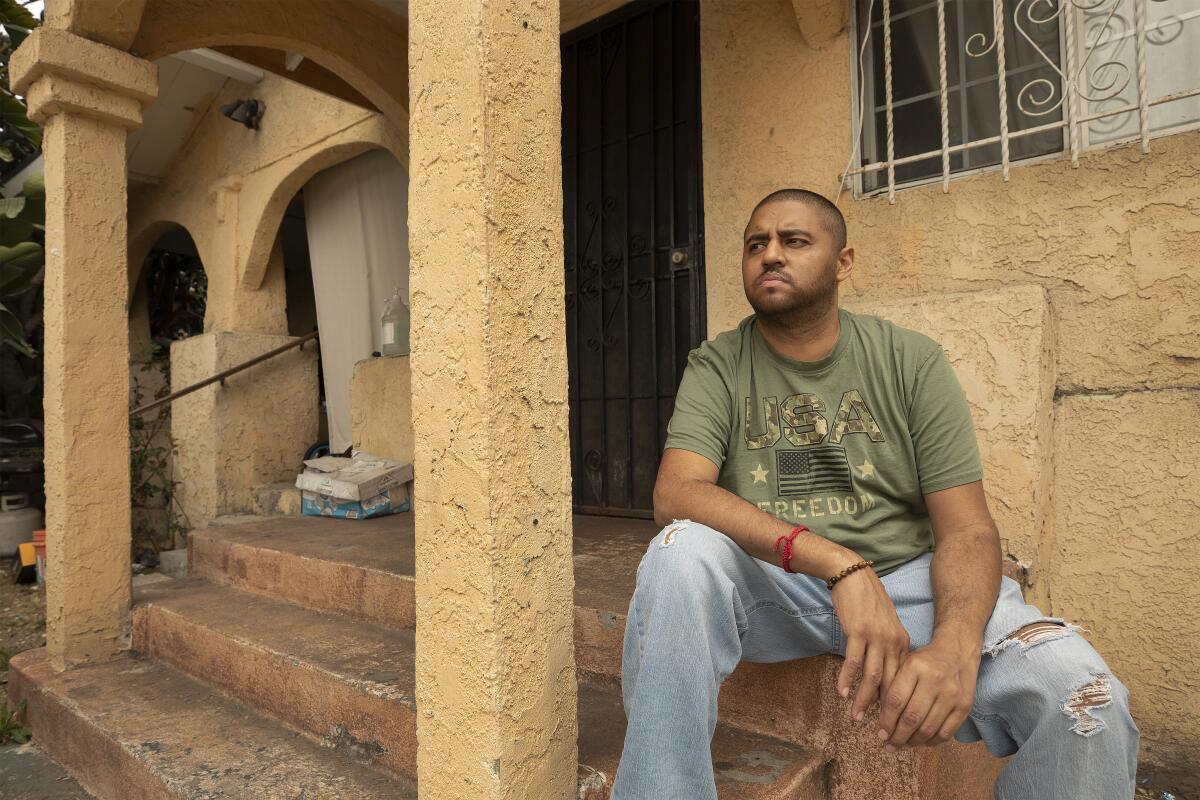
Rivas Williams says he doesn’t go out much because he takes medications that suppress his immune system after his double lung transplant.
(Al Seib / For The Times)
Too often, “doctors either don’t have the time, don’t take the time, or don’t know how to take a complete occupational history,” said Dr. Cecile Rose, an occupational pulmonologist at National Jewish Health in Denver.
Silicosis may show up years after someone is exposed, requiring doctors to also probe into past employment.
Many patients never pursue the process. One analysis of silicosis patients in Michigan, where the disease has sickened people whose work involves metal casting or abrasive blasting, found only 35% had applied for workers’ compensation — and the percentage had tumbled over time. Other studies involving a range of industries have put the numbers even lower.
“Even for clear-cut injuries, only about 50% of individuals apply for compensation,” said Dr. Kenneth Rosenman, chief of the division of occupational and environmental medicine at Michigan State University.

Rivas Williams with his wife, Monica Abigail Santos. He worries about his family. “Not everything in this life is money,” Rivas Williams said. “But imagine if I’m not here.”
(Al Seib / For The Times)
Experts said the California system tends to be smoother for workers lodging claims involving one-time injuries than for those facing diseases that developed over time. Rand senior economist Michael Dworsky estimated roughly 1 in 8 claims for workers’ compensation are initially denied in California, but said rejection rates have tended be higher for illnesses tied to workplace exposure, such as cancer or heart disease.
If injured workers fail to get workers’ comp, “it puts the burden on other resources. It puts the burden on your health insurance,” said attorney Cheryl Wallach, a board member with the advocacy group Worksafe.
Like many California workers stricken with silicosis, Rivas Williams said he was insured through Medi-Cal, California’s Medicaid program. State officials did not promptly provide figures for how much Medi-Cal pays for such care, but physicians estimated the costs of a double lung transplant exceed $1 million.
As more workers grow ill, “it’s a huge strain on taxpayers, when it really should be workers’ comp” shouldering those costs, said Dr. Sheiphali Gandhi, an assistant professor of medicine at UC San Francisco who has studied silicosis.

Science
Santa Monica Mountains’ last steelhead trout survived the Palisades fire — and even had babies

Scientists feared the Santa Monica Mountains’ last remaining steelhead trout were dead, smothered by debris flows unleashed by the Palisades fire.
But the endangered fish surprised them: A team of biologists recently spotted 30 of the rare trout — and 21 babies — in Topanga Creek.
“There was a lot of happy dancing in the creek,” said Rosi Dagit, principal conservation biologist for the Resource Conservation District of the Santa Monica Mountains, which works with public and private landowners to conserve natural resources.
That’s because the steelhead here are endangered, at both the state and federal levels. Once, they swam in most streams of the Santa Monicas, but their numbers plummeted amid overfishing and coastal development. Increasingly frequent wildfire has further stressed their habitat. Topanga Creek, a biodiversity hot spot, is home to their last known population in the mountains that stretch from the Hollywood Hills to Point Mugu in Ventura County.
The trout that were spotted, including this one, are part of a distinct Southern California population that’s listed as endangered at the state and federal levels.
(RCDSMM Stream Team)
The California Department of Fish and Wildlife spearheaded a complex mission to rescue trout threatened by the Palisades fire that sparked in January 2025.
Time was of the essence. The fire hadn’t yet been fully contained. But rain was on the way, which would sweep massive amounts of sediment from the denuded hillsides into the water. Fish are often killed this way.
Crews stunned the fish with electricity, scooped them up in buckets, trucked them to a hatchery and ultimately moved them to Arroyo Hondo Creek in Santa Barbara County.
Within days, Topanga Creek was choked with mud. Some assumed the fish left behind were goners.
But in March, the conservation district’s team found four. The following month, when water conditions were clearer, they saw more.
“These fish continue to amaze me,” said Kyle Evans, environmental program manager for the state Department of Fish and Wildlife, who had seen the damage to the creek. “I had seen populations get wiped out in similar situations. So when I heard, I was thrilled.”
Evans surmises the fish that survived were in an area of the creek where less charred material and sediment were swept in.
“These fish likely hunkered down, were hiding under some rocks or places to try to get away from the main concentration of flow,” he said. “And luckily they weren’t buried.”
The ones that were spotted were fairly small, around 6 to 14 inches. Rainbow trout and steelhead trout are the same species, but with different lifestyles. If the fish remain in freshwater, they’ll be considered rainbows. However, they can migrate to the ocean and become steelhead, where they typically grow larger before returning to their natal waters to spawn.
Topanga Creek hasn’t fully recovered from the damage it sustained, but scientists say it’s looking better. Surveys last year were “so depressing,” Dagit said, with very few animals, and stretches that were essentially transformed into flat roads from all the sediment buildup. Some of the riparian canopy burned right down to the creek.
Then came 32 inches of rain over the last nine months, scouring out and moving sediment, creating deeper pools. Dagit said they recently found newt egg masses for the first time in years, as well as a few adult newts and many frogs. Plants that provide cover are starting to recover.
She provided photos comparing certain pools last year and this year, some dramatically transformed. In September 2025, the Shrine Pool could have been an overgrown hiking trail. This April, it was filled with shallow water.

The Shrine Pool in September 2025, left, and the same location in April 2026, right, with RCDSMM’s Isaac Yelchin donning a wetsuit.
(RCDSMM Stream Team)
Topanga Creek is home to another endangered fish, the small but hardy northern tidewater goby, often described as cute. Not long before the trout operation, Dagit led a rescue of hundreds of these fish too. Many were repatriated to the lagoon at the mouth of the creek in a moving ceremony last June.
There’s still the matter of what to do with the trout that were moved to Santa Barbara County last year. Evans would like to bring them home to the Santa Monicas at some point, but isn’t sure if it will happen. On one hand, they could bolster the small, genetically isolated surviving population. On the other, they might inadvertently bring in a disease or bacteria. There is some time to decide. Evans estimates the creek still needs to recover for two to three more years.
For now, the fish are functioning fine in their adopted creek. Experts worried the trauma wrought by the move would disrupt their spawning process, but they had babies that spring. This year, they spawned again.

The Pacifica Municipal Pier was shut down and taped off Thursday after city workers noticed cracks running through the landmark structure and concrete chunks falling into the ocean.
It’s just one of many coastal California structures that have recently crumbled under pressure from a rising and relentless ocean.
Officials from the small, beach city south of San Francisco said the pier was closed due to “cracking, separation, and displacement of the concrete walkway and structural elements.”
It will stay closed while structural engineers asses its safety.
Photos taken by city employees show a wide crack that runs from top to bottom and across the structure as well. Other photos show a large horizontal crack under the foundation of a small restaurant on the pier, the Chit Chat Cafe.
The cafe was also shut down.
This is not the first time the 53-year-old pier has shown signs of stress. In 2021, part of it was shut down after handrails along the edge collapsed. And in 2023, after a series of storms pummeled the Central California coast, damaging parts of the pier, the structure was partially closed for more than year.
Those same storms caused extensive damage in Aptos and Capitola, 70 miles south, where piers and waterfront infrastructure were swept away or damaged.
In 2024, a 150- to 180- foot section of the Santa Cruz wharf was ripped off by powerful waves.
At least 10 of the state’s dozens of coastal public piers were closed for part or all of 2024 due to structural damage sustained in winter storms since 2022. At least five others have longer-term upgrades planned to address structural issues.
“These things are costly to maintain,” said Zach Plopper, senior environmental director at Surfrider. “They are a part of our California coastal culture in many ways, but we’re going to need to reckon with, one, the state that they’re in, and two, the continuous and worsening threats they’re going to experience,”
He said most of the piers were constructed in the early 1900s, and they weren’t built to withstand decades of rough seas, storms and rising sea level.
“With this incoming El Niño, which is forecasted to be significant, and this marine heat wave we’re in the midst of, we’re kind of in uncharted waters as far as what this winter could bring in terms of storms and swells to the California coast, and we’re likely going to see a lot more damage,” he said. “Not just piers, but roads and other coastal infrastructure up and down the state.”
There was no storm in Pacifica earlier this week, so no single event could be blamed for the destruction.
However, a 2025 report from an outside engineering firm, GHD, found that several sections of the pier were in “poor” or “serious” condition, and they recommended closure before anticipated storms or events that could “subject the piles to high winds, swells and large waves.”
The firm found several areas of the pier where concrete was missing and rebar was exposed and corroding.
“The pier has continued to experience high winds and large waves in a harsh marine environment,” the engineers wrote in the report, noting that continuous exposure to seawater or marine spray was “detrimental” to the structure.
A 2023 city report estimated it would cost $19 million to repair.
That same year, a state law was enacted to require local governments along the California coast to plan for sea level rise in the coming decades.
Sea level has risen some 8 inches, on average, along the coast in the past 150 years, Plopper said, and researchers anticipate another foot in the next 25 years.
“We’re going to see profound shifts on our coastline, none that we have ever experienced before, and building static structures on the coast just doesn’t work all that well,” he said. “We’re going to have to make some really hard decisions.”

The first five months of 2026 in Southern California have been the smoggiest — with the highest number of unhealtful air days — in more than a decade, according to statewide air monitoring.
So far this year, the South Coast air basin, which includes Los Angeles, Orange, Riverside and San Bernardino counties, has seen 39 days when the concentration of lung-irritating ozone (commonly known as smog) exceeded the federal standard, according to preliminary state air quality data.
That’s even worse than the infamously hot and hazy 2017, when Greater Los Angeles had 36 unhealthful air days by June 4 and ultimately saw 145.
Many of the roughly 18 million people who live in the air basin have been subjected to unhealthful levels of ozone, a highly corrosive gas that triggers asthma attacks and a wide range of respiratory illnesses. This has taken many by surprise since successive days of smog more commonly happen in summer, when heat waves and intense sunlight convert man-made pollution into ozone.
“If we have this many violations by this time, this could be a really awful year for air quality,” said Adrian Martinez, director of Earthjustice’s Right to Zero campaign, an initiative calling for the transition away from fossil fuels. “We’re already the worst place in the country for summertime smog pollution. So it could be one of the worst years in one of the worst places in the country.”
The pollution has been especially severe in valleys. On April 18, an air monitor in Reseda in the San Fernando Valley measured the second highest spike in hourly ozone levels in the last decade.
Greater Los Angeles has seen more high-smog days so far in 2026 than any other year in the past decade.
(Courtesy of South Coast Air Quality Management District)
The South Coast Air Quality Management District says the high ozone levels are due to early heat waves. Officials said they were not aware of any increase in the pollutants — most of them from different kinds of exhaust — that lead to ozone formation.
Local temperatures have been well above normal, climbing into the mid-80s and high 90s between January and April, breaking several daily high temperature records, according to the National Weather Service.
March in particular was the warmest on record in California. Riverside had an unprecedented 13 days of temperatures above 90 degrees, the weather service said.
“It was really that heat wave — conditions we typically see in July or August, we saw them in March,” said Sarah Rees, deputy executive officer of the air district. “That put us ahead of the curve in terms of how much ozone we got.”
Air district officials urged residents to monitor pollution levels on the agency’s website and mobile app, and spend only limited time outdoors when smog levels are high.
“People generally know when there’s a wildfire, because you see the smoke and smell it,” said Scott Epstein, the air district’s manager of planning and rules. “Then, it’s like, I’ve got to take precautions. Ozone, you can’t really tell.”
Southern California has been particularly susceptible to smog formation because of its millions of gas-powered cars releasing tons of tailpipe emissions each day. The region’s sunshine acts as a catalyst for smog formation. Then the mountains trap this pollution over densely populated communities.
For nearly half a century, state and local air regulators have made rules designed to alleviate this pollution, enacting the nation’s first tailpipe emission standards in 1966 and requiring catalytic converters in 1975.
Smog-forming pollution has been dramatically reduced over the last two decades, but the region still does not meet federal air quality standards for ozone.
At an air district meeting Friday in Diamond Bar, the governing board held a moment of silence for William Burke, a former longtime chair. During his tenure, the agency enacted nearly 270 rules that are credited with reducing smog-forming pollution by hundreds of tons per day. Burke, who also founded the Los Angeles Marathon, died in May at 87.
“Those are just emission reductions,” air district Chair Michael Cacciotti said at the Friday meeting. “But what it doesn’t tell you is how many kids, families, seniors were prevented from going to the hospital from an asthma attack, didn’t get cancer or other respiratory problems.”
Several residents from the Inland Empire, which suffers some of the worst smog pollution, expressed their appreciation for the air district’s efforts. But they also stressed the need for more progress.
“I’m old enough to remember growing up in the ‘70s and ‘80s … and not being able to see the mountains for weeks and months at a time,” said Erik Morden, one of several residents who spoke at the meeting.” I know things have improved, and I want to thank all of you for all the hard work that you’re doing. But there’s a lot of invisible stuff that you don’t see, that’s still out there — a lot of particulates in the ozone and chemicals that are causing a lot of problems.”
Martinez, the Earthjustice attorney, said the abnormally early outbreak of smog should be a wake-up call to government regulators that there’s work to be done, including offering more incentives to help residents and businesses transition to zero-emission appliances.
“We shouldn’t over-complicate it. We’ve got a lot of heat, we’ve got a lot of pollution,” Martinez said. “Our contention is, this agency can’t control the weather. But the one thing it can control is the pollution.”
-
 Lifestyle5 minutes ago
‘Office Romance’ stars J.Lo as a CEO with a bad case of Brett Goldstein : Pop Culture Happy Hour
-

 Technology17 minutes ago
Apple dials down Liquid Glass, and the Mac looks way better for it
-

 World20 minutes ago
US adversaries China, North Korea strengthening ties as Xi, Kim set to begin talks
-

 Politics25 minutes ago
Trump’s SAVE America Act shows signs of life in the Senate despite Republican revolt
-

 Health32 minutes ago
Woman with advanced Alzheimer’s regained speech and memories after taking magic mushrooms
-

 Sports35 minutes ago
Knicks guard nearly wipes out Michael Bloomberg diving for loose ball during NBA Finals Game 3
-

 Technology40 minutes ago
AI voice scams can clone your family’s voice
-
 Business47 minutes ago
Commentary: Here’s how Musk’s SpaceX IPO could crash your 401(k)

