Science
How Death Valley National Park tries to keep visitors alive amid record heat


As temperatures swelled to 128 degrees, Death Valley National Park rangers got a call that a group of six motorcyclists were in distress. All available medics rushed to the scene, and rangers dispatched the park’s two ambulances.
It was an “all-hands-on-deck call,” said Spencer Solomon, Death Valley National Park’s emergency medical coordinator. The superheated air was too thin for an emergency helicopter to respond, but the team requested mutual aid from nearby fire departments.
They arrived Saturday to find one motorcyclist unresponsive, and medics labored unsuccessfully to resuscitate him. Another rider who had fallen unconscious was loaded into an ambulance, where emergency medical technicians attempted to rapidly cool the victim with ice as they transported him to an intensive care unit in Las Vegas. The four other motorcyclists were treated at the site and released.
With record heat blanketing California and much of the West recently, Death Valley has hit at least 125 degrees every day since the Fourth of July, and that streak isn’t likely to change until the weekend, according to the National Weather Service.
Tourist Dave Hsu, left, feigns a chill as friend Tom Black takes a photograph at the Furnace Creek Visitor Center’s digital thermometer.
Extreme heat is both one of Death Valley’s greatest intrigues and its most serious safety concern. It’s not uncommon for a few people to die in the park from heatstroke in any given summer.
Located 200 feet below sea level and surrounded by steep, towering mountain ranges that trap heat, the valley is consistently among the hottest places on Earth.
In the summer, international travelers often schedule their trips without considering the weather. (All six of the men who fell victim to extreme temperatures near Badwater Basin on Saturday were from Germany.)
But even Southern California residents who are familiar with Death Valley’s hellish reputation will trek to the park just to experience the otherworldly heat.
“In L.A., people said, ‘No, don’t go out there; you’re crazy,’” said Nick Van Schaick, who visited the park early this week. He had spent the night in the nearby town of Beatty, Nev., then drove into the park at the crack of dawn Tuesday. “I don’t know. … There’s something compelling about this landscape.”
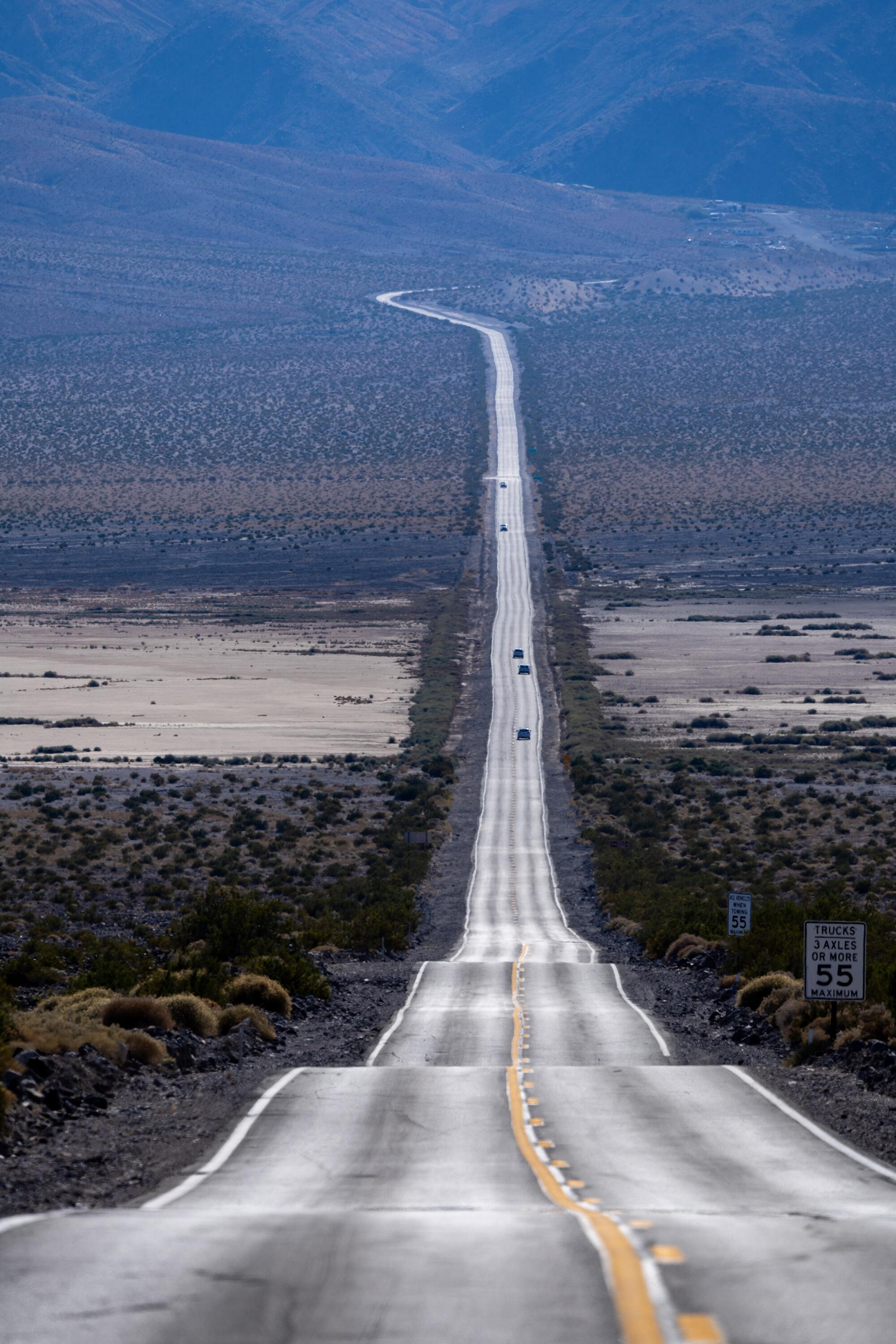
Visitors to Death Valley National Park drive in and out of the park on Highway 190 through the Panamint Valley, where temperatures were as high as 125 degrees recently.
Virtually all heat-related deaths are preventable, experts say, but what makes heat so dangerous is that it sneaks up on its victims.
The risk of Death Valley’s heat seems painfully obvious. It’s hard to miss the dozens of “Heat kills” signs throughout the park, and stepping out of a car there for the first time feels like sticking your face in an opened oven. Within seconds, your eyes begin to burn and your lips crack. Your skin feels completely dry — even though you’re sweating profusely, the sweat evaporates almost instantaneously.
But one of the first symptoms people experience as their core temperature begins to rise is confusion, which can inhibit a person’s ability to recognize that something is wrong or understand how to save themselves.
Studies have also shown that although almost everyone understands how to prevent heat illness, too few take action to protect themselves. That’s in part because many think they are uniquely able to handle the heat when in fact they are not. In 2021, a Death Valley visitor died from heat just days after another visitor had died on the same trail.
It’s a one-two punch. Hikers ignore the symptoms of heat exhaustion because they’re excited to hike or have nowhere else to go, said Bill Hanson, an instructor for Wilderness Medical Associates International and a flight paramedic in central Texas who specializes in heat-related emergencies. Then, “when a person reaches a pretty profound state of heat exhaustion — which by itself is not a lethal condition — and they’re still in that environment, the likelihood they’ll make the right decisions and reverse the process … is reduced because they have a reduced ability to make good decisions at all.”
One of the reasons that humans are quickly overcome by extreme heat is that there’s only one route for heat to exit the body. Blood carries heat from our core to our skin, and, when the breeze is too hot to carry heat away from us, the body can release it only through the evaporation of sweat. Any of that sweat that drips to the ground or is wiped off the face is a missed opportunity to cool down.
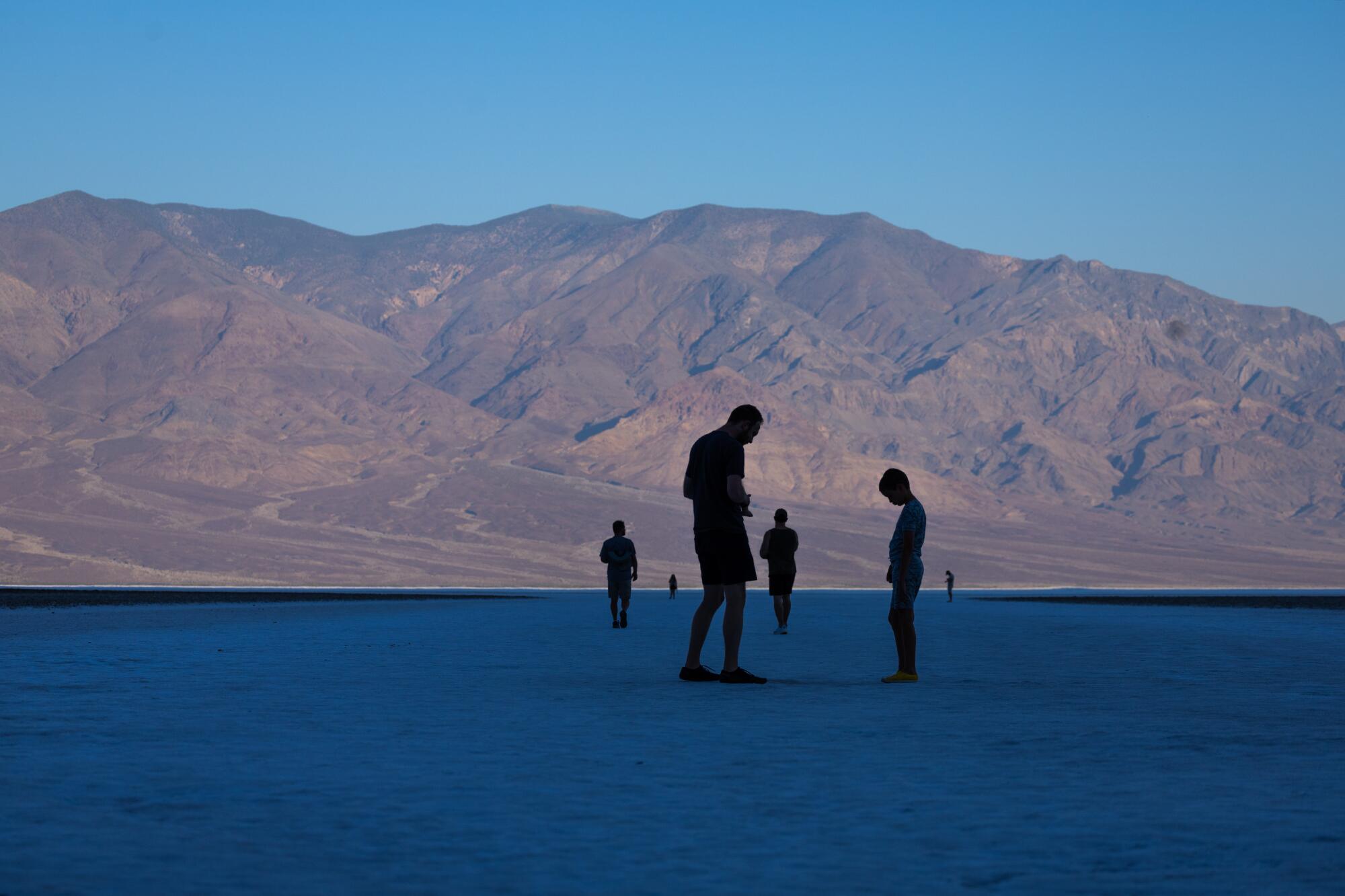
Visitors walk out onto the salt flats at Badwater Basin, taking advantage of cooler morning temperatures on a day when the mercury would rise as high as 125 degrees in Death Valley National Park.
In Death Valley, the air is so dry that sweat evaporates very easily, unlike in humid climates where the atmosphere contains more moisture. With profuse sweating, however, dehydration comes quickly. The park recommends visitors do their best to replenish lost water and drink at least a gallon a day if they’re spending time doing any physical activity outside.
But sweating and constant hydration will work only to a point.
“A 130-degree environment … there’s going to be a limited shelf life on a human body’s ability to exist in that environment without some technological support,” Hanson said.
Because of this, the park says to never hike after 10 a.m. during periods of extreme heat and recommends never straying more than five minutes away from the nearest air conditioning, whether it be in a car or building.
In the heat, sticking in groups can also save lives. While it might be difficult for a confused heat illness victim to recognize the symptoms or remember how to save themselves, friends can spot problems. In general, if you struggle to do anything that is normally easy for you — physically or mentally — stop to rest and seek cooler conditions immediately.
Muscle cramps are often the first sign the body is struggling to stay cool. They’re probably caused by a toxic concoction of dehydration, muscle fatigue and a lack of electrolytes like sodium, which are essential for chauffeuring water and nutrients throughout the body. Cramps are a sign that the body’s process for dumping heat is under stress.

Death Valley National Park visitor Steffi Meister, from Switzerland, photographs the landscape at Zabriskie Point where temperatures were as high as 125 degrees recently.
As the body struggles, heat exhaustion starts to set in. The brain, heart and other organs become tired from working to maintain the body’s typical temperature of 98 degrees. As the body passes 101 degrees, victims can start experiencing dizziness, confusion and headaches. It’s not uncommon for them to vomit, feel weak or even faint.
As the body passes 104 degrees, the entire central nervous system — responsible for regulating heat in the first place — can no longer handle the stress of the high temperatures. It starts to shut down. The victim might get so confused and disoriented that they no longer make sense. They might not even be able to communicate. They can start to have seizures and fall into a coma.
“To me, as a park medic, if you’re unresponsive, you’re going to the hospital,” Solomon said, “because your brain is essentially cooking.”
At this point, the heat has done irreversible damage that can leave the victim disabled for years to come. If internal temperatures don’t fall quickly, death becomes a very real possibility. Organs can fail within hours, killing the victim, even after their temperature starts to drop.
Heat illness can come on within just minutes or take hours to develop. “There’s kind of a weird phenomenon where there’s two times of day where we’ll get 911 calls for people who have fallen ill” due to heat sickness, Solomon said.
One is in the middle of the afternoon, when the heat is at its worst. The other is near 11 p.m. — visitors will feel OK during the day, but get increasingly dehydrated as they continue to exert themselves. “Then, they check into their hotel room and fall ill,” Solomon said.
In some extreme cases, heatstroke can overwhelm a person so fast that muscle cramps and other symptoms of heat exhaustion don’t have time to show. The Death Valley emergency response team typically gets about two or three heat illness calls per week in the summer, with visitors experiencing symptoms across the spectrum from mild fatigue to loss of consciousness.
Heatstroke experts overwhelmingly agree on the most effective treatment: cooling the patient as fast as possible.
“The key to survival is getting their body temperature under 104 within 30 minutes of the presentation of the condition,” said Douglas Casa, a professor of kinesiology at the University of Connecticut and the chief executive of the Korey Stringer Institute, a leading voice in treating heatstrokes. “It’s 100% survivability if you do that, which is amazing because there’s not too many life-threatening emergencies in the world that have 100% survivability if treated correctly.”
The fastest way to cool a patient is a cool ice bath, experts say. Hanson said his team in Texas will fly an ice bath on a helicopter and cool the victim in the middle of the desert until their temperature stabilizes before the medics even transport them.
However, in Death Valley, getting an ice bath to victims can be nearly impossible. The hot air is so thin that the team can’t fly helicopters. Instead, they bring a body bag and cool the victim inside with ice and cool towels as they’re transported via ambulance.
Although emergencies are regular, the park says they are preventable, and if people follow park guidance, they can experience the heat safely.
“It really is a reason why some people come to visit — because this is one of the few places on Earth where you can feel what that level of heat feels like,” said supervisory park ranger Jennette Jurado. “It’s our job as park rangers to do our very best to make sure people can have these experiences and then go home safely at the end of the day and remember these experiences.”

Visitors take a late-afternoon swim in the pool at Furnace Creek, where temperatures lingered in the 120s inside Death Valley National Park.
For Jurado, a safe visit looks like taking refuge in air conditioning during the hottest parts of the day and experiencing the heat in short five-minute intervals. The vast majority of visitors take this approach. If they hike at all, it’s early in the morning, and the car never leaves their sight. The rest of the day, they spend hanging at the hotel or by the pool — or they leave the park.
Although it might be possible for someone to — wrongly — convince themselves that a 90-degree heat wave in the city won’t affect them personally, it’s much harder to do that in a Death Valley heat wave.
Ironically, this makes Jurado worry more about cooler days in the park, when visitors may not be most on guard. When hikers died within days of each other a few years back, it was an unseasonably cool 105 degrees in the park.
“It’s that level of heat where people are like, ‘Oh, it’s not Death Valley hot, I can hike longer — I can take more risks,’” Jurado said.


The Pacifica Municipal Pier was shut down and taped off Thursday after city workers noticed cracks running through the landmark structure and concrete chunks falling into the ocean.
It’s just one of many coastal California structures that have recently crumbled under pressure from a rising and relentless ocean.
Officials from the small, beach city south of San Francisco said the pier was closed due to “cracking, separation, and displacement of the concrete walkway and structural elements.”
It will stay closed while structural engineers asses its safety.
Photos taken by city employees show a wide crack that runs from top to bottom and across the structure as well. Other photos show a large horizontal crack under the foundation of a small restaurant on the pier, the Chit Chat Cafe.
The cafe was also shut down.
This is not the first time the 53-year-old pier has shown signs of stress. In 2021, part of it was shut down after handrails along the edge collapsed. And in 2023, after a series of storms pummeled the Central California coast, damaging parts of the pier, the structure was partially closed for more than year.
Those same storms caused extensive damage in Aptos and Capitola, 70 miles south, where piers and waterfront infrastructure were swept away or damaged.
In 2024, a 150- to 180- foot section of the Santa Cruz wharf was ripped off by powerful waves.
At least 10 of the state’s dozens of coastal public piers were closed for part or all of 2024 due to structural damage sustained in winter storms since 2022. At least five others have longer-term upgrades planned to address structural issues.
“These things are costly to maintain,” said Zach Plopper, senior environmental director at Surfrider. “They are a part of our California coastal culture in many ways, but we’re going to need to reckon with, one, the state that they’re in, and two, the continuous and worsening threats they’re going to experience,”
He said most of the piers were constructed in the early 1900s, and they weren’t built to withstand decades of rough seas, storms and rising sea level.
“With this incoming El Niño, which is forecasted to be significant, and this marine heat wave we’re in the midst of, we’re kind of in uncharted waters as far as what this winter could bring in terms of storms and swells to the California coast, and we’re likely going to see a lot more damage,” he said. “Not just piers, but roads and other coastal infrastructure up and down the state.”
There was no storm in Pacifica earlier this week, so no single event could be blamed for the destruction.
However, a 2025 report from an outside engineering firm, GHD, found that several sections of the pier were in “poor” or “serious” condition, and they recommended closure before anticipated storms or events that could “subject the piles to high winds, swells and large waves.”
The firm found several areas of the pier where concrete was missing and rebar was exposed and corroding.
“The pier has continued to experience high winds and large waves in a harsh marine environment,” the engineers wrote in the report, noting that continuous exposure to seawater or marine spray was “detrimental” to the structure.
A 2023 city report estimated it would cost $19 million to repair.
That same year, a state law was enacted to require local governments along the California coast to plan for sea level rise in the coming decades.
Sea level has risen some 8 inches, on average, along the coast in the past 150 years, Plopper said, and researchers anticipate another foot in the next 25 years.
“We’re going to see profound shifts on our coastline, none that we have ever experienced before, and building static structures on the coast just doesn’t work all that well,” he said. “We’re going to have to make some really hard decisions.”

The first five months of 2026 in Southern California have been the smoggiest — with the highest number of unhealtful air days — in more than a decade, according to statewide air monitoring.
So far this year, the South Coast air basin, which includes Los Angeles, Orange, Riverside and San Bernardino counties, has seen 39 days when the concentration of lung-irritating ozone (commonly known as smog) exceeded the federal standard, according to preliminary state air quality data.
That’s even worse than the infamously hot and hazy 2017, when Greater Los Angeles had 36 unhealthful air days by June 4 and ultimately saw 145.
Many of the roughly 18 million people who live in the air basin have been subjected to unhealthful levels of ozone, a highly corrosive gas that triggers asthma attacks and a wide range of respiratory illnesses. This has taken many by surprise since successive days of smog more commonly happen in summer, when heat waves and intense sunlight convert man-made pollution into ozone.
“If we have this many violations by this time, this could be a really awful year for air quality,” said Adrian Martinez, director of Earthjustice’s Right to Zero campaign, an initiative calling for the transition away from fossil fuels. “We’re already the worst place in the country for summertime smog pollution. So it could be one of the worst years in one of the worst places in the country.”
The pollution has been especially severe in valleys. On April 18, an air monitor in Reseda in the San Fernando Valley measured the second highest spike in hourly ozone levels in the last decade.
Greater Los Angeles has seen more high-smog days so far in 2026 than any other year in the past decade.
(Courtesy of South Coast Air Quality Management District)
The South Coast Air Quality Management District says the high ozone levels are due to early heat waves. Officials said they were not aware of any increase in the pollutants — most of them from different kinds of exhaust — that lead to ozone formation.
Local temperatures have been well above normal, climbing into the mid-80s and high 90s between January and April, breaking several daily high temperature records, according to the National Weather Service.
March in particular was the warmest on record in California. Riverside had an unprecedented 13 days of temperatures above 90 degrees, the weather service said.
“It was really that heat wave — conditions we typically see in July or August, we saw them in March,” said Sarah Rees, deputy executive officer of the air district. “That put us ahead of the curve in terms of how much ozone we got.”
Air district officials urged residents to monitor pollution levels on the agency’s website and mobile app, and spend only limited time outdoors when smog levels are high.
“People generally know when there’s a wildfire, because you see the smoke and smell it,” said Scott Epstein, the air district’s manager of planning and rules. “Then, it’s like, I’ve got to take precautions. Ozone, you can’t really tell.”
Southern California has been particularly susceptible to smog formation because of its millions of gas-powered cars releasing tons of tailpipe emissions each day. The region’s sunshine acts as a catalyst for smog formation. Then the mountains trap this pollution over densely populated communities.
For nearly half a century, state and local air regulators have made rules designed to alleviate this pollution, enacting the nation’s first tailpipe emission standards in 1966 and requiring catalytic converters in 1975.
Smog-forming pollution has been dramatically reduced over the last two decades, but the region still does not meet federal air quality standards for ozone.
At an air district meeting Friday in Diamond Bar, the governing board held a moment of silence for William Burke, a former longtime chair. During his tenure, the agency enacted nearly 270 rules that are credited with reducing smog-forming pollution by hundreds of tons per day. Burke, who also founded the Los Angeles Marathon, died in May at 87.
“Those are just emission reductions,” air district Chair Michael Cacciotti said at the Friday meeting. “But what it doesn’t tell you is how many kids, families, seniors were prevented from going to the hospital from an asthma attack, didn’t get cancer or other respiratory problems.”
Several residents from the Inland Empire, which suffers some of the worst smog pollution, expressed their appreciation for the air district’s efforts. But they also stressed the need for more progress.
“I’m old enough to remember growing up in the ‘70s and ‘80s … and not being able to see the mountains for weeks and months at a time,” said Erik Morden, one of several residents who spoke at the meeting.” I know things have improved, and I want to thank all of you for all the hard work that you’re doing. But there’s a lot of invisible stuff that you don’t see, that’s still out there — a lot of particulates in the ozone and chemicals that are causing a lot of problems.”
Martinez, the Earthjustice attorney, said the abnormally early outbreak of smog should be a wake-up call to government regulators that there’s work to be done, including offering more incentives to help residents and businesses transition to zero-emission appliances.
“We shouldn’t over-complicate it. We’ve got a lot of heat, we’ve got a lot of pollution,” Martinez said. “Our contention is, this agency can’t control the weather. But the one thing it can control is the pollution.”

Federal agricultural inspectors detected a case of New World screwworm larvae — maggots that burrow into the flesh of living animals and sometimes humans — on a 3-week-old calf in south Texas, near the U.S.-Mexico border. Officials anticipated the arrival of screwworm in the United States and say they’re prepared to contain it.
New World screwworm, also known as Cochliomyia hominivorax, is starkly different from the average maggot that feeds on decaying organic matter such as garbage, rotting food or dead animals, said Tom Talbot, veterinarian and member of the California Cattlemen’s Assn.
That’s because a screwworm larva “attacks living flesh,” Talbot said.
On Thursday, the U.S. Department of Agriculture confirmed the detection of New World screwworm in the umbilical area of a bovine in Zavala County, Texas, more than 60 miles from the northern Mexico border.
As of Friday morning, there have been no additional cases of infected animals reported.
Screwworm is endemic in South America and parts of the Caribbean, according to the Centers for Disease Control and Prevention. However, the parasitic fly has been steadily moving north from Central America to Mexico since 2023.
The USDA says it has actively monitored the fly’s movement. Last month, the USDA was aware of more than 200 active screwworm infestation cases in the border states of Nuevo León and Tamaulipas, according to Mexico’s Secretary of Agriculture and Rural Development dashboard. There are currently more than 2,000 active cases throughout Mexico.
It was believed that the New World screwworm would enter the U.S. in 2025, “however, thanks to the hard work across the entire Trump administration and our industry, state, and local partners, we were able to buy time for this moment,” said Dudley Hoskins, undersecretary for Marketing and Regulatory Programs for the USDA, in a statement.
The potential economic impact of New World screwworm on the cattle industry due to import restrictions, reduced productivity and animal loss is substantial, said Sally DeNotta, director of the University of Florida’s Equine Performance Laboratory.
Last year, 175 key agricultural organizations signed a letter urging additional federal funding for screwworm-control measures, emphasizing USDA estimates that a New World screwworm outbreak in the U.S. could cost producers $4.3 billion annually and cause economic losses of more than $10.6 billion across the southern United States.
“While the fly does not survive at temperatures at or below freezing, infected animals could carry the parasite northward and spread infection during the summer months, and the temperate climate of Southern California could certainly support year-round New World screwworm populations,” DeNotta said.
Talbot said from the federal to the local level, everyone in the ranching community has been talking about the arrival of screwworm and how to combat it.
“My expectation is that there will be a minimal number of cases of [New World screwworm] in California,” he said.
That’s because there are several stations on the border in Southern California, he said, that are collecting data, monitoring for any incidents of the parasitic fly and trapping them.
Talbot says he’s confident that the proactive measures on behalf of the federal government will mitigate the screwworm’s reach and therefore not impact the beef supply locally or nationally.
How screwworm infection spreads
Female screwworm flies are attracted to the smell of wounds — that can be as small as a tick bite — and body openings such as the nose, eyes, ears and mouth where they can lay eggs, according to the CDC.
A female screwworm fly can lay 200 to 300 eggs at a time and may lay up to 3,000 eggs during her 10 to 30-day lifespan.
When the eggs hatch into maggots, the maggots eat live tissue, causing a worsening, often painful and foul-smelling wound, according to the CDC.
Screwworm has hit the United States before
There was a screwworm outbreak in the southwestern region of the United States in 1965 that prompted Mexican and U.S. livestock producers to sign a declaration to establish a joint program for the eradication of the screwworm from the states on either side of the Mexico-U.S. border, according to the National Agricultural Library.
By 1966, the United States had eradicated screwworms, but livestock remained vulnerable to reinfestation from screwworms migrating from Mexico.
Eradication was possible through the sterile insect technique, which uses gamma radiation to irradiate screwworm pupae and create sterile male flies.
The U.S. Department of Agriculture’s Animal and Plant Health Inspection Service maintains a screwworm pupae sterilization facility in North America and is currently building a new center in southern Texas.
When produced and released in large numbers, sterile male flies mate with wild female flies, which then lay unfertilized eggs, according to the USDA.
“Since female screwworm flies normally mate only once, the population progressively reduces and is, ultimately, eradicated,” according to USDA officials.
Last year, the Trump administration cut thousands of grants and programs from the U.S. Agency for International Development, which includes U.S.-funded animal disease monitoring projects operated by the United Nations Food and Agriculture Organization, Argi-Pulse Communications reported. Among the slashed programs were some dedicated to monitoring and containing New World screwworm in Central America.
Today, screwworm infestations aren’t a regular occurrence in the U.S., but cases have occurred in travelers returning from areas where the flies are present, according to the CDC.
Can infected animals be treated?
Infected wounds are cleaned and debrided to remove any screwworm larvae, after which the animal is treated with an approved insecticide, DeNotta said.
Last month, the U.S. Food and Drug Administration issued an emergency use authorization for several insecticides known to be effective against screwworm.
There are approved systemic and topical options for a variety of species, including cattle, horses, small ruminants, cats and dogs, DeNotta said.
“Multiple days of treatment are often required, and antibiotics and analgesics may also be administered to treat secondary infection and control pain,” she said.
If left untreated, the tissue destruction caused by flesh-eating larvae can be extensive and severe, often resulting in debilitation and eventual death of the host, DeNotta said.
“Animals that survive may suffer weight loss, poor growth and reduced productivity as a result of pain and discomfort,” she said.
Screwworm can infect humans
Human infection is rare, DeNotta said, but it can happen.
Humans are at risk of being infected by screwworms if they travel to an area where the flies are present, such as South America and the Caribbean, according to the CDC.
CDC officials said your risk of screwworm infection increases when you:
- Spend a lot of time outdoors during the day, especially if sleeping or unable to keep the flies at bay.
- Have any open wounds. A small break in the skin, including from a scratch, insect bite or recent surgery, may attract screwworm flies.
- Have a medical condition that causes bleeding or open sores, such as from skin or sinus cancer, or from treatments that can create breaks in the skin.
- Live, work or spend an extended amount of time with or near, livestock or other warm-blooded animals in areas where screwworm flies are present.
The symptoms humans experience when infected by screwworm
The following are symptoms of screwworm according to the CDC:
- Feeling maggots move or seeing maggots within a skin wound, sore or body opening.
- Painful skin wounds or sores that worsen within a few days.
- Foul-smelling odor from the site of the infestation.
- Bleeding from open sores.
Bacteria can also infect wounds where screwworm maggots are present and may cause an infection that can lead to symptoms like fever or chills.
To treat a screwworm infection, DeNotta said, people undergo the same combination of wound debridement and insecticides used in animals.
-

 New York5 minutes ago
Video: Spurs Beat Knicks, Quieting New York City Crowds
-

 Los Angeles, Ca10 minutes ago
In-N-Out Burger opens new flagship location on Las Vegas Strip
-

 Detroit, MI32 minutes ago
Man arrested for concealing gun in baby stroller
-

 San Francisco, CA40 minutes ago
Fatal stabbing leads to fines at SF hospital
-

 Dallas, TX47 minutes ago
Additional Mosquito Samples in Dallas, Carrollton Test Positive for West Nile Virus
-

 Miami, FL50 minutes ago
A Greg Dulcich breakout – The Splash Zone 6/9/26
-

 Boston, MA55 minutes ago
Officials investigating death of child in South End – Boston News, Weather, Sports | WHDH 7News
-

 Denver, CO1 hour ago
Denver Parks and Recreation begins work to rebuild historic bandshell destroyed in fire

