West
Some Democrats call for changes to homeless camping laws as 'uncertainty' follows Supreme Court ruling

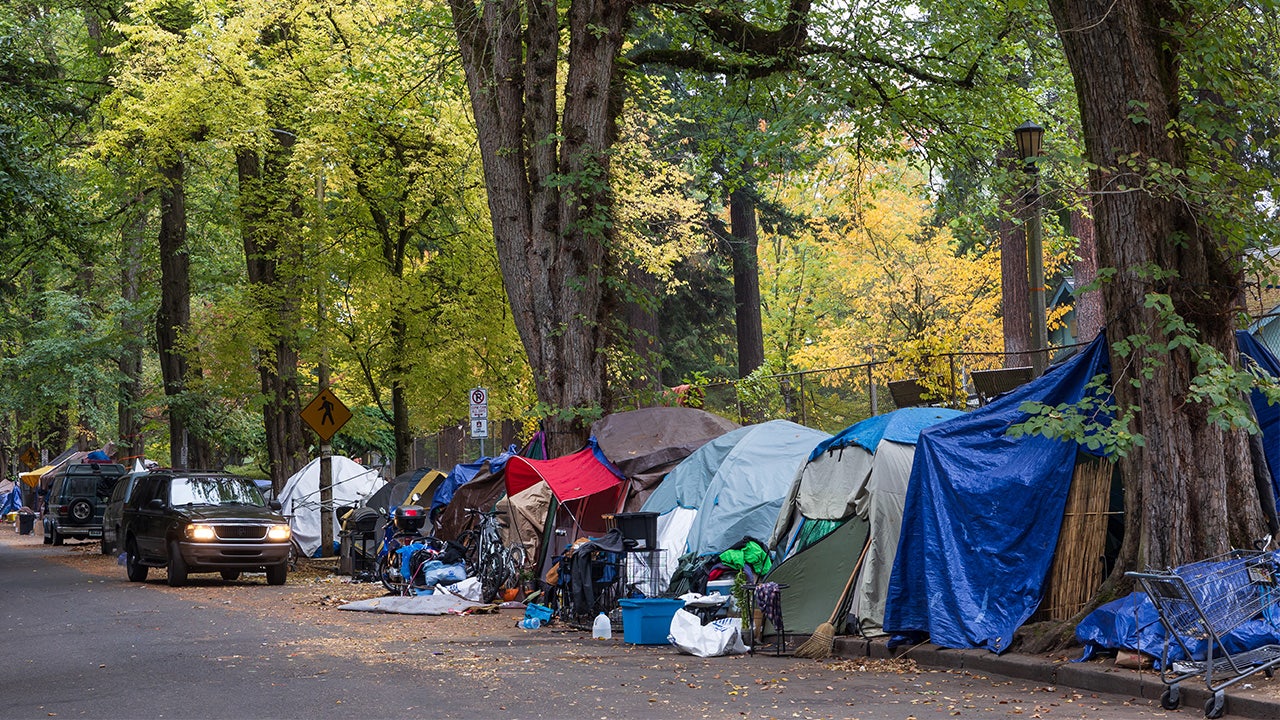
On the heels of the Supreme Court ruling that cities can outlaw homeless camps, at least two Oregon Democrats have signaled a desire to roll back a 2021 state law limiting municipalities’ ability to ban camping on public property.
“Our communities deserve streets that are safe and clean, not only for residents but also for businesses that drive our economy,” state Sen. Mark Meek said in a statement, according to the Portland Tribune. “We must reform restrictive laws… so that local communities can maintain public safety.”
A homeless man attempts to keep a fire going in the rain in a park in Salem, Oregon. (Hannah Ray Lambert/Fox News Digital)
‘ENDLESS REVOLVING DOOR’: BLUE STATE WILL RECRIMINALIZE DRUGS, BUT ONE KEY OFFICIAL IS LOOKING FOR A LOOPHOLE
In a 6-3 decision, the Supreme Court last week overturned a 9th Circuit ruling that found laws banning homeless people from sleeping in parks and on sidewalks violated the Eighth Amendment prohibition on cruel and unusual punishments. That case originated in Grants Pass, Oregon, and West Coast leaders across the political spectrum said it hamstrung efforts to clean up streets.
The new ruling gives cities more options as they grapple with an unsheltered homelessness epidemic, but in Oregon, a separate state law could still tie officials’ hands.
“Cities right now have been given so many different competing guidelines that there is a significant amount of uncertainty,” state Rep. Paul Evans said, according to OPB.
CRISIS IN THE NORTHWEST: INSIDE ONE OF OREGON’S LARGEST HOMELESS CAMPS WITH A FORMER DRUG DEALER
Oregon lawmakers passed a bill in 2021 that requires local ordinances regulating sitting, lying and sleeping on public property to be “objectively reasonable as to time, place and manner.” Then-House Speaker Tina Kotek, a Democrat who is now Oregon’s governor, championed the law.
Meek and Evans are among just three Democrats still serving who voted against the bill in 2021, OPB reported. After the Supreme Court’s ruling, they joined Republican minority leaders in calling for a change to the law, raising the likelihood that state lawmakers could take up the issue when they reconvene early next year.
But they’d have to get more of their own party on board, and the Democratic chair of the House Housing and Homelessness Committee told OPB the existing law “struck a good balance” for cities and homeless people.
Leaders like Portland Mayor Ted Wheeler disagree, arguing the word “reasonable” is too subjective.
A judge blocked Portland’s 2023 ordinance banning daytime camping in front of businesses or on sidewalks. (Hannah Ray Lambert/Fox News Digital)
SPENDING ON HOMELESSNESS SPIKES TO A ‘SHOCKING’ AMOUNT IN PORTLAND METRO AREA
Under the state law, a judge indefinitely barred Portland from enforcing a 2023 ordinance banning people from blocking access to businesses or sidewalks with tents from 8 a.m. until 8 p.m.
“The term ‘reasonable’ hasn’t been defined by the legislature, and that is one thing that I would request that they do if they want to keep some time, place and manner restrictions in place — they have to define reasonable because the court refused to do it,” Wheeler told KGW. “We thought we defined reasonable.”
A watered-down version of Portland’s ordinance took effect this week, but law professor Tung Yin told KOIN 6 News he expects it to be challenged again under the state law.
Advocates for homeless people have already promised to do just that if Oregon cities overstep.
“We intend to use that law, which is more important than ever, to protect homeless people in the state of Oregon,” Ed Johnson, lead counsel on the Grants Pass case, said in a news conference after the SCOTUS ruling.
Tents cover an open space near the Steel Bridge in Portland, Oregon, on July 7, 2023. (Hannah Ray Lambert/Fox News Digital)
If the legislature doesn’t revisit the law, Republican attorney general candidate Will Lathrop said “legalized tent cities” will remain, and act as a magnet for other homeless people.
“Not only will Oregon be unable to address our state’s widespread homelessness crisis — as other states start cleaning up their streets — I fear that we will see an influx of homeless populations flooding to Oregon where there is no accountability,” he said in a statement shared with Fox News Digital.
Read the full article from Here


Alaska’s eight prettiest downtown strips sit in towns as different from each other as the landscapes around them. Skagway draws cruise ship visitors to its Gold Rush history. Sitka pairs Russian Orthodox history with totem-lined trails just beyond downtown. Wrangell is one of the oldest towns in the state. Each downtown is worth spending time in, though Sitka, Ketchikan, and Wrangell are the only ones on this list accessible solely by air or water. In winter, clear dark nights can bring Northern Lights over several of these towns. After a day out, fresh seafood is never far away.
Skagway
Skagway is located in Alaska’s panhandle and is known as the gateway to the Klondike Gold Rush and a major cruise ship destination. For those who love nature and history, visit Klondike Gold Rush National Historical Park and hike part of the 33-mile Chilkoot Trail, the historic route between Dyea, Alaska, and Lake Bennett, British Columbia. Backpackers can stay at designated campsites along the route, with permits required in season. For food, check out Skagway Brewing Company, which offers craft beers and American comfort foods. Another seasonal Skagway option is Salty Siren, whose menu features Alaskan golden king crab, seafood chowder, fish and chips, and pulled-pork sandwiches.
Sitka

Sitka sits on Baranof Island and is known for its rich Tlingit and Russian heritage, gorgeous outdoor scenery, and variety of wildlife. Sitka is only accessible by sea or air and is a popular stop on cruises. The area offers lots of outdoor activities, including fishing, hiking, and kayaking. Tourists like to visit St. Michael’s Russian Orthodox Cathedral, a National Historic Landmark whose original 1844-1848 building was reconstructed after a 1966 fire. For a short walk through Sitka’s layered history, visit Sitka National Historical Park, where visitors can enjoy a scenic coastal trail lined with totem poles. Grab a bite to eat at Beak Restaurant for delicious seafood. Or if you’re craving pizza or wings, visit Mean Queen for some comfort food.
Talkeetna
Talkeetna is a historic place in Alaska’s Matanuska-Susitna Borough, famous as a gateway to Denali, North America’s highest peak, which welcomes tourists and climbers from all over the world. Beginning as an Alaska Railroad headquarters, this historic location has an artistic vibe and a vibrant art scene despite its small population. Locals and visitors enjoy flightseeing, rafting, fishing, and delving into the unique history, including Stubbs, the late honorary cat mayor who held the ceremonial role until his death in 2017. For those hoping to see the Northern Lights, Talkeetna’s dark winter skies can be a good base when skies are clear and aurora activity is strong. Once you’re hungry, grab some friends and visit Homestead Kitchen for some traditional rustic options like burgers and flatbreads. Then grab a craft beer at Denali Brewpub in their rustic setting.
Homer
Found on the Kenai Peninsula, Homer is famous for its gorgeous views of Kachemak Bay, the Homer Spit, and distant volcanoes. Here’s a perfect spot for those hoping to see wildlife and enjoy other outdoor activities, like hiking and fishing. Across the bay, Kachemak Bay State Park is reached by water taxi or air taxi and offers views of the mountains and the ocean. Or head to Bishop’s Beach, which is dog-friendly, and enjoy the soft sand with your four-legged best friend. After experiencing the beautiful scenery of Homer, grab some dinner at the Twisted Goat and dig into some comfort food, including pizza, fish and chips, and burgers. On a nice day, visitors won’t want to miss a local favorite, Water Rudders, which offers a beautiful view from its patio.
Seward
Located about 120 miles south of Anchorage, Seward is a scenic port town at the head of Resurrection Bay. It’s loved for its beautiful views of the mountains, marine wildlife, and glaciers, and it serves as a gateway to Kenai Fjords National Park. Here, visitors can take a hike, join in on ranger-guided tours, kayak, and so much more. For those wanting an aerial view, Seward Helicopter Tours offers flights over glaciers and other beautiful sites. For those looking to camp, Waterfront Park offers RV and tent sites with views you can’t beat. After enjoying sightseeing, grab some seafood or steak at Ray’s Waterfront with a wood-paneled dining room overlooking the marina and mountains. Or get some comfort food at The Highliner Restaurant, where the menu includes crab cakes and fish tacos, just to name a few.
Ketchikan
Ketchikan is located on Revillagigedo Island in Alaska’s Tongass National Forest, known for its rich native culture, totem poles, and salmon fishing. The town is a popular cruise ship destination and is only accessible by boat or plane. Here, visitors can enjoy wildlife viewing, especially in the summer months. For a beautiful site, look into Misty Fjords National Monument and see sheer granite cliffs, towering 3,000-foot rock walls, deep saltwater fjords, and waterfalls within Tongass National Forest. Locals and visitors enjoy spending time at Creek Street, a historic boardwalk built on pilings over the creek, which is now filled with shops, cafes, and galleries. Grab a bite to eat at The Alaska Fish House with beautiful views out the window and live music. Or order crab and seafood at Ketchikan Crab & Go, a seasonal spot at Salmon Landing that caters to the cruise-season crowd.
Valdez
Found in Southcentral Alaska, Valdez is known for its stunning mountain views, water scenery, and being the southern terminus of the Trans-Alaska Pipeline. This former Gold Rush town is a popular destination for fishing, glacier tours, and wildlife viewing, and is accessible via the Richardson Highway from Anchorage and Fairbanks. For shore views of icebergs and the face of Valdez Glacier, head to Glacier View Park at the end of Airport Road. For an easy family-friendly outing near town, try Dock Point Trail, a short coastal loop with ocean and Duck Flats views. In summer, The Potato serves handmade comfort food and beer or wine from its harbor-view location in Valdez. Or get some pizza or fish and chips at The Fat Mermaid. It has a laid-back setting and views of the marina.
Wrangell
Wrangell is found in Southeast Alaska, located on Wrangell Island in the Inside Passage, and is known for its Tlingit culture, variety of wildlife, and access to the Stikine River. This is one of Alaska’s oldest towns and offers plenty of outdoor activities like hiking, glacier exploration, and fishing, and is only accessible by air or the Alaska Marine Highway. Anan Wildlife Observatory is a must-visit to see bears, both black and brown, who call it home. You’ll have to take a boat or a floatplane to get there. Access the Stikine River from Wrangell for more wildlife viewing. For food, try Filipino, Thai, sushi, and other Asian dishes at Michelle’s Taste of Asia, a casual, family-run restaurant. Or grab pizza at Hungry Beaver Pizza and Marine Bar by Wrangell’s Inner Harbor.
These eight towns show a side of Alaska that operates at a different pace from the state’s most visited destinations. The downtowns are small, the history runs deep, and the wildlife has a way of showing up whether you plan for it or not.

Don’t miss these 5 metro Phoenix hidden gem restaurants
From Ethiopian cuisine to mesquite-grilled chicken, check out these five restaurants in metro Phoenix that have flown under the radar for too long.
A former candidate for Gilbert mayor has opened the first Arizona location of a Founding Fathers-themed ice cream shop in Chandler.
Brooker’s Founding Flavors Ice Cream is a Utah-based ice cream shop centered around the early history of the United States. Female employees scoop cones in bonnets and dresses; male employees wear tricorn hats and coats. The ice cream flavors have names like Martha Washington’s Colonial Cotton Candy and Alexander Hamilton’s Not Throwing Away My Scoop.
On a trip to Utah in 2019, Arizonan Shane Krauser went to a Brooker’s and was blown away.
“I walked out of that, called my wife Janelle and I said, ‘We will own one of these,’” Krauser said.
The couple had no previous restaurant experience, but decided to open up the chain’s first location outside of Utah, choosing a storefront near the intersection of Chandler Boulevard and Dobson Road. The store opened on June 6.
Krauser loves how the shop creates conversation among customers about American history.
“I love history. I love the Founding Fathers. I love the ideals of America,” Krauser said. “It’s an amazing concept.”
Opening Founding Flavors isn’t political, it’s a ‘labor of love’
Krauser is a retired lawyer turned motivational speaker who addresses topics including “freedom, the proper role of government and the parameters of the U.S. and state constitutions,” according to his website.
In 2024, Krauser ran for Gilbert mayor, but withdrew his candidacy amid scrutiny over involvement with a past investment fraud scheme and his son’s appearance in a video with the Gilbert Goons, The Arizona Republic reported.
Although the shop plans to host events celebrating the 250th anniversary of the U.S., such as one for Constitution Day in September, Krauser said he does not see the ice cream store as related to his political career.
“The mayoral run was something to be involved in politically. This is more of a labor of love,” Krauser said. “This is not political in nature at all. It’s an ice cream shop with an American theme.”
Details: 2560 W. Chandler Blvd. #3, Chandler. brookersicecream.com, 480-881-6100.
Reach the reporter at reia.li@gannett.com. Follow @reia_reports on Instagram.

The most significant seismic event in California’s history – an earthquake of 7.9 magnitude – occurred in 1857 and ruptured about 225 miles on the San Andreas Fault. That earthquake, dubbed the last “Big One,” killed two people and produced shaking that lasted between one and three minutes.
Since then, California has exploded in population and been has been rattled by many major earthquakes. But Californians have also grown familiar with the existential dread of another “Big One” looming.
Researchers have long warned there will be another massive earthquake in Southern California. They just don’t know when.
A recent study says warning signs continue to grow in 2026. The San Andreas and San Jacinto fault systems have reached the highest stress levels seen in the past 1,000 years, according to a study conducted at the University of Hawaiʻi at Mānoa.
The San Andreas fault runs throughout the state, passing through San Francisco and San Bernardino, while the San Jacinto fault is in Southern California and runs through Riverside, San Diego and Imperial Counties.
Unable to view our graphics? Click here to see them.
Why the San Andreas Fault is so risky
Faults rupture on the San Andreas Fault approximately every 150 years, according to UCLA professor Jonathan Stewart, who studies earthquake engineering.
But it’s been over 300 years since the last “large rupture” occurred south of the 1857 Fort Tejon earthquake, Stewart said. “As far we know it didn’t produce a large rupture since around 1690. To the present that’s a lot more than 150 years, so there’s a lot of build-up. That doesn’t mean it’s going to happen immediately, it just means there is more stress built-up.”
When the earthquake happens, it is likely to cause a lot of damage. One major concern is the state’s water systems.
“An earthquake like this would rupture most, if not all of the major aqueducts bringing water into Southern California,” Stewart said. “Most people will not be in a collapsed structure after this earthquake, but everybody’s going to be affected by water problems.”
Study highlights longstanding risk
To investigate the probability of an earthquake occurring, researchers built a physics-based simulation and fed it the earthquake history from the region. By doing so, they were able to estimate how much stress has built up along the southern San Andreas and San Jacinto fault systems.
The results suggest that catastrophe may be near.
“Right now, with stress at historically high levels across the region and more than 160 years elapsed since the last major rupture, the system is in a critically loaded state,” lead author Liliane Burkhard said.
Most importantly, the Cajon Pass, at the junction of the San Andreas and San Jacinto faults, could facilitate a joint rupture of the two faults. This scenario, according to the study, would probably be “significantly more damaging” than a single-fault event.
How is earthquake safety considered?
Seismic hazard assessments are critical for the safety of the millions of residents in California’s densely-populated and earthquake-prone areas.
Seismic Hazard maps show the relative hazard associated with earthquakes using information on past faults, the behavior of seismic waves and the near-surface conditions of specific locations, according to the U.S. Geological Survey.
Larger values indicate a stronger level of earthquake shaking. A peak ground velocity of 269 cm/sec would correspond to extreme shaking and heavy damage. For reference, the largest ground velocity recorded in Taiwan’s 1999 Chi-Chi earthquake reached 318 cm/sec and had a magnitude of 6.7.
That earthquake killed more than 2,000 people and incurred approximately $14 billion in damage.
How do the fault lines rupture?
The San Andreas and San Jacinto faults are strike-slip faults, which typically cause horizontal displacement. Both faults comprise the geologic boundary between the Pacific Plate and the North American Plate.
If a major earthquake occurs on the San Andreas fault, it is likely to produce surface rupture, which occurs when a fault breaks through to the surface. Most earthquakes, however, do not produce surface rupture, according to USGS.
In a major rupture, strong shaking could cause severe damage near the fault and in areas built on soft or water-saturated soils, which can amplify shaking. Rupture can directly offset roads, buildings, and other structures that span the fault trace.
Although the study helps explain the risk associated with the California fault lines, Burkhard emphasized that it shouldn’t serve as a forecast.
“This is not a prediction of when an earthquake will happen,” Burkhard said. “However, studies like this are important contributions to national and global earthquake hazard research in that we are using rigorous, quantitative science to better understand the risk facing millions of people.”
Contributing: Brandi D. Addison, USA TODAY NETWORK
-

 Cleveland, OH5 minutes ago
LOOK: Remembering the Cavs championship win, victory parade 10 years later
-

 Austin, TX12 minutes ago
Juneteenth celebrations in Austin include parade and fun run
-

 Alabama15 minutes ago
Gov. Kay Ivey sets execution date for Jeremy Williams
-

 Alaska20 minutes ago
8 Prettiest Downtown Strips In Alaska
-

 Arizona27 minutes ago
Founding Fathers-themed ice cream parlor makes Arizona debut
-

 Arkansas30 minutes ago
One dead in Lepanto drowning incident
-

 California35 minutes ago
Is California’s ‘Big One’ coming soon? Maps show growing danger.
-

 Colorado42 minutes ago
Colorado summer travel ideas, from glamping and hot air balloons to swimming and fishing

