Lifestyle
Tiana’s Bayou Adventure's joyous debut proves it was time for stale Splash Mountain to go

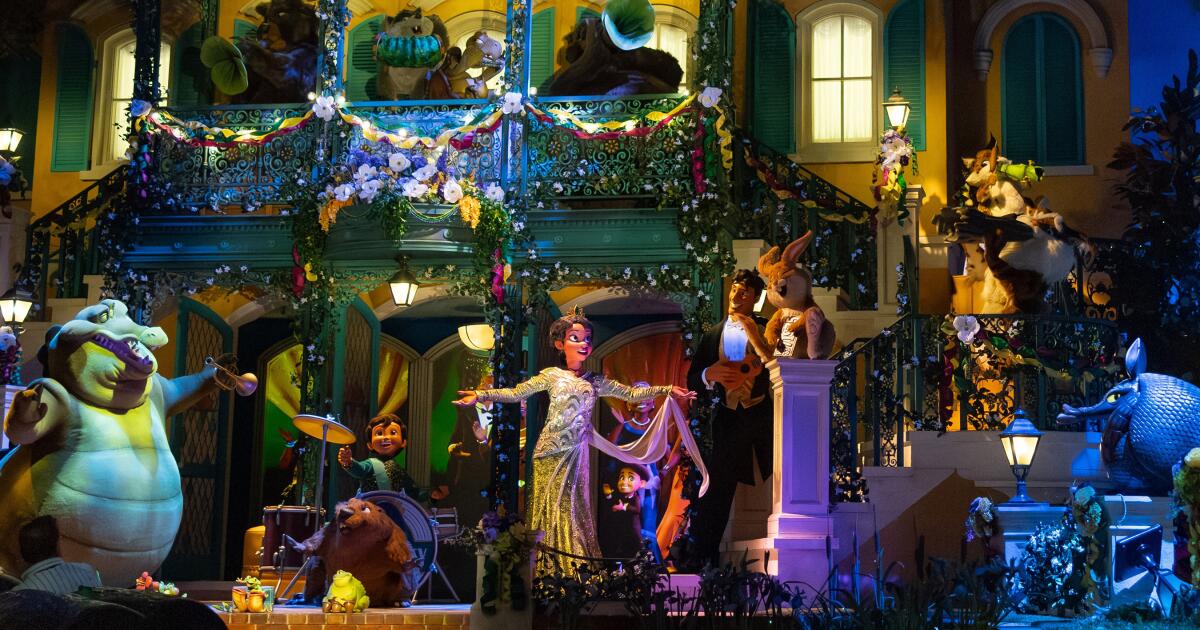
As we dip into the bayou, the scene before us feels a tad mystical, all glowing fireflies with hues of blue and purple seeping through the trees. While there’s a comfortably paced current carrying our log-carved vessels through the fantasy wetlands, what’s ultimately propelling us forward is the sound of music. In the distance we hear trails of zydeco, and as we come around a bend we’re greeted by an outsize, gregarious alligator, his welcoming green arms swinging to the tune.
“This zydeco band … can play!” says the gator, adding an excitedly drawn-out “hallelujah” for emphasis.
This is Louis, the friendly trumpet-blasting gator from Walt Disney Animation’s 2009 film “The Princess and the Frog.” Joining him is Princess Tiana, the entrepreneur turned musical archaeologist, dressed here in a regal but loose adventurer’s outfit. We can marvel at how human Tiana looks, with a carefully sculpted warm face and natural hair, or join in the festivities and smile at the band of critters — pay close attention to the rabbit playing a license plate as a washboard — swaying before us as we float by. Humor and friendliness abound in this invitingly good-natured attraction.
Tiana’s Bayou Adventure, the Walt Disney Co.’s replacement for its Splash Mountain log flume ride that was first announced in 2020, is at last ready for its closeup.
Princess Tiana is joined by a band of critters as she sings a song on Tiana’s Bayou Adventure.
(Olga Thompson / Disney)
The attraction opens here at Walt Disney World at the end of this month, but it’s currently in previews. A mostly exact replica is coming to Disneyland later this year. Consider it a drastic tonal shift from Splash Mountain, as the themes of Tiana’s Bayou Adventure center around the communal power of music and food, focusing on how a song can bring together people from all walks of life. If Splash Mountain had the illusion of peril and danger — a rabbit being hunted by a fox and a bear — Tiana’s argues that a thrill ride, one complete with a 50-foot, soak-inducing drop, can be a jovial, celebratory affair.
Like any ambitious creative agency, Walt Disney Imagineering, the highly secretive arm of the company responsible for its theme park attractions, doesn’t always get it 100% right. But the company has arguably never miscalculated as much as it did with the creation of Splash Mountain, which opened first at Disneyland in 1989. Though the ride focused on animal vignettes and became one of the park’s most popular destinations, it could never quite shake its association with the 1946 film “Song of the South,” a work long decried as racist for its idyllic and romanticized view of slavery.
In 2020, amid a moment of cultural reassessment and nationwide protests following the killing of George Floyd, Splash Mountain came to be seen as a blight. Disney, citing the need to embrace an “inclusive” concept, announced that the ride would be rethemed to “The Princess and the Frog,” a film that starred its first Black princess.
It took 35 years, but the Walt Disney Co. has at long last rid itself of an attraction that was anchored to an embarrassing part of its past. With the launch of Tiana’s, Disney has chosen to give us a princess-based ride not driven by a head-in-the-clouds fairy tale but one that is instead framed as an American success story, as Tiana, now a restaurant owner, is expanding her empire with a food co-op.
This is a ride for our times, an attraction that argues that Walt Disney World and Disneyland, two of the most visited places on the planet, can not just reflect our culture or parrot back what we’ve seen on film and television but show us better, more cooperative versions of ourselves. While based on “The Princess and the Frog” and featuring reinterpretations of a number of its jazzy songs, this ride doesn’t go the obvious route of repurposing known scenes or villains from the film. Tiana’s instead opts for a more abstract, uplifting perspective.
It was a creative risk, and one that has inspired a fiery social media debate, at least if the more than 8,000 comments on Disney’s YouTube page are to be believed. But it’s also one that largely works. I’ve ridden the attraction twice this week, and here are my three main takeaways.
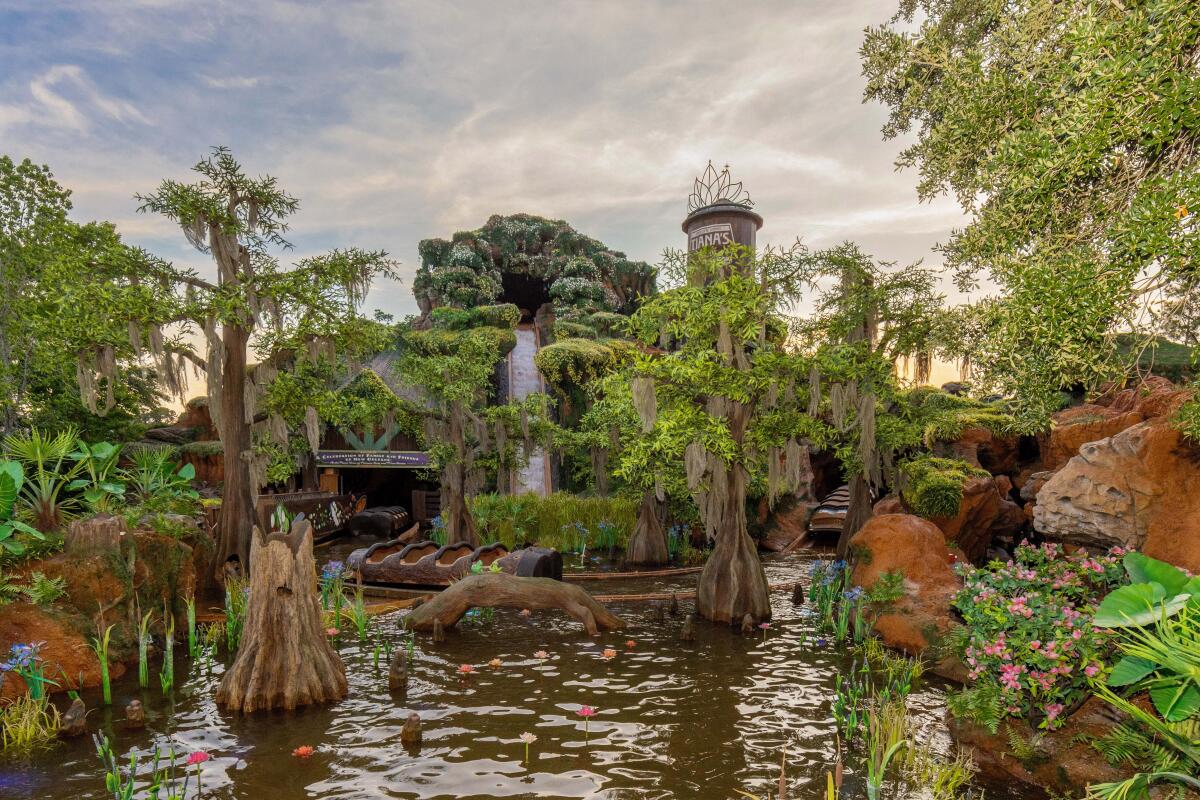
The exterior of Tiana’s Bayou Adventure at Florida’s Walt Disney World, which is designed to represent a salt mine as part of Tiana’s food co-op operation.
(Olga Thompson / Disney)
A thrill ride doesn’t need to be tense
The genius of Splash Mountain, in my mind, has always been the track layout. Its narrative, which followed Br’er Rabbit and his attempts to live a life of bliss while eluding Br’er Fox and Br’er Bear, never really emotionally connected with me.
It’s relatively loose, as Br’er Rabbit was hunted simply for being a rabbit, and his attempts at adventure and exploration eventually resulted in him being bullied back home, albeit via a rousing finale that appeared to recenter Br’er Rabbit’s priorities around friends and family. And while there could be critters on all sides of us to distract our attention, what brought me back was the design of the flume, which took unexpected turns that seemed to hide its drops from view.
But in the moments leading to Splash Mountain’s five-story drop, Br’er Rabbit appeared to be in danger. Ominous vultures warned us of what was ahead and the soundtrack turned foreboding. It created a taut moment before we were launched into the briar patch below and Br’er Rabbit could hop to safety.
Tiana’s opts for a significantly different vibe. Mama Odie, the magic-wielding swampland elder from “The Princess and the Frog,” appears to whisk us to a Mardi Gras celebration as the upbeat and bouncy “Dig a Little Deeper,” a song about learning to be true to one’s self, plays around us. We go up the lift swaying, and the hope is that we go down it swinging, in the musical sense of the word. In theme and amusement park design, it’s generally been believed that such thrill-inducing moments need to instill a sense of fear. See, even, the skeleton pirate warning us before a dip in Pirates of the Caribbean.
But Disney in recent years has been attempting to reinterpret how a ride system can be used. When reimagining the fraught elevator drops of The Twilight Zone Tower of Terror into Guardians of the Galaxy: Mission Breakout at Disney California Adventure, for instance, the sudden lifts and nosedives were played more for laughs to match the zaniness of the franchise. Likewise here, Tiana’s tale is framed as a story of strength, positivity and perseverance, and Imagineers, even in this ride’s most thrilling moment, aim to heighten those traits rather than interject any more trauma into Tiana’s life.
Charita Carter and Carmen Smith, the two core Imagineers who led the project, spoke with me about toying with people’s ride expectations and opting to avoid any sense of danger in the attraction, which is set about one year after the events of the film.
“One of the things that we thought about was that this particular flume configuration has always been a rite-of-passage type attraction for young kids,” Carter says. “And when you think about Tiana and everything that she brings to the table, when she’s inviting and welcoming and wanting everyone to participate, we thought by celebrating [the drop] and making it a fun challenge, we were opening it up to a wider audience.”
Adds Smith, “When I think about the dip drop, with most people there’s a lot of apprehension, and we wanted people to feel a sense of celebration. When you’re on the ride and you’re greeted by all these incredible musicians, you’re in a very different state. What this dip drop does is say, ‘We’re on our way to this party, and we’re going to get there as fast as we can.’ It is a rite of passage, but you’re going to this moment, to this place, to be at a party.”
Emotionally, after riding through a cavern featuring a frog-led band with a firefly chorus, all creating a rousing, sing-along take on “Dig a Little Deeper,” the mood is one of pure uplift. If you’re taken with the music, the drop is one to be greeted with open arms.
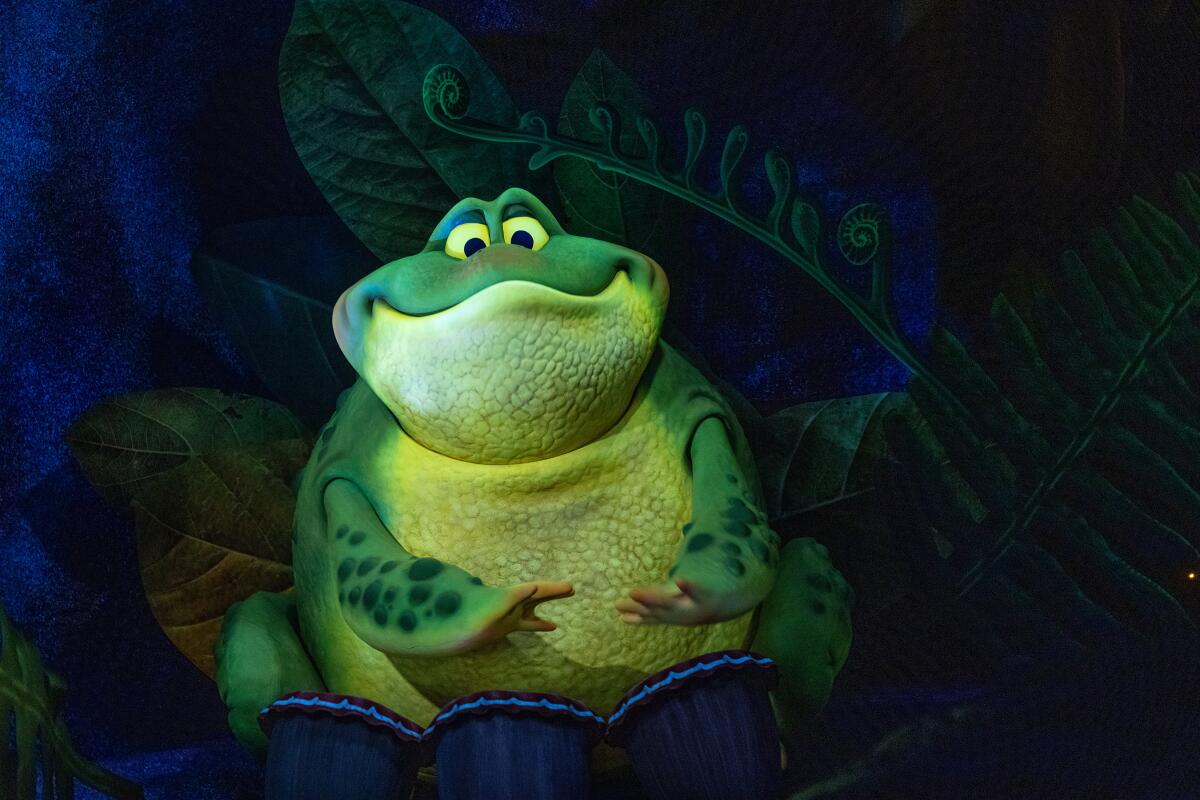
All new critters were designed for Tiana’s Bayou Adventure, including this musical frog.
(Olga Thompson / Disney)
Atmosphere matters more than plot
Splash Mountain, to be sure, was beloved, in large part due to its bevy of animatronic animals — a tally said to have topped 100 at Disneyland, many of which were rescued from the 1970s-era America Sings attraction. At the time, it was noble and efficient, a way to preserve Disneyland’s history while giving many of its historic audio-animatronics a new home.
In turn, Splash Mountain had plenty of details — possums, bees, turtles, owls and more, many of them caught in mischief — to entice us. Once inside the mountain, there was action on nearly all sides of us, including above. Animals sang, played instruments and avoided the rain by sitting under psychedelic mushrooms. Splash Mountain had a dedication to old-fashioned Disney craft, one that put an emphasis on feeding us dioramas rather than a plot.
Tiana’s takes an even lighter touch to theme park narrative design, as the story push is simply going on a journey in search of bayou musicians. Tiana’s features all new animatronics — 19 original critters and 48 animatronics in total, according to Disney. That figure includes multiple renditions of Tiana and her friends, including, in the finale, Charlotte La Bouff, Prince Naveen and others. They are all a joy. Louis, for instance, is striking, a technological creation that looks cartoonishly plump and pillowy rather than reptilian and scaly, a hand-drawn design now a tactile, real-world presence.
Ardent defenders of Splash Mountain will argue the animatronic number is significantly lower, and therefore the spacious show building feels less populated. That wasn’t my sense, in large part because the new critters are framed as relatively big set pieces. As we traverse the flume, any stretches without a major show scene become a chance to luxuriate in the wilderness atmosphere, watch the digital fireflies sway as they lead us on the journey or take in the joyous, jazz-leaning pop. The twilight nature of the lighting creates a fantastical atmosphere that makes this water ride feel somewhat cozy.
Additionally, the advancement in animatronic technology ensures that Tiana’s requires multiple rides before you spot all the details. The zydeco band is a delight, with details in not just what instrument an animal plays but how they play it. A beaver’s tail creates a rhythm on the deck and an opossum has a bass fashioned out of a gourd.
Things get weirder and more delightful with a bobcat and bear band, where instruments are fashioned out of logs and vegetation, and later some Afro-Cuban frogs jamming out with acorns. Here, story-wise, we’ve been shrunk down to the size of a frog by Mama Odie, and while placing guests in oversize environments to make them feel small is a bit of a theme park cliché, I’ll let it slide because the human-sized flowers and mushrooms enclose us as if we’re in a snug nightclub.
There are hidden tales throughout, including nods to how humans are affecting the natural environment. See, for instance, an otter whose fiddle looks composed of a paint thinner can and bottle caps. And that says nothing of the in-story radio in the ride’s queue, which features new, vintage-style arrangements of music from New Orleans.
Tiana’s is completely vibrant in its approach to sound. “That’s what New Orleans brings to the world,” Carter says. As various musical styles ebb and flow into one another, this fictional bayou feels fully alive.
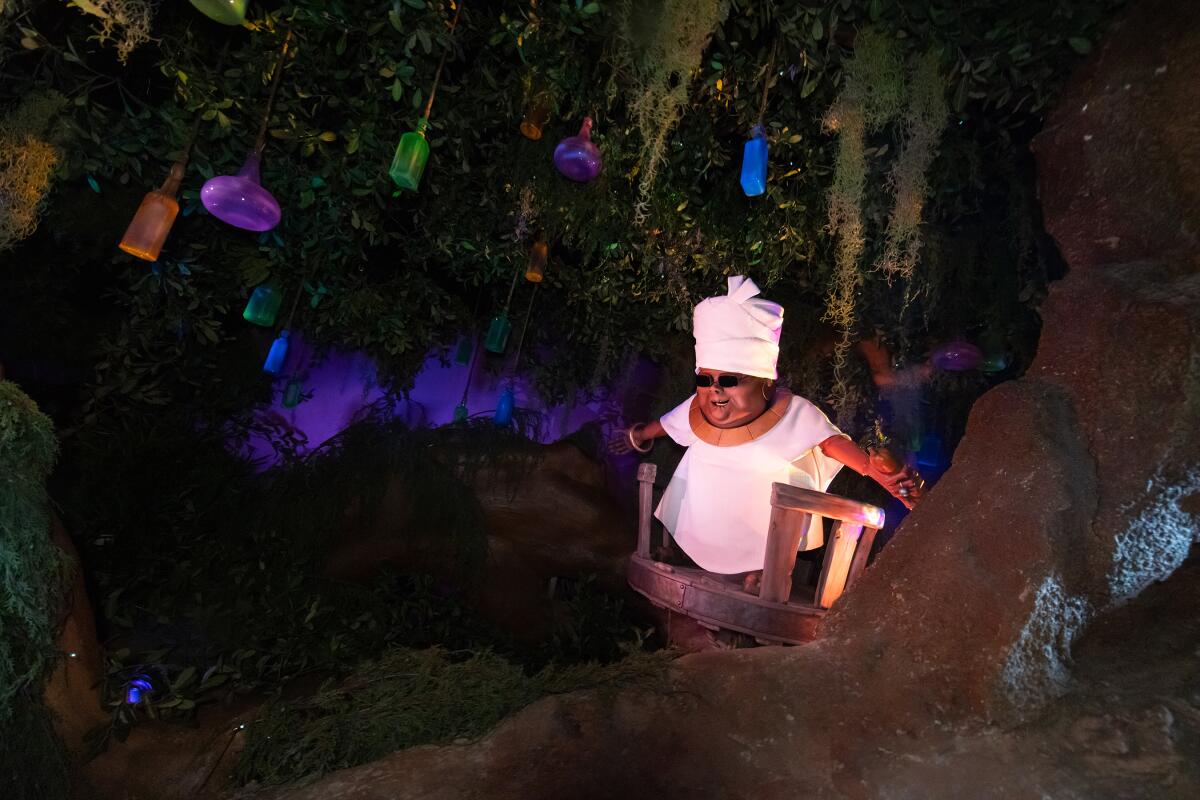
The magic-wielding Mama Odie sends guests off to experience a 50-foot drop on Tiana’s Bayou Adventure.
(Olga Thompson / Disney)
Theme park stories matter
Any change to a Disney theme park brings with it complaints. These spaces represent American myths and stories, shared among generations. A Disney park is not just a collection of intellectual property, even if it is sometimes treated as such by its corporate handlers. There’s simply too much history in these spaces, and lands such as New Orleans Square at Disneyland, the bulk of Epcot’s internationally focused World Showcase or Animal Kingdom’s representations of Africa and Asia help connect these tales to our lives outside the park gates.
Individual attractions, too, are representative of the era in which they were born, but unlike a film or a television series, a theme park is a living space. To expect the narratives of an attraction to remain fixed in time is to be wedded to a form of sentimentality. We visit theme parks to share and partake in stories, because stories are how we make sense of the day and our lives, and those stories should adapt to our changing culture.
Splash Mountain, of course, isn’t the first time Disney has tinkered with an attraction due to outdated cultural representations. Pirates of the Caribbean has received multiple updates, most recently one that removed a bridal auction scene in which women were relegated to property. Disneyland, which soon will turn 70, ultimately serves as a reflection of American pop culture, referencing our history with nostalgia while consistently challenging itself to reflect modern views.
And the culture eventually would catch up to Splash Mountain.
Times articles from the late 1980s cited Disney representatives already trying to justify the attraction, noting that it would skirt controversy by focusing solely on animated scenes and would avoid any references to the Reconstruction-era South. But even at the time of the ride’s opening, “Song of the South” was in the Disney vault, kept out of movie theaters and, eventually, off of streaming platforms.
But what was once a tale of a bullied cartoon rabbit is now a ride that serves as an ode to community, to a culture and to a region. Smith says she had long dreamed of bringing Tiana into Disney’s theme parks via a ride, and in 2019 began to fine-tune a potential story with then-Imagineering creative executive Bob Weis.
“I looked at it as an opportunity to tell a story that I think every young girl, young boy, mom and dad, and their parents could enjoy,” Smith says.
“For us,” Smith continues, “it is a love letter to all of our audiences. We see you. We hear you. We want you to be with us. This character is so worldly. Tiana is a princess, but yet she’s an entrepreneur. She’s a doer. She’s a dreamer. She’s all these things. We just felt what a great opportunity this was to give people a celebration.”
It is, essentially, the first thrill ride designed to feel entirely like a party. One could call it a splashing success.


Lifestyle
A meal with an animated Mona Lisa? Immersive dining goes high tech — but will L.A. eat it up?
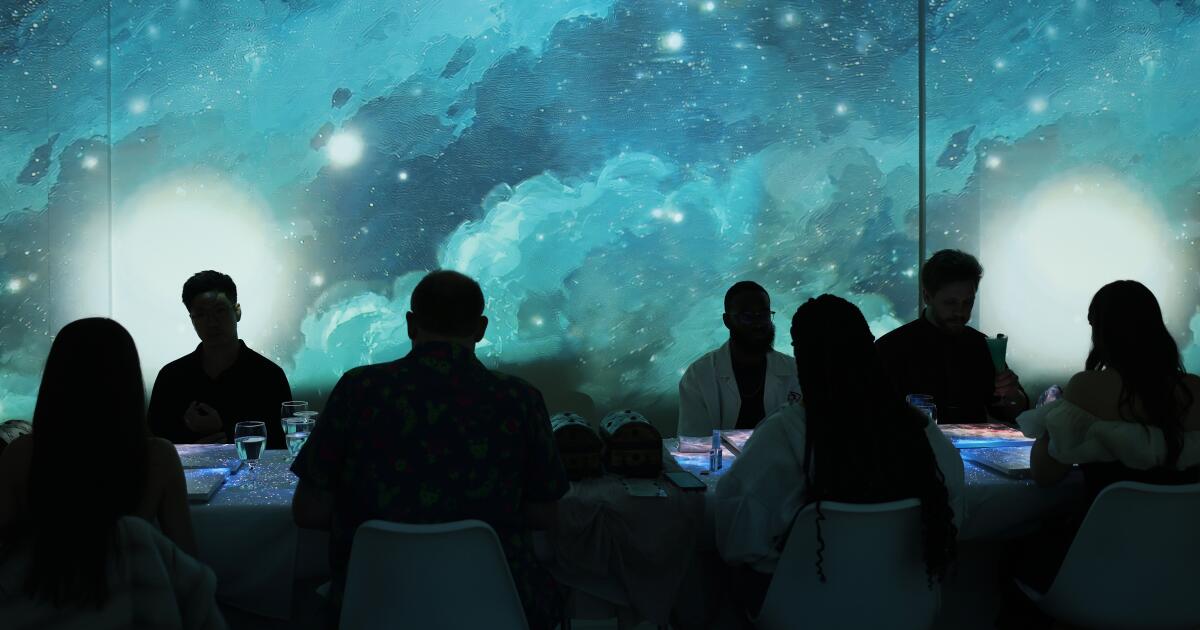
My dinner course is served. It is a Campbell’s-inspired soup can, lightly angled so strands of broccoli are peeking out. I lift the can to uncover a slow-braised short rib and mashed potatoes. An American dish to represent an American artist, here Andy Warhol.
The room is overtaken with projections, scenes of bustling New York traffic paired with bachelor-pad-like guitar riffs. Shown on a wall above a dinner table is a selection of Warhol silkscreens. It’s a Friday night in West Hollywood, and I’m surrounded by a mix of out-of-towners and those celebrating an anniversary. And while this is a special occasion, we’re urged to get a little messy with our food — to use our hands, to paint with a salad, to draw on a cookie.
The main course: A tomato soup can? “7 Paintings” is an immersive event that occasionally hides dishes in artist-inspired presentations.
(Christina House / Los Angeles Times)
Play is the primary side dish at “7 Paintings,” a tech-infused dinner theater that aims to be a crash course in fine art. That selection of veggies paired with multiple mini cups of colorful dressings? Guests are encouraged to mix and match the vinaigrettes into a mess of hues, a nod to abstractionist Jackson Pollock. And yellowfin tuna with dashes of avocado and taro chips? That’s an edible tribute to Banksy, of course. What does raw fish have to do with stenciled street art? It’s bold, heavily angled and has a short shelf life? Maybe? Perhaps don’t overthink it.

Even the paper is edible.
(Christina House / Los Angeles Times)
“Have you ever eaten a painting before?” says Nadine Beshir, the Dubai-based creator of “7 Paintings.” “We try to get people out of their comfort zones and eating paper. I want to bring out the child in them.”
“7 Paintings,” held at Sunset House L.A. through the end of August, is the latest example of immersive dining to arrive in this city. These experiences often involve guest participation and are accentuated with advanced multimedia technology and sometimes theatrical elements.
Worldwide, there have been standouts. For instance, Eatrenalin at Germany’s Europa-Park, a dining room-meets-ride where participants are whisked around the space on trackless “floating chairs,” has just received a coveted Michelin star. Ibiza’s Sublimotion has similar haute ambitions, pairing 12 diners together in a room that will come alive with otherworldly projections and performers. At times, diners will win don virtual reality headgear.
But tech-driven immersive dining experiences have never quite taken off in Los Angeles as a trend. Last year, the Gallery, where fantastical cityscapes and projections surrounded downtown L.A. diners, stood just a couple months before the concept was abandoned.

“7 Paintings” pairs food with art and music. It’s “fun dining, not fine dining,” says its founder.
(Christina House / Los Angeles Times)

Bartender Luca Famulari shakes a cocktail at the immersive dining event.
(Christina House / Los Angeles Times)
“The economics of a restaurant are not the same as the economics of theater and the challenge of combining the two lies in thinking outside the box with respect to pricing and cost structure, such that the customer perceives high value from both the food and the experience,” says the Gallery co-founder Daren Ulmer.
Entrepreneurs keep aiming for that careful balance. “Le Petit Chef and Friends” is currently running at Tangier at downtown’s Hotel Figueroa, an event in which a fully animated film is projected on our plates and tables. Long-running pop-up event Fork N’ Film leans more dinner and movie, pairing dishes directly inspired by what is happening on screen. Upcoming films include “Ratatouille” and “Lilo and Stitch.”
The field comes with challenges. “The costs are very high,” says Joanna Garner, an immersive designer and former creative director with experiential art firm Meow Wolf. Garner has been experimenting herself with communal, immersive dinner events, and her next, the flirtatious “Please Open Your Mouth,” is set for July 11. (No tech there, as Garner is after a more sensual, adult-focused gathering.) Tickets for her event are $150 and a spot in the “7 Paintings” dining room runs $175, priced on par with a number of city’s most acclaimed restaurants.
There is also the reality that all public dining is in some fashion immersive, usually requiring varying combinations of engagement, communication and presentation. And then, are all these added elements distracting?

An animated Mona Lisa sits on the wall as guests enjoy their meals. Throughout the dinner, the painting provides factoids on various artists.
(Christina House / Los Angeles Times)
Throughout “7 Paintings,” for instance, an animated Mona Lisa, situated on the wall next to the main dinner table, will provide brief biographical details of each artist represented.
“Being able to nail the food, and nail the story, those are two very difficult threads to weave,” Garner says. “I do think, ultimately, people come to a dinner table to talk to the people at the table and to have intimate experiences. To have an experience where you’re constantly being taken away from the food, I’m not so sure if that’s what people are looking for.”
Food is framed as a star of “7 Paintings” but tasting it is just one component. At one point, we must uncover a cheese course in a tiny treasure chest, the code for the lock hidden in the projections (don’t stress, it’s not a hard puzzle). Beshir highlights the Pollock-inspired salad course, which is accentuated with a jazz soundtrack, as the thesis of the evening.
1

2

1. A guest uses a silicon brush to apply sauces onto an entree, a nod to abstractionist Jackson Pollock. 2. Projections fill up the dining table during meals.
“This course is really about getting people to free their minds from preconceived ideas,” Beshir says. “Like, you have to eat with a fork and knife, or the salad comes and then the dressing. No, the dressing comes and then the salad, and it’s trying with big brushes to paint the way he did. A lot of people do not understand Abstract Expressionism, and they think it’s people just splashing colors around. But when you understand the link between the rhythm of the music and painting, you live it. We give you time to paint with your salad dressing.”
In L.A., Beshir has partnered with nightlife impresario Kim Kelly, who is plotting a “Sleep No More”-inspired walk-around theatrical show for the Sunset House venue later this year. “7 Paintings,” however, is fully seated, and purposefully a little silly. Beshir and Kelly have been evolving it during its L.A. run, recently adding a stronger painting component by giving guests their own canvas to work on throughout the evening. Each night crowns a winner.
“Everyone comes over to look at their art,” Kelly says. “It just kind of changed the whole thing, to be honest. People are now being creative throughout the entire evening. Instead of just watching and occasionally painting, you’re now painting the whole time.”
As for what, perhaps, soba noodles with edamame and mushrooms have to do with Pablo Picasso, or why Salvador Dali gets an unexpected dessert course of a white chocolate potato souffle, Beshir clarifies the goal of the evening. While the animated Mona Lisa will provide backstories on each painter, this isn’t an educational night. “It’s fun dining, not fine dining,” Beshir says.
And by the end of my night, strangers were socializing, showing off their painted cookie creations, sharing Banksy tidbits and asking for recommendations on various vinaigrette combinations. Ultimately, it’s an evening of discovery, packed with surprises like finding an entire course hidden under a canvas.

Darryl Mayes of Charlotte, N.C., left, and Taylor Smith of North Hollywood, right, uncover their course.
(Christina House / Los Angeles Times)
“We try not to have too much sophistication, like fried ants or something. I’m personally very adventurous in how I eat, but if I want to have this in 100 cities around the world, I cannot be too meticulous.”
And Beshir has big goals.
“I want this be your movie and dinner thing,” Beshir says. “I want people to be waiting for our next show, and to be able to afford to come every couple months.”
And to come home not with leftovers, but perhaps a painting of their own.
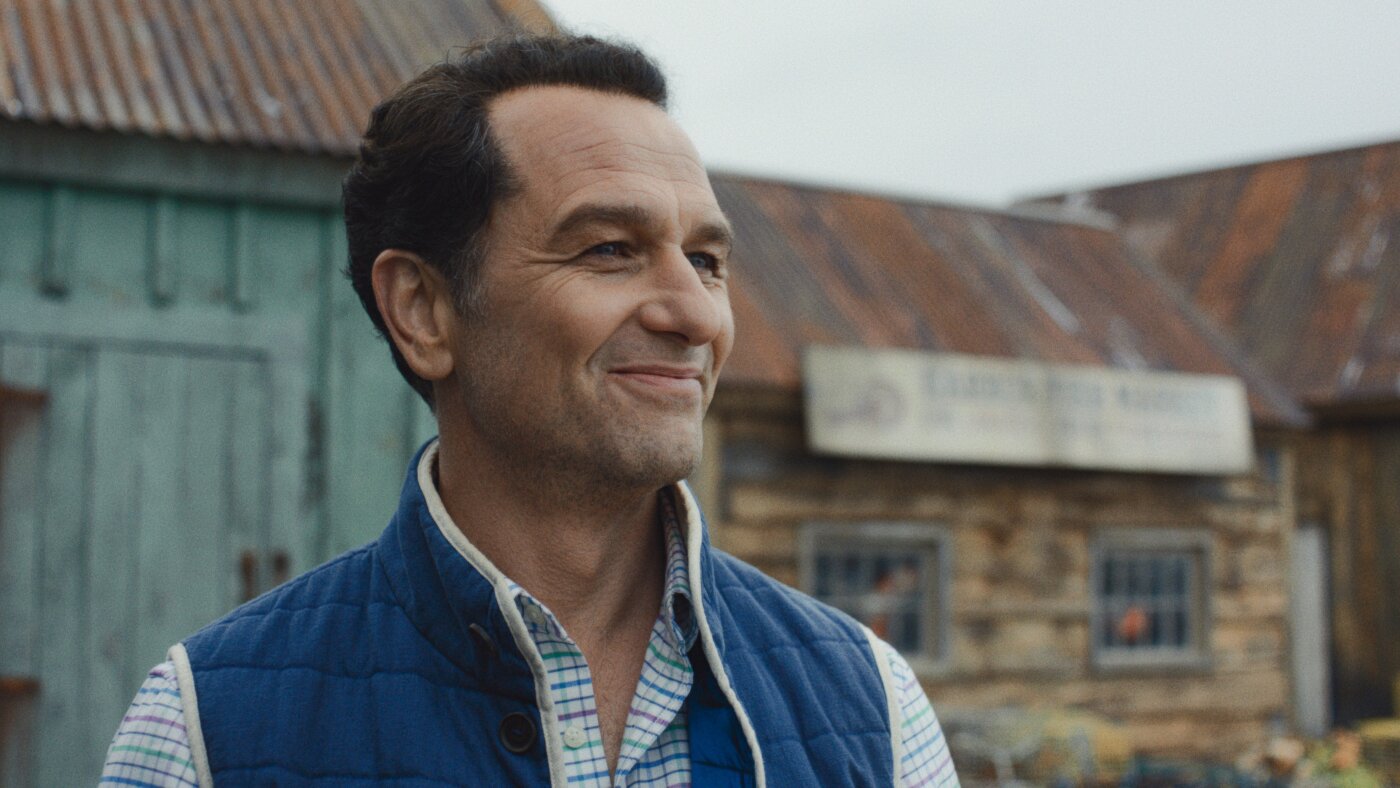
Matthew Rhys was nominated for his role in Widow’s Bay.
Apple TV
hide caption
toggle caption
Apple TV
The 2026 Emmy nominations are here. We’re unpacking the record-breaking nominations for Hacks, plus a big day for Widow’s Bay, The Pitt, and The Bear. We’ll also talk about the snubs and make some early predictions of who will win.
Connect with Pop Culture Happy Hour:
Letterboxd / Facebook
Our weekly newsletter
Support Pop Culture Happy Hour+

-

 Technology3 minutes ago
Meta is reportedly working on smart glasses that would be recording all the time
-

 World10 minutes ago
Trump says ‘Iran lies and cheats’ as IRGC emerges as dominant force in negotiations with US
-

 Politics13 minutes ago
Who is Valli Geiger? Meet the Maine Dem that Platner urged to run for Senate
-

 Health18 minutes ago
Deadly Legionnaires’ disease outbreak sparks concern in major US city: Know the symptoms
-

 Sports24 minutes ago
Caitlin Clark’s return falls flat after Fever coach limits her in loss to shorthanded Sparks
-
Business33 minutes ago
Commentary: Trump wants to let companies make fewer disclosures, thus keeping investors in the dark
-
 Entertainment40 minutes ago
Justin Baldoni and wife break silence after ‘It Ends With Us’ legal battle with Blake Lively
-
Lifestyle42 minutes ago
A meal with an animated Mona Lisa? Immersive dining goes high tech — but will L.A. eat it up?

