Politics
Column: Hey, Joe, it's OK to call it quits and leave with dignity and pride

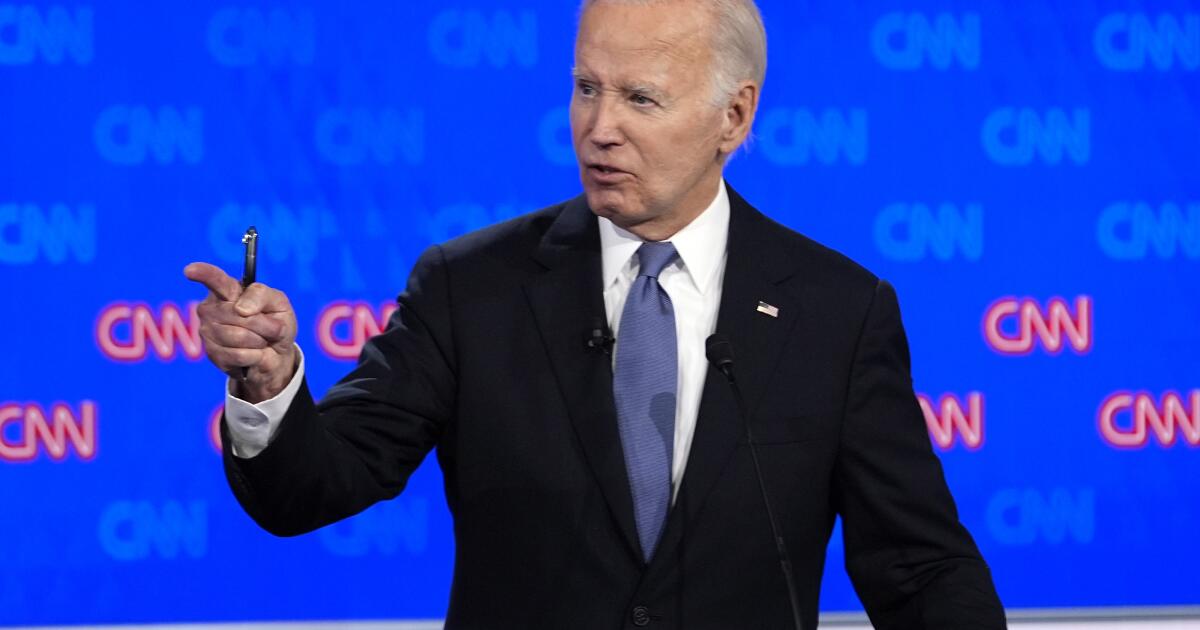
If I were a relative or close confidant of President Biden, I’m pretty sure I’d give him a hug, thank him for his service, and tell him to seriously consider walking away.
I’d tell him that after a life of service, he can pass the torch with pride, with dignity, and with grace.
Someone probably should have done this months ago, out of love or duty, and out of the concern that Biden’s health is likely to get worse in coming years.
But we’re not very good at this sort of thing — at summoning the courage it takes to confront a loved one or a boss who’s in decline and being totally honest about it. To be courteous but firm. I had trouble telling my own father it was time to give up driving. He resisted, unaware of or unwilling to accept the reality of his obvious shakiness behind the wheel, and unwilling to surrender his keys or his pride.
California is about to be hit by an aging population wave, and Steve Lopez is riding it. His column focuses on the blessings and burdens of advancing age — and how some folks are challenging the stigma associated with older adults.
By many accounts, people close to Biden have been aware of a decline but have not pressed him to step aside. The New York Times reported on Tuesday that in “the weeks and months” before last Thursday’s presidential debate, “several current and former officials and others who encountered him behind closed doors noticed that he increasingly appeared confused or listless, or would lose the thread of conversations.” There are also reports that people are encouraging him to keep going.
There are some analogies to California‘s Sen. Dianne Feinstein, who died last year at the age of 90 after more than 30 years in office. If there was any inner-circle effort to persuade her to leave the Senate due to her obvious cognitive and physical decline, that effort failed. She died in office after announcing she would not run again.
In some cases, stepping aside is the right thing to do.
This might sound odd to those who’ve followed my Golden State column over the last 28 months. One of my driving principles has been to stand firm against the notion that we’re incapable of contributing as we age, or that our value diminishes.
In recent columns, I’ve been pointing out, with the help of experts, that you can’t diagnose dementia from afar, though many people have tried to do so in Biden’s case, especially after his debate performance.
I’ve also written that whatever the cause of his foggy gaze and occasional meandering phrase (the medical possibilities are numerous), Biden seemed lost and unsteady. He may still have some gas in the tank, but time is working against him. A year from now, or two, or three or four, how will he be?
The world population is aging rapidly, and more people are staying on the job longer — and while the benefits are many, the risks are real. Bodies and minds break down. It’s OK, when they do, to punch out and move on.
Since the debate, I’ve been thinking about something USC gerontology professor Caroline Cicero said to me last year, when I wrote about whether Biden or Feinstein should step aside.
“I’m very concerned about ageism in the workplace, but I’m also concerned about people who think they have to work forever,” said Cicero. “Giving people permission to retire is something I think we need to do.”
She picked up on that line of thinking this week.
“In recent decades, society has told us that we can have it all. In a battle against ageism, we tell people they can work as long as they want,” she said. “In a battle to prove ourselves, we tell ourselves we can beat normal slowdowns that come with the passage of time.”
But most of us can’t.
Mick Jagger and Paul McCartney, each north of 80, are still holding a tune, and Warren Buffett, at 93, seems to be doing OK. But that’s the thing about aging, as I‘ve said before: You can be old at 60 and young at 85.
Biden has obvious strengths, chief among them experience, wisdom, decency, civility and the empathy that comes with crushing loss. It may be that those in his inner circle, knowing what he’s made of, can’t bring themselves to question his strength and resolve, even in the face of obvious decline. Sure, his family knows him better than we do, but maybe they can’t see what we see from afar.
Some of you might be wondering, right about now, that if I’m all about frank discussions on knowing when it’s time to go, then how come I’m not bringing the Trump family into this.
I would, but their task is even harder than the Biden family’s. What would be the point of saying to a convicted felon who continues to insist he won the 2020 election, “Hey Pop, the fact-checkers are still recovering from the workout you gave them in the last debate”? It takes a bit of humility to see the truth about yourself, and when you begin listing the qualities that define Donald Trump, humility and truth do not make the cut.

Former President Trump, debating Biden last week, would be even less inclined to heed any advice to leave the race.
(Gerald Herbert / Associated Press)
Biden may be having trouble seeing himself as anything other than what he is now — a public servant at the top of the flow chart. You can’t be president of the United States without a healthy ego, and in jobs that people are passionate about — that become their very identity — they often can’t imagine what or who else they could be in retirement, provided they can afford to retire, which many cannot.
These people may not be able to imagine that anyone waiting in the wings is as up to the task as they are, and perhaps that’s part of Biden’s calculation. If he takes the next exit, who would take his place? And is there enough time for Vice President Kamala Harris or any of the other potential last-minute candidates to find traction?
It never should have come to this.
The late Supreme Court Justice Ruth Bader Ginsburg comes to mind as Exhibit A for lessons on the price of stubbornly holding on. She refused to surrender her position as her health faded, and women’s reproductive rights suffered a blow as a result.
“I see it with entrepreneurs who created a business and have hard time letting go,” said Helen Dennis, who started a support group called Renewment — combining the words “renewal” and “retirement” — 25 years ago for successful women who had trouble imagining the next versions of themselves. The group now includes “teachers, nurses, doctors, several attorneys,” all of them leaning on each other as they learn “how to navigate the next chapter.”
Work is not life, and life is not work, USC’s Cicero once said to me. That must be a foreign concept to a sitting president, but I’m thinking of former President Jimmy Carter as one of the best examples of those who have found ways to contribute after leaving office. He took up a hammer and went to work for Habitat for Humanity — and he won the Nobel Peace Prize for working on peaceful solutions to world conflicts.
“People often fear retirement because they don’t want to be labeled as old, invisible or unimportant,” Cicero said. And many of those who are “addicted to routine don’t know how they will spend their time without the rigors of a work schedule,” she added — but that “does not mean they need to keep working to have a satisfying later life.”
Biden, after his debate stumble, was quickly back on the stump, telling supporters that when you’re knocked down, you get back up and keep fighting.
But Father Time, as they say, is the one who’s undefeated.
I’d remind Biden that the country and the world have problems neither he nor Trump can fix, and that if he’s reelected he will be subjected to four more years of unrelenting judgments about his fitness to hold office.
I’d tell him that, at 81, when you’re knocked down, you’ve earned a rest.
And there’s no shame in that.
steve.lopez@latimes.com


WASHINGTON — A tentative armistice between the United States and Iran reached less than a month ago appeared all but dead Wednesday after the two sides traded fresh military strikes, and as President Trump directed further attacks on the Islamic Republic.
The escalation marked a dramatic turn after the Trump administration spent weeks selling a diplomatic breakthrough with Tehran that proved controversial across the political aisle, lifting oil sanctions and a naval blockade on Iran in exchange for the promise of talks over the status of the Strait of Hormuz and its decades-old nuclear program.
Now, speaking to reporters at the NATO summit in Turkey, Trump said he believed the truce — which diplomats describe as a memorandum of understanding — was “over” and that it was a “waste of time” dealing with Iranian leadership.
“They’re scum. They’re sick people,” Trump said of Iranian leaders, whom he had characterized last month as “very rational people” and “very nice to deal with.”
The president’s dim views of the ceasefire agreement’s fate were shared by Iran’s foreign ministry, which issued a statement on Wednesday saying the American attacks, the reinstatement of a U.S. naval blockade on the Strait of Hormuz, and Israel’s continuing attacks in Lebanon rendered “important and fundamental” parts of the deal “ineffective.”
The truce’s unraveling was underscored by Trump ordering the U.S. military to launch a series of strikes against Iran on Wednesday afternoon to “further degrade their ability to threaten” the commercial shipping through the Strait of Hormuz.
“The United States is holding Iran accountable for recent unjustified aggression against commercial shipping and civilian crews freely navigating a vital international waterway,” U.S. Central Command said in a statement on social media.
Earlier in the day, Trump signaled that the United States planned to “hit them hard” and floated the possibility of taking over Kharg Island, which is vital to Iran’s economy. His remarks quickly prompted oil prices to rise and global stock markets to fall, a worry that Trump acknowledged but which did not seem to sway his decision-making in relation to Iran.
“If we hit Iran, oil goes up a little bit, it is all right,” Trump said. He later added that the United States may “do some other thing that could lift it a little bit, but I don’t think it’s gonna lift it a lot at all.”
As Trump signals the continuation of fighting, his administration has been seeking more than $67 billion in funding to cover expenses related to the Iran war, a request that Congress has not yet approved as lawmakers have been split over the president’s handling of the conflict.
“The American people are paying the price for Trump’s total failure in Iran,” Senate Minority Leader Chuck Schumer (D-N.Y.) said in a statement Wednesday. “Our troops are back in harm’s way and high gas costs are continuing to punish working families.”
The president’s stance on the war marked the latest setback to a fragile truce that has barely held since the 14-page agreement was signed June 17, as the U.S. and Iran engaged over the last few weeks in cycles of attacks and counterattacks.
Trump was noticeably angrier at Iran on Wednesday as he cast doubt over the deal. Last month, Trump had complimented Iranian leadership for trying to reach a peace deal and celebrated the reopening of the Strait of Hormuz, a crucial shipping route for the world’s oil and gas. But based on his remarks, it was clear he was out of patience.
“I am not happy with them,” Trump said. “They’re cuckoo. There’s something wrong with these people. For 47 years, they’ve been the bully of the Middle East and they are not the bully anymore. They are not the bully anymore.”
Trump expressed frustration with Iran’s negotiators and their resistance to abiding by U.S. demands to reopen the strait. When asked if he intended to send troops to Iran, the president dismissed the idea.
“Why would I go in now?” Trump said. “I’d go in when they’re completely eliminated or an agreement is made.”
Still, the president kept the door open for negotiations, saying that his envoys Steve Witkoff and Jared Kushner “want to negotiate.”
“They’re good people, Steve Witkoff, Jared Kushner, but they have to come back to me,” Trump said. “As far as I’m concerned, it’s just a waste of time dealing with [the Iranians]. They’re liars.”
The latest breakdown to the ceasefire followed a now-familiar chain reaction of tit-for-tat attacks, starting with a series of strikes on three oil tankers transiting the Strait of Hormuz on Tuesday, including a Qatari vessel carrying natural gas, according to the United Kingdom Maritime Trade Operations center.
The Qatari tanker was off the coast of Oman when it was hit and caught fire, the maritime monitor said, in what experts say was a move to thwart ships attempting to use an alternate transit route to the one Iran specified. Iran did not claim responsibility, but a report on Iranian state television said the Qatari tanker came under attack after ignoring warnings to turn back.
The two other vessels were damaged but were able to continue to their destination, according to the U.K. group.
Qatar, which has played a vital role in facilitating negotiations between the U.S. and Iran, condemned the attack on its tanker as “unacceptable.”
The U.S. responded with a wave of strikes against more than 80 Iranian targets aimed at “impos[ing] heavy costs for targeting and attacking commercial shipping crewed by innocent civilians in an international waterway,” according to a statement from U.S. Central Command. That tally included roughly 60 Islamic Revolutionary Guard Corps small boats in the strait.
Iranian state media said U.S. strikes targeted Sirik, Qeshm Island and Bushehr and Bandar Abbas, while a U.S. drone strike on the port city of Mahshahr killed one Revolutionary Guard member.
Ahead of the strikes, the White House revoked the 60-day temporary license given to Tehran to sell and deliver oil during the truce.
Iran’s military countered with its own strikes on 85 U.S. military facilities in Bahrain and Kuwait; it also shot down an MQ-9 drone, according to a statement on Wednesday.
Kuwait said its military intercepted two ballistic missiles and 13 drones, but that none had resulted in material damage or casualties.
Global oil prices surged 6% on news of Trump’s reversal on the deal, rising to more than $78 a barrel, down from the peak during the war but still above prewar levels.
The renewed violence appeared to have little effect on the funeral for Iran’s Supreme Leader Ayatollah Ali Khamenei, who was killed in an Israeli strike on Feb. 28, in the war’s opening hours.
The funeral, a days-long period of mourning, is set to end on Thursday, when Khamenei’s body will return from Iraq to be buried in the city of Mashhad, his birthplace. Negotiations were to begin once more.
In his remarks Wednesday, Trump said Iranian leaders had asked for a “timeout” to attend the funeral, and that he had promised not to kill them.
“And I said give it to them, and they start shooting missiles,” Trump said.
Whether those talks — which were meant to deal with the thorniest issues between the two countries, including the Strait of Hormuz and Iran’s nuclear program — will go ahead remains unclear. Iran, for its part, maintained a defiant attitude.
“The era of bullying and extortion is over,” wrote Mohammad Ghalibaf, Iran’s parliamentary speaker. “It leads nowhere. We don’t fold.”
Ali Akbar Velayati, a senior advisor to the supreme leader, posted on X that Trump’s policy had “driven the region towards fire.”
“We had previously warned that the region is not a place for the political gambling of small countries, and we have repeatedly proven that adventures are met with an immediate response,” he wrote.
He added that the Axis of Resistance — a reference to Iran’s network of allied groups in Lebanon, Iraq and Yemen — would not be “silent against humiliation and adventurism” and has “its finger on the trigger.”
Bulos reported from Beirut and Ceballos from Washington.
Politics
Omar’s disclosures erased millions, leaving her with potential negative net worth. She won’t explain why.

NEWYou can now listen to Fox News articles!
Rep. Ilhan Omar, D-Minn., refused to address her revised financial disclosures that could imply she has a negative net worth after the progressive lawmaker dramatically reducing the reported value of assets tied to her husband’s business ventures.
“Can you tell us if your husband still has the consulting business and the wine business?” Fox News Digital asked Omar.
The congresswoman stayed silent as she was repeatedly questioned, after previously telling Fox News Digital that the original filing — showing Omar’s reported assets reducing by as much as $29.9 million — was inaccurate and “incomplete” information.
ILHAN OMAR’S OFFICE SAYS SHE’S ‘NOT A MILLIONAIRE’ AFTER $30M FILING REVISED DOWN TO UNDER $100K: REPORT
US Representative Ilhan Omar, Democrat of Minnesota, speaks during a press conference with family members of Palestinian-American journalist Shireen Abu Akleh as members of Congress call for US investigations into Israel’s actions and reintroduce the Justice for Shireen Act, outside the US Capitol in Washington, DC, May 18, 2023. The Al Jazeera journalist, who was a dual US citizen, was killed on May 11, 2022. The Israeli army later admitted one of its soldiers likely shot the reporter. (Photo by SAUL LOEB / AFP) (Photo by SAUL LOEB/AFP via Getty Images)
The controversy surrounding Omar’s finances began when a 2024 financial report estimated that Omar and her husband possessed between $6 million and $30 million in assets, all while the Minnesota fraud scandal within the Somali community was beginning to come to fruition.
A more recent 2025 financial disclosure report shows Omar’s revised value of shared assets between her and husband to sit at a maximum of $125,000 — a multi-million-dollar drop from the year prior. The lower estimate of their assets, $20,000, compared to the low and high debt estimates, $30,000 and $100,000, would imply the Minnesota Democrat could have a negative net worth.
Both her and her husband have separate debts, each ranging somewhere between $15,000 and $50,000 — from her own student loans and her husband’s credit card debt, according to the disclosures.
WATCH: OMAR SILENT WHEN CONFRONTED ON ALLEGED TIES TO MASSIVE MINNESOTA FRAUD SCANDAL
RICHFIELD, MN – AUGUST 08: Rep. Ilhan Omar (D-MN) (C) campaigns with her husband Tim Mynett (R) at the Richfield Farmers Market on August 8, 2020 in Richfield, Minnesota. Omar is hoping to retain her seat as the representative for Minnesota’s 5th Congressional District in next week’s primary election. (Photo by Stephen Maturen/Getty Images)
The biggest change in the documents involved Omar’s husband, Tim Mynett. His reported ownership interests in both his winery and venture capital advisory firm, which were previously valued in the millions of dollars, are listed with no value now.
In Omar’s 2024 financial disclosure records, Mynett’s share in his winery was valued between $1 million and $5 million, and his share at the venture capital advisory firm was valued between $5 million and $25 million. Now, his equity interests are both listed at $0.
Omar’s office previously told Fox News Digital that Mynett has partners in both businesses and said the earlier disclosure mistakenly reflected the businesses’ total equity rather than his ownership interest. The office also said the original filing listed assets without accounting for liabilities.
VANCE REFERS TIM WALZ, MINNESOTA ATTORNEY GENERAL TO DOJ FOR CRIMINAL INVESTIGATION OVER STATE’S ALLEGED FRAUD
House Oversight Committee Chairman James Comer, R-Ky., has publicly voiced his interest in the Ethics Committee opening an investigation into Omar’s personal finances after the 2025 financial reports came out showing the possibility of a $29 million drop in her net worth.
Vice President JD Vance also has previously said the U.S. Department of Justice will be opening a probe into her alleged fraud as part of the administration’s anti-fraud taskforce that he spearheads, though no formal investigations have been shared with the public at this time.
Omar has been reluctant to answer Fox News Digital’s questions about her financial fallout and potential probes to be opened against her.
The Minnesota lawmaker similarly dodged answering any of Fox News Digital’s questions just last month about the revised disclosures.
CLICK HERE TO DOWNLOAD THE FOX NEWS APP
“There’s also the possibility that it might rain on this sunny day,” Omar replied without responding directly to the content of the question.
Fox News Digital’s Robert Schmad contributed to this report.

As a student years ago, I dove deep into the history of the Red-hunting McCarthy era and became familiar with the actor who emerged second only to Wisconsin Sen. Joe McCarthy as the villain of that insidious time: his shameless, conniving young lawyer, Roy Cohn. Never would I have imagined that a future president would count Cohn as a mentor and role model.
Then came Donald Trump.
Now, in Cohn-inflected McCarthyesque style, President Trump is channeling his tutor yet again, baselessly labeling his political enemies — all Democrats — as communists as he looks ahead to the fall’s midterm elections. Once more Trump shows that his catchphrase “Make America great again” means regressing, this time to Trump’s formative 1950s and the McCarthy era that sadly helped define it.
In recent speeches, including on the Fourth of July, Trump’s utterances of “communist” or “communism” reached double digits each time. (As that implies, the president didn’t set aside his divisive rhetoric even for the nation’s 250th birthday.)
“Our warriors did not fight communism on battlefields across the world only to have that menace rear its ugly head right back here in America,” Trump said late on the Fourth on the National Mall.
Trump couples his commie-baiting with a dash of his trademark xenophobia. “There is now a resurgence of the communist menace in our land, including by newcomers to our country who embrace ideas totally opposed to our way of life and our great success,” he said at Mount Rushmore a day earlier. (He’s got it backward, of course: Immigrants come here for the American way of life and promise of success.)
Here’s the irony: Trump’s actions in his second term make him look more like the commie. He’s projecting again.
Now that Trump is exploiting a few victories lately by left-wing democratic socialists in Democratic primaries to paint the entire party as communists, it’s time to review the record — his record.
A hallmark of communism is government ownership of companies and control of the economy, at the expense of private property and free markets. In just over a year, Trump has used billions of taxpayers’ dollars to buy shares for the government in a growing list of private companies — U.S. Steel, Intel, Westinghouse and more — citing national security. The companies don’t always welcome their new stakeholder; at a minimum, they rightly fear it for the demands the government could make about prices and production.
“It’s what Putin did,” the estranged Republicans at the Lincoln Project posted online Monday. “Trump is the closest we’ve ever come to communism.”
“What began as a populist revolt against so-called elites has become a program of state ownership, price fixing and top-down industrial control,” free-market economist Veronique de Rugy wrote in The Times last October of Trump’s actions. “The power to ‘partner’ with business is the power to control it.”
Comrade Trump’s first big government grab, and a model for those to come, was in June last year, when he wrested a permanent “golden share” in U.S. Steel in return for approving its sale to Japan’s Nippon Steel. The company’s charter was revised to give the U.S. president extraordinary veto power over nearly a dozen corporate activities, including closing or relocating plants, supply-chain decisions, even pricing.
“We have a golden share, which I control,” Trump told reporters at the time, in words I never thought I’d hear from a president of the party once associated with free markets.
Just last week, Trump boasted to CNBC how he’d extracted a 10% stake in beleaguered chip giant Intel last August, after first demanding that its chief executive resign. “Intel came in. They had a problem. I said, ‘I can solve your problem, but I want 10% of the company.’ … Somebody said that’s not very American. I said, ‘No, I think it is very American, actually.’ And I’ve done that with other deals.”
And so he has.
The Pentagon is now the largest stockholder in struggling MP Materials, a large rare-earth mine in California, and guarantees a 10-year price floor for its output that stunned competitors. The administration has since taken shares in other rare-earth companies. The Commerce Department took an option for an 8% stake in Westinghouse, to spur construction of nuclear reactors, and has the right to 20% if the government decides the company should go public. The government takes a 15% cut of Nvidia’s and Advanced Micro Devices’ AI chip sales to China.
As much as anything he does, Trump’s direct intervention in private enterprise invites the question “What if Biden/Harris/Obama did that?” The answer, of course: Trump and Republicans would cry “Communist!”
Trump’s actions are the sort Americans generally have only seen during economic emergencies or major wars, and then rarely. I covered the frenzied and ultimately successful response to the near-collapse of the global financial system and the U.S. auto, insurance and housing industries. Behind the scenes in the Obama White House (and George W. Bush’s at the outset) was constant, angst-filled debate about any actions smacking of government takeovers and a determination that interventions be temporary, unlike Trump’s schemes. (For all the still-lingering unpopularity of the banking bailout, the Treasury — the taxpayers — got all the money back and then some, and exited the business.)
Trump’s economic big-footing isn’t the only way in which he resembles the commies Americans know best, and whom he so admires: Vladimir Putin, Xi Jinping, Kim Jung Un. There are also the images of himself everywhere, monuments planned, drearily long and self-adulating speeches and interference in the nation’s cultural, educational and legal spheres and — worst of all — in elections.
At Rushmore, Trump closed with a demand that Congress pass his so-called SAVE America Act to restrict voting. “We do that and we’re not going to lose an election for 100 years,” he said, speaking of course about Republicans.
One-party rule through central government election finagling? Now that’s a communist.
Bluesky: @jackiecalmes
Threads: @jkcalmes
X: @jackiekcalmes
-

 Technology5 minutes ago
Google turns old phones into cloud servers
-
 Business12 minutes ago
Waymo is starting robotaxi service in San Diego
-
 Entertainment15 minutes ago
‘Children of Blood and Bone’ author won’t see film after feud with star Amandla Stenberg
-
 Lifestyle20 minutes ago
After her son’s death, she found a new purpose. ‘He’s whispering: Mom, this is your path’
-
Politics27 minutes ago
Iran ceasefire is ‘over,’ Trump says, and orders additional strikes
-
 Science30 minutes ago
Diarrhea-causing cyclosporiasis exceeds 1,000 cases in U.S. What Californians should know
-
 Sports35 minutes ago
Arthur Fery’s fairy-tale Wimbledon run puts British wild card on brink of history
-

 World45 minutes ago
Burnham on course to become next UK PM with backing of 322 Labour MPs

