Midwest
Democrats' nomination of Biden in virtual roll call could come as early as mid-July

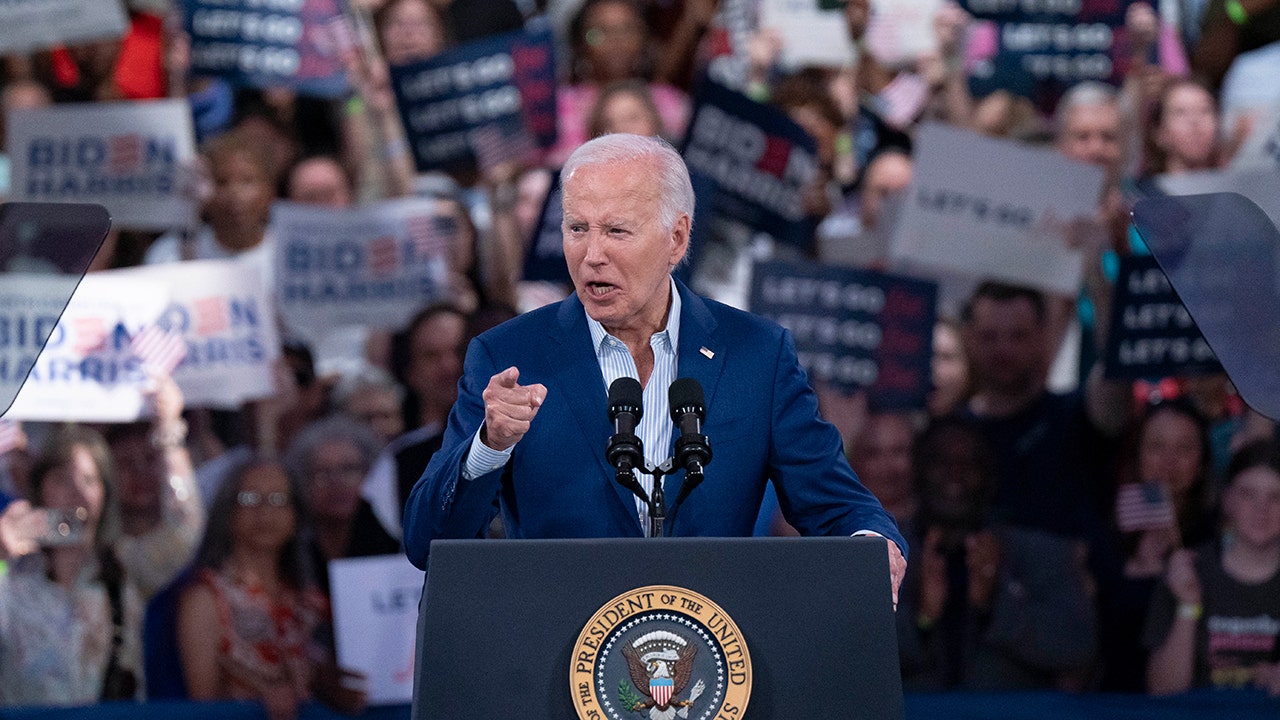
The Democratic National Committee is considering formally nominating President Biden as early as mid-July, two Democratic sources confirm to Fox News.
A potential date for Biden’s nomination is July 21, which is when the Democratic National Convention’s credentials committee meets virtually.
As has been reported for weeks, Democratic Party officials decided that the formal roll call would not take place at their convention, which kicks off on August 19th in Chicago.
BIDEN TRIES TO FLIP THE SCRIPT ON THE NEGATIVE NARRATIVE COMING OUT OF THE DEBATE
President Biden speaks at a post-debate campaign rally on June 28, 2024, in Raleigh, North Carolina. (Allison Joyce/Getty Images)
The reason is that the Democrats’ convention comes after Ohio’s ballot deadline of August 7th. Party officials, in a maneuver to allow Biden to appear on the Ohio ballot, said they would hold the roll call ahead of Ohio’s ballot deadline.
But the latest development on a potential July 21 roll call date also comes in the wake of last Thursday’s disastrous debate performance by the president in his first face-to-face showdown with former President Trump.
President Biden and former President Trump debated on Thursday night. (Getty Images)
The 81-year-old president’s halting delivery and stumbling answers at the debate sparked widespread panic in the Democratic Party and spurred calls from political pundits, editorial writers, and some party politicians and donors, for Biden to step aside as the party’s standard-bearer.
Word of the potential July 21 roll wall was first reported by Bloomberg News.
Get the latest updates from the 2024 campaign trail, exclusive interviews and more at our Fox News Digital election hub.
Read the full article from Here


The capsule will be buried in Philadelphia on July 4. Here’s a look at what each state contributed to “America’s Time Capsule.”

‘America’s Time Capsule’ has been officially sealed. What’s inside?
All 50 states contributed items to “America’s Time Capsule,” which will be buried in Philadelphia on July 4 and will be opened 250 years later.
South Dakota sent a special edition of poetry to be sealed in “America’s Time Capsule” along with 200 items from every state, five territories and some institutions.
“This Far Country” is a suite of poems by South Dakota native Joseph Bottum celebrating four themes and symbols of the state: the meadowlark, chokecherry jelly, the homestead and rivers. The edition is illustrated by Jeanne Bowman and designed by Angela Corbo Gier.
South Dakota also contributed a letter from Gov. Larry Rhoden to the Americans of 2276, when the capsule is meant to be opened.
The time capsule has been officially sealed in commemoration of the United States’ 250th birthday.
The 900-pound steel cylinder contains over 200 artifacts, records and objects to tell America’s story when it is opened 250 years later.
The capsule will be buried in Philadelphia on July 4 as part of the hundreds of events for America’s 250th anniversary that will take place nationwide.
America250, the official nonpartisan commission designated by Congress to organize the July 4 celebrations, spearheaded the work to design the capsule and collect relics. All 50 states in conjunction with numerous national organizations contributed items (ranging from a vial of sand to an Olympic gold medal) reflecting the people, places and moments that shaped their history.
California contributed a NASA photo, an AI prediction and a fusion superconducter segment. Arizona contributed a copper ingot and a laser-etched challenge coin. Maine contributed a whale bone and a woven bookmark. And Utah contributed tickets to their amusement parks and George Washington’s prayer medal.
“Now that America’s Time Capsule has been sealed, it carries with it a remarkable record of this moment in our nation’s history,” said Chair of America250 Rosie Rios. “This moment is as much about the future as it is the past. When it is opened in 2276, future generations will see the care, pride, and optimism with which Americans marked our 250th anniversary.”
Below is a list of an item contributed from each state and territory of the United States. Most states submitted multiple items, and the full list can be viewed on America250’s official website.
- Alabama: A series of poems written by author and professor James Matthew Wilson titled “America.”
- Alaska: A map of New Archangel, Alaska, when Russia sold Alaska to the United States in 1867.
- American Samoa: A set of two uncirculated quarters from 2009 and 2020 with images of American Samoa.
- Arizona: A laser nano-etching of the text and signatures of the Declaration of Independence and the U.S. Constitution on a coin.
- Arkansas: A diamond found at the Crater of Diamonds State Park, the only place in the United States where people can search for diamonds and keep what they find.
- California: A Claude AI prediction of what California will be like in 250 years on archival paper. This will serve as a “tangible representation” of AI in 2026.
- Colorado: A set of postcards selected to represent “what life was like in Colorado in 2026.”
- Connecticut: The Official Proclamation document for the state.
- The District of Columbia: A challenge coin with “Washington, D.C. 250” on one side and a building with flags and the Mayor’s name etched on the other.
- Delaware: A set of 12 notecards with writings and drawings from the state’s citizens to answer what Delaware is to them.
- Florida: The Florida Senate Booklet from 2024 to 2026, which describes the operations of the Senate.
- Georgia: A distinct medallion of The Masters Logo, which has a yellow silhouette of the United States with a red flagstick to mark where Augusta, Georgia is located.
- Guam: A Gualofan ornament pendant, which is a traditional ornament that has become a “modern expression of Chamorro identity.” The pendant represents the full moon.
- Hawaii: A letter from Governor Josh Green.
- Idaho: A star garnet, which is the state’s official gemstone found only in Idaho and one other place in the world. The garnet is meant to highlight the state’s geological heritage.
- llinois: A poem authored by Illinois Poet Laureate Mark Turcotte titled “Dear New Blood.”
- Indiana: The Indiana 250 Annual Report, which shares the mission and objectives of the commission working to celebrate July 4th.
- Iowa: Astronaut Peggy Whitson’s International Space Station medallion, which commemorates Whitson’s leadership as the first woman to command the International Space Station.
- Kansas: A document identifying Kansas250 commissioners and news items from the last year.
- Kentucky: A commemorative coin from the Sons of the Revolution, intended to serve as a reminder of how the American Revolution influenced Kentucky.
- Louisiana: A necklace with a Krewe of Bacchus pendant, a collectible from Mardi Gras, and glass beads.
- Maine: A whale bone from the North Atlantic right whale, which is one of the world’s most critically endangered large whale species.
- Maryland: A challenge coin with Governor Wes Moore’s name and a map of the state on it.
- Massachusetts: A set of archival prints, including a print of the Boston Massacre and a letter from John Adams and Benjamin Franklin to the Massachusetts Council.
- Michigan: The state stone, or the Petoskey stone, which is native to the shores of Lake Michigan and formed nearly 350 million years ago.
- Minnesota: The state’s flag.
- Mississippi: Four brass coins commemorating the U.S.’s largest rocket engine test site and the Birthplace of America’s Music, amongst other notable events.
- Missouri: A letter from Governor Mike Kehoe to Americans 250 years later.
- Montana: A beaded artwork created by a Arikara artist representing the state’s landscapes and heritage.
- Nebraska: An archival photo of the Vice Grip pliers, which symbolize the state’s commerce and history.
- Nevada: A set of gambling chips to reflect the history of casinos across the state, which legalized gambling during the Great Depression.
- New Hampshire: A print of a sticker depicting the center emblem of a flag carried by the Second New Hampshire Regiment of the Continental Army.
- New Jersey: A stainless steel plate with greetings to people in 2276, with “the hope that the values that guide us in 2026 — liberty, opportunity, cooperation, love and respect for one another — continue to shape society.”
- New Mexico: A hand-crafted red chile tile created by Mexican-American artist Jennel Juarez. The tile is one of New Mexico’s longstanding cultural symbols.
- New York: A written reflection from New York State.
- North Carolina: A copper disk engraved with an image of the North Carolina State Capitol Building.
- North Dakota: A commemorative coin representing the opening of the Theodore Roosevelt Presidential Library in Medora, North Dakota.
- The Northern Mariana Islands: A crescent-hewn symbol representing the Chamorro ancestors’ leadership and noble standing.
- Ohio: Fabric from the Wright Brothers’ flight honoring the state’s connection to the birth of aviation.
- Oklahoma: A belt buckle that features images that represent the “grit, determination and spirit” of the state.
- Oregon: A handcrafted pin created by Native American artist Lillian Pitt.
- Pennsylvania: A “Greetings from Harrisburg” letter from Governor Josh Shapiro.
- Puerto Rico: A rosary to represent the importance of faith in the island.
- Rhode Island: A holiday ornament meant to honor the state’s Revolutionary War legacy.
- South Carolina: A coin commemorating the work done by the state’s 250 Commission.
- South Dakota: A poetry book celebrating the state’s rivers, wildlife and homestead culture through a special edition of “This Far Country” authored by Joseph Bottum.
- Tennessee: An original poster designed by one of the state’s artists to highlight Tennessee’s agricultural history and cultural symbols, including its role in the Civil Rights movement and women’s suffrage.
- Texas: The state seal on a chiseled glass paperweight. The seal was designed in 1836 during the Texas Revolution.
- The U.S. Virgin Islands: A letter from Governor Albert Bryan, Jr.
- Utah: A set of 101 paper cards with different people that shaped Utah history.
- Vermont: A Battle of Hubbardton ornament. The battle was the only Revolutionary War battle fought entirely on what is now considered Vermont.
- Virginia: A challenge coin representing the state’s commemoration of America’s semiquincentennial.
- Washington: A letter from Washington State Lieutenant Governor Denny Heck to the future.
- West Virginia: A student essay authored by Alyssa Dalton titled “Remembering our Foundation” celebrating the nation’s 250th birthday. The essay was solicited from a statewide essay contest to recognize how “the young people… will continue to guide our state.”
- Wisconsin: An Eagle feather and photo of Old Abe, an American bald eagle who served with the Eighth Wisconsin Volunteer Infantry Regiment during the civil war.
- Wyoming: A letter from Governor Mark Gordon to future Americans.
Many of the capsule’s collections were specifically designed for the commemoration. For example, the Library of Congress contributed a molecular data storage device about 0.2 inches with synthetic DNA encoded with digital copies of the library’s items. It includes Thomas Jefferson’s rough draft of the Declaration of Independence, a 3D rendering of President Abraham Lincoln’s hand and an 1898 audio recording of the national anthem.
Companies such as Coca Cola and Apple along with museums like the Smithsonian Institute also contributed items.

Vessels are anchored along the Strait of Hormuz.
Amirhossein Khorgooei/ISNA/AFP via Getty Images
hide caption
toggle caption
Amirhossein Khorgooei/ISNA/AFP via Getty Images
The war in Iran was a costly blunder, according to swing voters in the battleground state of Wisconsin.
NPR observed two online focus groups on Tuesday featuring voters who supported Joe Biden in 2020 and then Donald Trump in 2024.
President Trump had just announced a framework agreement to end the war, which he signed on Wednesday.
Yet among the focus groups’ 13 participants, no one said they thought the conflict with Iran was “worth it,” and nine said they felt that the U.S. is coming out of this conflict weaker than before.
Corey M., a 33-year-old independent voter, said he is concerned that the U.S. expended “so much financially and so much of our arsenal,” with little to show for it. (All participants agreed to be part of the focus groups on the condition that they be identified by their first name and last initial only.)
“We essentially got nothing out of it,” he said. “It’s hurt our economy and increased expenses for the everyday American, and it accomplished the square root of nothing.”
Focus groups are not scientifically significant like polling. But they provide insight into how Americans are thinking about what they see in the news.

These focus groups — made up of 10 self-described independents, two Democrats and one Republican — were conducted by messaging and market research firms Engagious and Sago as part of the Swing Voter Project. NPR is a partner on the project.
Rich Thau, president of Engagious, moderated the focus groups. He has been asking voters in key states about this conflict since March. And he said voters have been consistent.
“They were never on board,” Thau said. “Not the beginning. Not in the middle. And as we just learned, not at the end either, judging from what we heard from Wisconsin swing voters.”
Sam M., a 30-year-old independent, said from what he read about the deal, it wasn’t leaving the U.S. in a better position than before the war. In fact, he said he thought the Iran nuclear deal brokered by the Obama administration — which Trump backed out of — was a better deal for the United States.
Anger over high gas prices
For most voters, though, their biggest concern has remained the high gas prices that are a consequence of the war.
Tammy S., a 53-year-old independent voter, said Americans have been unfairly caught in the middle.
“I just don’t think the way that everybody else had to suffer through the tantrums of these two playing tug-of-war — I just don’t think that it was fair to the American people,” she said. “I don’t think that anybody was a real winner here.”

Several voters said they’ve felt squeezed by costs and as a result have given up something that had been a regular part of their life. They’ve cut vacations and eating out or are getting their hair done less often.
“I’ve given up all my extracurricular hobbies … paddleboarding, yoga,” said Jaylyn M., a 27-year-old who identifies as a Republican. “And then a lot of my subscriptions I’ve cut out, along with my daily coffee, which is minor, but all things that I’ve had to give up to make ends meet.”
“I had to raise all my deductibles on everything — my car insurance, my health insurance — to lower my premiums, so that I can continue to make it,” added Robyn T., a 63-year-old independent.
Trump owns the economic problems
The latest NPR/PBS News/Marist poll, out Thursday, finds that only a third of Americans approve of how Trump is handling the economy.
In the focus groups, nine of the 13 voters said they are more anxious about the economy than they were before Trump took office last year. And all but one voter said that “President Trump himself is responsible for those higher prices” because of the war.
“And 10 said he’s out of touch with their economic concerns,” Thau told NPR. “So for them, there’s a clear disconnect between how the president’s operating on the economy and what their needs are.”
And heading into what could be some tough midterm elections for Republicans, voters are really frustrated that Trump isn’t delivering a better economy by now.
“It seems to me, like, pick your issue, and things are not going well for him,” said Josh K., a 29-year-old independent voter. “I mean, we got this stupid war in Iran, and it turns out that we actually aren’t getting anything out of it. I mean, all we got was $4 gas. I mean, pick your issue — the economy, things are more expensive.”
Detroit, MI
First responders honored after rescuing 12 people from capsized sailboats near Belle Isle

DETROIT – Detroit first responders and several private citizens are being credited with helping rescue a dozen people after multiple sailboats capsized in the Detroit River near Belle Isle during severe weather last week.
The incident occurred shortly after 7:30 p.m. on June 10 as a line of thunderstorms moved through southeast Michigan, bringing strong winds to the area.
According to the Detroit Fire Department, crews were dispatched to Belle Isle near the beach following reports of overturned boats and people in the water.
Firefighters, EMS personnel, Engine 27, and Fireboat 2, known as the Sivad Johnson, responded to the scene.
When crews arrived, they found multiple small sailboats overturned in the river.
Officials said 20 people aboard seven sailboats were involved in the incident.
Twelve people were rescued from the water, while eight others safely returned aboard two boats that remained upright.
Fireboat 2 rescued four people from the water.
The Detroit Police Department Harbormaster rescued two more, while a private boater assisted three people. Another three were brought to safety by a nearby boat club vessel.
The operator of the sailing group said as many as 26 people were on the water before the storm arrived, with six making it back to shore on their own before rescue efforts began.
Despite the dangerous conditions, no serious injuries were reported. Officials said all rescued individuals declined medical treatment.
Authorities praised the coordinated response among firefighters, police officers, boat club members, and private boaters who assisted during the emergency.
“Be aware of your surroundings,” said Detroit Fire Department Fireboat Operator Daniel Familant. “To be honest, we do make a lot of the saves by the private boaters out there that are fishing or just having a good time, and people were out there screaming, ‘Help, help,’ and there they go, so everyone helps out. It’s an all-hands effort.”
Emergency crews remained on scene until everyone involved was accounted for.
Officials noted that one member of the Fireboat 2 crew was serving on the vessel for the first time during the rescue operation.
Copyright 2026 by WDIV ClickOnDetroit – All rights reserved.
-

 South Dakota2 minutes ago
South Dakota sends poetry to the America250 time capsule
-

 Tennessee9 minutes ago
Inside Tennessee 4×100 relay’s NCAA title, outlasting four botched exchanges
-

 Texas12 minutes ago
Flu sickens some 160 troops at Lackland Air Force Base in Texas
-

 Utah17 minutes ago
San Juan County assessor resigns after allegations of being ‘unfit’ for office
-

 Vermont24 minutes ago
Norman Rockwell finally gets his day in new Shelburne Museum exhibit
-

 Virginia27 minutes ago
Motorcoach failed to slow for traffic in Virginia work zone before crash that killed 5 from Western Mass., NTSB says – The Boston Globe
-

 Washington32 minutes ago
Storm Team4 Forecast: Much-needed morning rain before sunny afternoon
-
Wisconsin39 minutes ago
These Wisconsin swing voters say Trump’s war in Iran wasn’t worth it

