Politics
Opinion: If you were relieved by the Supreme Court's abortion rulings this term, think again

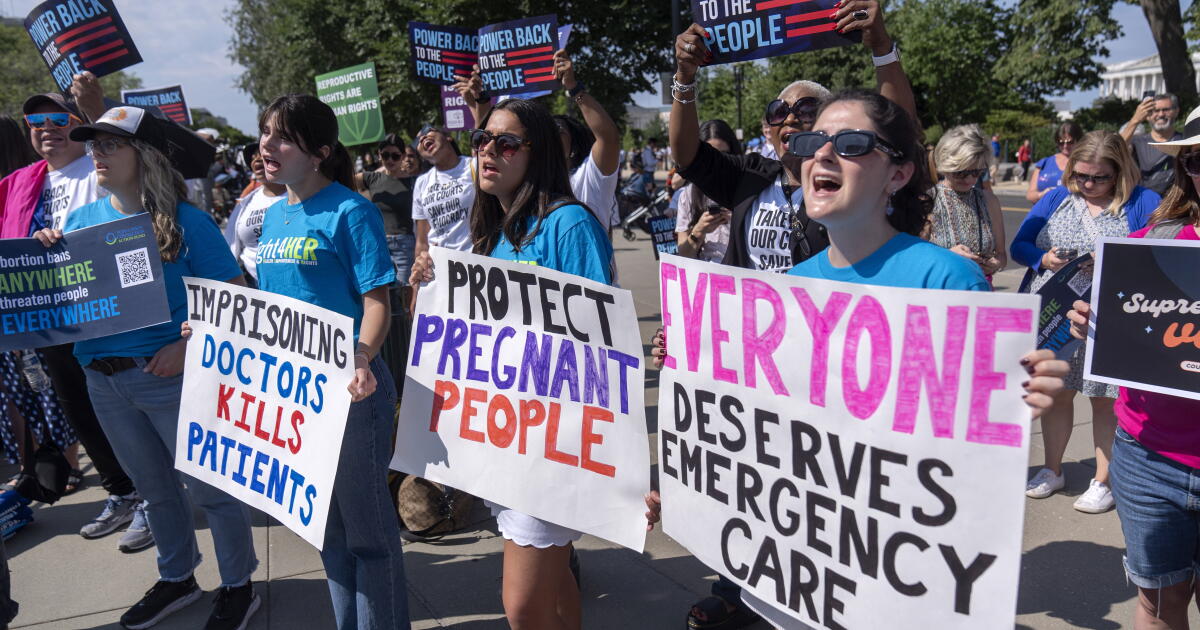
Emergency access to abortion has been a flashpoint in the chaotic aftermath of the Supreme Court’s overturning of the right to terminate a pregnancy in Dobbs vs. Jackson Women’s Health Organization in 2022.
Can states deny women the care they need to preserve their health in the aftermath of Dobbs, or does federal law provide some protection for patients?
In January, the Supreme Court agreed to hear two cases testing whether the federal Emergency Medical Treatment and Labor Act — or EMTALA — could override Idaho’s strict state abortion ban. Idaho has some of the narrowest exceptions to its ban in the nation — allowing doctors to intervene only when there was a threat to the life, not health, of the patient. The Biden administration argued that the federal law provided broader protection — and trumped the state’s ban. But on Thursday, the justices decided they had taken up the issue too soon, dismissing the cases as “improvidently granted” and sending them back to the U.S. 9th Circuit Court of Appeals.
In practical terms, Thursday’s ruling means that a district court order in Idaho that agreed with the administration about EMTALA went back into effect: Emergency access to abortion will be protected in the state, at least for the time being.
It may seem at first that abortion supporters should be happy. The Supreme Court’s conservative supermajority agreed to hear two major abortion cases in a single term. And yet with Thursday’s ruling, and the court’s earlier decision that maintained wide access to mifepristone, a drug used in more than half of abortions nationwide, things didn’t get worse for reproductive rights.
The truth is that the court’s Idaho ruling is its own kind of disaster. It will increase the confusion and chaos women face when they need an emergency termination in states that ban all or most abortions. And the decision contains important clues about what could happen when or if the justices get another chance at these issues. The bottom line is simple: Don’t expect the Supreme Court to come to the rescue of women who find themselves in dire need of an abortion.
In theory, every state that severely limits or bans abortion has some kind of exception for threats to the life or health of the patient, but many of those exceptions are narrowly drawn and hard to understand. In addition, states impose unprecedented penalties on physicians who perform abortions that don’t fall under an exception — including, in some cases, life in prison. For these reasons, physicians have been reluctant to intervene, even when a patient may qualify under an exception.
States have scrambled to offer clarity, with some legislatures or medical boards adding explicit examples of when certain abortions may be performed, but these moves have only amplified the confusion. If an emergency condition doesn’t appear on a state’s list, does that automatically mean that a physician can’t act? Are there state or federal constitutional limits on denying access to patients who may die or suffer severe and permanent health damage? And what role, if any, does EMTALA play? The Supreme Court’s ruling ensures that none of these questions will be fully answered in the short term, and patients will be the ones to pay the price.
The “improvidently granted” ruling split the court into three three-justice factions, with a center-right bloc agreeing with the liberals to dismiss the case, and the most conservative justices, led by Samuel A. Alito Jr., prepared to hold that EMTALA does absolutely nothing to limit strict abortion bans.
Justice Amy Coney Barrett, joined by Brett M. Kavanaugh and Chief Justice John G. Roberts Jr., agreed that it was too early for the court to intervene, but they didn’t seem averse to accepting Idaho’s arguments against EMTALA. Even if the center-right justices could find some rationale for providing patients with protection under EMTALA, they suggested a Faustian bargain: The court would interpret EMTALA to apply only to physical, not mental, health — and would conclude that the law does nothing to stop doctors with conscience-based objections from turning patients away, even when they face life-threatening emergencies.
The opinion Barrett penned clearly reflects suspicions about patients who invoke mental health as a justification for terminating a pregnancy, a long-standing talking point for those who consider psychological struggles during pregnancy to be a mere excuse for “abortion on demand.”
As for conscience-based denials of care, we can guess what Barrett has in mind because Kavanaugh’s majority opinion in the mifepristone case already spelled it out: Instead of the law having to balance doctors’ conscience-based objections with patients’ safety, the objecting doctors would be able to just say no, even in healthcare deserts where other providers may be unavailable.
The most concerning signal about what could be in store for those who get pregnant came in Alito’s dissent in the decision to send the Idaho case back to the lower court. Joined by Justices Neil M. Gorsuch and Clarence Thomas, he suggested that EMTALA, rather than protecting a pregnant patient with a life-threatening emergency, protects the unborn patient instead.
Antiabortion groups have long argued that the 14th Amendment of the Constitution guarantees constitutional fetal rights. Alito did not explicitly take up that question, but his reading of the statute aligns with so-called fetal personhood views. He reasoned that because the wording in EMTALA includes the term “unborn child,” its framers must have prioritized the fetus over the mother, even when the mother’s life or health is in jeopardy.
As EMTALA litigation moves back into the federal courts, the 2024 election could make the whole thing moot. A second Trump administration would almost certainly withdraw President Biden’s guidance on EMTALA and let the states make their own decisions about when to withhold emergency care from patients. That is precisely what conservatives, led by the Heritage Foundation, have recommended in Project 2025, a proposed blueprint for another Trump presidency.
Abortion rights advocates may have been relieved on Thursday that the conservative majority on the Supreme Court punted on the Idaho abortion cases, but any celebration will be short-lived. In reality, there is no relief in sight for pregnant patients facing the dangers of a post-Roe America.
Mary Ziegler is a law professor at UC Davis and the author of “Roe: The History of a National Obsession.”

Construction workers unfurled a large printed tarp to cover scaffolding installed at the White House’s front entrance. Doug Burgum, the interior secretary, said President Trump had ordered the repairs after noticing damage to columns.
Politics
WATCH: Trump’s Energy chief reveals what escalating Iran tensions could mean for gas prices

NEWYou can now listen to Fox News articles!
Energy Secretary Chris Wright is telling Americans not to be concerned about the possibility of another surge of sharp increases in gasoline prices as tensions with Iran have started to escalate once again.
Asked whether Americans should worry about higher prices at the pump and how the Trump administration is preparing to keep the economy stable if the conflict continues to worsen, Wright told Fox News Digital: “It has not been any good behavior from Iran that’s allowed oil to flow. It’s been the United States military.”
“That’s not changing,” he assured, speaking from the Great American State Fair on the National Mall this week.
US CLAWS BACK KEY CONCESSION TO IRAN AFTER FRESH ATTACKS ON COMMERCIAL SHIPS IN STRAIT OF HORMUZ
(Mario Tama/Getty Images) (Mario Tama/Getty Images)
With Iran striking three commercial vessels transiting the Strait of Hormuz on Monday and Tuesday, Wright doubled down in urging citizens to not credit Iran for the U.S. military’s work to ensure oil shipments continue flowing through the strait.
“Look, the U.S. Military has been the key asset here,” he said. “They have assured the flow of oil and gas through the Strait of Hormuz throughout. Not at the beginning of this conflict, but through the last six weeks.”
Wright said the administration is closely monitoring global oil supplies as the tentative ceasefire with Iran seemingly came to come to a halt, with President Donald Trump telling Secretary-General Mark Rutte the call for peace with Iran is “over” at the NATO Summit in Turkey on Wednesday.
But, he pointed to the continued shipping through the Strait as evidence that markets should remain stable.
TRUMP SAYS IRAN CEASEFIRE IS ‘OVER’ AFTER IRANIAN ATTACKS TRIGGER MASSIVE US RESPONSE
President Donald Trump speaks at the White House on Tuesday, April 22. (AP/Alex Brandon)
“We’re of course constantly watching the supply of oil, the supply of refined products and what’s going on there,” Wright said. “And I think still all positive trends.”
Beyond geopolitical concerns, Wright also praised the new chain of discounted gas stations across Pennsylvania and New Jersey, Freedom Fuel, which promises customers prices below the national average.
The Trump administration, though not involved with the network, has heavily endorsed the new chain and its 25 locations.
“We love it,” Wright said when asked about Freedom Fuel. “I mean, look, any mechanism we can to lower energy costs for Americans of all kinds, we’re all in on.”
“With Freedom Fuels, they’re just lowering it down to their wholesale price of gasoline,” Wright said. “So they’re not making any money selling gasoline, but they’ve got convenience stores. That’s how most gas stations make money.”
NEWSOM UNDER FIRE AS CALIFORNIA GAS TAX HIKE SENDS PUMP PRICES EVEN HIGHER
Gasoline costs are a known concern for many Americans, and amid surging prices there has been a considerable increase in those opting to purchase electric vehicles to save money long-term at the pump — with Tesla dominating the market for these types of models.
Wright argued one of the benefits to living in America is having the option to choose what type of vehicle you drive.
CLICK HERE TO DOWNLOAD THE FOX NEWS APP
“We just want people to buy what they would prefer,” he told Fox News Digital when asked his thoughts on increasing calls for support of the electrification of cars. “Consumer choice — you wanna buy an electric car, you wanna buy a gas powered car, diesel powered car, buy a big truck. That’s the choice.”
“That’s why you live in America. You get the choice of all those.”

In 2023, California regulators levied more than $100,000 in fines against the private operator of a federal immigration facility, kicking off a three-year battle over whether detainees who do work at the facilities should be considered employees.
The question went beyond semantics: If considered employees, the detainees would be subject to state worker protection laws.
A legal settlement announced this week now affirms that private immigrant detention facilities are subject to California’s workplace safety and health requirements.
“Every worker deserves a safe and healthy workplace and should be able to report workplace hazards without fear of retaliation,” said Denisse Gómez, spokesperson for the California Division of Occupational Safety and Health or Cal/OSHA.
“Individuals who perform work in these facilities are entitled to workplace safety protections, and this settlement reinforces Cal/OSHA’s commitment to enforcing those protections and safeguarding vulnerable workers,” she added.
Under the settlement between California and the GEO Group, a Florida-based private prison company, the company recently withdrew its legal challenges and agreed to pay more than $100,000 in the fines.
The GEO Group did not respond to requests for comment.
Back in 2023, Cal/OSHA issued $104,510 in fines against the GEO Group. The agency had found six violations of state code by the company after detainees complained about a lack of protective equipment and proper training while cleaning the facility for $1 per day.
Detainees alleged they routinely wiped black mold off shower walls at the facility, saw black dust spew from air vents and used cleaning solutions that lacked instructions during the COVID-19 pandemic.
The biggest fine levied against the GEO Group was for failure to establish and maintain “effective written procedures to reduce employee risk of exposure to aerosol transmissible disease.”
Advocates viewed Cal/OSHA’S recognition of the detainees as workers as a victory that could pave the way for future labor rights fights at other detention centers in the state.
But the GEO Group appealed, arguing that detainees participating in ICE’s voluntary work program make their own schedules and aren’t employees, so hazard exposure couldn’t be “as a result of assigned duties,” as California law states. Plus, the company argued, there wasn’t enough evidence that detainees were exposed to any hazard.
Early last year, the state’s Occupational Safety and Health Appeals Board rejected the GEO Group’s argument and found that detainees should be considered “affected employees.”
The GEO Group sued, but three days before a California Superior Court hearing in May, the company and Cal/OSHA reached the settlement.
Along with paying the fines, the GEO Group agreed to draft plans for avoiding aerosol transmissions at 12 secure and reentry facilities in California, including five detention centers that hold immigrants.
“GEO ensures detainees are afforded the necessary tools, equipment, and personal protective equipment … to safely and effectively perform any necessary tasks,” the settlement states.
Gómez said the settlement also leaves intact the appeals board’s ruling that civil immigration detainees who participate in work programs can participate in proceedings anonymously, “acknowledging the potential for retaliation when individuals raise workplace safety concerns.”
But the question of whether detainees are employees and deserve certain protections isn’t entirely resolved — at least not for the federal government.
Last month, U.S. Immigration and Customs Enforcement released new standards for detention facilities across the country. The revised guidelines “emphasize that detainee volunteers participating in the voluntary work program are not considered facility and/or government employees” and thus not entitled to labor regulations.
Attorney Mariel Villarreal said the timing of the new detention standards made her question whether the GEO Group had asked ICE to specify in its standards that detainees are not workers in response to its battle with Cal/OSHA.
“To me, it’s a reaction to this very settlement,” she said. Villarreal works for the California Collaborative for Immigrant Justice, which filed the original complaint on behalf of detainees who said they worked in unsafe conditions.
Villarreal pointed to a Washington Post report that GEO Group executives privately asked ICE to specify that detainees are not employees of the facilities where they work. Two top Trump administration officials, border czar Tom Homan and acting ICE director David Venturella, previously worked for the GEO Group.
New versions of ICE detention standards take effect as contracts are established or modified, so this year’s rules won’t immediately apply to every facility.
An ICE spokesperson did not comment about the settlement. The spokesperson, who did not provide their name in an emailed statement Wednesday, said the agency has begun transitioning detention facilities to meet the 2026 standards, “building on its longstanding commitment to safe, secure, and professional detention operations.”
“ICE has consistently implemented many of these best practices independently, reinforcing its role as the leader in detention operations,” the spokesperson added.
The GEO Group and other immigrant detention center operators have faced other legal battles over workers’ rights, including lawsuits in Washington, Colorado and California over the $1-per-day payment.
Villarreal said she’s confident that the Cal/OSHA settlement would continue to hold even if California facilities incorporated the new standards. But she said she believes the statements are an attempt by the GEO Group to “sidestep responsibility” and avoid the possibility of being fined under similar circumstances in other states.
“These statements in the new standards are a way for them to try and preserve profits as much as possible,” she said. “GEO and ICE are so intertwined at this point that they have the same motives.”
-

 Virginia3 minutes ago
Rabid cat, bat, raccoons and skunks reported in these 4 Virginia counties
-

 Wisconsin11 minutes ago
Shipwreck Coast sanctuary council to meet July 16 in Sheboygan
-

 West Virginia18 minutes ago
Helicopter crashes in Pocahontas County
-

 Wyoming21 minutes ago
Wyoming officials say Meta’s 715,000-square-foot data center is responsible for contaminating its water system with a rare bacterium | Fortune
-

 Crypto26 minutes ago
What Are KOLs Discussing About the Cryptocurrency Market Today?
-

 Finance33 minutes ago
From Love Island to Precious Metals, Prediction Markets Are Changing Finance | PYMNTS.com
-

 Fitness36 minutes ago
80-year-old fitness icon Joan MacDonald reveals her simple exercise for a stronger, more stable core
-

 Movie Reviews48 minutes ago
‘Gail Daughtry and the Celebrity Sex Pass’ Review: We’re Off to Hump the Wizard

