As grim as the political scene is in Israel today – with Prime Minister Benjamin Netanyahu’s coalition bulldozing through contentious and damaging legislation on the final days of the Knesset before the October election – the view on the other side of the world in Washington regarding Israel is just as worrisome.
West
Thousands of military families and civilians continue to suffer health problems from 2021 fuel leak in Hawaii

In November 2021, 93,000 people living near the U.S. military’s strategic fuel storage facility near Honolulu, Hawaii woke up to find their drinking water contaminated with toxic jet fuel. 27,000 gallons had leaked into the aquifer near Joint Base Pearl Harbor-Hickam. Now more than 2,500 plaintiffs who have dealt with the side effects of ingesting jet fuel joined a lawsuit asking the government for up to $1.25 million each in damages.
The fuel storage facility known as Red Hill was the largest in the Pacific and was built during World War II. The fuel was stored in miles of tunnels up to 20 stories underground to provide as much as 250 million gallons of strategic fuel reserves for the Navy’s Pacific Fleet.
Trial Lawyer Kristina Baehr of Just Well Law is representing the military families and civilians suing the U.S. government for the water contamination at Red Hill.
TRIAL UNDERWAY FOR MILITARY FAMILIES SUING US GOVERNMENT OVER TAINTED WATER AT HAWAII BASE
“The government calls it contamination, and our clients call it poisoning because that’s what happened. The government knew it was contaminated and let them use it,” Baehr said in an interview with Fox News.
Baehr says her clients have a wide range of long term symptoms including Parkinson’s and seizures.
This case is personal for Baehr. After her own family experienced toxic exposure, she decided to leave her job at the Department of Justice to represent families like her own.
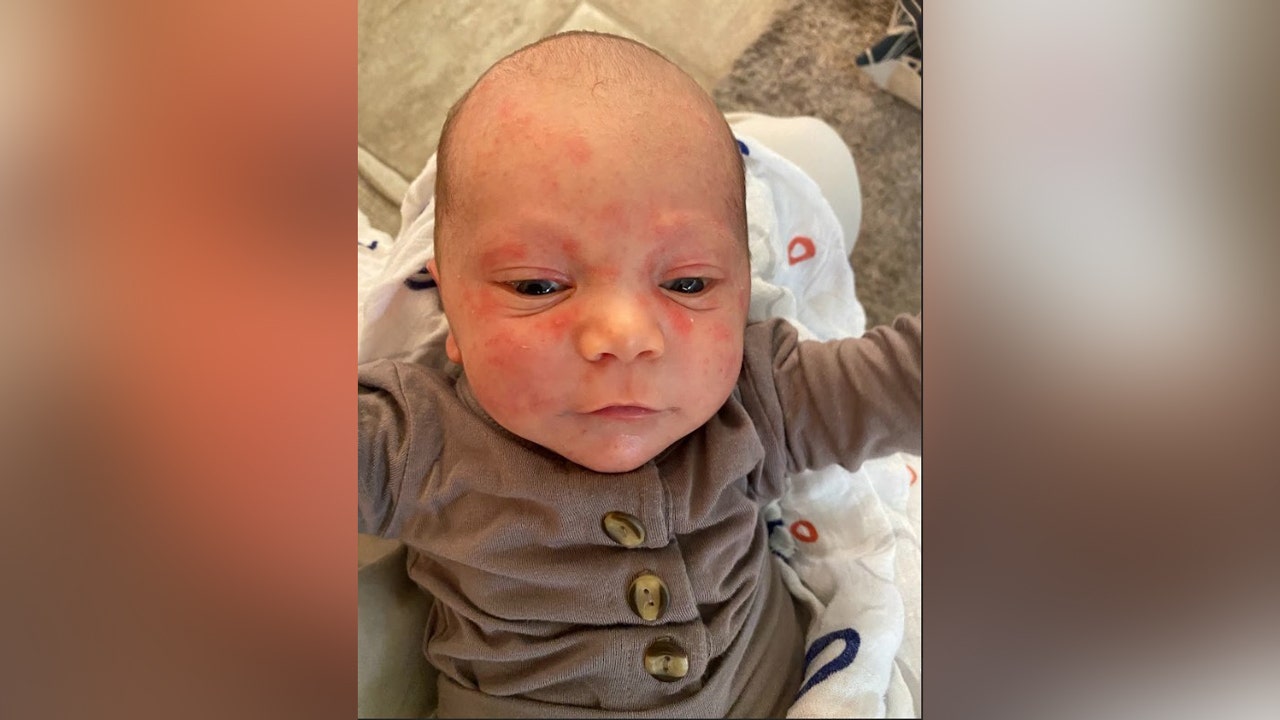
Baby Maverick with rashes days after he was born. (Courtesy of Jaclyn Hughes)
“They are coming forward not for themselves, but for everybody else to make sure it doesn’t happen again. We can’t be mission ready as a country if we’re sick or if our people are sick,” Baehr said of the thousands she is representing in the lawsuit.
The case is named for Jaclyn Hughes and her family. Hughes had just given birth to her son, Maverick, at the time of the leak. Just days after he was born, he was covered in red rashes, and Hughes’s own throat immediately began to burn after drinking the water in their home.
Hughes’s husband deployed with the U.S. Navy at the time of the leak. He missed the birth of their son and when he got home to meet Maverick, the water had an oily sheen and smelled of gasoline, Hughes explained.
LAWSUIT AIMS TO STOP ARMY, FBI FROM CREATING FALSE ARREST RECORDS FOR SOLDIERS, VETS NEVER CHARGED WITH CRIMES
“My husband was forward deployed at the time. He missed the birth of his son. He came home when he was five days old to meet him. To come home to jet fuel in our drinking water and have to deploy again, leaving us in the hands of the Navy he was sworn to protect, to have us refused care, denied, gaslit, and to this day not have all the appropriate care that we need for our daughter,” Hughes told Fox.
Their daughter Kyla, who was just four years old at the time of the leak, went into a full psychosis, Hughes said.
“When Kyla started experiencing her symptoms, she went from a happy-go-lucky four-year-old little girl that went into full psychosis. We went through her being a normal functioning in school to not being able to leave our house for months at a time because of her level of disability,” Hughes said.
The Hughes family. (Courtesy of Jaclyn Hughes)
Aurora Briggs, another plaintiff, was 22-years-old at the time of the leak. She was living in civilian housing on land owned by the U.S. Navy with her younger siblings and her mom. Briggs has dealt with dozens of symptoms ranging from a sore throat to memory loss and brain fog. Living in Arizona now, she has had trouble getting care.
It is not every day a doctor is told the patients’ symptoms stem from long-term exposure to jet fuel, Briggs explained.
“The list is so long that we have a binder just to keep track of all the different conditions, symptoms, doctor’s appointments, and everything. It’s extensive,” Briggs said.
MYSTERIOUS SHOOTING OUTSIDE ARMY SPECIAL FORCES RESIDENCE IN NORTH CAROLINA RAISES QUESTIONS
Of her symptoms, Briggs said, “I feel like I have dementia because I just get to the point where I can’t remember things, and I struggle with, you know, even thinking of words. Sometimes just talking is a struggle.”
Both Hughes and Briggs find the U.S. Navy at fault for how the leak was dealt with.
“The institution of the Navy grossly mishandled this. Specifically, those who were in charge of communicating to us in testing, in maintenance and in handling all of the Red Hill contamination. We are a proud Navy family. My husband serves, he is underway as we speak. Our family has served. We feel betrayed by the institution that was supposed to be protecting us,” Hughes said.
Aurora in the hospital after experiencing symptoms from ingesting jet fuel. (Courtesy of Aurora Briggs)
Defense Secretary Lloyd Austin ordered the Red Hill facility closed in March 2022. 12.4 million gallons of diesel and 93 million gallons of jet fuel had to be moved to multiple locations in the Indo-Pacific area of command.
But, Baehr said the Navy still hasn’t cleaned up the jet fuel still sticking to the pipes. Families are still reporting a sheen in the water and an oily smell.
“What we know either way is that there’s a sheen in the water. People are reporting symptoms. The EPA is concerned and the Navy is continuing to turn a blind eye. So no, that water is not safe. We’ve got a situation where people are still sick who were there in November of 2021. And the water is still not safe.”
The U.S. Navy pushed back on this claim in a statement to Fox News.
RETIRED NAVY ADMIRAL CHARGED WITH BRIBERY FOR ALLEGEDLY OFFERING GOVERNMENT CONTRACT IN EXCHANGE FOR JOB
“After the initial spill in November 2021 the Navy took immediate action to recover (flush) the system and implemented a robust sampling program. The Navy also disconnected the affected well and ensured all drinking water was provided from a different shaft,” the statement read.
The Navy told Fox it has taken 9,000 samples to EPA-approved labs and found the water now meets state and federal safety standards. The Navy noted the Hawaii Department of Health confirmed through its own independent investigation that no petroleum or jet fuel compounds were detected in drinking water samples collected at or near the Navy base.
But there is a long road ahead to deal with the fallout from the leak.
“We as the families impacted in the thousands need to hear them say, yes, you were injured by this. There are kids that are sick. There are kids that need long term care. There needs to be accountability,” Hughes said.
Read the full article from Here

Continue Reading

BEAVER COUNTY, Utah — A massive community effort is underway as volunteers and Beaver County crews distribute thousands of sandbags to protect homes from the potential path of floodwaters.
After the Cottonwood Fires, residents have been waiting for weeks for relief to come in the form of rain, though officials now warn it may come all at once with an increased risk of flooding and debris flow.
Emergency Service Director Les Whitney believes that the fire has left plenty of debris to bring trouble for residents.
“We got a lot of water. We’re bringing debris with it, so tree branches, tree limbs, logs, lots of different size firewood, and that’s all in the creeks. We’re worried about that plugging up our bridges and stuff, so we have heavy equipment and excavators located in strategic places so that we can keep those bridges open,” said Whitney.
An estimated 140 homes and condominiums were spared from the flames, but remain in the paths of floodwaters.
Residents can also pick up sandbags at the Beaver County Sheriff’s Office or at the Beaver County Rodeo Fairgrounds.

Two events overnight Wednesday emerging from the US Capitol, one a vote and the other an interview, exemplified the rockslide – turning into an avalanche – of anti-Israel sentiment that has taken hold in the hallowed halls of decision-makers.
The degree to which both the Republican and Democratic parties are sharpening their claws against Israel and hyper-focusing on it to the exclusion of critical issues indicates that the long-standing US-Israel bond is in a real crisis.
Nearly half of the Democrats in the House of Representatives, 103, voted for an amendment to cut off aid to Israel. The amendment was defeated 314-104. It was sponsored by Rep. Thomas Massie (R-Kentucky), whose disagreement with his party on Israel is his signature issue. He recently lost the GOP primary to run for reelection in the November midterms.
Lest we breathe a sigh of relief that Republicans en masse voted against the amendment, US Vice President JD Vance demonstrated that Israel has just as much to worry about from the Right in the US.
Vance claims Israeli ‘influence campaigns’ affect US political decisions
In an interview with highly popular America First podcaster Joe Rogan, who has labeled Israel’s war efforts in Gaza as “genocide,” Vance suggested that shadowy Israeli “influence campaigns” exist in the US.
“I definitely think you have seen this very discreet, extremely well-funded campaign to try to derail the negotiation and try to derail the deal,” he told Rogan.
An article in Time magazine on Tuesday was “worth reading because it lists a bunch of people who have quite literally been paid by a former Trump campaign person, who was himself paid by certain elements within the Israeli government,” Vance said. “And those people are attacking me viciously for quite literally trying to accomplish the negotiation objective that the president set for the country.”
“Many of the people who were receiving that money were actually attacking me in completely dishonest ways,” he said. “You know, my response to that is: ‘Go to hell.’ I’m going to do what I have to do for the American people. I represent Americans first.”
Vance shares claim spread by far Right influencers linking Jeffrey Epstein to Israeli intelligence
Vance, who is seen as a prime contender to be the Republican nominee for president in 2028, also waded into the conspiracy surrounding Jeffrey Epstein, the late convicted sex offender. Epstein “clearly had connections to the highest levels of Israeli intelligence,” he said, reiterating a claim that has been refuted and discredited.
The embrace by such a senior Trump administration official of conspiracy theories about Epstein’s ties to Israeli intelligence, which have proliferated in the years since his death and often have veered into antisemitism, is part and parcel with Vance’s increasing alignment with the far Right base populated by the likes of Tucker Carlson, Nick Fuentes, and Candace Owens.
Taken separately, the vote in the House of Representatives and the Vance interview are worrisome signs that the “special” relationship between Israel and the US is on life support at best. Taken together, they should be an alarming wake-up call that the days of the “kishkes” identification test with Israel – as exemplified diversely by the late Lindsey Graham and former president Joe Biden – are long gone.
Although it’s easy to place the blame elsewhere – and there are a plethora of strong arguments to be made in retort to both Democratic and Republican detractors of Israel – we must also look inward and see what can be done to reverse the tide of sentiment against us.
We can surely criticize the headline-provoking gambit by US Rep. Ro Khanna (D-California) last week, who chose to only hear and see the Palestinian side of life in the West Bank. But we can also acknowledge that vigilante Jewish groups are patrolling the area in a heavy-handed and lawless fashion that creates potentially lethal friction points and does irreparable damage to Israel’s image.
We can criticize Rahm Emmanuel for haughtily coming to Israel and warning us about what needs to be done to repair the US-Israel relationship, while acknowledging that some of his points were spot-on and unfolding before our very eyes in the House vote and Vance interview.
Jerusalem can no longer ignore or downplay the growing trends in the US of having to endorse the “Israel is genocide” trope to become a candidate, or of blaming Israel for getting the US entangled in Iran. The unsettling news this week demonstrates that with stark clarity.

The National Weather Service in Riverton has issued a Flood Watch advisory for portions of central and northwest Wyoming, including Owl Creek, the Bridger Mountains, the Southwest Bighorn Basin, the Absaroka Mountains, and the Cody Foothills. This includes the cities of Cody, Thermopolis, Meeteetse, and Clark, and many areas near or partially in Fremont County. […]
-

 Rhode Island5 minutes ago
Would You Dare Step Inside the Scariest Porta Potty in Rhode Island?
-

 South-Carolina11 minutes ago
South Carolina Lottery Pick 3, Pick 4 results for July 16, 2026
-
 South Dakota17 minutes ago
South Dakota opera ‘Giants in the Earth’ finds new audience
-

 Tennessee23 minutes ago
State encouraging Paramount to come to Tennessee
-

 Texas29 minutes ago
Texas floods ravage through southwestern areas of state
-
Utah35 minutes ago
Beaver County residents set up thousands of sandbags ahead of flashfloods
-
Vermont41 minutes ago
VT Lottery Gimme 5, Pick 3 results for July 16, 2026
-

 Virginia47 minutes ago
Did you know West Virginia has an official state gun?

