Politics
Supreme Court wipes out anti-corruption law that bars officials from taking gifts for past favors

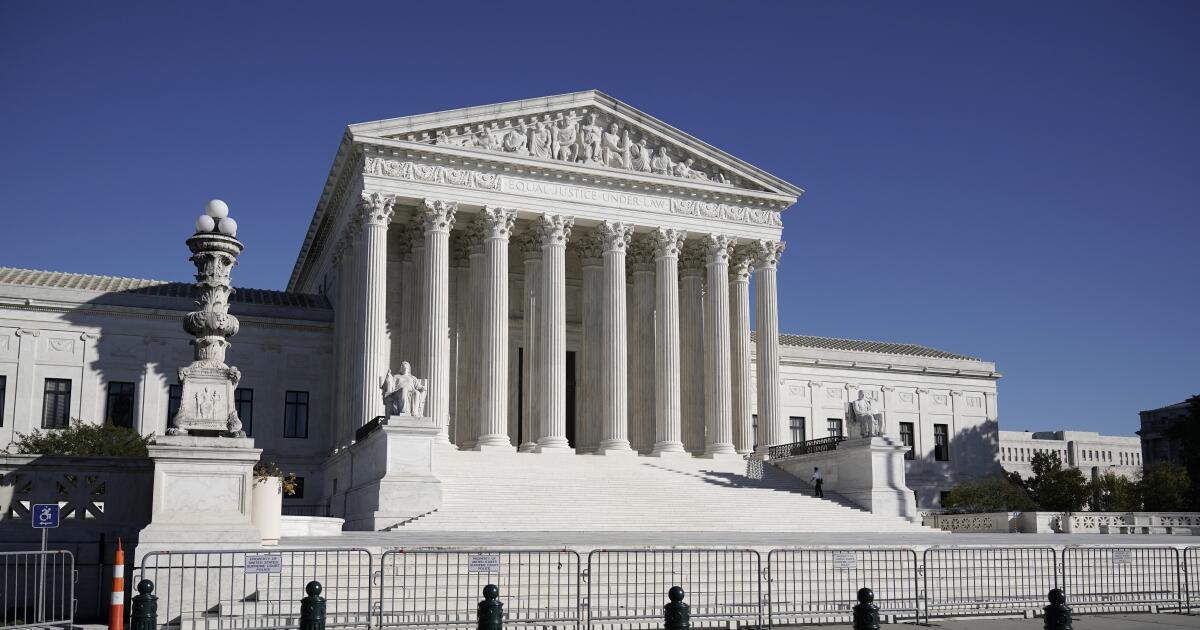
The Supreme Court on Wednesday struck down part of a federal anti-corruption law that makes it a crime for state and local officials to take gifts valued at more than $5,000 from a donor who had previously been awarded lucrative contracts or other government benefits thanks to the efforts of the official.
By a 6-3 vote, the justices overturned the conviction of a former Indiana mayor who asked for and took a $13,000 payment from the owners of a local truck dealership after he helped them win $1.1 million in city contracts for the purchase of garbage trucks.
In ruling for the former mayor, the justices drew a distinction between bribery, which requires proof of an illegal deal, and a gratuity that can be a gift or a reward for a past favor. They said the officials may be charged and prosecuted for bribery, but not for simply taking money for past favors if there was no proof of an illicit deal.
“The question in this case is whether [the federal law] also makes it a crime for state and local officials to accept gratuities — for example, gift cards, lunches, plaques, books, framed photos or the like — that may be given as a token of appreciation after the official act. The answer is no,” said Justice Brett M. Kavanaugh, writing for the majority.
Despite his reference to token gifts such as lunches and framed photos, the federal law was triggered only by payments of more than $5,000.
But the court’s conservative majority said the law in question was a “bribery statute, not a gratuities law.” Kavanaugh said federal law “leaves it to state and local governments to regulate gratuities to state and local officials.”
Justices Elena Kagan, Sonia Sotomayor and Ketanji Brown Jackson dissented.
“Officials who use their public positions for private gain threaten the integrity of our most important institutions,” Jackson wrote in dissent. The law as written “poses no genuine threat to common gift giving” but it “clearly covers the kind of corrupt (albeit perhaps non-quid pro quo) payment [the mayor] solicited after steering the city contracts to the dealership.”
The ruling could have a broad impact. About 20 million local and state officials are covered by the federal anti-corruption law, including officials at hospitals and universities that receive federal funds.
Justice Department lawyers told the court that for nearly 40 years, the anti-bribery law has been understood to prohibit payments to officials that “rewarded” them for having steered contracts to the donors.
The Supreme Court justices have faced heavy criticism recently for accepting undisclosed gifts from wealthy patrons. Justice Clarence Thomas regularly took lavish vacations and private jet flights that were paid for by Texas billionaire Harlan Crow. Justice Samuel A. Alito Jr. took a fishing trip to Alaska in 2008 aboard a private plane owned by Paul Singer, a hedge fund billionaire.
The high court has long held that criminal laws restricting “illegal gratuities” to federal officials require proof that the gifts were given for a specific “official act,” not just because of the official’s position.
The Indiana mayor was charged and convicted of taking the $13,000 payment because of his role in helping his patrons win city contracts.
Congress in 1986 extended the federal bribery law to cover officials of state or local agencies that receive federal funds. The measure made it a crime to “corruptly solicit or demand … or accept … anything of value of $5,000 or more … intending to be influenced or rewarded in connection with any business or transaction.”
Prosecutors said James Snyder was heavily in debt and behind in paying his taxes when he became mayor of Portage, Ind., in 2012. The city needed new garbage trucks, and the mayor took over the required public bidding. He spoke regularly with two brothers who owned a local truck dealership that also had financial problems, and he designed the bidding process so that only their two new trucks would meet all of its standards. He also arranged to have the city buy an older truck that was on their lot.
Two weeks after the contracts were final, the mayor went to see the two brothers and told them of his financial troubles. They agreed to write him a check for $13,000 for undefined consulting services.
An FBI investigation led to Snyder’s indictment, his conviction and a 21-month prison sentence.
The former mayor argued that an after-the-fact gift should not be a crime, but he lost before a federal judge and the U.S. appeals court in Chicago.
The high court agreed to hear his appeal in Snyder vs. U.S. because appeals courts in Boston and New Orleans had limited the law to bribery only and not gratuities that were paid later.
In recent years, the Supreme Court has repeatedly limited the scope of public corruption laws and often in unanimous rulings. The common theme is that the justices concluded the prosecutions went beyond the law.
Last year, the court was unanimous in overturning the corruption convictions of two New York men who were former aides or donors to then-Gov. Andrew Cuomo, a Democrat. The court noted that one of the defendants convicted of taking illicit payments did not work for the state during that time.
Four years ago, the justices were unanimous in overturning the convictions of two aides to then-New Jersey Gov. Chris Christie, a Republican, who were charged with conspiring to shut down lanes to the George Washington Bridge into New York City. The court said they were wrongly convicted of fraud because they had not sought money or property, which is a key element of a fraud charge.
In 2016, the court overturned the corruption conviction of former Virginia Gov. Bob McDonnell, a Republican. While the governor took $175,000 in gifts from a business promoter, he took no official actions to benefit the donor, the court said.

Politics
Commentary: Bass clears first hurdle, but if Pratt holds off Raman, the mayoral race could be a holy war

L.A. Mayor Karen Bass made what sounded like a victory speech Tuesday night.
Councilmember Nithya Raman made what sounded almost like a concession speech.
And former reality TV star Spencer Pratt relayed a message from the heavens.
“Well, obviously God wanted five more months of me exposing all the failures of our mayor, so it’s gonna be a fun ride,” Pratt said. “I hope she’s ready.”
Assuming Pratt holds on to one of the two spots in the Nov. 3 general election as the final votes are tallied in the next few days, the smart money will be on Bass, for reasons I’ll get into in a moment.
But the supreme being and patron of all pontiffs has to be considered a wild card. This is the first time, to my knowledge, that an incumbent mayor in the City of Angels would be running against a challenger whose campaign manager is God Almighty.
So here we go. We could be in for one of the more remarkable electoral adventures in city history, with a complete novice and MAGA conservative going up against a liberal career politician in a deep-blue city and state full of people who are tired of hearing excuses from Democrats. (If Raman ends up ousting Pratt, my apologies for jumping to conclusions. But it’s not my fault. The devil made me do it.)
If you intend to follow closely, as of course you should, maybe you can help me count the number of times Pratt plays the faith card. I went to St. Peter Martyr School and attended the church by the same name, and I don’t recall ever hearing a nun or a priest drop God’s name as often as Pratt does.
In fact, I just watched a clip of Pratt talking to Fox News TV host and Donald Trump disciple Kayleigh McEnany, and over the course of 1 minute and 52 seconds, he mentioned God or Jesus 10 times.
“Thankfully, I married an angel who was very connected with Jesus and has brought me to the light,” Pratt said of his wife and former reality TV co-star Heidi Montag. “It’s been very empowering to just pray and just be on his path and just say, ‘God, if you want me to save these animals, save these humans and protect my city, just keep putting me in the place where I can do that.’”
Is he running for mayor or cardinal?
Look, I totally respect your average true believer. But I’m not entirely comfortable with a mayor who might be sitting around City Hall waiting for signs and smoke signals rather than knowing what to do on his own.
God has a lot on his plate. He might be busy multiplying fishes and loaves so people don’t go hungry thanks to the president’s tariffs and warmongering. Is he going to rush to answer a prayer for guidance about underfunded parks or broken sidewalks in Los Angeles?
How did we get here, you ask?
Well, Pratt is an AI creation, in a way. A composite of sorts. You combine the forces of social media, political rebellion, second-rate celebrity obsession and the Peter Principle, and here’s a little Trump puppet walking around L.A. like he’s the chosen one.
Add to that the very real essence of his appeal to some voters:
Los Angeles has problems. Big problems that don’t get fixed quickly enough or at all, and Pratt represents the angry voter who wants to know why City Hall can’t do better and where all the money went. He’s absolutely right when he says we shouldn’t have people living on the streets, using drugs on the streets and dying on the streets.
But if Pratt is in the general election rather than Raman, we’re in for a national media circus rather than a summit on solutions. Raman is well-versed on matters of relevance and could have pushed back against Bass in substantive, detailed ways. On the other hand, as Pratt has fairly argued, Raman headed City Council’s homelessness committee, so isn’t she partly to blame for the failures she tried to pin on Bass?
As for Pratt’s policy chops, he has not responded to my offers of a get-together. Absent that, and given his careful avoidance of local reporters who know their stuff, I read his platform on his campaign website and I can tell you that while he touches on many of the right issues — public safety, fiscal integrity, homelessness — attention to detail and depth of knowledge are not God-given strengths.
Maybe Pratt can actually deliver on his promise of a “treatment-led recovery model that addresses mental illness and addiction as the primary drivers of chronic homelessness.” But that would require an act of God (which I suppose is possible given their relationship), because those matters are primarily under the direction of the county, not the city.
This is the main problem here. Bass was beatable, and could have been pushed by a serious challenger to do better.
In the last election, Rick Caruso gave her a scare. That was partly because he had some depth on the issues, he was a successful businessman and philanthropist, he had served on the police commission and the water and power board, he had built relationships across the city and, along with his family, he had poured time and millions of dollars into underserved communities.
In this election, it looks as though Bass could get lucky and face off against a guy who lost his house in the Palisades fire, saw a few homeless encampments through his car window, and decided he wanted to be mayor. Some might have questioned his hubris, but only before learning that he was on a mission from God.
If you’re keeping count, that’s nine mentions of God so far in this column.
One more for the tie, with an eye toward five more months of campaign fodder.
Thank you, God.
steve.lopez@latimes.com

NEWYou can now listen to Fox News articles!
Sen. Ron Wyden, D-Ore., suddenly found himself on the defensive at a budget hearing on Wednesday when, amid levying accusations of the Trump administration’s “corrupt” dealings, Treasury Secretary Scott Bessent fired back by bringing Wyden’s son’s investments into the exchange.
“We would like to hear what Adam Wyden and Jeffrey Epstein talked about,” Bessent said, referring to unearthed emails drawing a connection between the senator’s son and the disgraced financier.
“Did your son and Jeffrey Epstein talk about pole dancing as he begged him for money?”
The moment continues the political fallout for the many names associated with Epstein that — despite not amounting to proof of wrongdoing — continue to prompt embarrassment and scandal at even the smallest mention.
TOP FIERY MOMENTS AS DEMOCRATS CLASH WITH TREASURY SECRETARY BESSENT IN CHAOTIC HILL HEARINGS
Treasury Secretary Scott Bessent, left, pictured along Sen. Ron Wyden, D-Ore, right. (Aaron Schwartz/Bloomberg via Getty Images; Chip Somodevilla/Getty Images)
Epstein, a former financier, died while in prison on charges of sex trafficking minors in 2019, leaving behind questions of whether he facilitated illegal sexual encounters for his vast network of rich and powerful figures.
Amid public demands for transparency on the matter, the Department of Justice released troves of documents on Epstein late last year, unveiling a slew of new names with all manner of ties to the infamous figure ranging from purely innocuous to alarming.
Among them, emails surfaced indicating that Adam Wyden, Ron Wyden’s son, went to Epstein, hoping to gain his support for a business venture.
UNEARTHED EMAILS REVEAL DEM SENATOR’S SON WANTED EPSTEIN TO JOIN HIS FUND: ‘ENJOYED OUR CONVERSATION’
Sen. Ron Wyden leaves a Senate Democratic meeting at the U.S. Capitol Building in Washington, D.C., on Oct. 3, 2025, as the federal government shuts down after Congress and the White House failed to reach a funding deal. (Kevin Dietsch/Getty Images)
“Jeffrey, I wanted to thank you for taking the time to meet with me. I thoroughly enjoyed our conversation and hope my passion and dedication for my business came through in the meeting. I live and breathe this business and take my returns, integrity and reputation quite seriously,” the younger Wyden said in an email in April 2016.
“I intensely appreciate like-minded individuals and would very much look forward to having you join us at the fund.”
The emails came after Epstein pleaded guilty to soliciting a minor for prostitution in Florida in 2008.
It’s unclear what the business venture discussed by Adam Wyden and Epstein may have been or what, specifically, had been discussed in their conversations.
Even so, Bessent reminded viewers that the younger Wyden had a history of investing in off-color markets at Wednesday’s hearing.
DEMOCRATS ARE HAMMERING REPUBLICANS ON EPSTEIN, BUT ONE SENATOR BRUSHED OFF THE ISSUE YEARS AGO
Treasury Secretary Scott Bessent addresses a press conference in Rosenbad after trade talks between the U.S. and China concluded in Stockholm, Sweden, on July 29, 2025. (Magnus Lejhall/TT News Agency/AFP via Getty Images)
CLICK HERE TO DOWNLOAD THE FOX NEWS APP
“Your son’s largest investment position was Rick’s Cabaret,” Bessent said, referring to a series of strip clubs.
Wyden, who has widely panned the Trump administration and its many officials for their own connections to Epstein, didn’t respond to Bessent’s jabs.

As election officials continued tallying ballots Wednesday, Republican Steve Hilton and Democrat Xavier Becerra continued to lead in the unsettled race to replace termed-out Gov. Gavin Newsom, with billionaire Democrat Tom Steyer hoping for a surge in late-arriving votes to push him into one of the top-two spots to advance to the November general election.
Hilton, a British immigrant and former Fox News commentator, told reporters outside the state Capitol in Sacramento Wednesday morning that he was “very encouraged” by the latest results, though he stopped short of declaring victory.
“It does look as if change is coming to California, and that is good news for everyone, every small business, every working family, everyone who wants to see our state set back on track,” he said.
Becerra and Steyer did not hold public events as of Wednesday afternoon.
Election data analyst Paul Mitchell said it would be nearly mathematically impossible for Steyer to close the gap.
“As we start to get more data, the runway is going to get shorter and shorter,” he said.
He said Steyer, to finish in the top two in the primary, would have to get about 30% of the remaining uncounted votes while Becerra would need to be limited to 15%. The self-funded billionaire has “a very high hill to overcome, and the challenge gets steeper and steeper as we get more data from the counties,” Mitchell said.
Once mired near the bottom of a crowded pack of Democrats in opinion polls, Becerra, a former Biden administration cabinet member, rocketed ahead of his rival candidates after former Rep. Eric Swalwell dropped out of the race in April amid allegations of sexual assault and misconduct. The scandal triggered an upswing of voter interest in California’s once sluggish governor’s race and in Becerra, who seized the moment.
“Here in Hollywood’s hometown, we love a good underdog story,” Becerra told cheering supporters at his election night party at La Plaza de Cultura y Artes in downtown Los Angeles.
Becerra spoke about his Mexican immigrant parents and becoming the first in his family to attend college. Though a longtime California politician, Becerra said that his campaign for governor was outspent and that he faced calls to drop out of the race.
“The underdog stayed in the fight,” he said. “Like my parents, I never gave up. … Never stopped believing in the beacon-light goodness of California and thankfully, neither did you.”
Steyer, who spent more than $216 million of his wealth on the race, has not conceded defeat.
His campaign manager, Heather Hargreaves, wrote in a letter to supporters Wednesday that “we’re going to give democracy time to work. County election officials are still counting ballots and don’t expect to know how many people voted in total until” Thursday, when officials are required to report the estimated number ballots left to process.
The billionaire former hedge fund owner campaigned against the corporate and special interests that have a powerful presence in Sacramento and often spend heavily in elections, including this year against Steyer.
Billionaires “do everything they can to hoard their wealth and avoid paying taxes, and we see corporations continue to rig the system for themselves — raising your prices to juice their profits. Screw that,” Steyer said at his election watch party at the Regency Ballroom in San Francisco.
Other candidates in the race included Republican Riverside County Sheriff Chad Bianco and Democrats including former Rep. Katie Porter, San José Mayor Matt Mahan, former Los Angeles Mayor Antonio Villaraigosa and state Supt. of Public Instruction Tony Thurmond.
Villaraigosa, Mahan and Porter conceded the race Tuesday night.
California’s 2026 race for governor started slow but ended with a flourish, including the demise of a scandal-ridden Democratic favorite, the anointing of a Republican by Trump and Becerra’s unexpected rise from the depths of the candidate field.
Unlike gubernatorial elections in the last quarter of a century, this year’s race lacked a clear crowd-pleasing front-runner able to win over voters, such as movie star Arnold Schwarzenegger or Jerry Brown, a sage of the California electorate and scion of a storied political family. But it unfolded at a time when the state’s residents are overwhelmed by high housing costs, steep gas prices and overall unaffordability that threatens the “California dream” that once drew millions of people to the state.
“Normal people are not living and breathing politics on a daily basis,” said Tim Rosales, a strategist who ran Republican John Cox’s unsuccessful 2018 gubernatorial campaign. In today’s information-saturated environment, Rosales said, the race and its roster of “extremely milquetoast candidates” didn’t break through until the Swalwell scandal grabbed voters’ attention.
The 2026 gubernatorial primary has been one of the most unpredictable and expensive in decades and a race that was shaped early on by a number of heavyweight Democrats staying on the sidelines.
Though supporters urged them to run, former Vice President Kamala Harris, Sen. Alex Padilla and Atty. Gen. Rob Bonta passed on the race. It was in a state of limbo for months last year as Harris, one of the state’s most high-profile politicians, weighed whether to jump in.
“I don’t ever recall a playing field that looks like this one. Usually there’s a clear front-runner,” said veteran Democratic strategist Darry Sragow. “It’s easy to say that it reflects a lack of talent [but] that’s absolutely not true. Almost any of the candidates running could make a good governor.”
Still, candidates struggled for months to break through to voters.
In February, polls showed the crowded field of Democrats splitting liberal voters and opening a statistical possibility that the party would be boxed out of November under California’s open, top-two primary, which places all candidates on the same ballot. Only the first- and second-place finishers in the primary advance to the general election, regardless of their party affiliation.
Just when Swalwell appeared on the cusp of becoming the Democratic front-runner the San Francisco Chronicle and CNN published allegations that he sexually assaulted a former staffer and acted inappropriately with other women. Swalwell suspended his campaign.
It was Becerra who benefited the most. In less than two months, he vaulted from polling in the low single digits to the top of the field of candidates, according to surveys conducted by UC Berkeley’s Institute of Governmental Studies that were co-sponsored by the Los Angeles Times.
“Becerra caught lightning in a bottle,” Rosales said. “It could have easily gone to any of the other candidates,” but many had baggage. Videos of Porter losing her temper hurt her image, the source of Steyer’s wealth and his unbridled campaign spending weighed on voters’ minds, and Villaraigosa and Mahan were “more centrist than what most Democrats wanted, and so Xavier Becerra was really the safe choice,” Rosales said.
Before Democratic voters began to narrow down their choices, Trump endorsed Hilton in early April. It helped the former Fox News host break away from Bianco, his main GOP rival.
In the days before the primary election, the race solidified into a three-way contest involving Becerra, Steyer and Hilton.
Steyer stepped up his fight in the remaining days, seeking to squeeze into one of the top two spots by battering Becerra in ads and at campaign rallies as a politician propped up by corporate special interests.
“We cannot afford to have a governor who’s been bought off by Big Oil. Period,” he said at a Sunday rally in Los Angeles.
Corporations, along with labor unions and interest groups including the California Assn. of Realtors, had spent more than $18.7 million to boost Becerra, according to the election spending tracker California Target Book. Many of the same groups also gave money to a committee intended to attack Steyer.
As the election neared, Becerra sharpened his attacks against Steyer, calling the billionaire a “liar” and accusing him of trying to buy the election.
“We are not going to let a billionaire or Trump’s handpicked candidate take over this state,” he said during a Sunday rally in Long Beach.
If Becerra faces off with Hilton in November he’ll have a distinct advantage. Democratic voters outnumber Republicans nearly 2 to 1 in left-leaning California.
Winning the general election would make the 68-year-old Becerra the first elected Latino governor of California. At roughly 40% of the state’s population, Latinos are California’s largest ethnic group but have not been represented in the governor’s mansion since 1875, when then-Lt. Gov. Romualdo Pacheco was elevated to fill a 10-month vacancy.
Times staff writers Iris Kwok, Susanne Rust, Andrew Khouri and Christopher Goffard contributed to this report.
-
Politics7 minutes ago
Commentary: Bass clears first hurdle, but if Pratt holds off Raman, the mayoral race could be a holy war
-
 Sports15 minutes ago
The Ball brothers’ head coach at Chino Hills, Steve Baik, is the new coach at Calabasas
-
World25 minutes ago
Social media operation linked to Iran manipulated public through fake Irish and Scottish profiles
-
 News52 minutes ago
National Guard has done little to reduce violent crime in D.C., a new study finds
-

 Los Angeles, Ca2 hours ago
Man claiming to be armed robs Culver City bank, gets away with $10,000
-

 Detroit, MI2 hours ago
Fired Detroit TV anchor Taryn Asher files sex discrimination lawsuit against old station, claims new GM protected men
-

 San Francisco, CA3 hours ago
San Francisco family devastated as they face nearly 90% rent increase
-

 Dallas, TX3 hours ago
Wings’ top pick Azzi Fudd hosts clinic as Cash App donates to Dallas nonprofit

